
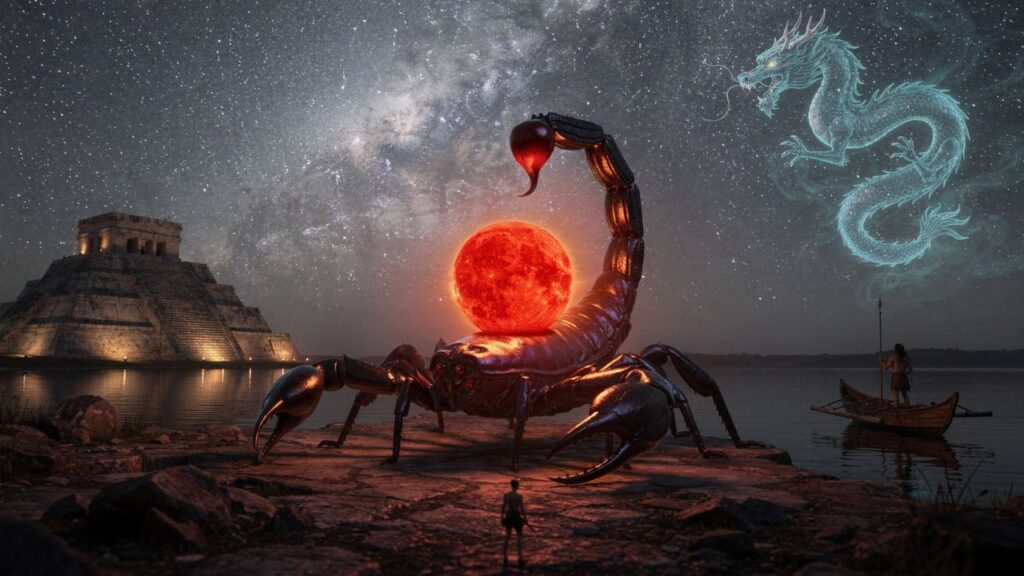
And what four civilizations saw in the same stars
By Juan Pablo Martín | ASTRONOMIKA TV | May 2026 | Updated: July 2026
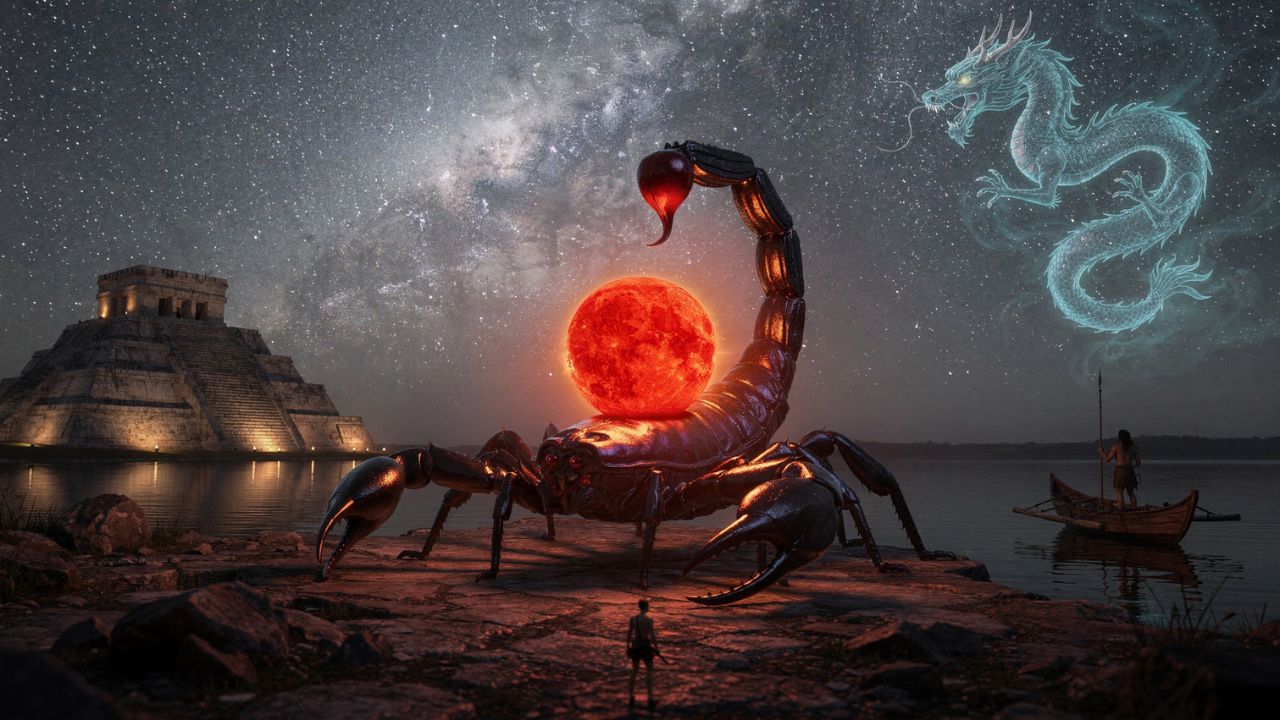
There is a story the Greeks told three thousand years ago, that the Maya narrated in their temples across southern Mexico and Central America, and that the islanders between Australia and Papua New Guinea still tell today. They all looked at the same corner of the sky. They all felt something important was happening there. And every one of them saw a completely different story.
That alone is enough to blow your mind.
But before talking about what each culture saw, we need to talk about what that corner of the sky actually hides: a star so enormous that if you placed it where the Sun is, its surface would reach beyond the orbit of Mars. And right next to it, one of the oldest and closest star clusters that exists, visible through binoculars from your rooftop.
Let’s start from the beginning.
✦ ✦ ✦
The humiliation Orion never saw coming
Orion was the most famous hunter in the world. Not just in his village, not just in his region. In the entire known world, no one hunted like Orion. And he knew it. He absolutely knew it.
But before talking about the scorpion, we need to talk about Artemis. Because without understanding Artemis, Orion’s death makes no sense at all.
Artemis was the goddess of the hunt. A virgin by her own choice, she had asked Zeus as a child never to force her to marry or belong to any man. Zeus agreed. Artemis hunted alone, with her nymphs, free from any bond. She was the only woman in Greek mythology who needed no one.
Until she met Orion.
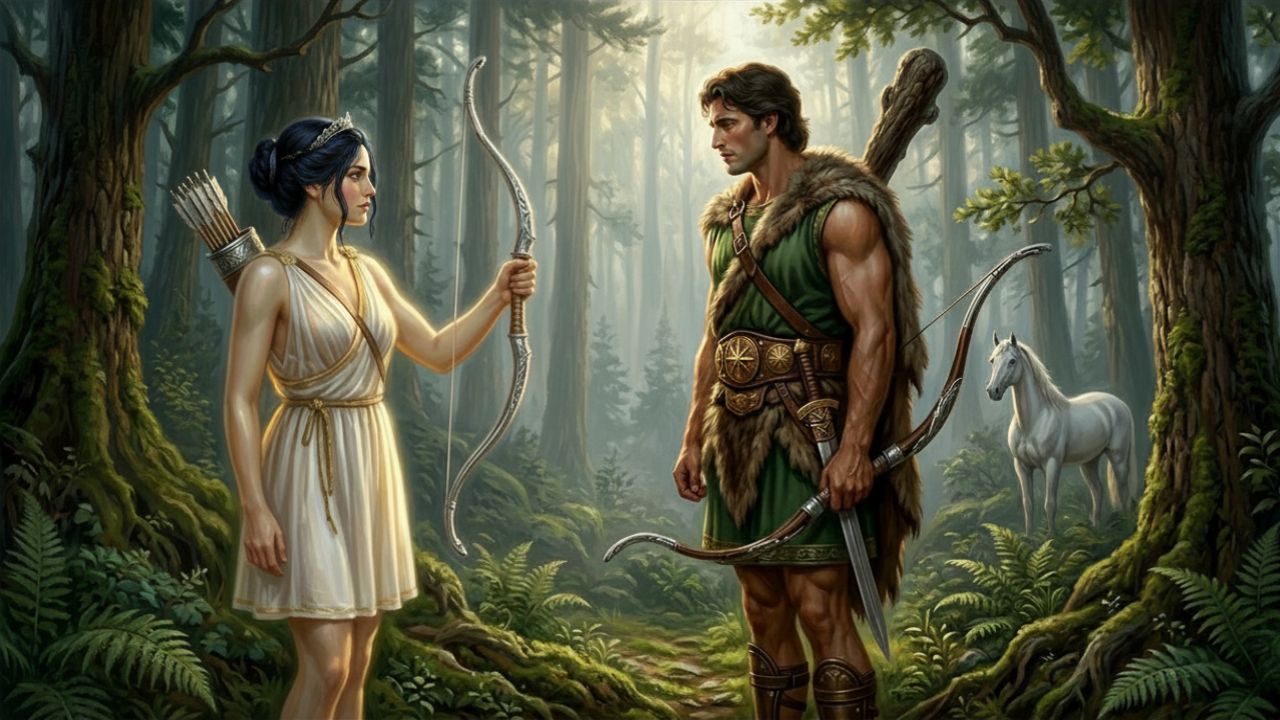
No one knows exactly how they met. What every version agrees on is what happened next: Artemis, the goddess who had rejected every god on Olympus, began hunting with Orion. Every day. Together. The only mortal the most elusive goddess in the Greek pantheon had ever allowed into her world.
And that is when Orion’s ego betrayed him.
The problem with Orion was never his talent. It was his mouth. Orion had a habit of boasting, loudly and in front of the gods, that he could kill any creature that existed on the face of the Earth. Any creature. Without exception. And with Artemis at his side, his confidence had no limits.
Gaia, the goddess of the Earth and mother of all animals, heard him. And decided enough was enough.
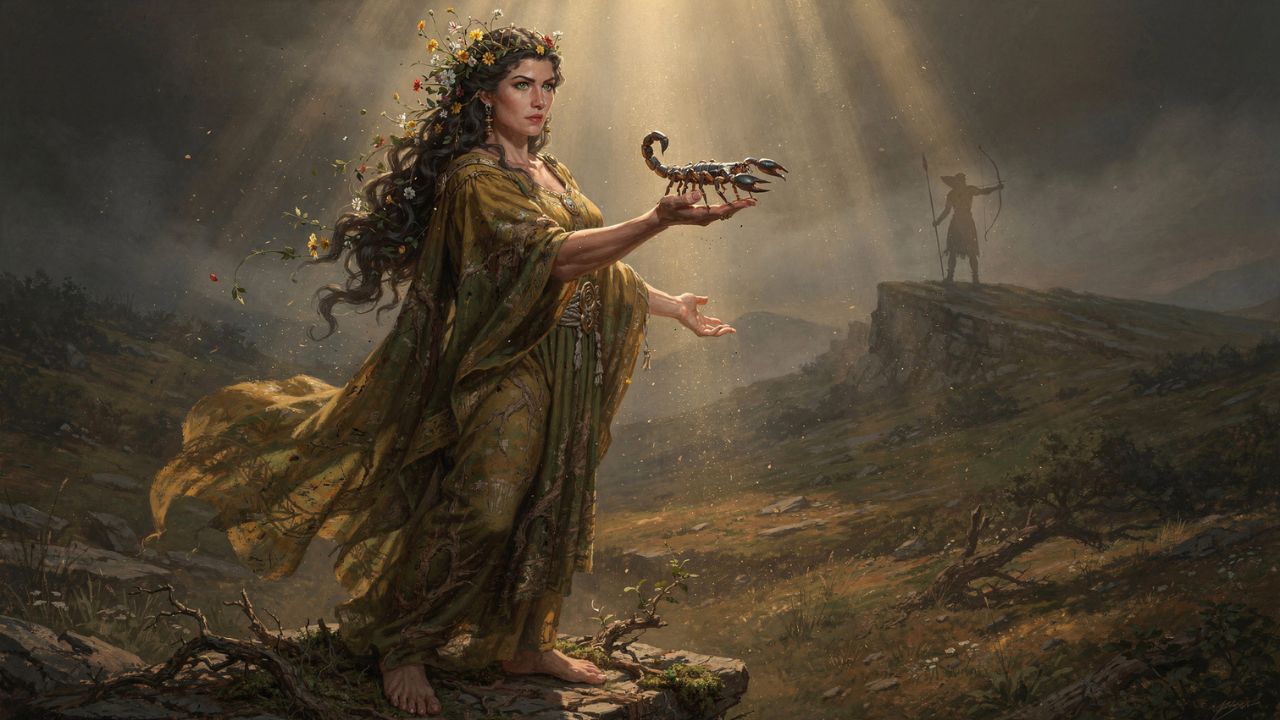
Here comes the part no one expects: Gaia did not send a monster. She did not summon a dragon, a giant, or any of the epic creatures of the Greek pantheon. She sent a scorpion. A small, common, ordinary scorpion. The kind of creature you step on by accident in the garden.
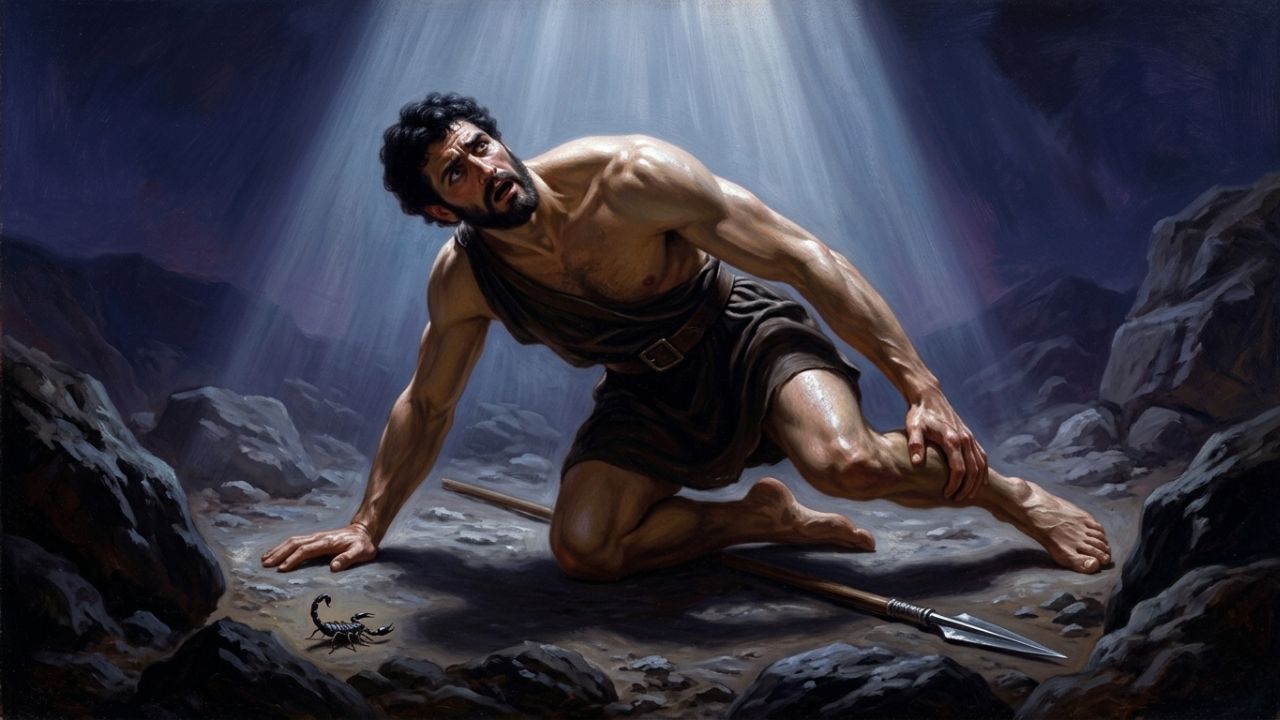
The scorpion found Orion, the most powerful hunter in the known universe, and stung him on the heel. A single sting. End of the story.
The humiliation was so perfect, so calculated, that the story took centuries to fade. There are other versions of Orion’s death, with other gods and other reasons, but they all end the same: with the hunter defeated and Artemis devastated. Because it was she who asked Zeus to place Orion in the sky forever. Not as punishment. As a tribute. It was the only thing she could do for him.
Zeus agreed. And since he could not ignore the dramatic symmetry, he placed the scorpion on the exact opposite side of the sky. So that Orion would never have to face his executioner again.
That is why, from any point on Earth, Orion and Scorpius never appear together in the night sky. When one rises, the other hides. They have been avoiding each other for three thousand years.
But that is only the Greek version. On the other side of the ocean, the same curve of stars told completely different stories.
✦ ✦ ✦
The same sky, different stories
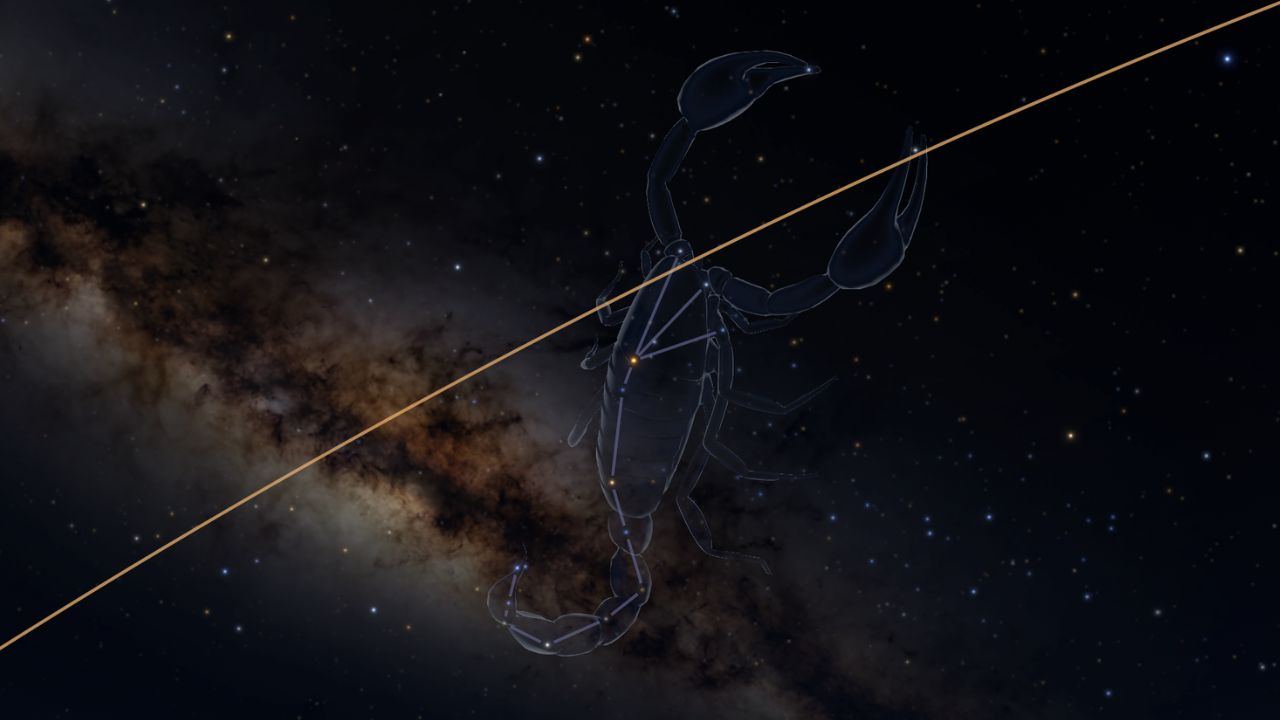
Before we continue, something worth saying: Scorpius is a fascinating exception in the history of cultural astronomy. Most Western constellations do not visually resemble what they claim to be. Try finding a real bull in Taurus, or a maiden in Virgo.
Scorpius is different. The curve of bright stars with the raised tail and the stinger at the end actually looks like a scorpion. So clearly, in fact, that cultures with no contact whatsoever with each other, separated by entire oceans, reached the same conclusion: that is a scorpion.
Though some saw something completely different.
The Maya: where the sky swallows the dead
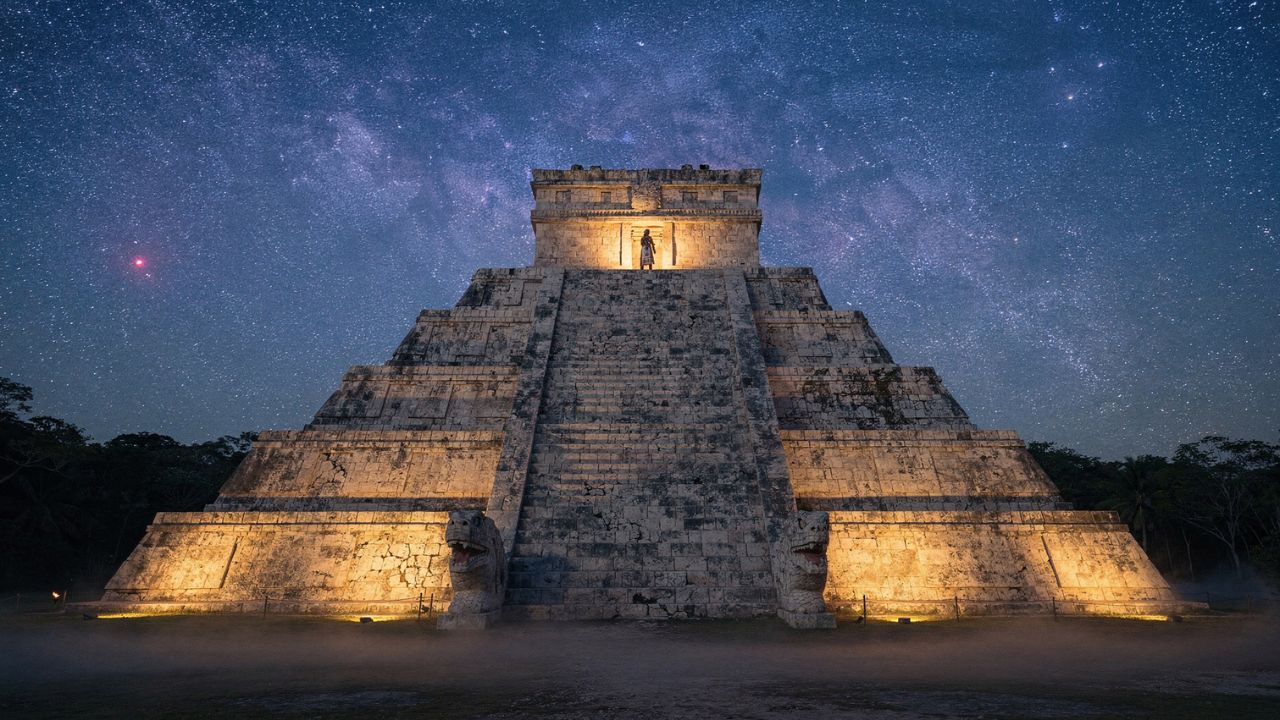
For the Maya, the night sky was not a spectacle. It was a roadmap to the other world.
The Milky Way was the World Tree, the axis connecting the underworld with the heavens. And at the exact point where the Milky Way crosses the ecliptic, right where the Sun, Moon and planets trace their annual path, was Scorpius.
That crossing was not an accident for Maya astronomer-priests. It was the entrance to Xibalba, the underworld. The place where the Lords of Death ruled in eternal darkness.
When the Scorpius constellation appeared on the horizon on summer nights, it was the signal: the gate was open. Not metaphorically. Literally open, according to Maya cosmology. The moment for rituals, for communication with ancestors, for offerings that maintained the balance between worlds.
Researchers who traced the Popol Vuh, the sacred Maya book of creation, found something astonishing: the story of the Hero Twins who descend into the underworld to defeat the Lords of Death follows the movement of these stars across the sky. The descent occurs when Scorpius and the center of the Milky Way disappear below the horizon. The triumph and return coincide with their reappearance at dawn.

The Maya did not just tell stories about the sky. They used the sky to preserve the most important story of all, written in movements that no one could erase or burn. And they succeeded, at least in part, despite the Spanish destroying most of their codices in the sixteenth century.
The Torres Strait Islanders: the warrior standing in his canoe
Thousands of kilometers away, on the islands separating Australia from Papua New Guinea, the Torres Strait Islanders looked at the same stars and saw no scorpion. They saw Tagai.
Tagai was a warrior and fisherman of great reputation. One day he went out fishing with twelve men. When he returned to the canoe, he discovered that his crew had drunk all the water and eaten all the food for the journey, violating the most basic laws of the sea.

Tagai, blinded by fury, killed them all.
Afterwards, as his rage cooled and guilt set in, he sent them to the sky. Six he placed in the Pleiades. The other six, in Orion’s Belt. And he himself ascended, standing in his canoe.
That canoe is the stars of Scorpius.
Tagai standing over the curve of bright stars, with a spear in one hand and sea fruit in the other, is a constellation that Torres Strait Islanders still use today to navigate. A figure of moral authority who killed his own crew, immortalized in the sky as a permanent warning:
The laws of the community are not broken. Ever.
Three cultures with no contact between them. A scorpion, a gateway to the underworld, a warrior standing in his canoe. Same stars.
And if this left you wanting more, Scorpius has a direct rival in the zodiac: Virgo. When Scorpius dominates the south on summer nights, Virgo is already saying goodbye on the western horizon. Two constellations that never share the full sky, each with their own stories and their own protagonist object. Virgo’s story is just as good.
✦ ✦ ✦
The star that would make Mars disappear, and its secret neighbors
Four civilizations, four stories. But there is something none of them could have known: what is actually out there.
Antares: the star named after a planet that is larger than an orbit
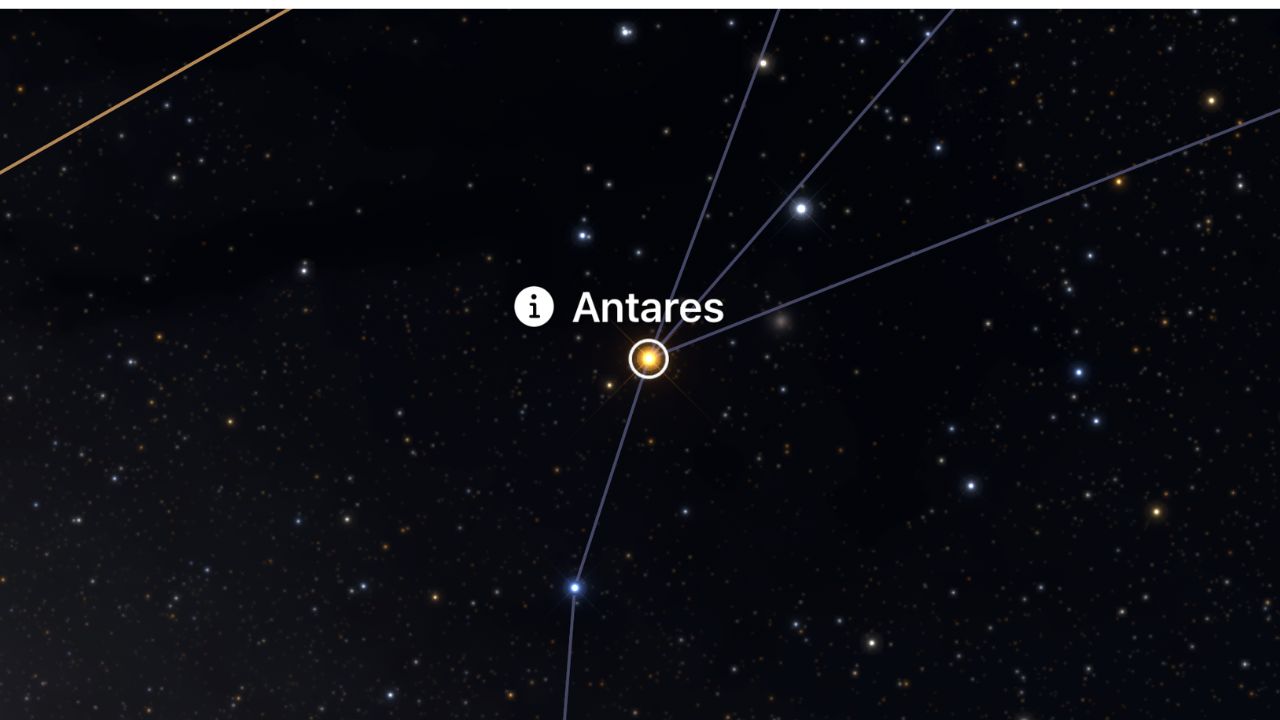
The name says it all, though few understand it at first. “Antares” comes from Greek and means “rival of Ares,” that is, rival of Mars. The Greeks named it that because its reddish-orange color is almost identical to that of the red planet. At certain times of year, Mars and Antares appear together in the southern sky and are very difficult to tell apart with the naked eye.
Antares is a red supergiant. And when we say large, we need an analogy to make the number mean something.
Our Sun has a diameter of 1.4 million kilometers. Antares has between 700 and 800 times that diameter, depending on the exact moment it is measured, because the star pulses and its size constantly changes.
Every calculation agrees on one thing: if Antares were where our Sun is right now, its surface would not stop at Earth. It would pass Earth. It would pass Mars. It would reach some point between Mars and Jupiter, swallowing the entire asteroid belt along the way. The entire Earth would be inside Antares.
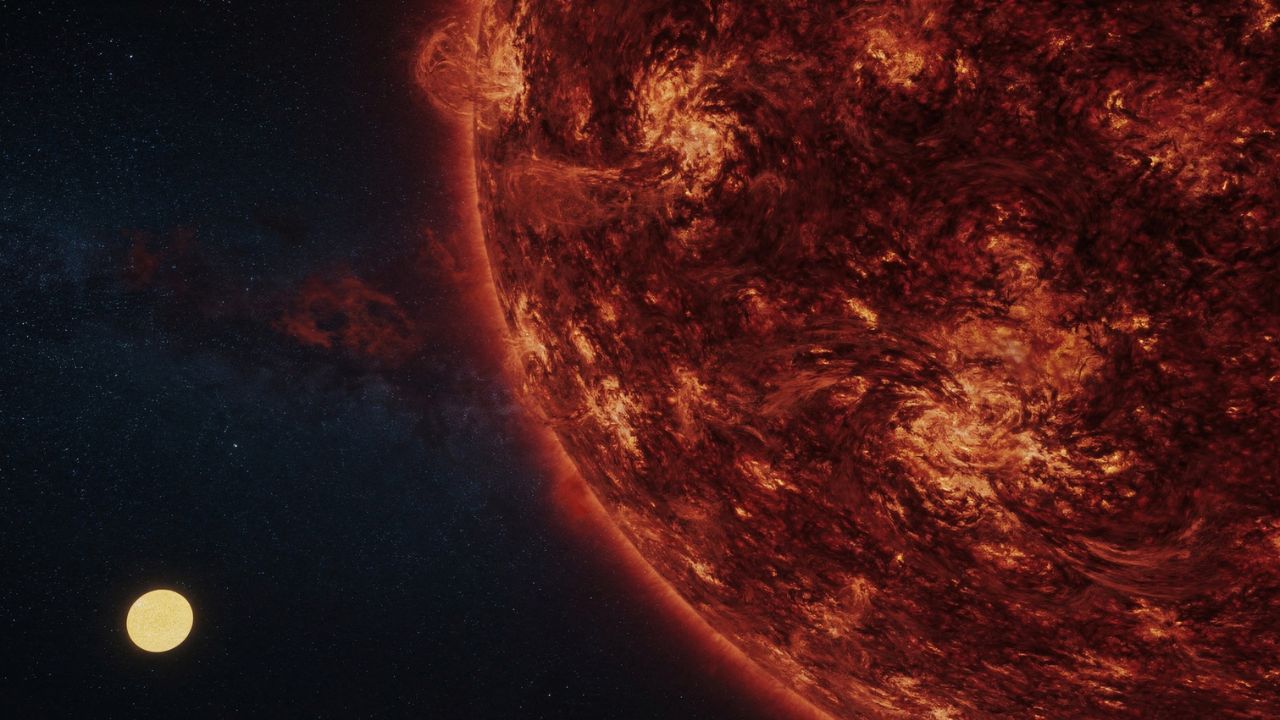
And yet, from here it looks like a bright reddish dot in the night sky of May and June. That tells you how far away it is: about 550 light-years. The light you see tonight left Antares around the year 1475, when the Aztecs (Mexica) still ruled in Mexico and Cortés had not yet been born.
Antares is in its final stages of life. In cosmic terms, it is an old and exhausted star that at some point, no one knows exactly when, will explode in a supernova. When it does, for several months it will be visible in daylight from Earth, brighter than the full Moon. The greatest spectacle any human being will ever see in the night sky, and we will be here to witness it.
If you want to hear what that stillness before the storm sounds like, Antares’ Lullaby, from the album Path of the Sun: The Infinite Cycle by ASTRONOMIKA BEATS, is exactly that.
M4: the 12-billion-year-old cluster that fits in your binoculars
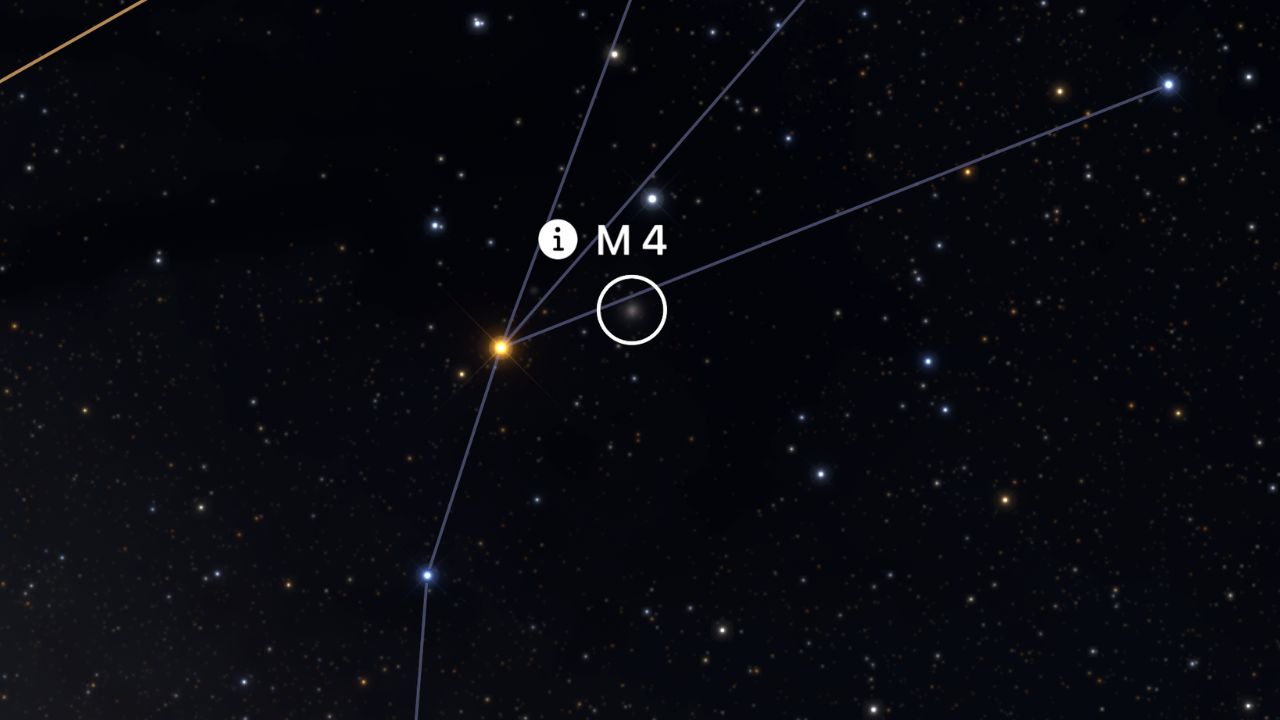
Just 1.3 degrees from Antares, so close they almost touch in the sky, lives M4. It is a globular cluster: a compact sphere of hundreds of thousands of stars orbiting our galaxy like an ancient satellite.
M4 is approximately 6,000 light-years from Earth, making it one of the closest globular clusters in existence and the easiest to locate from the Northern Hemisphere. It is about 12.2 billion years old. To put that in perspective: our Sun is 4.6 billion years old. The stars of M4 formed when the universe was young and our Solar System did not even exist as an idea.
What makes M4 remarkable is not just its age. It is that you can see it without being a professional astronomer or spending a fortune on equipment.
With 7×50 binoculars like the CELESTRON Cometron 7×50 (Mexico | United States | Spain) you can already make out the diffuse smudge of M4 next to Antares. But if you have 15x70s like the CELESTRON SkyMaster 15×70 (Mexico | United States | Spain), the experience changes completely: M4 becomes a real object, with texture, with a clearly visible circular structure. It is no longer a smudge. It is a cluster.
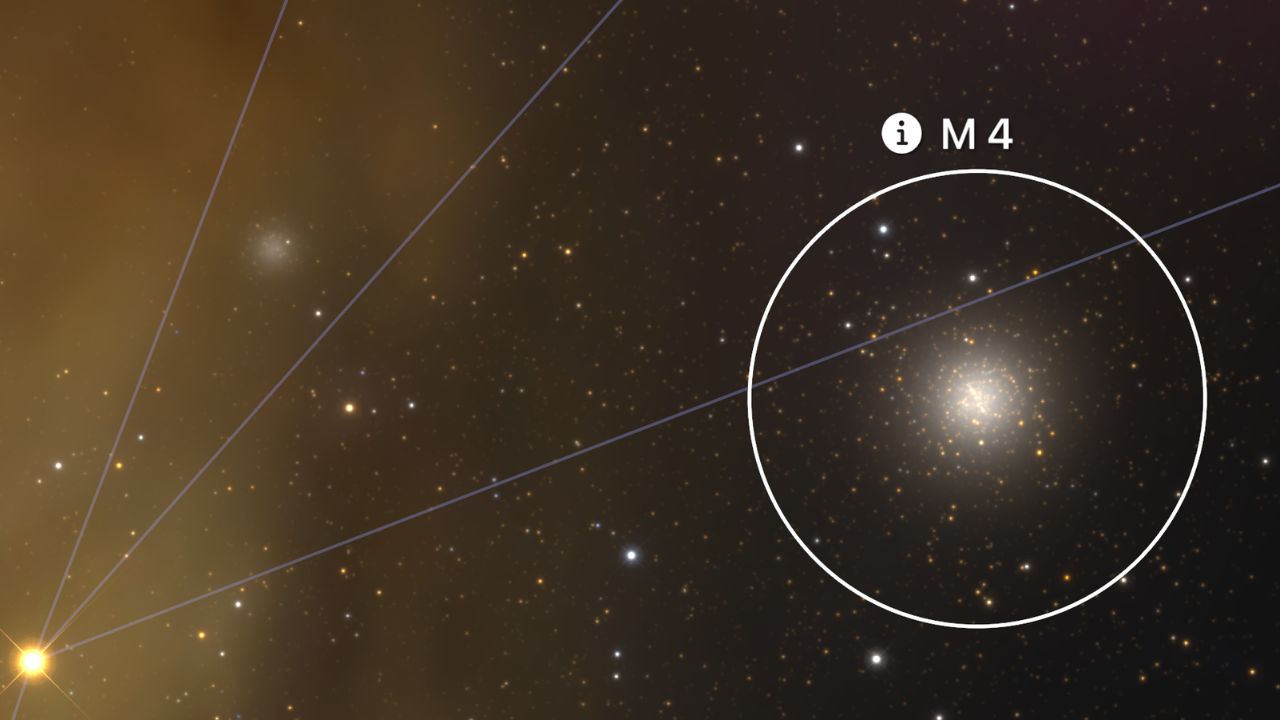
You are looking at 100,000 stars three times the age of our Sun, from your backyard, with equipment that fits in a backpack.
If you want to take the next step, the ZWO Seestar S50 (Mexico | United States | Spain) completely changes the experience. With binoculars you see M4 as a circular smudge with some structure. With the Seestar, the globular cluster appears resolved into individual stars, with the black contrast of deep space behind them. It is the difference between knowing something is there and actually seeing it. You can also point it at NGC 6231, the open cluster in the scorpion’s tail, which barely registers in binoculars but opens up into dozens of bright stars with different colors in the Seestar. The Smart Telescope finds the object on its own, frames it and delivers the processed image in real time. No astronomy knowledge required to get started.
The heart of the Azure Dragon
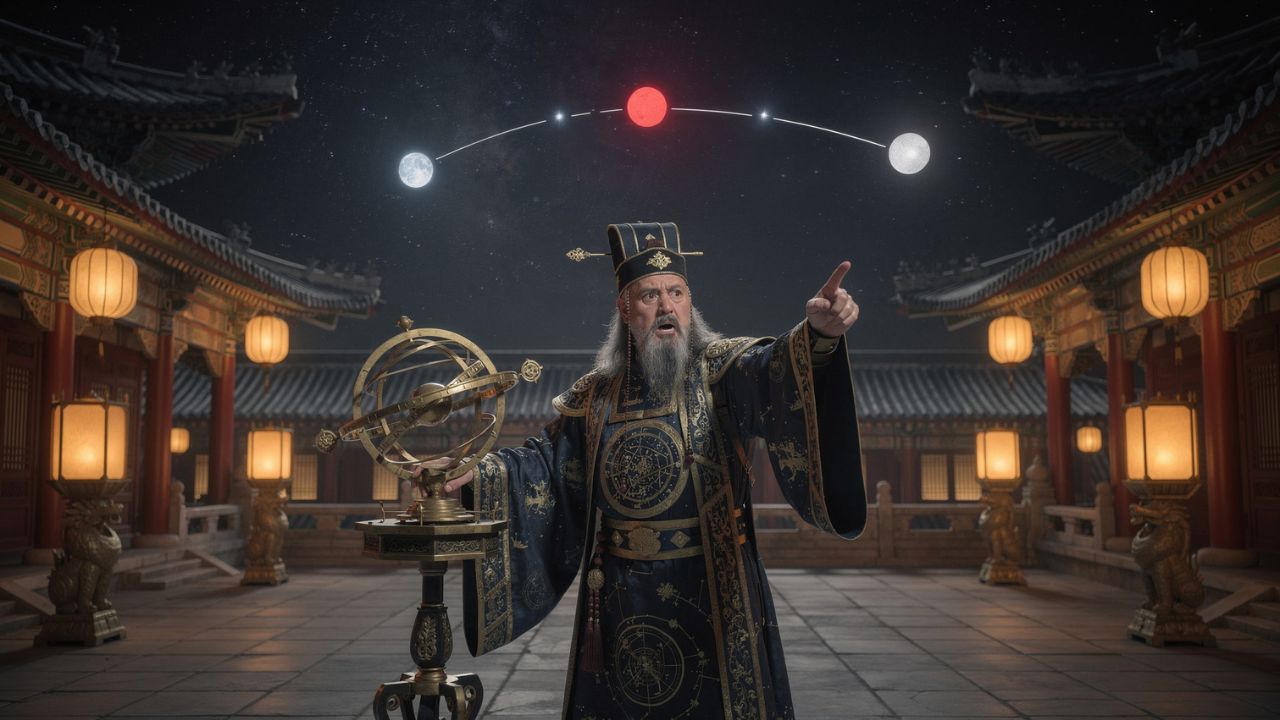
And there is a fourth civilization that looked at the same stars and read in them something completely different: the politics of an empire.
In classical Chinese astronomy, the stars of Scorpius formed part of the Azure Dragon of the East, one of the four celestial guardians. Antares had its own name: Huǒxīng, literally “fire star.” Together with the two stars flanking it, it formed Xin, the heart of the dragon. And in the protocol of the imperial court, that same star represented the Emperor’s throne, with its neighboring stars embodying the Crown Prince and the son of a concubine on either side.
An entire dynasty’s politics, projected onto the sky.
A star that for the Greeks rivaled a planet, for the Maya marked the gateway to the underworld, for the Australians was a warrior’s canoe, and for the Chinese was the heart of a dragon and the throne of an emperor. Four ways of looking at the same point in the sky. Four completely different truths about the same thing.
Same stars. Four completely different worlds.
✦ ✦ ✦
What do you see?
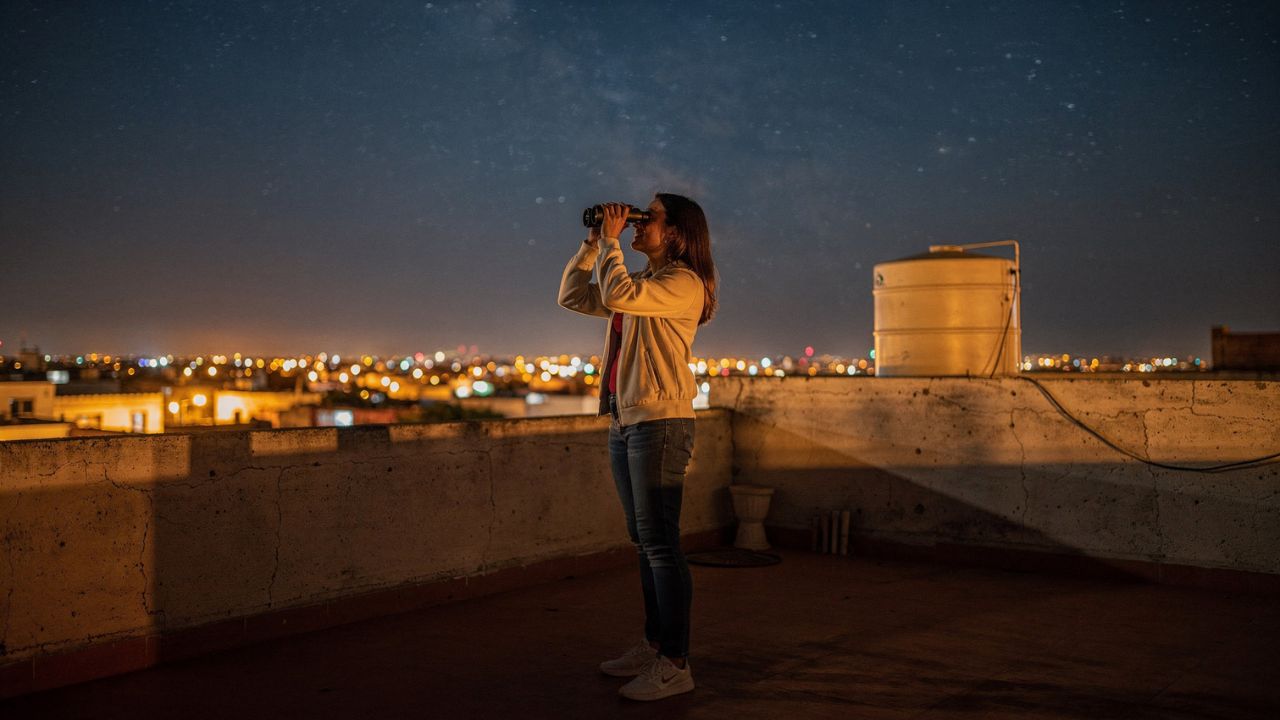
The next time you are outside on a clear May or June night, look south. The curve of bright stars with that intense red dot at the center. You already know that red dot is a star that would swallow the orbit of Mars. You already know that right next to it sits a ball of hundreds of thousands of stars that are 12 billion years old and 6,000 light-years away. You already know that curve has been a scorpion, a gateway to the underworld, a canoe and the heart of a dragon, depending on who was looking.
The sky did not change. Only the eyes did.
If you want to see it for real, with basic binoculars you can start tonight. And if you want real resolution, individual stars and objects binoculars cannot reach, at ASTRONOMIKA TV we show all of that live from our rooftop in Guadalajara, in our YouTube videos.
✦ ✦ ✦
Frequently asked questions about the Scorpius constellation
What months is the Scorpius constellation visible?
Scorpius is visible in the Northern Hemisphere from May to August, with the optimal window in July when it reaches its greatest height in the southern sky. In the Southern Hemisphere it is visible practically year-round and reaches significant height during the winter sky of June and July.
Why is Antares called that?
Antares means “rival of Ares” in Greek, where Ares is the god of war that the Romans called Mars. The star received that name because its intense reddish color is almost identical to that of the planet Mars. At certain times of year, both appear close in the sky and are very difficult to tell apart with the naked eye, even for experienced observers.
How large is Antares compared to the Sun?
Antares has between 700 and 800 times the diameter of the Sun, and its size changes because it is a pulsating variable star. If it were in the place of the Sun, its surface would extend beyond the orbit of Mars and reach the asteroid belt between Mars and Jupiter. Earth would be completely inside the star.
Can I see M4 without a telescope?
With binoculars and a reasonably dark sky, yes. Locate Antares, the brightest and most reddish star in the constellation, and move your binoculars approximately 1.3 degrees to the west. M4 appears as a diffuse circular smudge. With higher-power binoculars like 15x70s you can start to perceive its granular structure.
When will Antares explode as a supernova?
There is no precisely calculated date. Astronomers know that Antares is in the final stages of its stellar life and that at some point it will experience a supernova explosion. When it happens, it will be visible in broad daylight from Earth for several months. The uncertainty is real: it could occur in a thousand years or in a hundred thousand.
Did the Maya really have their own constellations?
Yes. The Maya developed a highly sophisticated astronomical system, independent of the Greek system we use today. They identified constellations, tracked planets with remarkable precision and linked celestial movement to their ritual calendar and mythology. The region of Scorpius was especially important because it marks the crossing between the Milky Way and the ecliptic, which the Maya interpreted as the entrance to Xibalba, the underworld. Much of that knowledge was lost when Spanish conquistadors burned Maya codices in the sixteenth century. What survived continues to astonish researchers.
Are there other versions of the myth of Orion’s death?
Yes, several. Greek mythology is not a single book with one official version: myths were told differently depending on the region, the era and the poet narrating them. The story of Gaia and the scorpion is the one that directly explains the constellation and the eternal separation between Orion and Scorpius in the sky. The other versions have their own dramas, but those are a story for another time.
How do I find the Scorpius constellation without an app?
Look south between May and August. Your reference point is Antares, the brightest star in that area with an unmistakable reddish color. Once you find it, the curve of bright stars that dips and rises forming the scorpion’s tail is impossible to confuse with any other constellation. It is one of the few that actually looks like what it claims to be.
Is the Scorpius constellation visible from Mexico and Latin America?
Yes, and with an advantage over the Northern Hemisphere in general. From Mexico, Central America and all of Latin America, Scorpius reaches a considerable height in the southern sky between May and August, enough to see the complete constellation including the tail and the stinger. From more northerly latitudes, such as Europe or the northern United States, the tail sits partially below the horizon and you miss the best part.
This article contains affiliate links. If you purchase through them, I receive a small commission at no additional cost to you.
Sources and further reading
Books
Ridpath, I. (2018). Star Tales. Lutterworth Press. Classic reference on the mythological origins of the constellations, with analysis of primary Greek sources.
Schele, L. and Freidel, D. (1993). A Forest of Kings: The Untold Story of the Ancient Maya. Harper Perennial. Foundational work on Maya astronomy and cosmology, including the role of Scorpius in the mythology of the Popol Vuh.
Norris, R. and Norris, C. (2009). Emu Dreaming: An Introduction to Australian Aboriginal Astronomy. Emu Dreaming. Introduction to the astronomical system of Australian Aboriginal peoples and the Pacific islands.
Harney, B. Y. and Cairns, H. (2003). Dark Sparklers. Hugh Cairns. The most complete record of the astronomical knowledge of the Wardaman people, which includes the stars of Scorpius in their initiation ceremonies.
Digital sources
NASA Science. Messier 4 (NGC 6121). science.nasa.gov. Official technical profile of the M4 globular cluster with data on distance, age and stellar composition.
Ridpath, I. Star Tales: Scorpius. ianridpath.com/startales. Detailed analysis of Greco-Latin sources on the constellation, including references to Eratosthenes and Ovid.
The Conversation. (2016). Kindred Skies: Ancient Greeks and Aboriginal Australians Saw Constellations in Common. theconversation.com. Peer-reviewed academic article on the connections between Greek and Australian Aboriginal astronomy.