
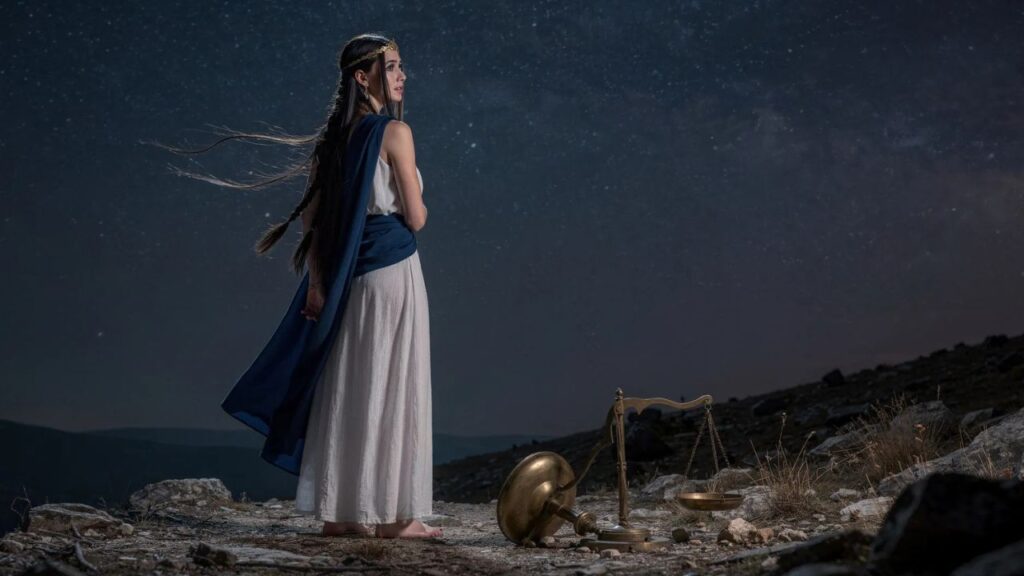
Libra constellation: mythology, stars, and facts that will blow your mind. By ASTRONOMIKA TV.
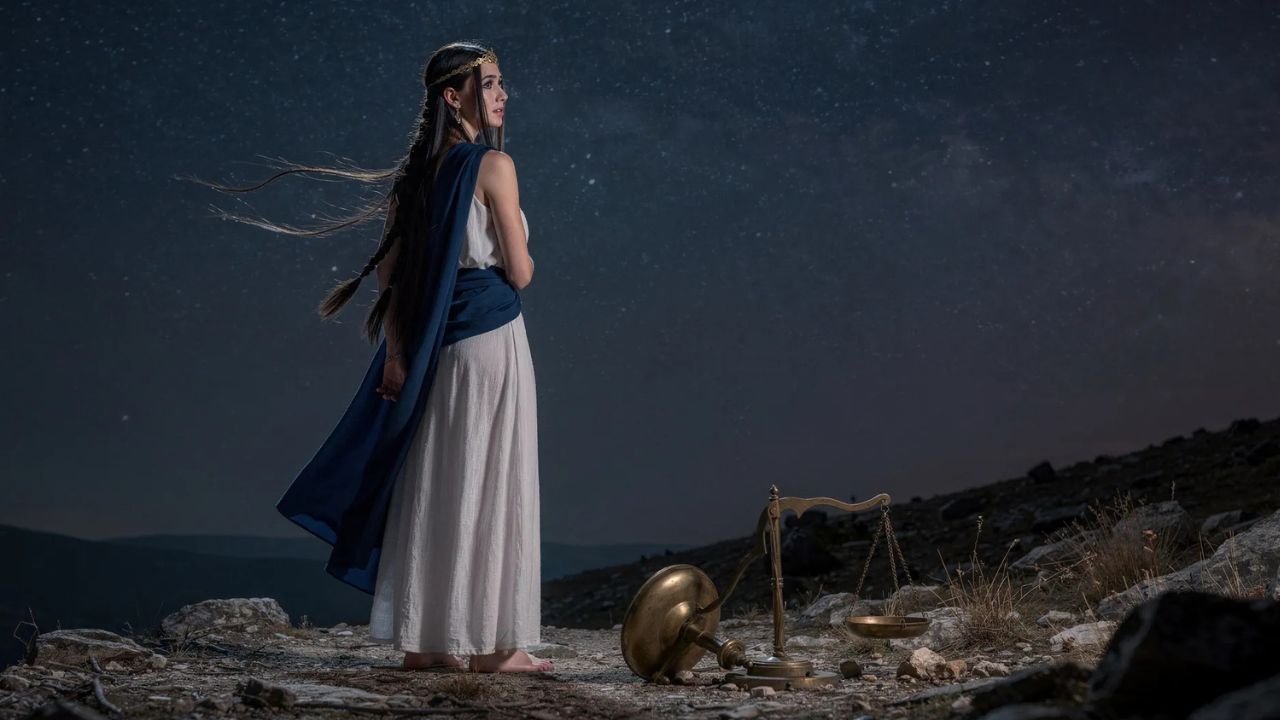
The Greek story of abandonment, the Egyptian judgment of the soul, and the Maya shark that saw no scale at all
By Juan Pablo Martín | ASTRONOMIKA TV | May 2026
Libra constellation: the only one in the zodiac that is not a living being, has no proper Latin star names of its own, and exists formally because the Romans decided to steal the claws off the neighboring Scorpion. That alone tells you this story is not going to be boring.
Because behind those four faint stars, three civilizations looked at the exact same corner of the sky and saw completely different things. One saw the precise moment the gods gave up on humanity. Another saw the most terrifying scale in history, where your heart decides whether you deserve eternity. And the third saw no scale at all: it saw a shark from the underworld.
✦ ✦ ✦
The goddess who held out until the end and then left without looking back
There are stories of gods who abandon humans over an insult, out of jealousy, on a whim. The story of Astraea is different. Astraea did not leave out of anger over a single offense. She left because she had outlasted every other god, watched humanity rot century after century, tried everything to save it, and finally accepted that it was beyond saving.
And when she left, she dropped her scale on the sky.
That scale is Libra.
To understand the drama, you need to understand the context. The Greeks divided human history into five ages: the Golden Age, the Silver Age, the Bronze Age, the Age of Heroes, and the Iron Age. In the Golden Age, humans were virtuous, lived in peace, and the gods walked among them on Earth. It was, essentially, paradise. Astraea, goddess of justice and innocence, daughter of the Titan Astraeus and Eos, goddess of the dawn, was the guardian of that perfect order.
But the ages kept deteriorating. The Silver Age brought arrogance and ingratitude. The Bronze Age brought war. The gods began abandoning Earth one by one, fed up with the spectacle. Astraea stayed. She kept trying to reach people, to persuade them, to shame them. According to Ovid in the Metamorphoses, she was the last immortal to withdraw when iron and greed had finally corrupted everything.
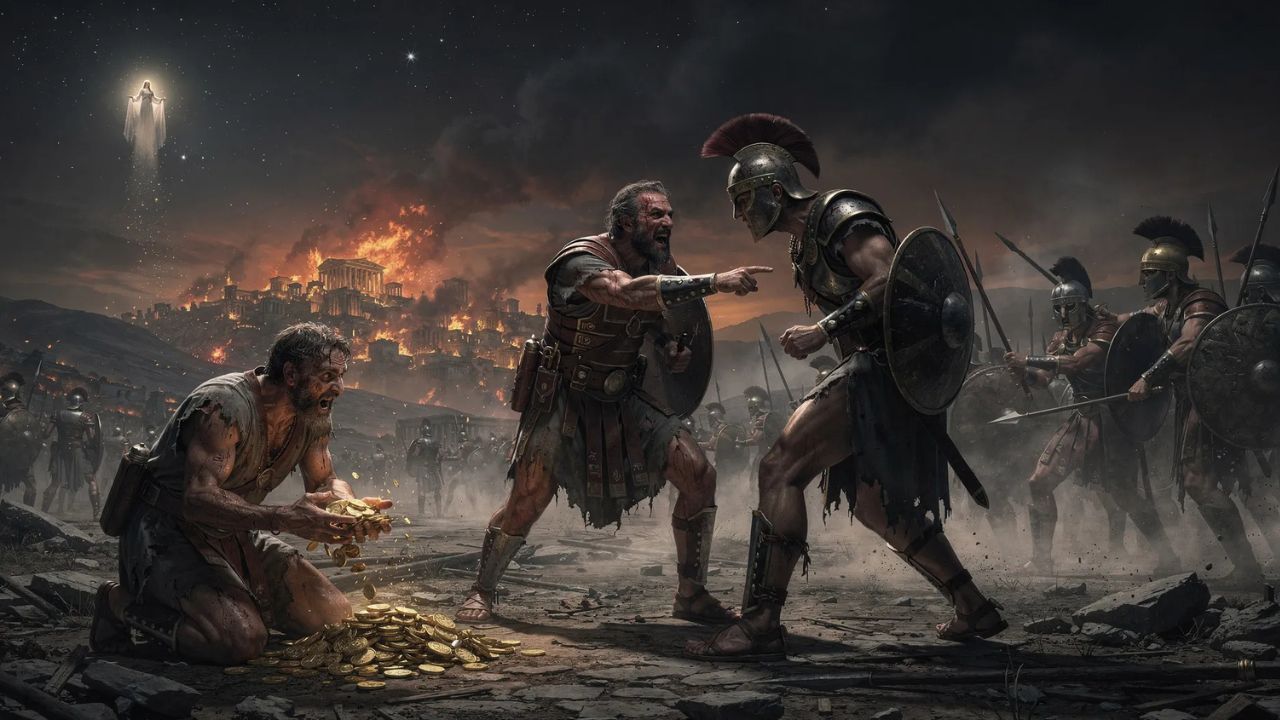
When she finally left, she abandoned the scale of justice she had always carried. That scale was left suspended in the sky, and it became the constellation we now call Libra.
There is an irony the Greeks could not ignore: Astraea did not destroy her scale when she departed. She did not shatter it as a sign of condemnation. She left it there. Hanging. As if still waiting for someone, at some point, to pick it up and use it correctly.
A second version of the myth exists, less poetic but equally interesting. In it, the scale does not belong to Astraea but to Themis, goddess of divine order, or to her daughter Dike, personification of human justice. In that version, Libra is the active instrument of cosmic judgment, not the abandoned object of a disappointed goddess. Both versions circulated in antiquity and ancient authors switched between them freely; Hyginus, Aratus, and Ovid contradict each other with complete ease.
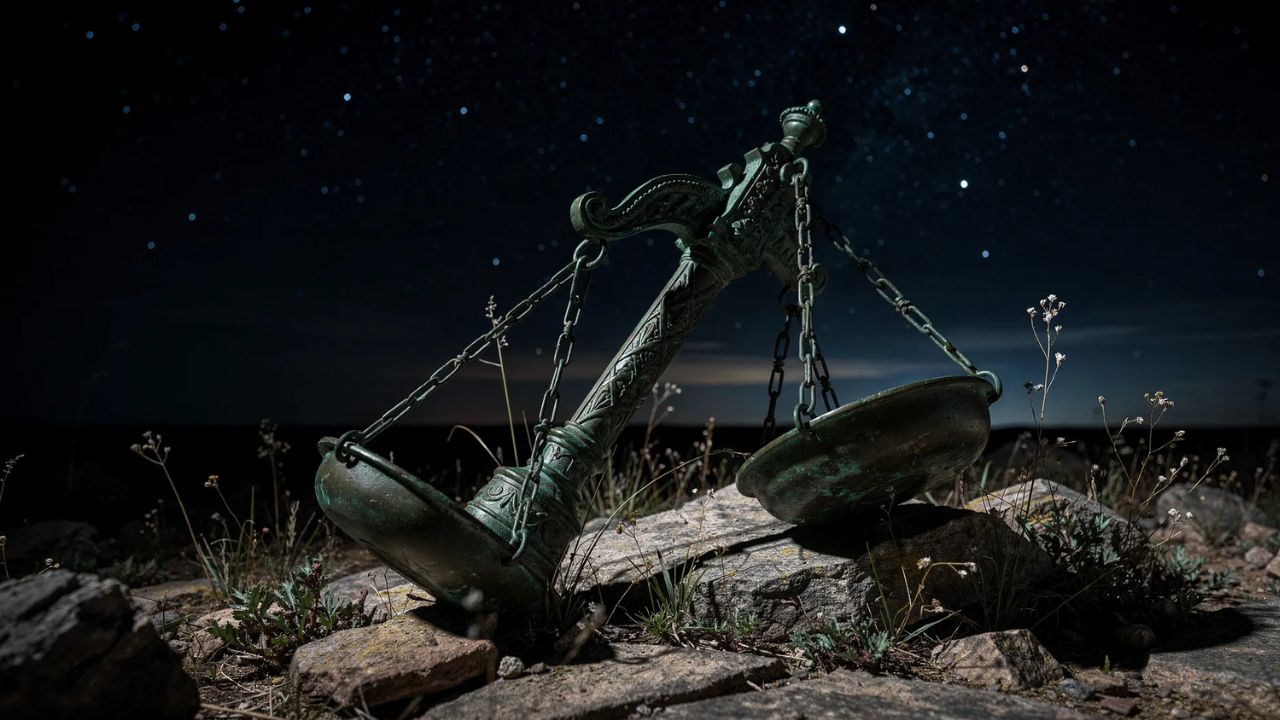
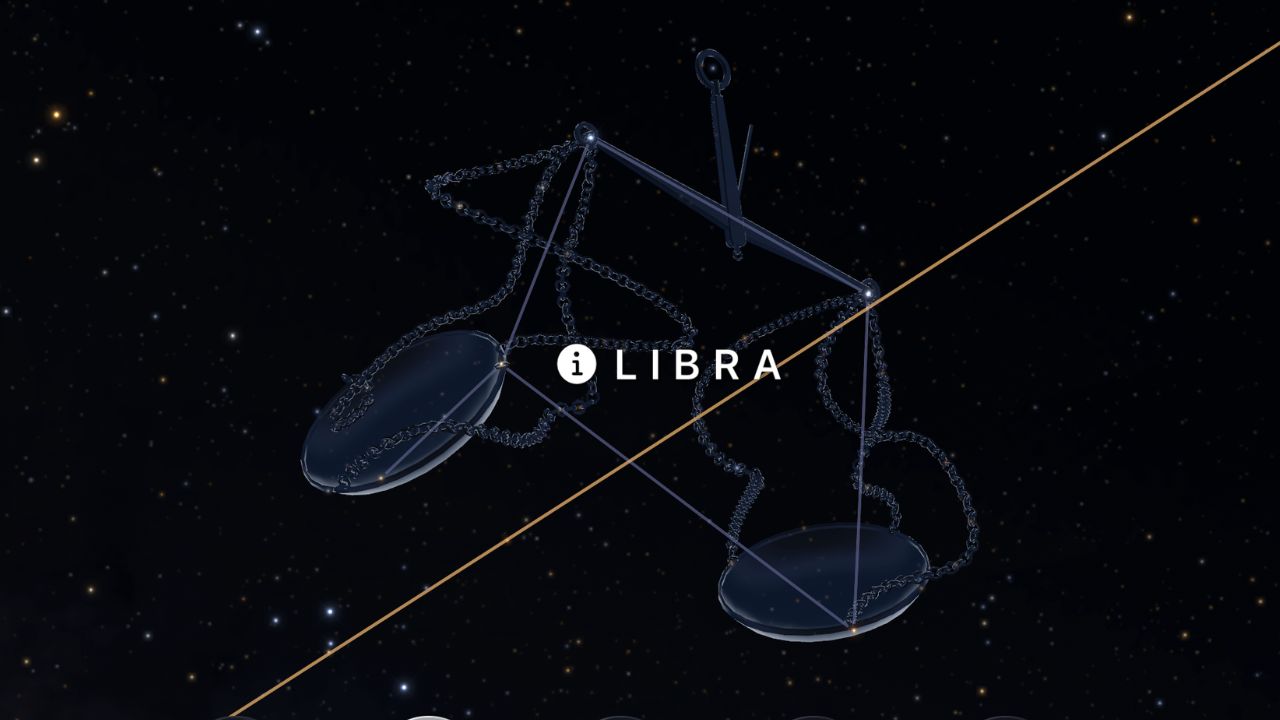
There is one more detail that complicates the story. The Greeks did not even see Libra as an independent constellation. For Aratus and the Hellenistic tradition, these stars were the Chelae, the claws of Scorpius. It was the Romans, around 100 BC, who decided to carve out this region of the sky and make it its own constellation, associating it with the scales of Justitia. In other words: Libra was not born as a constellation. It was created by decree, cut from the body of its neighbor.
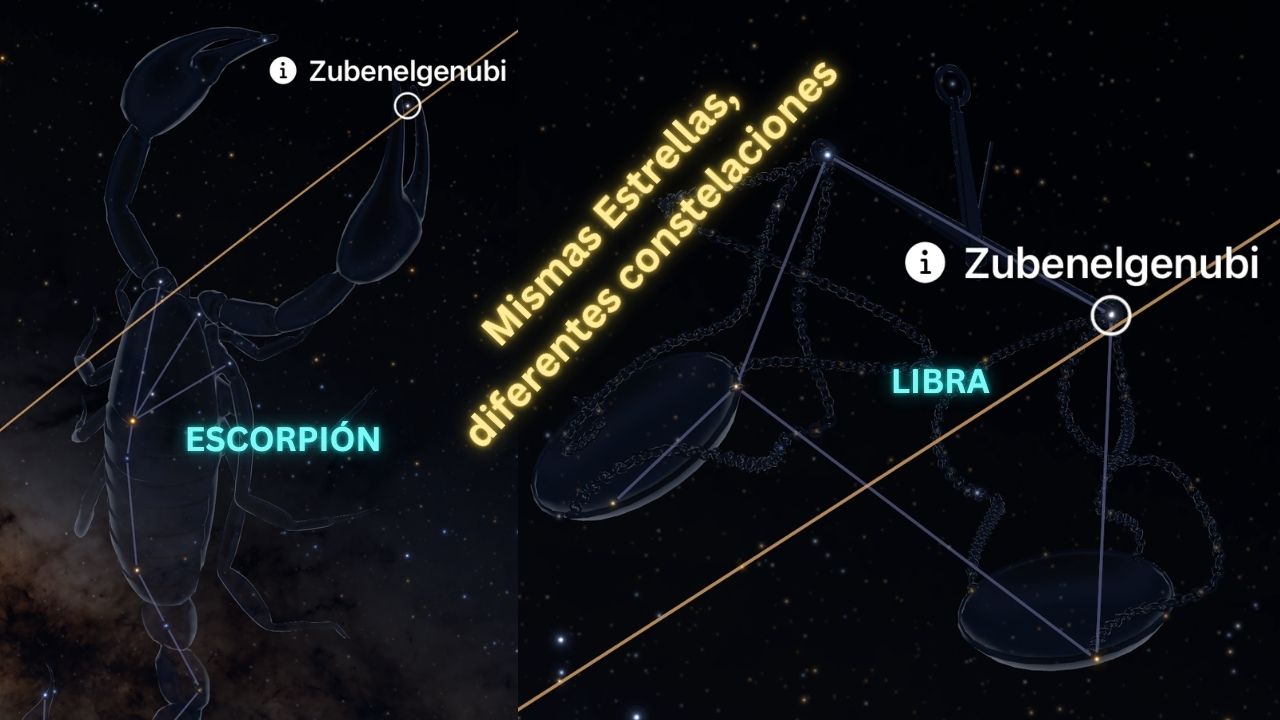
And as a permanent reminder of that theft, the two brightest stars in Libra still carry Arabic names that give away their origin: Zubenelgenubi, “the southern claw of the scorpion,” and Zubeneschamali, “the northern claw.” Scorpius lost its claws two thousand years ago and the sky has yet to update the records.
But what the Romans found on the other side of the world was a civilization that had been looking at that same region for centuries with a completely different idea of what a scale means.
✦ ✦ ✦
The same sky, completely different stories
The Greeks and Romans were not the only ones who looked at that region of the sky and saw a scale. On the other side of the Mediterranean, a civilization had been using that same symbol for something infinitely more personal: deciding whether you, specifically you, deserve eternity. And on the other side of the Atlantic, a culture that had no contact with either of them looked at the same stars and saw no scale at all. It saw something much darker.
Egypt: the scale that never stopped working
The most brutal difference between the Greek and Egyptian versions can be summed up in one line: for the Greeks, the scale of Libra is abandoned. For the Egyptians, it is still running. And you are what gets weighed on it.
In ancient Egypt, after death, your soul descended into the Duat, the underworld. The journey ended in the Hall of Two Truths, where Anubis, the jackal-headed god who presided over the dead, took your heart and placed it on one pan of the scale. On the other pan he placed the feather of Maat, goddess of truth, order, and cosmic justice.
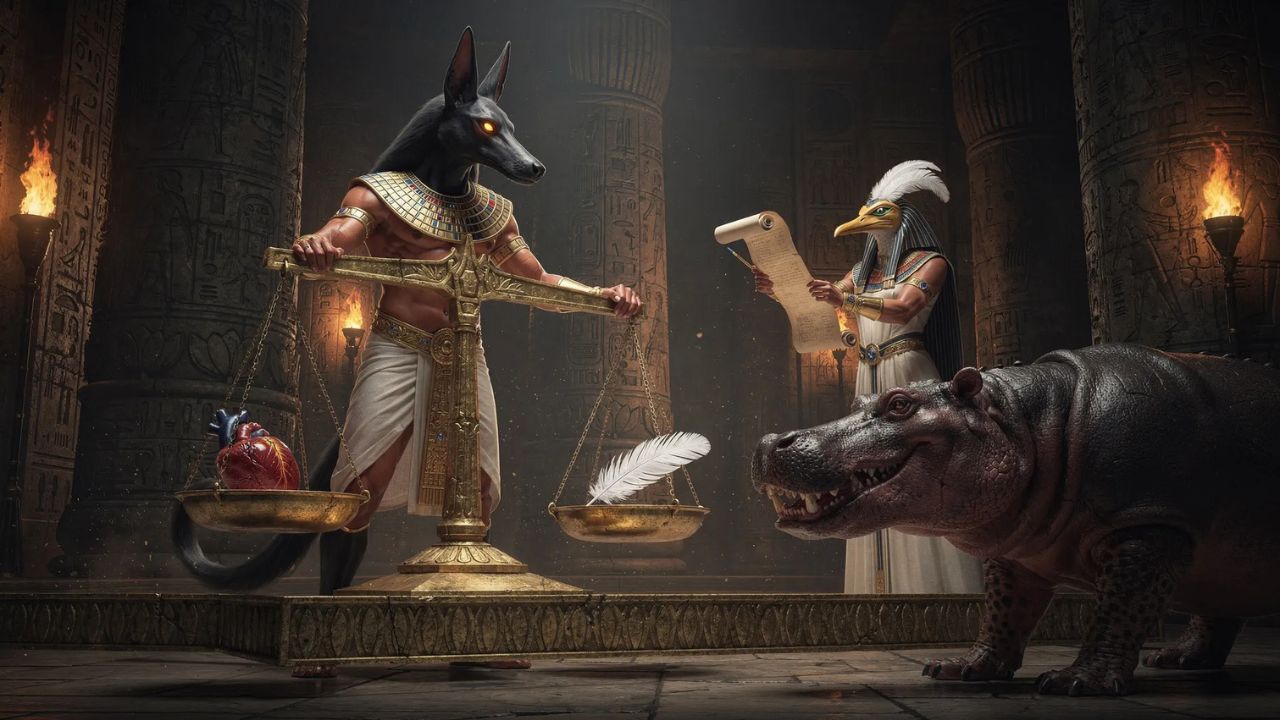
The logic was ruthlessly simple. If you had lived with integrity, your heart was light, equal to the feather, and the scale balanced. Anubis sent you to the paradise of Osiris. But if you carried the weight of your lies, your greed, and your cruelty, your heart was heavier. And then Ammit stepped in.
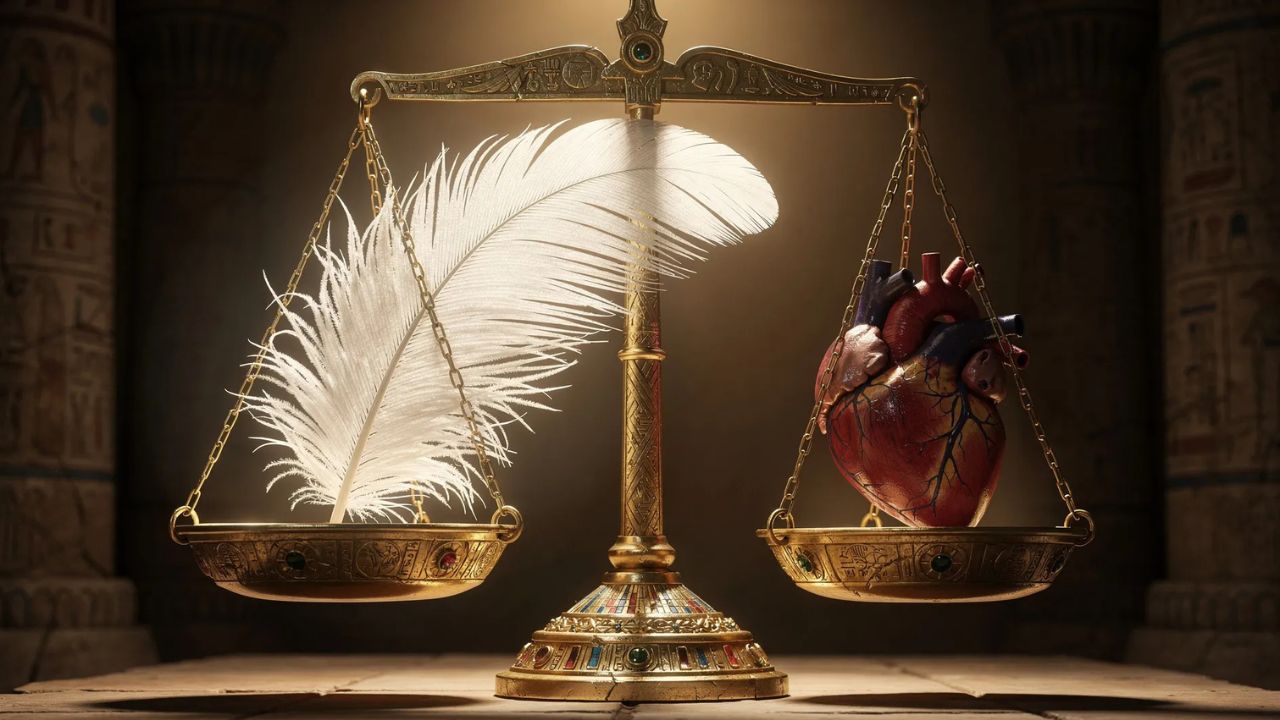
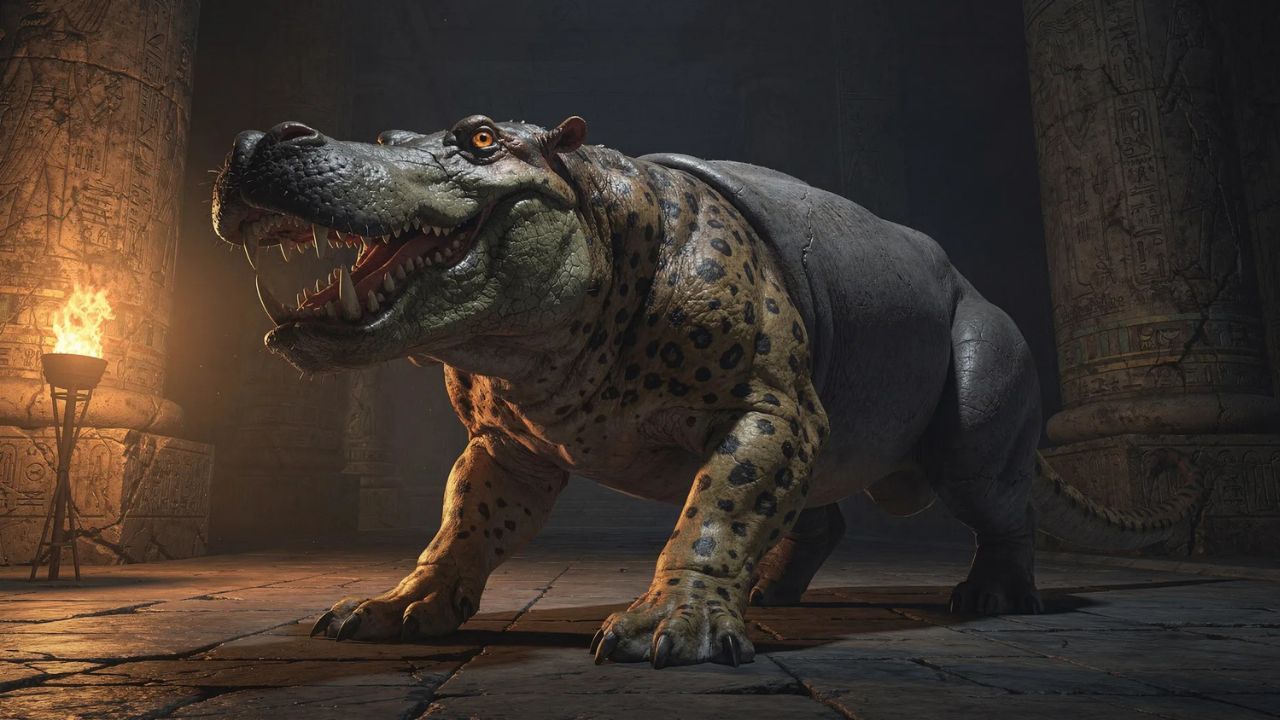
Ammit was the creature waiting at the foot of the scale. It had the head of a crocodile, the body of a leopard, and the hindquarters of a hippopotamus. Not exactly a being you would want to encounter. If your heart failed the test, Ammit devoured it, and your soul ceased to exist forever. No hell, no eternal damnation, no second chance. Just nothing.
This ritual is documented in the Egyptian Book of the Dead, one of the oldest funerary texts in the world, with surviving copies dating to around 1550 BC. Illustrations of the psychostasia, the weighing of the soul, appear across papyri throughout the New Kingdom period with remarkable consistency: Anubis beside the scale, Thoth recording the result, Ammit waiting.
The contrast with Astraea could not be more striking. The Greek goddess abandoned her scale because humanity disappointed her. In Egypt, the scale is never abandoned, never rests, and shows no mercy. It does not matter who you were in life, your rank or your wealth. When you arrived at the Hall of Two Truths, you were just a heart on a pan.
The Maya: there is no scale here
If the Egyptian version is more terrifying than the Greek, the Maya version breaks the pattern entirely. Because the Maya looked at the exact same stars and saw no scale, no instrument of justice, no symbol of moral order. They saw Xoc.
Xoc is the sacred shark of the Maya pantheon, lord of the aquatic underworld, inhabitant of the depths where the sun travels at night before rising again at dawn. In the Paris Codex, one of the few Maya manuscripts that survived the Spanish conquest, pages 23 and 24 show what researchers have interpreted as a Maya zodiac of 13 constellations. Among those figures appears a xoc, a shark or sea monster, in the region of the sky that roughly corresponds to present-day Libra. Epigrapher Linda Schele and researcher K.D. Villela analyzed this document in 1993 and confirmed the association.
One thing worth stating honestly: the Maya did not leave a text that literally says “this constellation is a shark.” The correspondence comes from academic interpretation of the Paris Codex. But the figure is there, in the manuscript, in that region of the sky.
And about Ah Xoc, the shark god, there is a myth with a specific story. It goes like this.
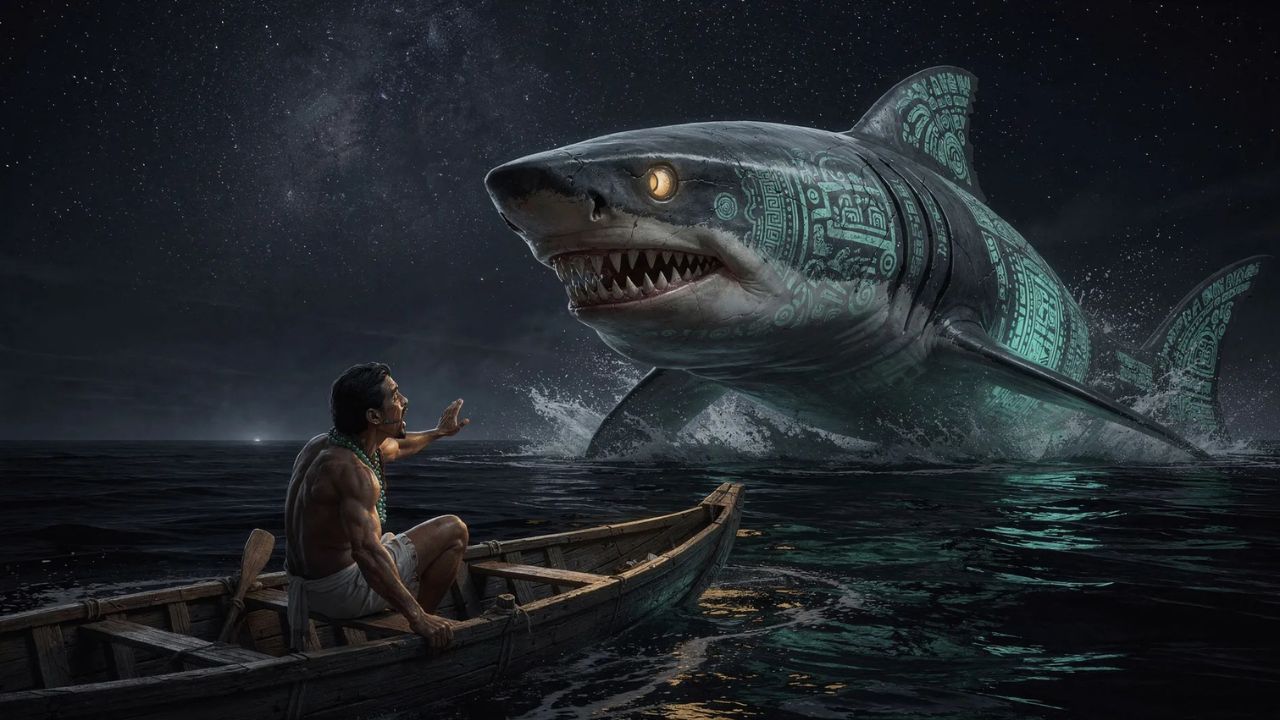
A fisherman was going hungry. He could not catch anything. Then Ah Xoc rose from the depths and offered him a deal: abundant fish in exchange for the life of one of his children. The man accepted, and gave up his daughter. Ah Xoc dragged her down into the aquatic underworld.
The problem with dark deals is that they create appetite. Some time later, the same fisherman, drunk on the abundance, went back to find Ah Xoc and offered his second child in exchange for even more fish. Ah Xoc agreed. But this time the son escaped to the highlands, far from the sea, where the shark had no power.
Ah Xoc was not the forgiving type. From that day on, he withdrew the fish from the region forever. The fisherman had gained abundance, lost his daughter, tried to cheat the god of the underworld, and ended up with no children and no fish.
For the Maya, that region of the sky was the territory of a deity who made deals, collected with interest, and never forgot. No scales, no abstract justice. Just an eternal creditor waiting in the depths.
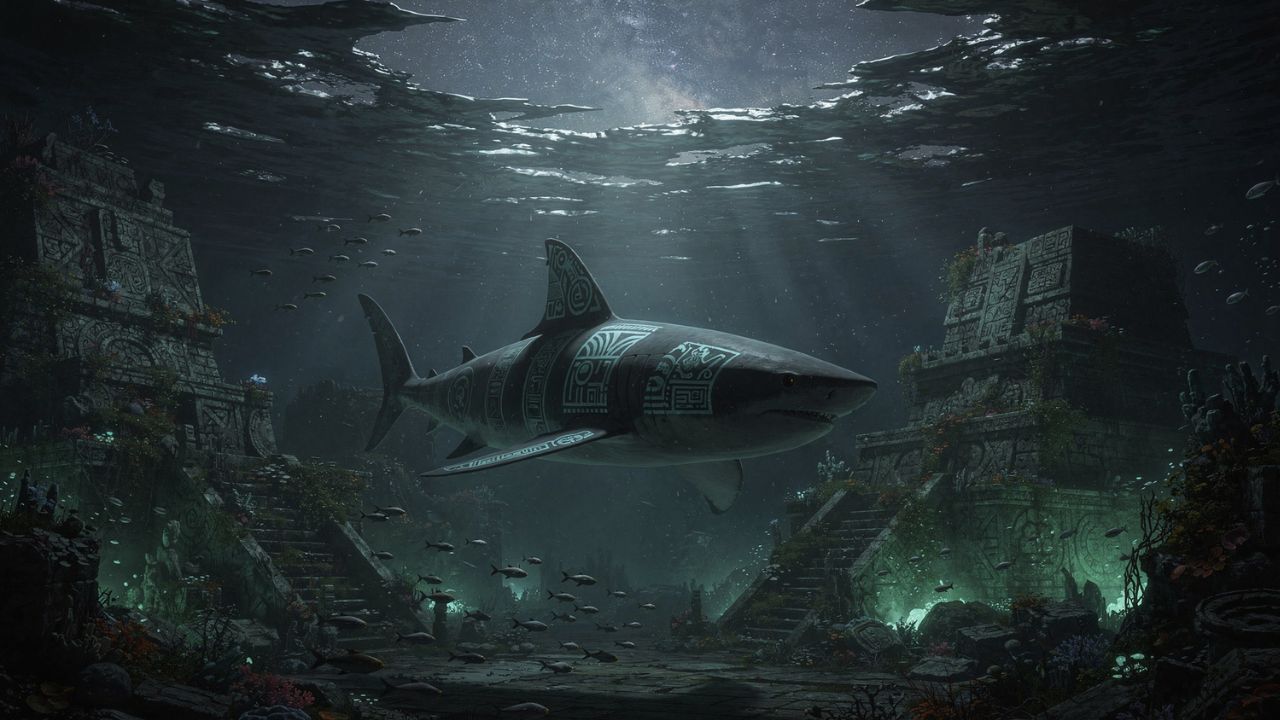
And there is a linguistic connection that no one planned: the English word “shark” comes directly from the Maya word “xoc.” The first English sailors who navigated the Caribbean in the 16th century heard local populations using the term for sharks and adopted it. A trace of Maya astronomy that ended up in the English language without anyone intending it.
✦ ✦ ✦
20 light-years from here there is a planet that may not exist, and we sent it a message anyway
Libra is one of the most understated constellations in the zodiac. No first-magnitude stars, no spectacular naked-eye objects, none of the visual drama of Scorpius or Orion. But within its borders there is a star system that for years was the most promising place in the known universe to search for extraterrestrial life. And the story of that system is itself a perfect summary of how science works when hope gets slightly ahead of objectivity.
The star is called Gliese 581. It is a red dwarf, the most common type of star in the galaxy, so faint at magnitude 10.6 that it is completely invisible to the naked eye. It sits 20.5 light-years from Earth, making it one of the 100 nearest stars to the Sun. On the scale of the stellar neighborhood, it is practically next door.
Starting in 2005, a team of astronomers from the European Southern Observatory began detecting planets orbiting Gliese 581 using the HARPS spectrograph at La Silla Observatory in Chile. By 2007 they had confirmed at least three planets. Gliese 581d, with a mass nearly seven times that of Earth, orbited within the habitable zone of its star, the region where temperatures allow water to exist as a liquid. It was the first confirmed extrasolar planet inside a habitable zone. The news shook astronomy.
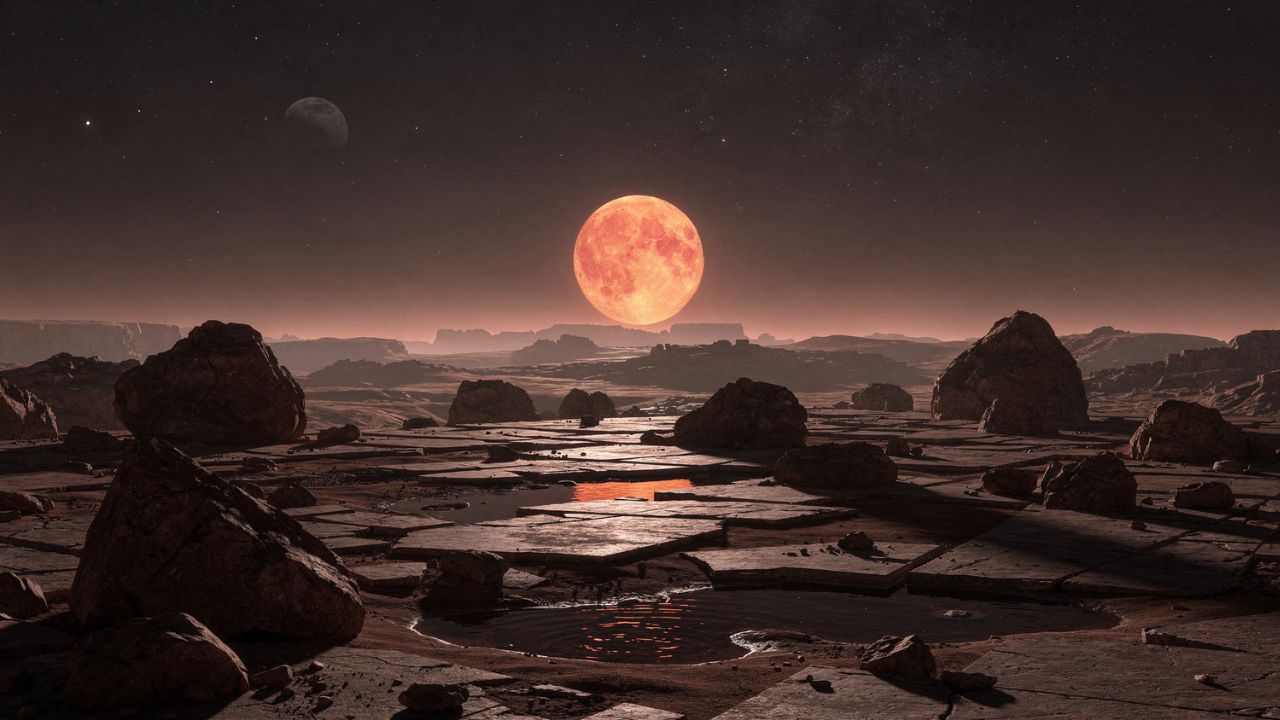
But the real earthquake came in 2010. Astronomer Steven Vogt announced the discovery of Gliese 581g, a planet between three and four Earth masses located right in the center of the habitable zone, not at the edge but exactly in the middle. Vogt stated at a press conference that, in his personal opinion, the probability of life on that planet was 100%. The scientific community froze.
Gliese 581g: mass between 3 and 4 times Earth’s, estimated average temperature between -37 and -12 degrees Celsius. Right in the center of the zone where water can be liquid. The most Earth-like candidate ever found up to that point.
The problem came in 2014. A rival team analyzed the same data and published that Gliese 581g did not exist. That it was an “artifact of stellar activity,” an illusion produced by the star’s own spots and eruptions interfering with the measurements. The most promising planet in history had been, perhaps, a misreading of the data.
The story does not end there. In January 2024, a new study from the University of Texas at Arlington and Villanova University challenged the 2014 analysis, arguing it was based on an incorrect stellar rotation period. If the new value is correct, Gliese 581d, the one nobody disputes, is firmly back in the habitable zone.
What is a verified, indisputable fact is this: in October 2008, a group of Ukrainian scientists transmitted a high-powered radio signal directly toward Gliese 581 using the RT-70 radio telescope. The signal contained 501 messages, photographs, and documents selected from the internet. That signal is traveling through space right now. It will reach the vicinity of Gliese 581 in 2029. If anyone is there, the earliest possible reply would arrive in 2049.
We sent a message to a planet that may not exist. And the reply would arrive when most of the people reading this are already old. At best. Because if no one is there, there simply will be no reply. The universe has that uncomfortable habit of leaving you on read.
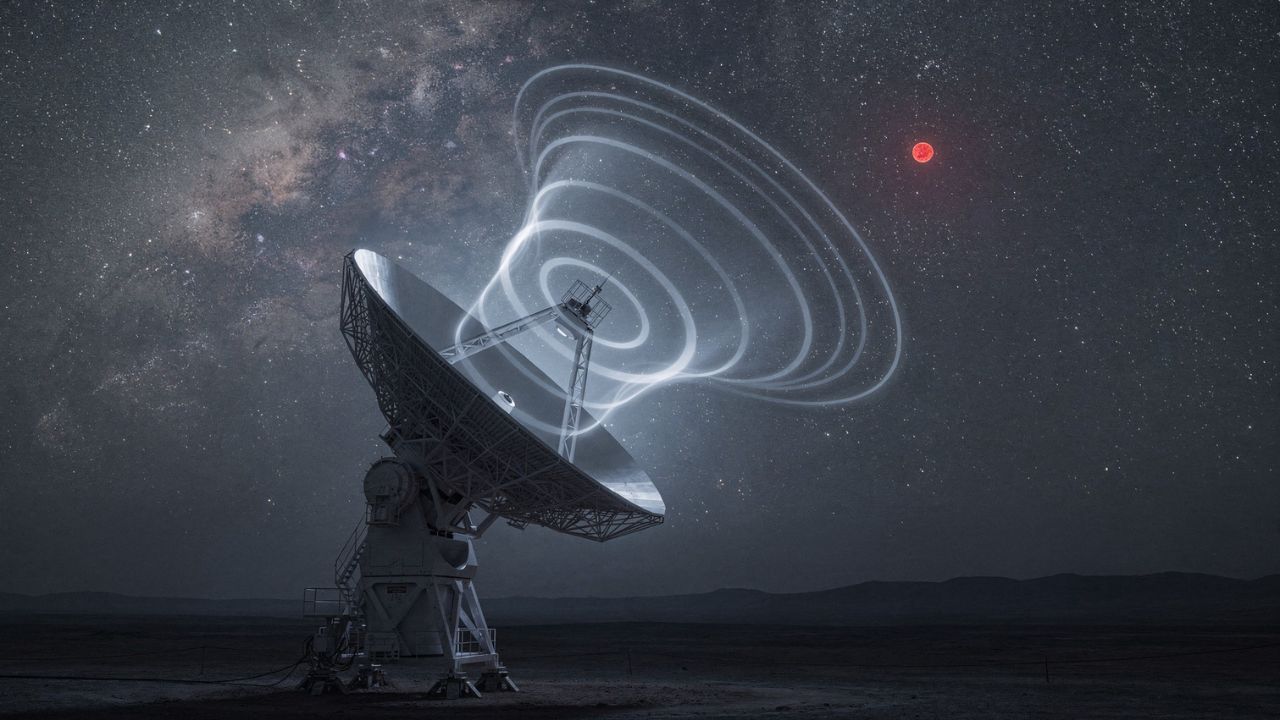
With the Seestar S50 you can point to the exact field where Gliese 581 sits, though the star itself, at magnitude 10.6, is at the edge of what the instrument can capture. You will not see anything spectacular. You will see a faint reddish point of light among thousands of similar ones. But you will know exactly what you are looking at.
If you want something you can actually see with your own eyes, Libra has two much more generous options.
The first is the constellation’s own stars. Zubenelgenubi, Libra’s alpha star 75 light-years away, is actually a double system separable to the naked eye under good conditions, and trivially so through Celestron Cometron 7×50 binoculars. What you will see are two clearly separated points of light: a blue-white primary at magnitude 2.7 and its companion at magnitude 5.2. Very few objects in the night sky let you confirm through binoculars something your naked eye already suspects.
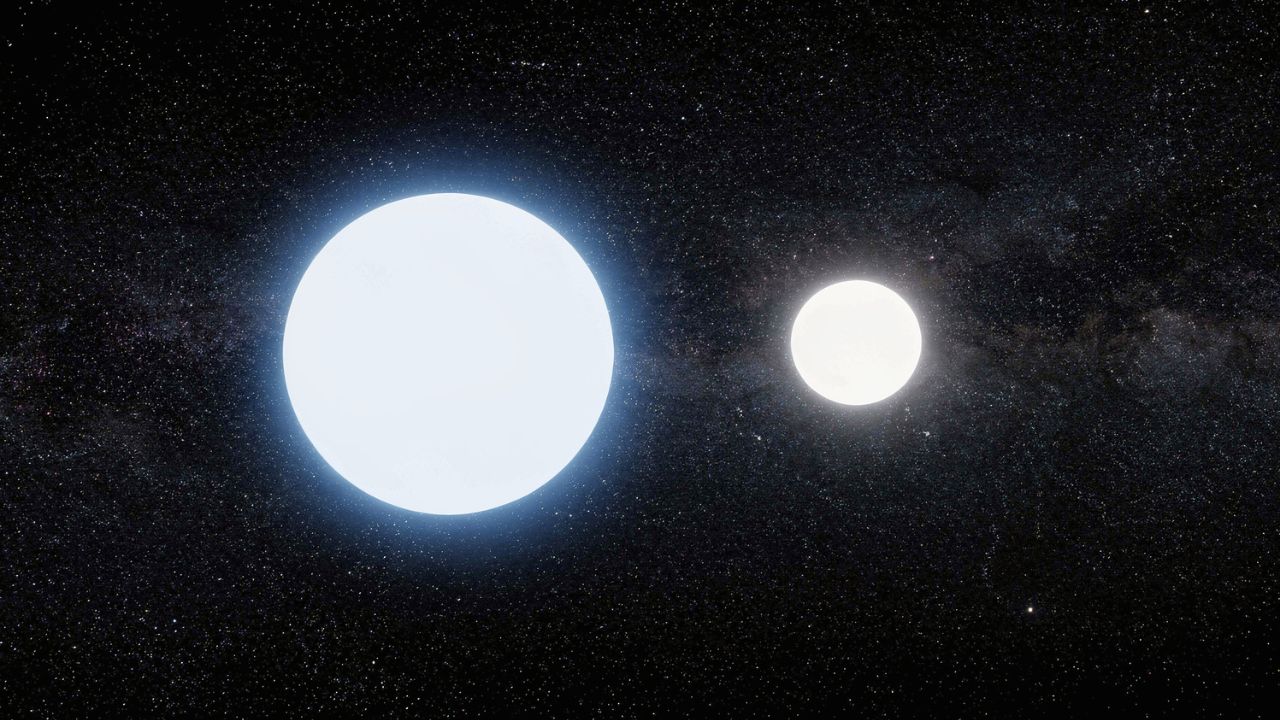
The Arabic name Zubenelgenubi means “the southern claw of the scorpion.” Zubeneschamali, Libra’s brightest star, means “the northern claw.” Both names are a linguistic fossil from when these stars belonged to Scorpius. Scorpius lost its claws two thousand years ago and the sky still has not updated the records.
Zubeneschamali also holds an unsolved mystery. It is possibly the only star visible to the naked eye with a greenish tint, something that goes against all known stellar physics: stars cannot be green. Observers have been reporting it for centuries, from antiquity to the present day. No consensus explanation exists. The astronomer Eratosthenes, in 276 BC, recorded that Zubeneschamali was brighter than Antares. Ptolemy, 350 years later, said they were equal. Today Antares outshines it by a full magnitude. Whether Zubeneschamali faded or Antares brightened is a question modern astronomy has not yet answered.
The second observable option is NGC 5897, a globular cluster informally nicknamed the Ghost Globular for its diffuse, hazy appearance. At magnitude 8.5 with an apparent diameter of nearly 13 arcminutes, it is reachable through SkyMaster 15×70 binoculars from dark skies, though it will not impress with detail: you will see a soft patch of light, without the tight central concentration of clusters like M13. It sits roughly 40,000 light-years away. The light reaching your eyes left that cluster when modern humans were just beginning to cross from Asia into the Americas.
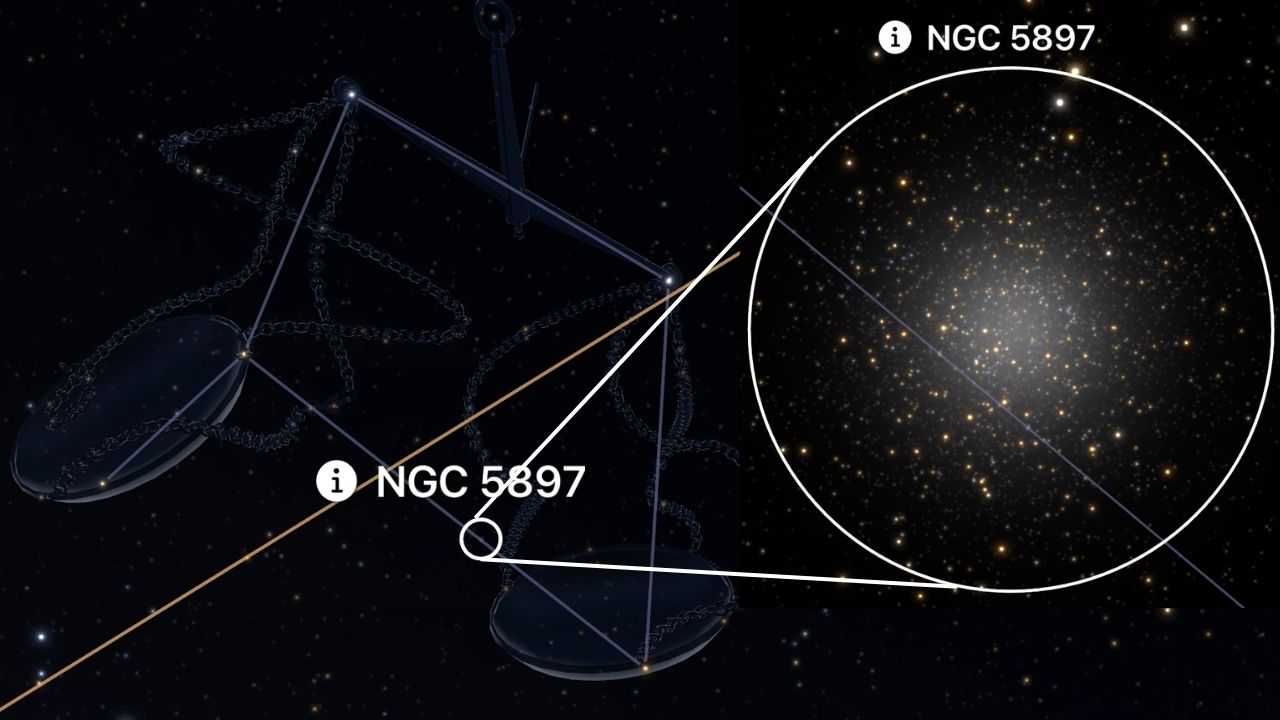
Libra is best seen in June in the Northern Hemisphere, when it reaches its highest point around 9 PM. In the Southern Hemisphere, the best window is November through December.
✦ ✦ ✦
Libra is the only zodiac constellation that is not a living being. No hero, no monster, no animal. Just an object. The scale a goddess dropped when she decided she had finally had enough of us.
And yet, three different civilizations looked at that same corner of the sky and projected onto it their deepest questions: Can justice survive human nature? What happens to your soul when you die? What lurks in the depths we cannot see? None of them found the same answer. All three were right in their own way.
Within those understated, first-magnitude-free stars there is a planetary system that may harbor life, a star that may have dimmed without anyone noticing, and a globular cluster whose light set out on its journey when humans were crossing the Bering Strait for the first time. Libra does not boast. It simply holds all of that in silence, waiting for someone to take the time to look.
If you want to keep looking, ASTRONOMIKA TV has more stories like this one. Long-form videos on YouTube where the universe has room to breathe, images on Instagram that speak for themselves, and bite-sized cosmos on TikTok when the whole thing fits in under a minute.
Frequently asked questions about the Libra constellation
Why is Libra the only zodiac constellation without a living figure?
Because it was never an independent constellation to begin with. The Greeks called these stars Chelae, the claws of Scorpius, and never considered them a figure on their own. It was the Romans who separated this region of the sky around 100 BC and associated it with the scales of Justitia. Without a Greek mythological figure of its own, it became the only inanimate object in the zodiac.
What do the names of Libra’s stars mean?
Zubenelgenubi means “the southern claw of the scorpion” in Arabic, and Zubeneschamali means “the northern claw.” Both names are a linguistic fossil from when these stars belonged to Scorpius, before the Romans carved out this region of the sky to create Libra.
What is Gliese 581 and why does it matter?
Gliese 581 is a red dwarf star 20.5 light-years away in the constellation Libra. It matters because its planetary system was the first to contain a confirmed planet within the habitable zone of another star, the region where liquid water can exist. For years it was the most promising candidate in the search for extraterrestrial life.
Does Gliese 581g actually exist?
That is one of the most interesting open questions in recent astrobiology. It was announced in 2010 as the most Earth-like planet ever found. A 2014 study dismissed it as an artifact of stellar activity. A 2024 analysis challenged that dismissal. As of today, its existence remains unconfirmed.
Can you see Libra with the naked eye?
Yes, though it is one of the most understated constellations in the zodiac. Its brightest stars, Zubeneschamali and Zubenelgenubi, have magnitudes of 2.6 and 2.7. They are visible from areas with low light pollution. The best time to observe Libra is June in the Northern Hemisphere and November through December in the Southern Hemisphere.
What is Zubenelgenubi and why is it special?
It is the alpha star of Libra, 75 light-years away, and a double star system separable to the naked eye under good conditions. Through binoculars you can clearly distinguish two components: a blue-white primary at magnitude 2.7 and a fainter companion at magnitude 5.2. Very few objects in the night sky let you confirm with binoculars something your unaided eye already suspects.
Is Zubeneschamali really green?
That is Libra’s greatest visual mystery. Observers throughout history have reported a greenish tint in this star. Stellar physics has no consensus explanation, because stars technically cannot be green. Whether what you see is real or an optical illusion is a question modern astronomy has not yet closed.
What is NGC 5897?
It is a globular cluster in Libra, informally nicknamed the Ghost Globular for its diffuse, low-concentration appearance. It has magnitude 8.5 and sits roughly 40,000 light-years away. It is visible through mid-aperture binoculars from dark skies, though it will not reveal fine detail. The light reaching your eyes left that cluster when the first modern humans were crossing from Asia into the Americas.
What is the Egyptian myth associated with Libra?
The Egyptians associated this region of the sky with the scales of Anubis, the jackal-headed god of the underworld. In the judgment of Osiris, the heart of the deceased was weighed against the feather of Maat, goddess of truth. If the heart was heavier, the creature Ammit devoured it and the soul ceased to exist forever. There was no second chance.
What did the Maya see in the region of Libra?
They saw Xoc, the sacred shark of the Maya aquatic underworld. The figure appears in the Paris Codex, one of the few surviving Maya manuscripts, in the region of the sky that corresponds roughly to Libra. Ah Xoc was a deity of the depths associated with dark deals, the marine underworld, and death. The English word “shark” derives directly from the Maya word “xoc.”
Sources and recommended reading
Books
Allen, R. H. (1899). Star Names: Their Lore and Meaning. Dover Publications.
The classic reference on the etymology of Arabic, Greek, and Latin star names. Covers the origin of Zubenelgenubi and Zubeneschamali and the astronomical history of Libra in detail.
Schele, L. & Freidel, D. (1993). Maya Cosmos: Three Thousand Years on the Shaman’s Path. William Morrow.
The academic reference for understanding Maya cosmology, the zodiac of the Paris Codex, and the figure of Xoc as a constellation. The foundation of Linda Schele’s work on Classic Maya astronomy.
Digital sources
European Southern Observatory (2007). First Earth-like Planet in Habitable Zone. ESO Press Release eso0722.
https://www.eso.org/public/news/eso0722/
Official announcement of the discovery of Gliese 581c by Stéphane Udry’s team. The primary source for the finding that turned Libra into the most discussed constellation in modern astrobiology.
NASA Exoplanet Archive.
https://exoplanetarchive.ipac.caltech.edu
Updated database of all confirmed exoplanets and candidates in the Gliese 581 system. The live reference for following the ongoing debate over the existence of Gliese 581g.