
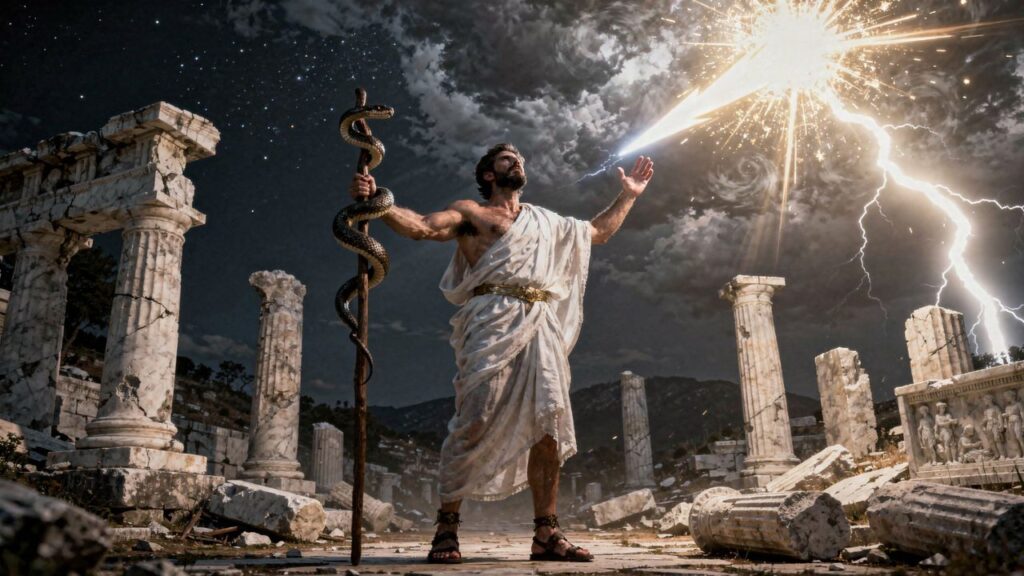
Ophiuchus constellation is the only zodiacal constellation that never appears in any horoscope, and the reason is over 2,500 years old.
Credit: ASTRONOMIKA TV / Flux 2 Pro
The healer Zeus killed for knowing too much
And how the Babylonians erased him from the zodiac 2,500 years ago. What Egypt and the real sky say about the sign you were never given.
By Juan Pablo Martín | ASTRONOMIKA TV | May 2026
There is a constellation the Sun visits every year between November 30 and December 18. A constellation so large it takes up more sky than its neighbor Scorpius. A constellation the Greeks, Egyptians, and Babylonians all knew perfectly well. And yet if you look up your horoscope this week, you won’t find it anywhere.
Someone removed it from the zodiac. On purpose.
The story of Ophiuchus, the Serpent Bearer, is at once the story of a healer so gifted that the gods killed him out of fear, the story of a real human being who earned his place among the stars without anyone handing it to him, and the story of a mathematical crime committed in Mesopotamia two and a half millennia ago that nobody has ever been held accountable for.
Spoiler: if you were born between November 30 and December 18, that sign you’ve never heard of is yours.
✦ ✦ ✦
The healer who learned the secret of life from a dead snake
Before hospitals, pharmacies, and medical degrees existed, there was Asclepius. And the story of how he became the most powerful healer in the universe reads like the script of an Olympian soap opera.
Asclepius was the son of Apollo, god of the Sun, music, and medicine, widely regarded as the most handsome deity on Olympus and quite possibly the worst choice anyone could make as a romantic partner. His mother, Coronis, was a mortal princess from Thessaly in northern Greece, daughter of Phlegyas, king of the Lapiths: the kind of ruler who governs with the temperament of someone who hasn’t slept well in far too many years, violent, unpredictable, with a reputation for impiety that preceded him everywhere. His daughter, however, was known throughout the region for a beauty that classical sources describe as unmatched in all of Thessaly.
Apollo saw her on the shores of Lake Boebeis. And decided she was his.

Credit: ASTRONOMIKA TV / Flux 2 Pro
There was no courtship, no declaration. Apollo was a god with things to do, empires to illuminate. He arrived, seduced Coronis in her own home, and left, because gods keep a very busy schedule. What he did not bother to find out before leaving was whether Coronis had any opinion on the matter. It turned out she did, and it was fairly clear: she did not love him.
The myth contains no record of Coronis pining for Apollo’s return. No poetry of longing, no anxious waiting by the lake. What it does record is what she did while the god was away. Coronis, already pregnant with Apollo’s child, met Ischys, a mortal, son of Elatus, prince of Arcadia. And fell in love with him. Some versions of the myth say they even married.
Here is the detail that turns this from a simple jealousy story into something far more twisted: Apollo, god of prophecy, the one who sees and knows everything, did not find out through his own divine awareness. He found out through the crow.
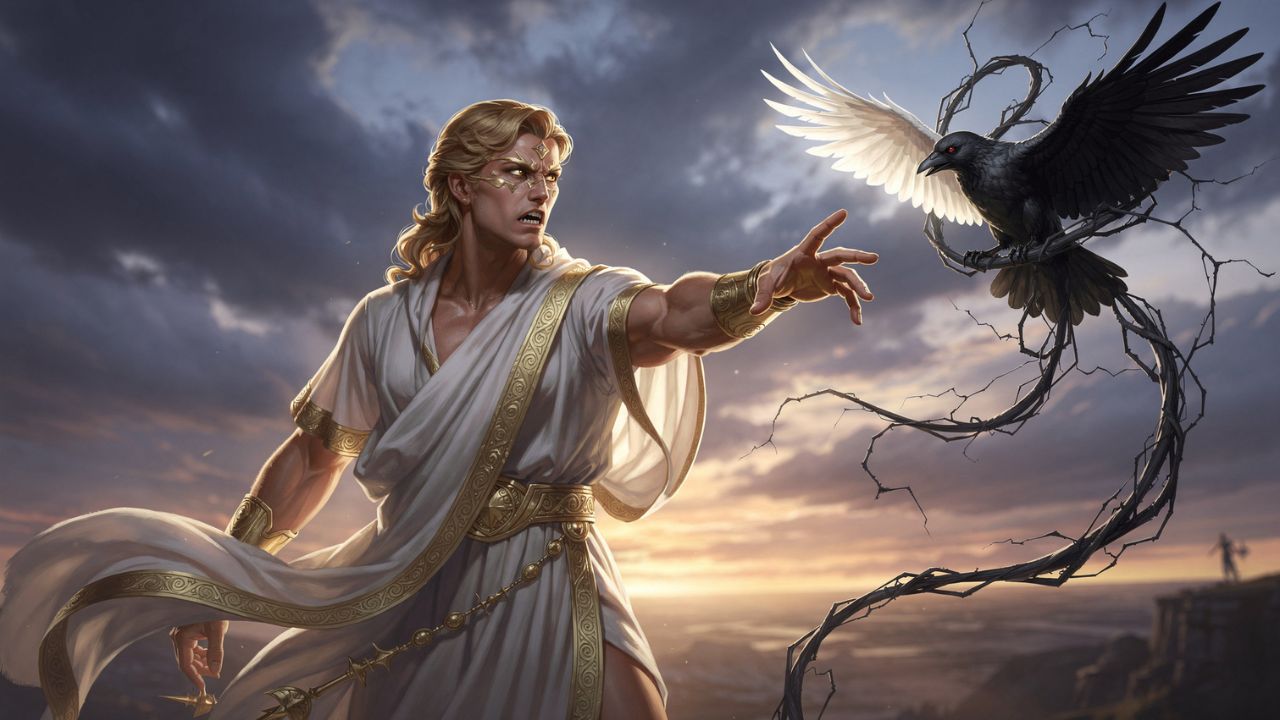
Before leaving, Apollo had stationed a snow-white crow to keep watch over Coronis. The crow was his messenger, his spy, his feathered security system. When it saw what was happening, it flew straight to Apollo and reported everything, with full detail and what was probably considerable enthusiasm for the role of informant.
Credit: ASTRONOMIKA TV / Flux 2 Pro
Apollo heard the crow’s report. And instead of being grateful for the information, he cursed the bird so furiously that its feathers scorched from white to black on the spot. The divine logic was airtight: if the crow had been watching Ischys approach Coronis and hadn’t immediately gouged his eyes out, it did not deserve to keep its original color. All crows have been black ever since. That is, literally, the explanation the myth provides.
Then came the punishment for the actual guilty parties. Apollo went personally to kill Ischys with his own hands. Then he asked his sister Artemis, goddess of the hunt, to deal with Coronis. Artemis released her arrows with characteristic precision, and did not stop at Coronis: she leveled half the village.
And here comes the moment that defines the entire myth, the one that makes this story something far more twisted than a straightforward revenge narrative.
Coronis’s body was placed on the funeral pyre. The flames began to rise. And it was exactly then, only then, that Apollo felt something gods experienced far less often than they should: regret. Not before ordering the killing. Not while the arrows were flying. Only when the fire was already burning.
According to Ovid in the Metamorphoses, Apollo approached the pyre at the last possible second and pulled the infant from Coronis’s womb before the flames could reach it. An improvised caesarean at the edge of a funeral fire. That is how Asclepius was born: cut from his dead mother’s womb, with the smoke of the pyre still in the air.

Credit: ASTRONOMIKA TV / Flux 2 Pro
Apollo did not raise the child himself. He had his own affairs to attend to. He brought the infant to Mount Pelion, into the care of Chiron, the wisest of the centaurs, tutor of heroes, physician of gods. If Hogwarts had one professor worth having, it would be Chiron. Under his guidance, Asclepius learned everything there was to know about medicinal plants, anatomy, surgery, poisons, and their antidotes. He was so gifted that at some point Chiron simply ran out of things to teach him.
But the moment that changed Asclepius’s destiny was one nobody planned.
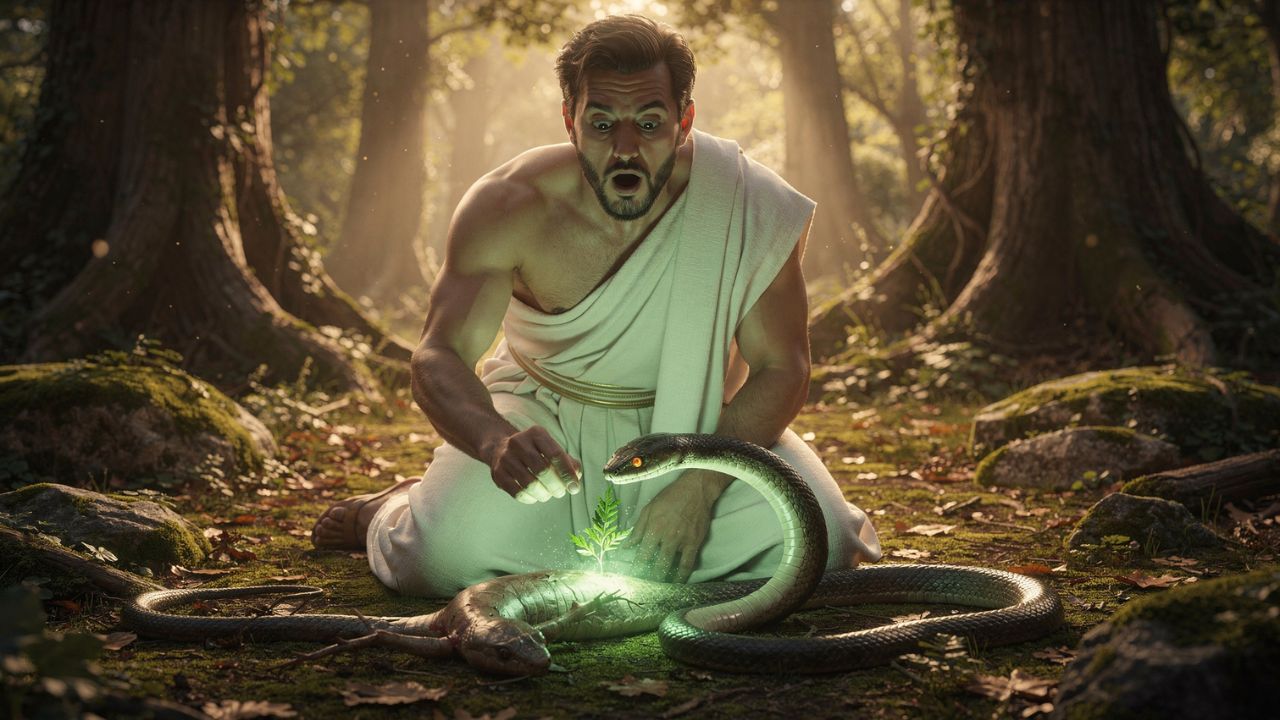
One day, while working, a serpent coiled itself around his staff. Asclepius killed it. Then a second serpent appeared, carrying in its mouth an herb he had never seen before. It placed the herb on the body of the dead snake. And the dead snake came back to life.
Asclepius memorized that herb. And learned to use it.
Credit: ASTRONOMIKA TV / Flux 2 Pro
From there the stories multiply. That Athena gave him two vials of Gorgon Medusa’s blood: one to kill, one to resurrect. That he used the right vial to bring back Hippolytus, son of Theseus, killed in a chariot accident. That he went so far as to charge for his resurrection services, turning the most sacred gift in the universe into a business with a price tag.
That last detail was what signed his death warrant.
Hades, king of the underworld, had been running the numbers and they were not adding up. The souls that were supposed to arrive in his realm had stopped coming. He went directly to Zeus with a formal complaint: the count of the dead was falling steadily, and the authority of the underworld was being undermined. If it continued, the order of the universe would collapse.
But Hades was not the only one with reasons to act. Zeus had his own, darker and more personal. The Olympian gods lived off mortal worship: temples, sacrifices, offerings, prayers. That entire system rested on one foundational principle: humans die and gods do not. That gap was the basis of all divine power. If Asclepius kept raising the dead, if humans could defeat death as casually as taking medicine for a fever, the line between mortals and immortals would dissolve. And a human who does not fear death is a human who does not need to pray.
Zeus did not act out of anger. He acted out of politics.
One thunderbolt. Straight to Asclepius’s chest. No trial, no warning, no second chance. The historian Diodorus Siculus recorded it with near-administrative coldness: “Zeus, indignant, killed Asclepius with his thunderbolt.”
Apollo found out what had happened to his son and reacted the way Apollo reacts when something genuinely matters to him: with indirect violence. He could not attack Zeus, who was his father and the most powerful god on Olympus. But he could kill the Cyclopes who had forged that thunderbolt. And he did. Zeus, furious at the insubordination, sentenced him to a year of servitude as a shepherd in the service of a mortal king. The god of the Sun, herding sheep in Thessaly as penance.
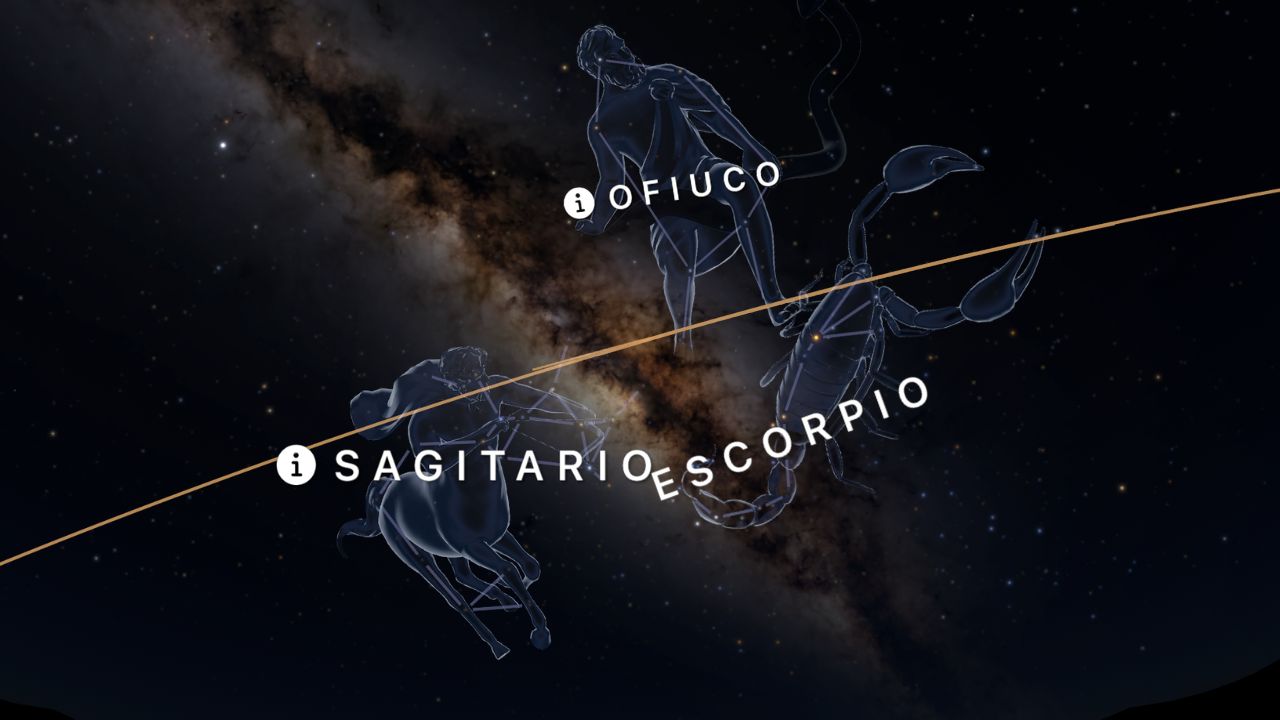
In the end, Zeus yielded to Apollo’s persistent demands. Asclepius was lifted to the sky and made a constellation. There stands Ophiuchus, the Serpent Bearer, treading on the head of Scorpius, with the serpent coiled in his arms, facing south from the celestial equator.
The most brutal irony of the whole story is this: the symbol that today decorates clinics, ambulances, medical uniforms, and prescriptions around the world, the staff with the coiled serpent we know as the symbol of medicine, comes directly from the moment a snake taught a demigod the secret of life. Every time you walk into a pharmacy and see that symbol, you are looking at Asclepius. You are looking at Ophiuchus.
Zeus killed the best healer who had ever existed because his talent was too great and because the mortality business could not afford the competition. Then he immortalized him in the sky so Apollo would not completely hold it against him. That is Olympian politics for you.
There is another version of the myth, less well known but equally dramatic, that identifies Ophiuchus with Laocoon, the Trojan priest who warned his people about the Trojan Horse. The gods, who had other plans for Troy, sent two sea serpents to silence him. The famous Laocoön sculpture in the Vatican Museums, the same one that inspired generations of Renaissance artists, shows exactly that moment. The astronomer Johannes Kepler argued that this was the correct version. The resemblance between the sculpture and celestial maps of Ophiuchus is striking enough to be hard to dismiss. But Asclepius wins. The healer always wins.
✦ ✦ ✦
Two civilizations, one corner of the sky, and the crime nobody investigated
The Greeks were not the only ones to look at that corner of the sky and see a man holding a serpent. Two thousand years before Ptolemy catalogued Ophiuchus in his list of 48 constellations, on the other side of the Mediterranean, someone already existed who fit that figure perfectly. Not a demigod of dubious parentage. Not the illegitimate son of a god with a busy agenda. A real man, with a documented name, with works you can still visit today, and with a story that makes Asclepius’s look like a premium version with too many inherited advantages.
Credit: Sky Guide App
Egypt: the man who earned eternity without anyone giving it to him
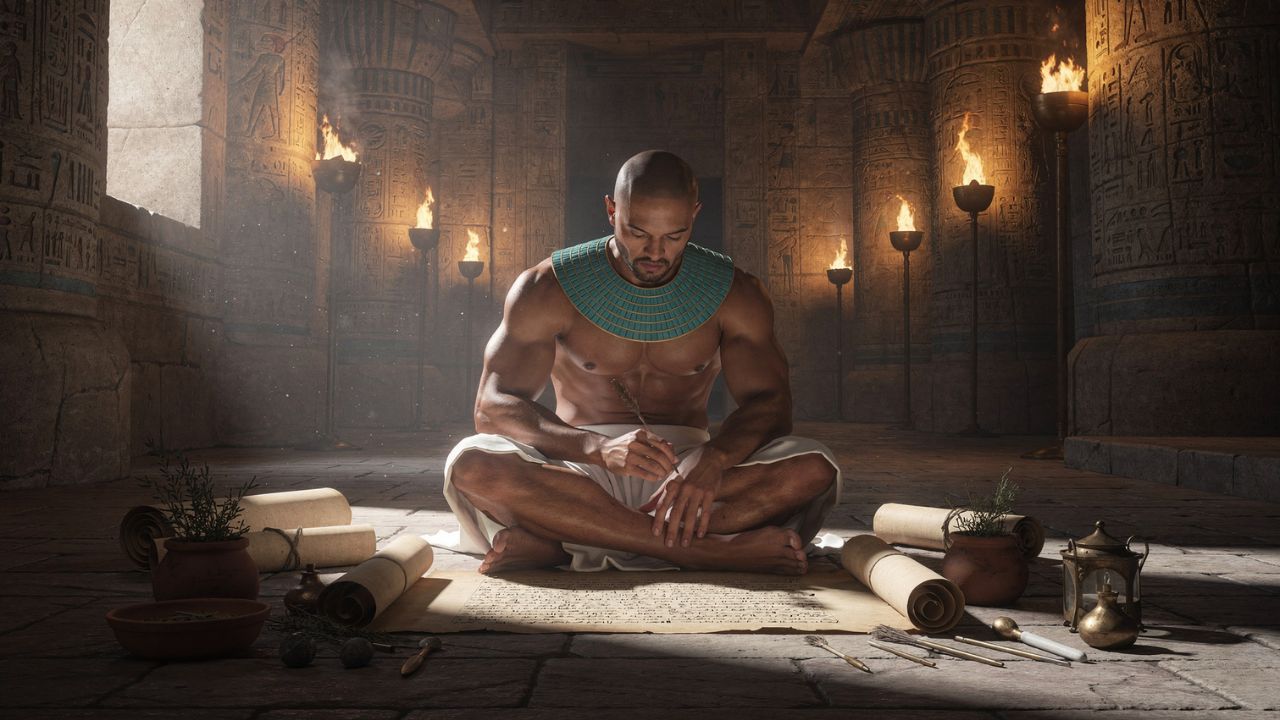
Around 2650 BC, in Memphis, capital of the Old Kingdom of Egypt, there lived a man who accumulated more titles in a single lifetime than most Greek gods managed across their entire mythological existence. Imhotep was chief architect to Pharaoh Djoser, vizier of the crown, high priest of Ra at Heliopolis, astronomer, poet, and above all else, a physician.
He is the architect who designed the Step Pyramid of Saqqara, the first monumental stone building in human history. You can go see it today. It is still standing.
Credit: ASTRONOMIKA TV / Flux 2 Pro
But what makes Imhotep the perfect mirror of Asclepius is not the pyramid. It is the papyrus. The medical documents attributed to his school, including the Edwin Smith Papyrus, one of the oldest scientific texts in existence, describe surgical procedures, clinical diagnoses, and treatments that are systematic, rational, and completely free of magic. Forty-eight documented clinical cases with a methodology any modern physician would recognize: symptom, examination, diagnosis, prognosis, treatment. In 2600 BC.
When the Greeks arrived in Egypt centuries later, they were stunned. The resemblance to their own Asclepius was so obvious they simply merged the two. For the Greeks, Imhotep was Asclepius. They called their god of medicine by the same name as the Egyptian sage, placed him in the same temples, and adopted the serpent-coiled staff as a shared symbol.
But the contrast between the two runs so deep it deserves a moment. Asclepius was born a demigod through an accident of divine paternity, educated by the wisest centaur in the world, given Gorgon blood with supernatural powers by Athena, and still Zeus struck him down at the height of his career. His is the story of someone the universe gave everything to and then took it all away out of fear.
Imhotep was born mortal. No divine blood, no centaur tutors, no magical vials. He reached the peak of Egyptian power through pure merit, documented in stone and papyrus. And when he died, the world did not strike him down. It waited for him.
Two thousand years after his death, the Egyptians deified him. Not as a political favor or a post-mortem gesture of guilt, the way Zeus handled Asclepius. They deified him because the generations that came after him were still curing diseases with his methods, still building with his principles, still finding in his writings answers that had not aged. The Egyptian people, without anyone ordering it, began leaving offerings at his tomb, asking him to intercede for the sick, treating him as a god. It took two thousand years. But they did it on their own.
The line runs directly from Imhotep to Asclepius to the pharmacy sign you pass every day without thinking twice.
The perfect crime: how the Babylonians erased Ophiuchus from the zodiac and never answered for it
Credit: ASTRONOMIKA TV / Flux 2 Pro
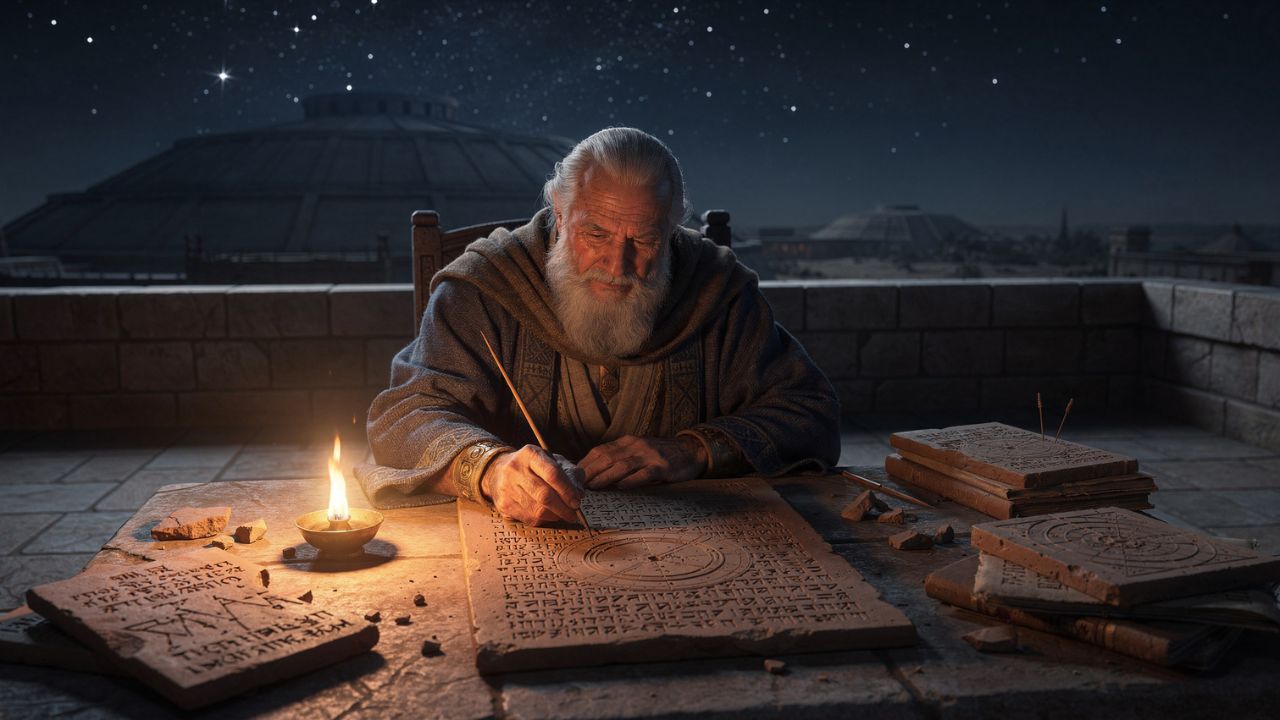
There is a moment in the history of astronomy when someone, sitting in front of a clay tablet in Mesopotamia, looked at the sky, counted the constellations the Sun crossed over the course of the year, arrived at thirteen, and decided that number would not do.
Twelve was better. Twelve months in the year. Twelve principal gods in the pantheon. Twelve as a sacred, orderly, divisible number. Thirteen was awkward, asymmetrical, impossible to divide into equal thirty-degree portions.
So someone had to go.
The Babylonians had been observing the sky with a precision that still impresses modern astronomers. Their most important star catalog, the MUL.APIN, compiled around 1000 BC, recorded between seventeen and eighteen constellations along the Sun’s path. Ophiuchus was there. The Sun passed through it. It was an astronomical fact.
But around the fifth century BC, Babylonian astronomers carried out the reform that would change astrology forever: they standardized the zodiac into twelve signs of exactly thirty degrees each, aligned to the twelve months of their administrative calendar. To make the numbers work, Ophiuchus was removed.
Not because the Sun stopped passing through it. It kept passing through it, and still does today. The Sun enters Ophiuchus around November 30 and exits on December 18, eighteen full days of transit. Its neighbor Scorpius, which stayed in the zodiac, receives the Sun for only seven days a year. Less than half. And yet Scorpius is in every horoscope on the planet and Ophiuchus appears in none.
The official reason is mathematical: Ophiuchus broke the symmetry of the twelve-sign system. But there is an answer that makes sense when you look at the zodiac for what it was: a system designed to work with animals and recognizable symbols. The Bull. The Scorpion. The Lion. The Crab. The Scales. Simple, iconic figures, easy to carve on a tablet or paint on a temple ceiling. Ophiuchus is a man holding a serpent. A complex human figure, too large to fit cleanly into thirty degrees, with a troublesome neighbor whose head he was literally stepping on in every celestial map.
If you were born between November 30 and December 18, the real sky, the one you can verify with any astronomy app tonight by pointing your phone upward, says you are Ophiuchus. Not Sagittarius. The Sun was in front of Ophiuchus at the exact moment you were born. It always was. The Babylonians simply decided that did not count.
Historians say it was pure mathematics. No malice involved. Simply the most logical decision given the system they were trying to build.
Maybe the question is not why they erased Ophiuchus. The question is how many other things we accept as absolute truths are, at their core, decisions someone made a very long time ago because the numbers did not add up.
✦ ✦ ✦
The star that moves, the day the sky exploded, and the treasure of seven ancient star spheres
Some constellations are beautiful. Some have great stories. And some, when you scratch the surface, hide objects so extreme they make you reconsider what the word “far” actually means. Ophiuchus is that third kind.
In the northeastern part of the constellation, in an area of sky with nothing spectacular to mark it, there is a point of light at magnitude 9.5. Too faint to see with the naked eye. Too unassuming for anyone to pay attention to for centuries. But that point of light does something no other known star in the sky does.
It moves. And it can be measured.
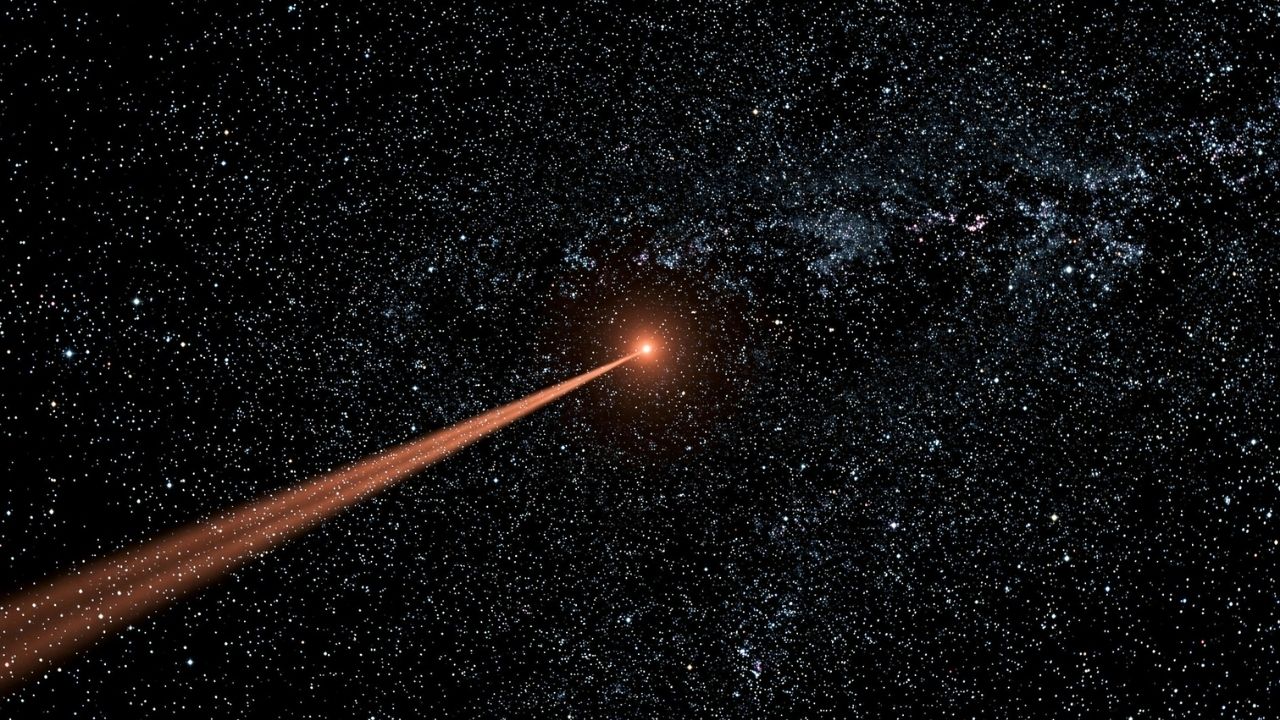
Barnard’s Star, discovered by American astronomer Edward Emerson Barnard in 1916 by comparing photographic plates taken 22 years apart, has the greatest known proper motion of any star: 10.3 arcseconds per year. That number means nothing on its own, so here are the analogies that actually make it land.
Over a human lifetime of 75 years, Barnard’s Star moves across the sky approximately a quarter of a degree, roughly half the apparent diameter of a full Moon. Nothing remarkable, you might think. Now run the calculation in reverse.
Hernán Cortés arrived in Mexico in 1519. That was just over 500 years ago. In that time, Barnard’s Star has moved approximately 1.4 degrees across the sky. If you placed two images of the same patch of sky, one from 1519 and one from today, side by side on a screen, Barnard’s Star would be in a clearly different position in each. Three full Moon diameters apart. Any amateur astronomer would notice immediately. Not one other star in the sky would do that.
And here is the contrast that makes the number truly staggering: most stars visible to the naked eye have proper motions between 0.001 and 0.1 arcseconds per year. Barnard’s Star clocks in at 10.3. It moves between one hundred and ten thousand times faster across the sky than a typical night sky star. If the average star’s motion is a snail crossing a soccer field in a year, Barnard’s Star is a hundred-meter sprinter on the same field.
In the 500 years since the Spanish conquest of Mexico, Barnard’s Star has moved across the sky a distance equal to three full Moon diameters placed end to end. No other visible star has changed position detectably in that same time.
The reason for that apparent speed is twofold. It is very close, just 5.96 light-years away, making it the nearest individual star to the northern hemisphere. And it travels at 143 kilometers per second relative to the Sun, not following the general flow of stars in our galaxy. It is passing through our cosmic neighborhood and has no plans to stay: in about 9,800 years it will come even closer, to within 3.75 light-years of the Sun, and then continue on its way forever. In 2024, astronomers confirmed it has planets. Small, rocky, too close to their star to be habitable as we know it. But they are there.
Credit: ASTRONOMIKA TV / Flux 2 Pro
On October 9, 1604, an Italian astronomer named Lodovico delle Colombe was observing the sky from Florence, watching a spectacular conjunction of Mars, Jupiter, and Saturn. It was precisely because so many eyes were already on that corner of the sky that nobody could ignore what suddenly appeared next to the three planets: a new star. Bright. In a place where the night before there had been nothing.
Kepler, working in Prague as Imperial Astronomer, could not see it until October 17 due to bad weather. But once he did, he would not let it go. He observed it for more than a year and published his findings in 1606 in a book whose title says everything: De Stella Nova in Pede Serpentarii, “On the New Star in the Foot of the Serpent Bearer.”
What Kepler could not know was exactly what he had seen. Today we do: a Type Ia supernova, the most violent kind of stellar explosion known. Not a star that simply dies. A white dwarf that has spent billions of years stealing mass from a companion star, accumulating gas without limit, until it exceeds the physical threshold beyond which matter cannot contain itself. The ignition is instantaneous and total. The explosion releases in seconds more energy than the Sun will emit over its entire ten-billion-year lifespan.
At its peak, Kepler’s Supernova reached magnitude -2.5, brighter than Jupiter. It was visible in daylight. For more than three weeks, anyone in Europe, China, Korea, or the Arabian Peninsula who looked south during daylight hours could see a star that should not have been there.
And Galileo Galilei, then teaching mathematics at the University of Padua, had a moment of tactical clarity that would change the history of science. The official doctrine of Aristotle, in force at every European university in the seventeenth century, held that the heavens beyond the Moon were perfect, eternal, and immutable. A new star appearing from nowhere was a crack in that doctrine. Galileo measured it, calculated it was far beyond the Moon, and used that argument in his lectures to begin dismantling the Aristotelian edifice. Five years after Kepler’s Supernova faded from the sky, Galileo pointed his telescope at Jupiter and found four moons orbiting it. Aristotelianism did not survive that year.
Kepler’s Supernova outshone Jupiter and was visible in daylight for three weeks. It was observed simultaneously in Europe, China, Korea, and Arabia in 1604, five years before the telescope existed. We have been waiting more than 420 years for the next one in our galaxy.
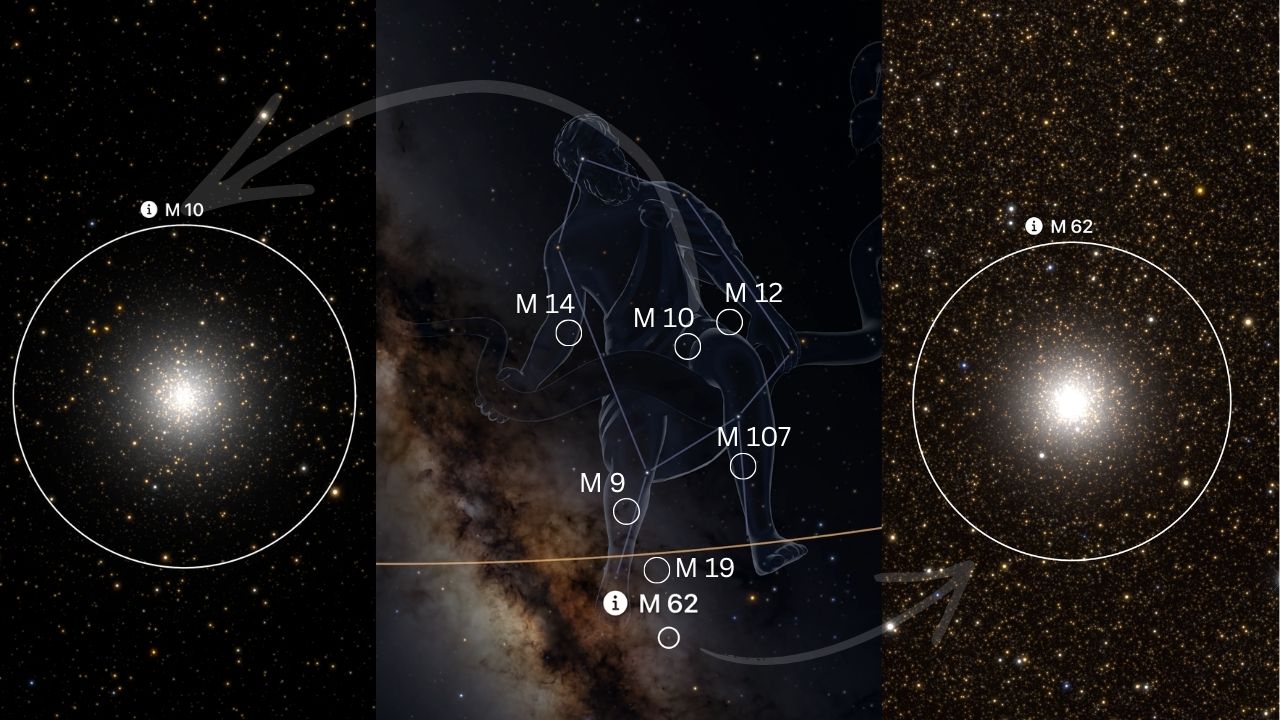
If Barnard’s Star and Kepler’s Supernova are the most fascinating individual objects in Ophiuchus, the constellation’s collective treasure is its seven Messier globular clusters. M9, M10, M12, M14, M19, M62, and M107, all catalogued by Charles Messier in the second half of the eighteenth century, all visible through modest telescopes, all with radically different stories.
The reason for that concentration is not geographical coincidence. Ophiuchus points directly toward the center of the Milky Way, the densest region of our galaxy where most globular clusters orbit. When you look toward Ophiuchus on a dark July night, you are looking toward the galactic heart.
Credit: Sky Guide App / ASTRONOMIKA TV
Of the seven, the most compelling to obsess over is M10, and the reason is not its size or brightness but what is happening inside it.
M10 holds 100,000 stars compressed into a sphere 83 light-years in diameter, roughly 14,300 light-years away. It is 11.4 billion years old. To understand what that means: when M10 formed, Earth did not yet exist. The Sun did not yet exist. The raw material from which the Sun, Earth, and everything living on it would eventually be made had not yet been synthesized in any prior supernova. M10 has been sitting there waiting since before our neighborhood existed.
But the truly strange thing about M10 is not its age. It is that some of its stars look young when they should not. Globular clusters are time capsules: all their stars were born together, from the same gas, at the same time. They should all age at the same rate. But M10 is full of blue stragglers, bright blue stars that appear to be two to five billion years old inside an eleven-billion-year-old cluster. The explanation is that in the dense crush of a globular cluster, stars collide with each other or steal mass from neighbors, and that process rejuvenates them. Science calls them blue stragglers. I would call them the stars that figured out eating your neighbor makes you ten billion years younger. More effective than any cream. Cheaper than Botox. Mildly illegal in most planetary systems with intelligent life.
Three degrees away from M10 in the sky, close enough that both fit in the same binocular field of view, lives M12. Messier discovered it one day after M10 in May 1764, and the contrast between the two is immediate: M10 is dense and concentrated toward the center, M12 is looser, more porous. The reason for that difference is a story of galactic theft in slow motion. Every time M12 passes through the disk of the Milky Way in its orbit, our galaxy’s gravity strips the lowest-mass stars from its outer edges, like pulling leaves off a tree with each pass of the wind. Astronomers estimate M12 has lost a million stars that way. And it has only about four and a half billion years left, roughly the same time Earth has existed, before the process unmakes it completely. It is the only one of Ophiuchus’s seven Messier clusters with a calculated expiration date.
Credit: NASA / ASTRONOMIKA TV
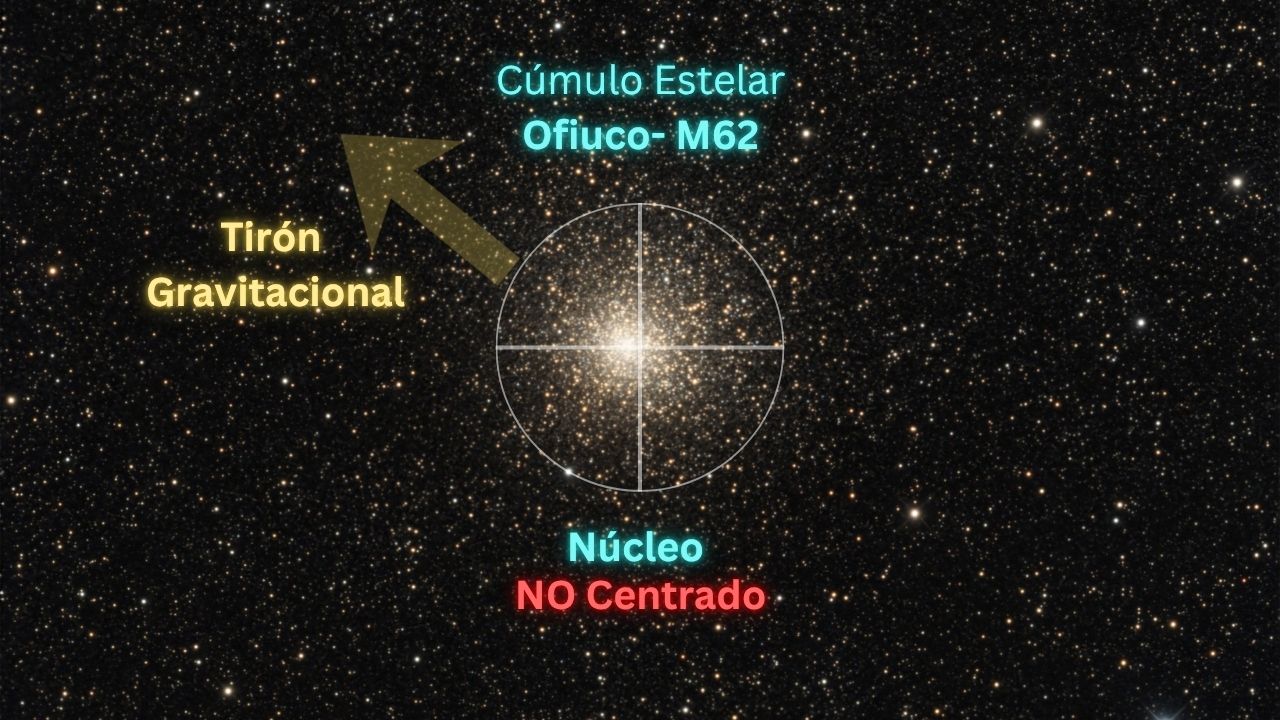
If M10 and M12 are the twins in the quiet neighborhood, M62 is the cousin who insists on living in the most dangerous part of the galaxy. Just 6,100 light-years from the center of the Milky Way, it is one of the closest globular clusters to the galactic nucleus in the entire galaxy. And that proximity has a visible consequence: M62 is deformed.
A normal globular cluster is a near-perfect sphere, with its nucleus exactly at the center and stars distributed symmetrically outward. M62 is not that. Its nucleus is displaced to one side, visibly off the geometric center of the cluster. The reason is physical and brutal: the galactic center has such overwhelming gravity that every time M62 passes close to it in its orbit, tidal forces, the difference in gravitational pull between the side of the cluster closest to the center and the side farthest away, literally stretch and compress the cluster asymmetrically. It is like squeezing an orange from one side only: the interior shifts. Astronomers have even detected stars that M62 sheds as it passes, forming faint tidal tails extending in the direction of the galactic center. M62 is not just an ancient cluster. It is a cluster being slowly torn apart by the most massive thing in our galaxy, and it carries the visible scar to prove it.
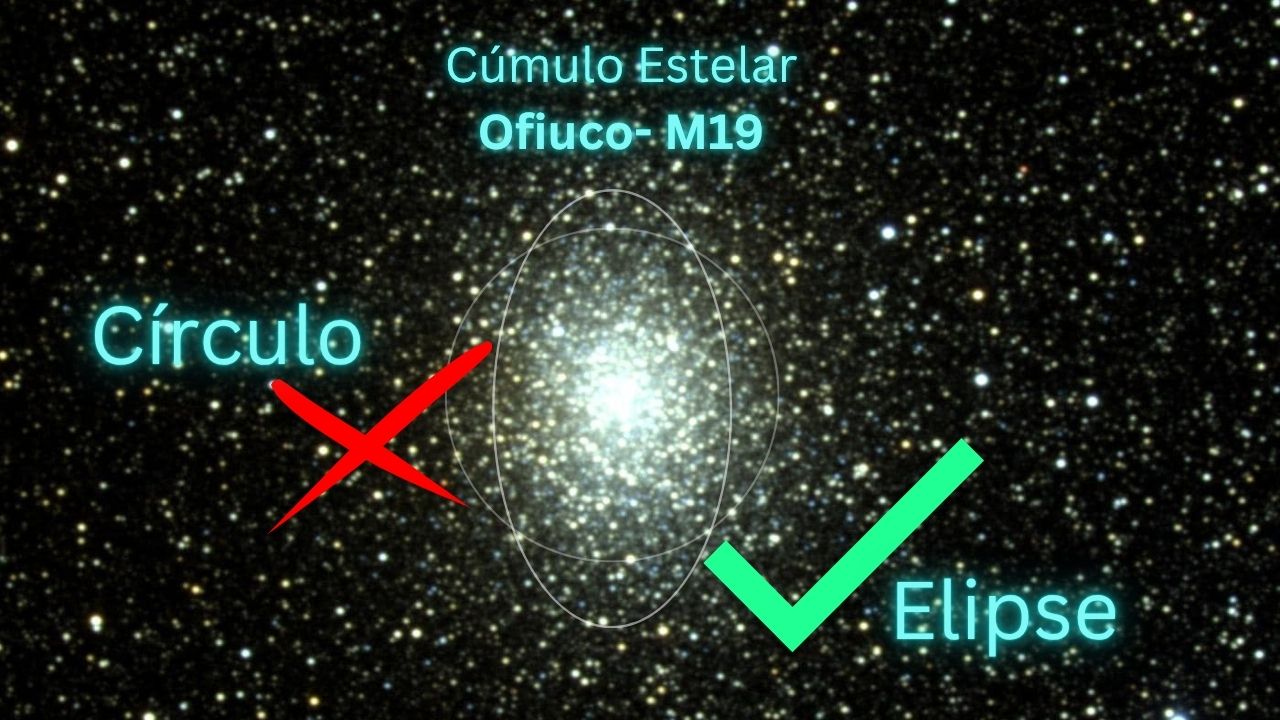
M19, M62’s nearest neighbor in the sky of Ophiuchus, just four degrees away, tells the same story at a lower intensity. It too is deformed by the galactic center’s gravity, flattened along its north-south axis like a sphere someone pressed from above and below. But it lives farther from the nucleus than M62, and that distance spares it a more violent fate. Comparing the two in the same field of view is watching galactic gravity acting at two different intensities on the same kind of object.
Credit: NASA / ASTRONOMIKA TV
With the SkyMaster 15×70 binoculars under a dark sky, away from city light pollution, M10 and M12 begin to resolve as soft patches of light with a clearly condensed core. Both fit in the same field of view, and that direct comparison is one of the most instructive visual experiences the summer sky offers. With the Seestar S50, any of the seven can be photographed within minutes even from the edges of a city, and the automatic processing pulls out details the eye cannot distinguish: the density gradient from the core outward, the difference in concentration between M10 and M12, the colors of individual stars at the cluster edges. For Barnard’s Star, though, you need the NexStar 8SE and a precise reference chart, because there is nothing visually spectacular to set it apart from the thousands of other faint points in the area. What is spectacular about it is not what it looks like but what it does.
Ophiuchus is best viewed in July from the northern hemisphere, when it reaches its highest point in the night sky at midnight. From the southern hemisphere, the window runs from May through August, with Ophiuchus riding considerably higher in the sky than from northern latitudes. In both cases, the most important rule has nothing to do with the telescope: getting away from city lights makes more difference than any increase in aperture. For globular clusters especially, sky darkness is the factor that separates a blurry smudge from a resolved sphere of ancient stars.
✦ ✦ ✦
Ophiuchus is, in many ways, the most honest constellation in the sky. It makes no pretense of being something it is not. It is there, enormous, crossing the celestial equator, stepping on the head of Scorpius, with a serpent in its arms and seven ancient globular clusters at its back. The Sun visits it every December without fail. And the horoscope still does not mention it.
The healer Zeus killed for knowing too much, the real human being the Egyptians took two thousand years to recognize, the sign the Babylonians sacrificed so the numbers would add up, the star that has been moving for five centuries while the rest of the sky pretends to stand still. All of it in the same corner of the sky.
If you want to keep exploring these kinds of stories, the ones that mix mythology, science, and the cosmic gossip nobody taught you in school, find us on YouTube, Instagram, and TikTok as ASTRONOMIKA TV.
Frequently asked questions about Ophiuchus constellation
What is the Ophiuchus constellation?
Ophiuchus is a constellation on the celestial equator representing a man holding a serpent. It is the eleventh largest constellation in the sky, covering 948 square degrees, located between Scorpius and Sagittarius. In astronomy it is considered a zodiacal constellation because the Sun crosses it every year, although it is not part of the traditional twelve-sign astrological zodiac.
Why is Ophiuchus not a zodiac sign?
Because Babylonian astronomers of the fifth century BC standardized the zodiac into twelve equal signs of thirty degrees each to match their twelve-month administrative calendar, and Ophiuchus was left out. The Sun passes through Ophiuchus from November 30 to December 18, eighteen full days, more than through Scorpius, which receives the Sun for only seven days a year and is included in the zodiac.
What are the Ophiuchus zodiac sign dates?
If the zodiac included Ophiuchus, its dates would be approximately November 30 to December 18. People born on those dates are classified as Sagittarius in traditional astrology, but astronomically the Sun was in front of Ophiuchus at the moment of their birth, not Sagittarius.
What mythological figure does Ophiuchus represent?
Ophiuchus primarily represents Asclepius, the Greek god of medicine and son of Apollo. Asclepius was the most powerful healer in Greek mythology, capable of raising the dead. Zeus killed him with a thunderbolt because his abilities threatened the natural order between mortals and immortals, then placed him among the stars. There is also a version of the myth identifying Ophiuchus with Laocoon, the Trojan priest who warned against the Trojan Horse.
Who was Asclepius in Greek mythology?
Asclepius was the Greek demigod of medicine, son of Apollo and the Thessalian princess Coronis. He was born under tragic circumstances: his mother was executed for infidelity while pregnant, and Apollo rescued the infant from her funeral pyre at the last moment. Raised by the centaur Chiron, he mastered the art of raising the dead, prompting Hades to complain to Zeus, who struck him down with a thunderbolt. His serpent-coiled staff is the symbol of medicine to this day.
What deep sky objects does Ophiuchus contain?
Ophiuchus hosts seven Messier globular clusters: M9, M10, M12, M14, M19, M62, and M107. It also contains Barnard’s Star, the one with the greatest known proper motion and the fourth closest star to the Sun. Within its borders lies the remnant of Kepler’s Supernova of 1604, the last stellar explosion visible to the naked eye in our galaxy. You can explore other zodiacal constellations in our article on the Scorpius constellation.
What is Barnard’s Star and why is it special?
Barnard’s Star is a red dwarf in Ophiuchus located 5.96 light-years from the Sun, the fourth closest star to Earth. It has the greatest known proper motion of any star: 10.3 arcseconds per year. In the 500 years since the Spanish conquest of Mexico, it has moved a distance equal to three full Moon diameters placed end to end. No other visible star changes position detectably in that same timeframe.
What was Kepler’s Supernova and why does it matter?
Kepler’s Supernova, formally SN 1604, was a stellar explosion in Ophiuchus first observed on October 9, 1604. At peak brightness it reached magnitude -2.5, brighter than Jupiter, and was visible to the naked eye in daylight for over three weeks. It is the last supernova in our galaxy observed without a telescope. Galileo used it to demolish Aristotelian cosmology. We have been waiting over 420 years for the next comparable one in the Milky Way.
When and from where can you see Ophiuchus?
Ophiuchus is visible between latitudes +80° and -80°, covering virtually all inhabited parts of the world. From the northern hemisphere, the best time is June through August, with July ideal. From the southern hemisphere, excellent visibility runs May through August, with Ophiuchus riding higher in the sky. Dark skies away from light pollution matter more than telescope aperture.
How do you find Ophiuchus in the night sky?
The easiest approach is to find Antares, the bright red heart of Scorpius, and look directly north. Ophiuchus extends above Scorpius like a figure stepping on it. Its brightest star is Rasalhague, magnitude 2.07, forming the head. Apps like Stellarium or Sky Guide show the full figure in real time by pointing your phone at the sky.
Sources and recommended reading
Books
Ridpath, I., & Tirion, W. (2017). Stars and Planets. Princeton University Press.
Field reference for constellations and deep sky objects. Includes verified technical data on Ophiuchus, its principal stars, and the Messier clusters.
Hurry, J. B. (1926). Imhotep: The Vizier and Physician of King Zoser and Afterwards the Egyptian God of Medicine. Oxford University Press.
The academic reference on Imhotep. Documents his historical life, his posthumous deification, and his identification by the Greeks as the original model for Asclepius.
Kepler, J. (1606). De Stella Nova in Pede Serpentarii. Prague.
The primary source on the supernova of 1604. Kepler’s observations over more than a year of follow-up are the most complete scientific record of the event that changed Western astronomy.
Digital sources
NASA Science. (2024). Messier 62. NASA Hubble Space Telescope.
https://science.nasa.gov/mission/hubble/science/explore-the-night-sky/hubble-messier-catalog/messier-62/
Technical and photographic description of M62, including its irregular shape and proximity to the galactic center. Primary source for the tidal deformation data cited in this article.
NASA Chandra X-ray Observatory. (2013). Kepler’s Supernova Remnant. NASA.
https://chandra.harvard.edu/photo/2013/kepler/
X-ray analysis of the 1604 supernova remnant. Explains the physics of Type Ia supernovae and the historical significance of the event for the history of astronomy.