
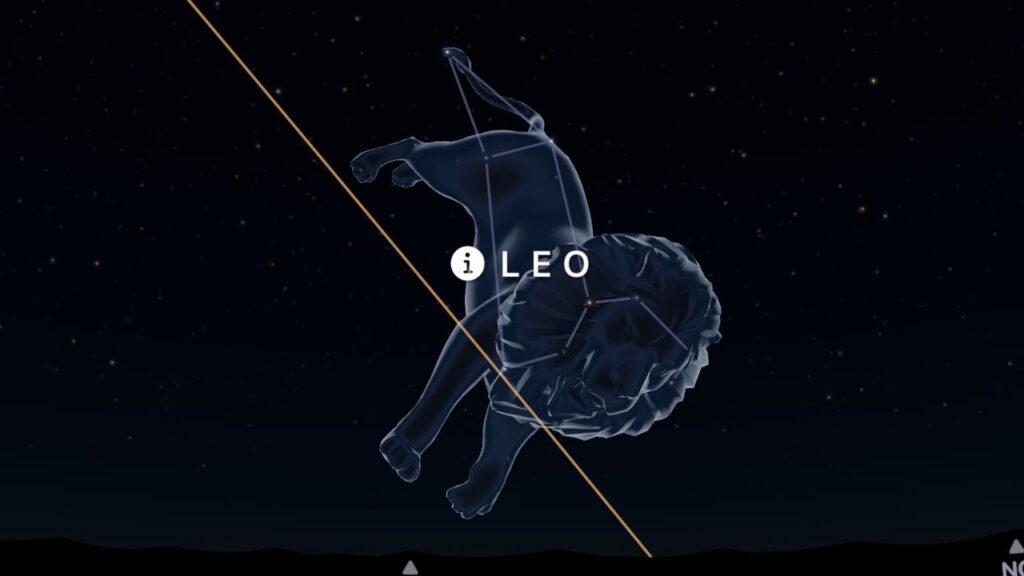
Leo constellation: Hercules, Sekhmet, and the Maya peccary looked at the same sky. They did not see the same thing.
By Juan Pablo Martín | ASTRONOMIKA TV | May 2026
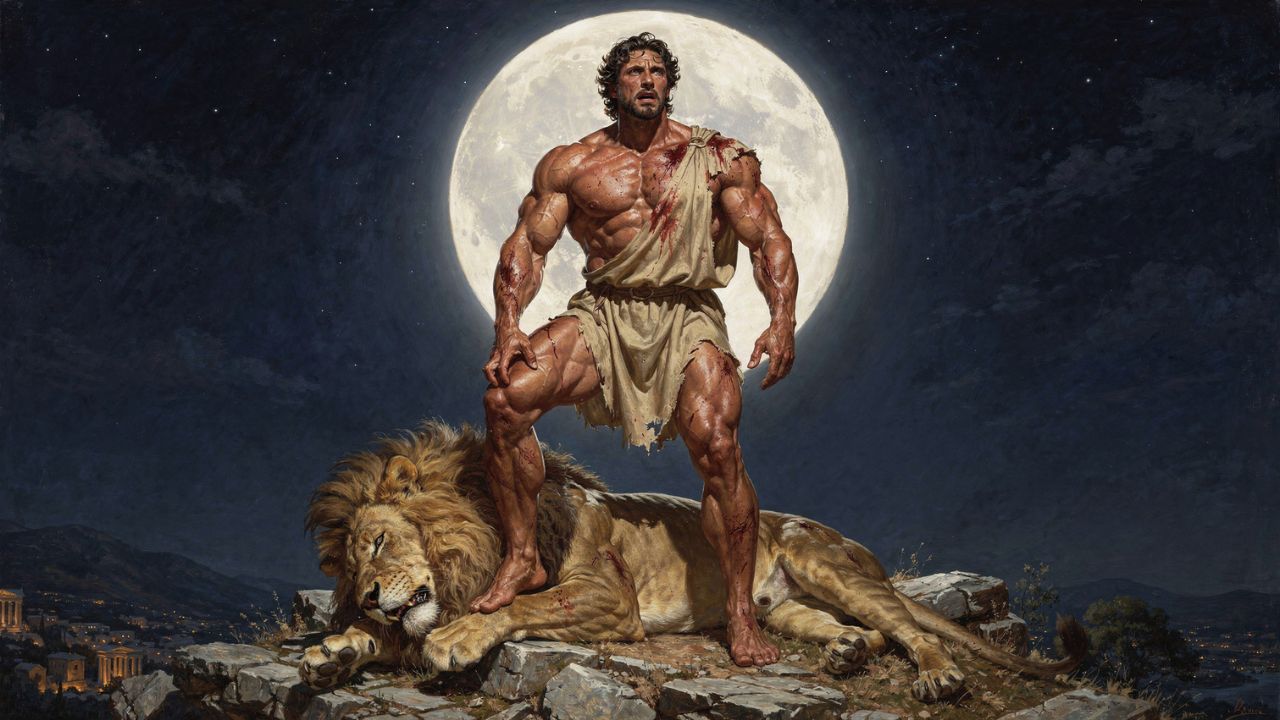
There is a star at the heart of Leo spinning so fast it is on the verge of tearing itself apart. It has been doing this for thousands of years, right above our heads, while we looked up and invented stories about it. Greeks, Egyptians, Mayans, and Chinese watched it shine and each put there what obsessed them most: power, destruction, failure, immortality. This article is about those stories. And about the star that outlasted them all.
✦ ✦ ✦
The Lion that no weapon in the world could kill
To understand the Lion you have to understand who went looking for it. Hercules was the son of Zeus and a mortal woman, which earned him from infancy the eternal hatred of Hera, the god’s wife. That same Hera drove him mad as an adult until he killed his own family without knowing what he was doing. As penance, the oracle at Delphi imposed twelve impossible labors on him. If you want that full story, we tell it in the Hercules constellation article. Here what matters is the first of those labors.
Eurystheus, the mediocre and cowardly cousin who assigned the tasks, did not choose the Nemean Lion by accident. He chose it because it was, in every possible sense, impossible to kill.
The Nemean Lion was the terror of the region of Argolis, in the northeast of the Peloponnese, the great peninsula hanging from the south of mainland Greece. It was no ordinary lion: it was an animal of enormous size whose hide was literally impenetrable to any known weapon. Arrows, spears, swords: everything bounced off. The villagers had stopped trying. The Lion went out, killed what it wanted, and returned to its cave. Nobody could do anything.
And the reason for that impossible hide was its origin.
The Nemean Lion was the offspring of Typhon and Echidna. You need to know who these two were to understand the scale of the problem.
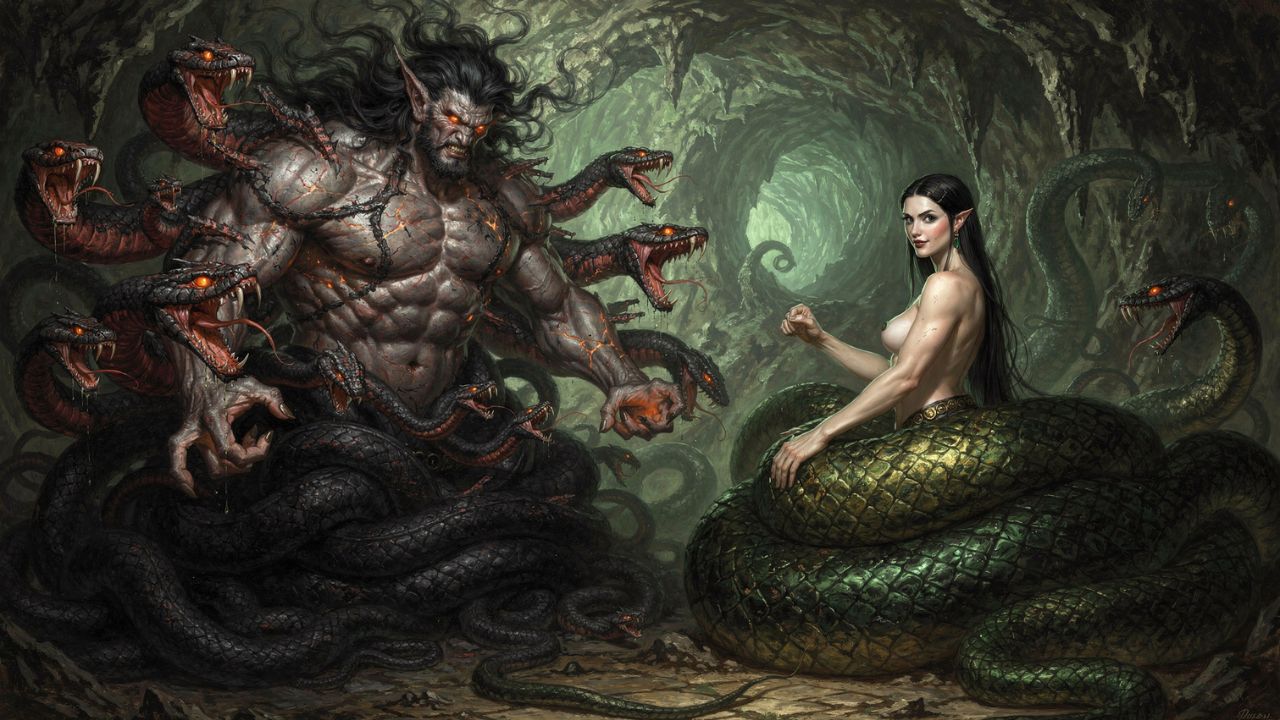
Typhon was the most fearsome being that had ever existed in the Greek universe. Son of Gaia, the Earth itself, and Tartarus, the deepest abyss of the underworld, he was born as a cosmic revenge against the Olympian gods. His body was so enormous that his shoulders touched the stars. He had a hundred serpent heads, each with its own voice, and from his mouths came simultaneously the roar of a lion, the bark of a dog, the hiss of a snake, and a sound that no ancient text could describe well. When he first appeared, the gods of Olympus, including Zeus, fled in terror to Egypt and disguised themselves as animals to hide. The king of the gods needed three attempts to finally defeat Typhon. He buried him under Mount Etna, where according to the Greeks he still is, and earthquakes are his movements.
Echidna was different, but no less terrifying. From the waist up she was a woman of extraordinary beauty: pale skin, black hair, dark eyes. From the waist down she was a colossal serpent. Immortal and indestructible, she lived in a cave at the ends of the world and fed on humans. The gods never killed her. They simply decided not to get involved with her.
How did they meet? The texts offer no elaborate love story, and it makes sense: they were the only two beings in the universe that the other could not frighten. Typhon, before whom Zeus fled, and Echidna, whom the gods preferred to ignore, met at the margins of the known world and recognized each other. Two absolutes that needed no explanation. From that union came, among others, the Lernaean Hydra, Cerberus, the Chimera, the Sphinx, and the Nemean Lion.
So when Hercules arrived at Nemea with his bow, his arrows, and his bronze club, he was not going to hunt an animal. He was going to face the offspring of the two most dangerous beings in the history of the Greek universe.
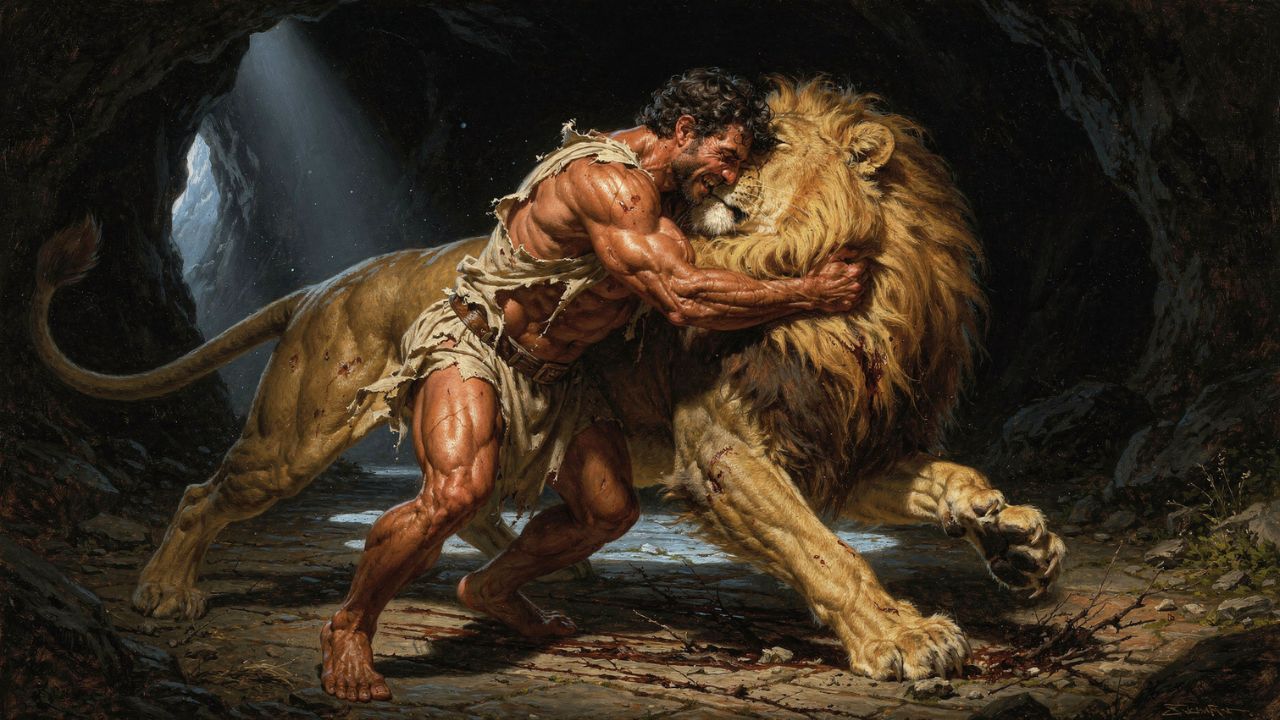
The arrows bounced. The club was useless. Hercules chased the Lion to its cave, blocked one of the entrances with rocks, entered through the one he left open, and in the darkness, with no weapons that would serve him, did the only thing he had left: he grabbed it with his hands. He immobilized it. He strangled it.
The Nemean Lion died with bare hands.
But the problem was not over. Hercules needed the hide as a trophy and no knife could cut it. The solution came from the goddess Athena, who suggested the obvious once you think about it: use the Lion’s own claws. If nothing external can cut that hide, something internal can. Hercules used the animal’s own claws to skin it.
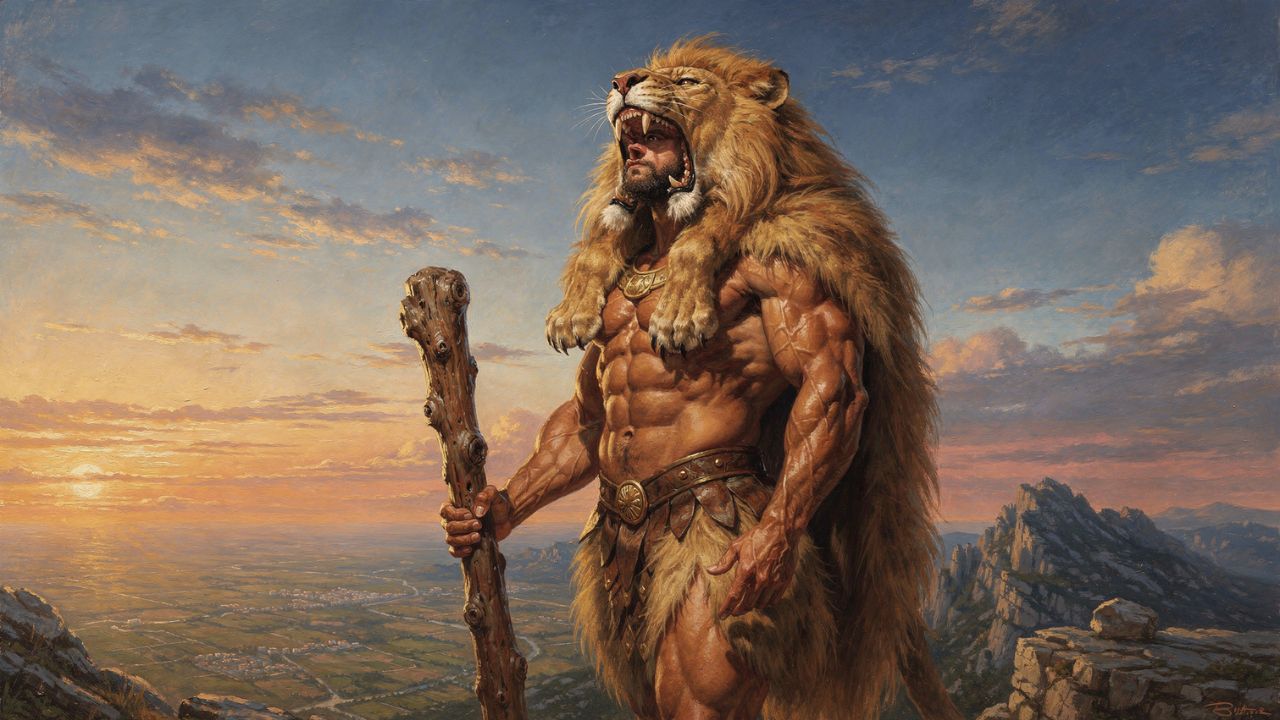
The skin of the Nemean Lion became his armor. The same hide that had made it invincible now protected the man who had killed it. From that day on, Hercules appears in every Greek representation with that skin over his shoulders: a permanent reminder that his first labor was not just killing a monster. It was learning to use the enemy’s own tools.
Eurystheus, when he saw Hercules return with the hide, locked himself in a bronze jar from fright. Eleven labors still lay ahead.
In Greek mythology, the original name is Heracles. Hercules is the Roman version. Both names refer to the same hero; in this article we use Hercules because it is the name most people know.
The same stars that the Greeks placed in the sky to immortalize this story were seen by other cultures that did not know Hercules, did not know Typhon, and had no interest in a Lion. What they saw was completely different.
✦ ✦ ✦
The same sky, different stories
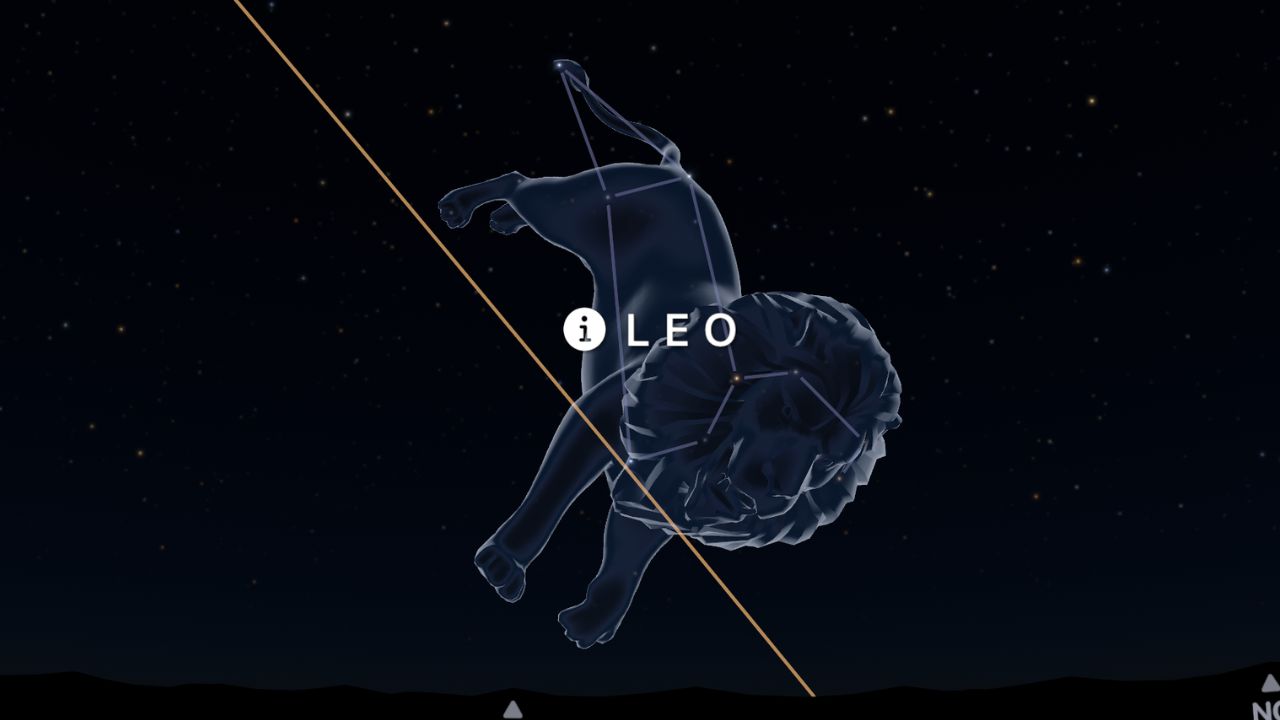
The Greeks were not the only ones to look toward Leo and see something extraordinary. Thousands of kilometers away, not knowing the others existed, other cultures looked at exactly the same stars and saw completely different things. No version is more correct than the others. All of them say something profound about the culture that invented them.
Egypt: the goddess who almost ended humanity (and became the goddess of love)
To understand Sekhmet you first have to understand Ra, because without Ra the story makes no sense.
Ra was the sun god of ancient Egypt, which in a civilization built literally on the rhythm of the sun meant he was the most important god of all. Everything revolved around him: the calendar, agriculture, the legitimacy of the pharaoh, life itself. Ra was not an abstract character; the Egyptians imagined him as an elderly man crossing the sky in a solar barque during the day and navigating the underworld at night, fighting demonic serpents so the sun could rise again each morning. Every day. Without fail. For millennia.
The problem was that Ra was aging. And humanity knew it.
Humans began to murmur. First quietly, then louder. That Ra was no longer what he had been. That perhaps it was time for someone else to take control. Human arrogance was reaching a level Ra could not ignore.
So Ra made a decision. He summoned his eye, his direct extension in the world, and sent it to teach humanity a lesson.
That eye was Sekhmet.
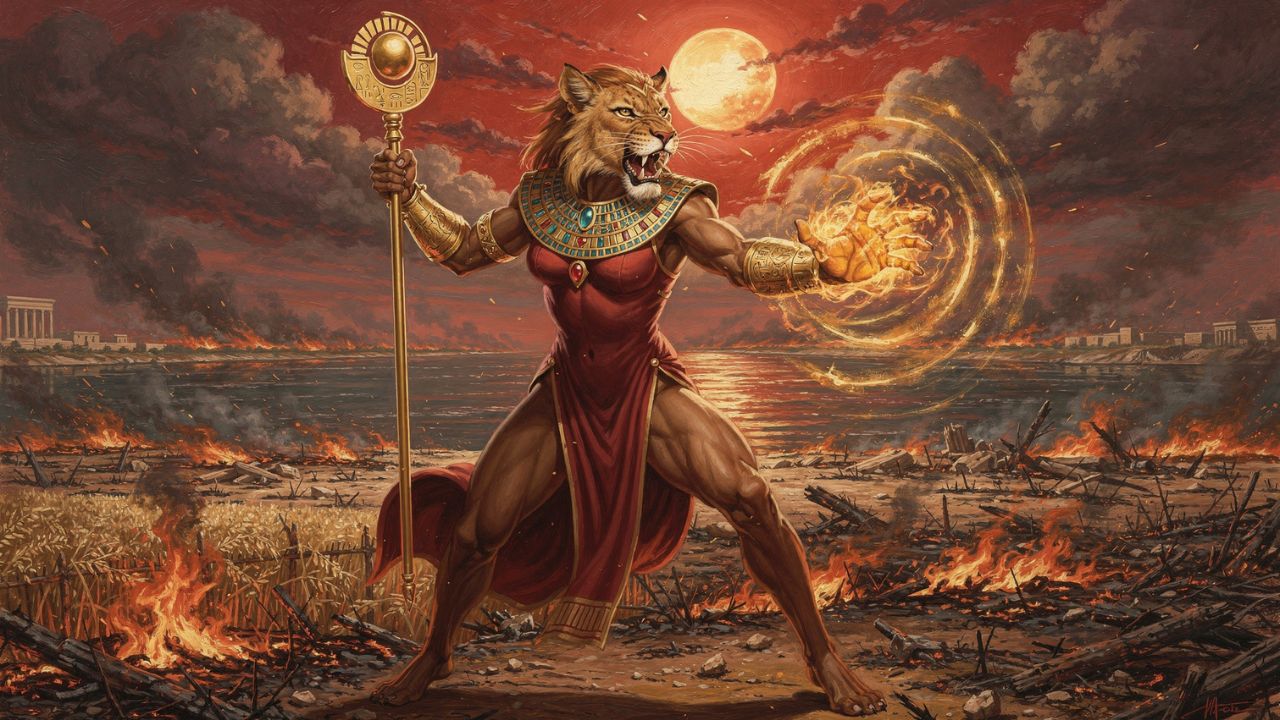
Sekhmet, whose name in ancient Egyptian means “the powerful one,” was a goddess with a lioness head and a woman’s body. Protector of the pharaoh in battle, mistress of war and medicine at the same time, because in Egyptian thought whoever can destroy can also heal. When Ra called her, Sekhmet asked no questions. She was a war goddess; questions were not her style.
She descended to Earth and began to kill.
Ra had asked for a lesson. Sekhmet understood extermination.
The massacre was so efficient and so enthusiastic that Ra, watching from above, was frightened by what he had unleashed. Humanity was disappearing. Sekhmet was no longer killing on orders; she was killing for the pure pleasure of the hunt, in a trance of violence from which there was no way to pull her with words. Ra tried to stop her. Sekhmet did not listen.
The problem was that no god could simply attack another god to stop them, especially if that god was his own daughter and his direct extension in the world. Ra needed another plan.
The solution was ridiculous, brilliant, and completely Egyptian: make beer. Seven thousand jars of beer mixed with red ochre so it would have the exact color of blood. They poured them over the fields where Sekhmet was going to hunt that night.
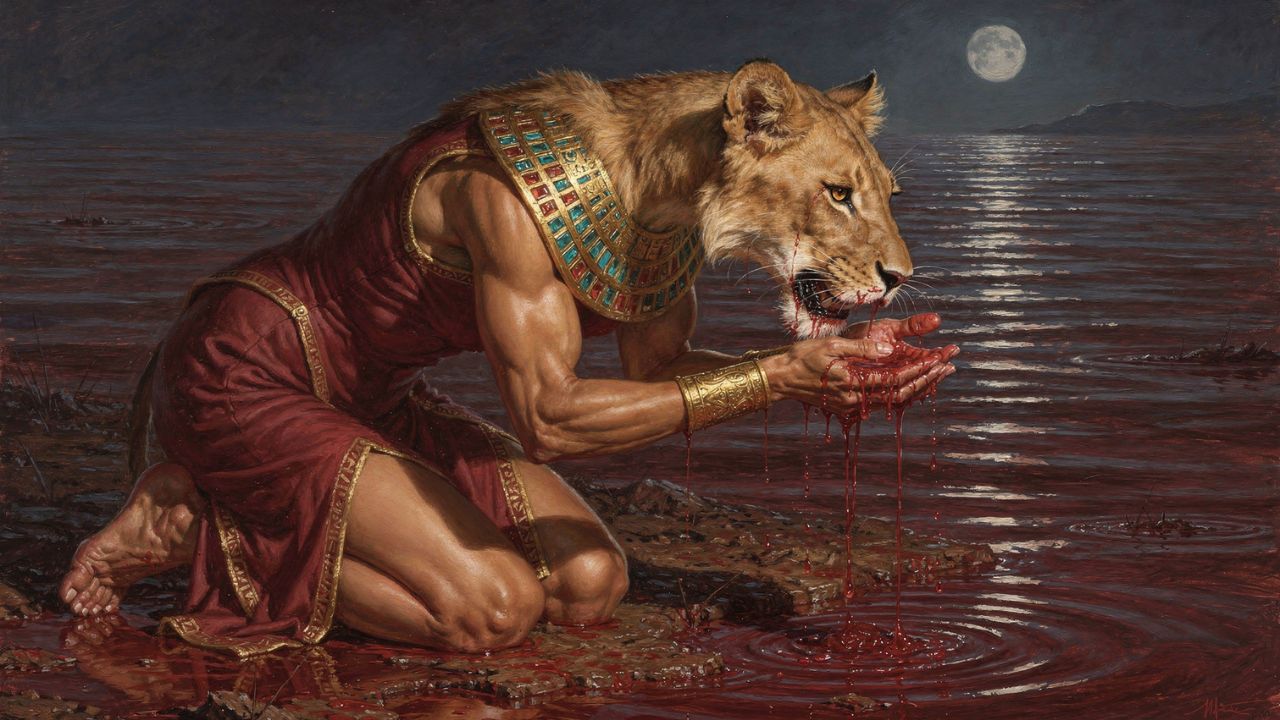
Sekhmet arrived, saw what she believed was a field flooded with blood, and drank. All of it. Seven thousand jars.
She fell into a drunken sleep, woke up transformed, and humanity survived.
What happened next is the twist nobody expects: the same goddess who almost destroyed all of humanity became Hathor, the goddess of love, music, joy, and fertility. In some versions it is a gradual transformation of character: Sekhmet, sated and at peace, discovers a side of herself that war had never allowed her to express. In others, Sekhmet and Hathor are two aspects of the same divinity, two sides of a coin that the Egyptians understood perfectly: the same force that destroys can create.
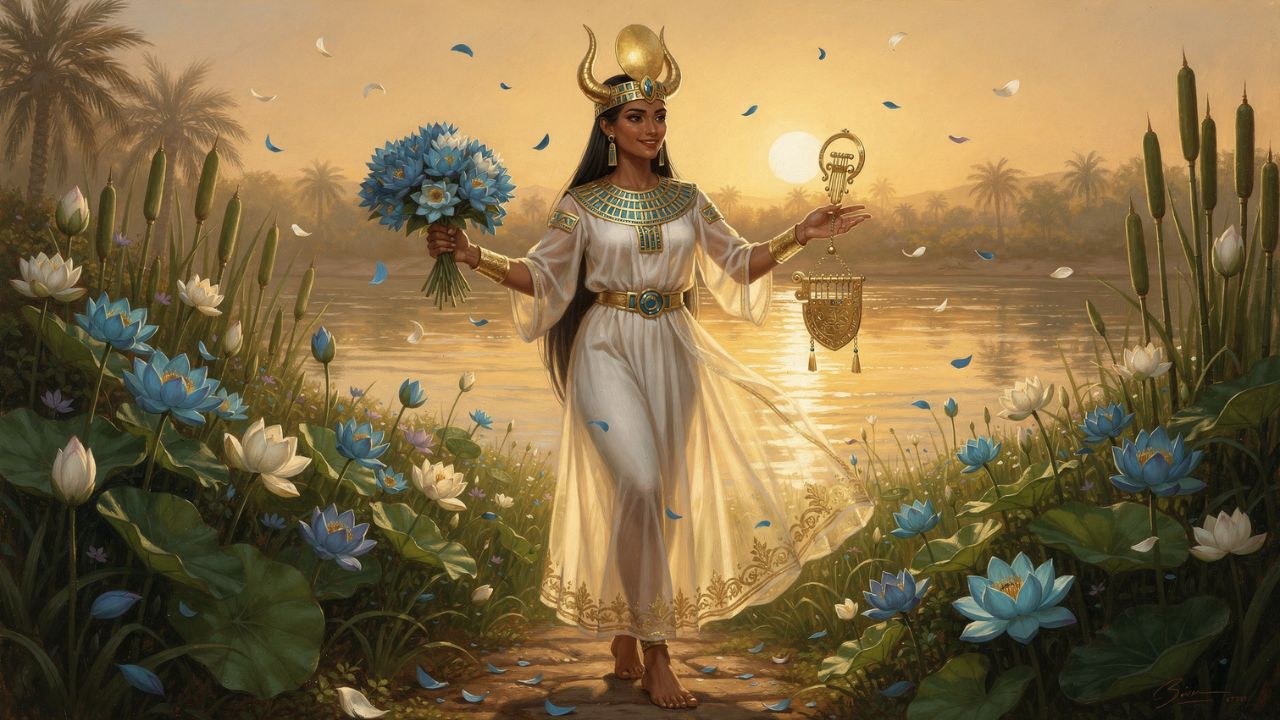
Hathor was depicted with solar horns and a solar disk between them, presided over banquets, protected women in childbirth, and received the dead in the afterlife with bread and beer. Which also happens to be what saved humanity from her previous version.
The contrast with the Greek story could not be more perfect. In Greece, the hero kills the Lion. In Egypt, the Lion is the goddess, and she almost kills everyone. And then becomes the goddess of love. Hercules never had that kind of narrative arc.
The Maya: the peccary and the humans who failed before us
Before talking about the peccary we need to clarify what it is, because it is not an animal that comes up much in everyday conversation outside the Americas. The peccary (also called the collared peccary or javelina depending on the region) is an American mammal that looks like a wild pig with tusks, thick fur, and a temperament that makes domestic pigs look docile by comparison. If you ever saw Pumbaa in The Lion King, imagine him darker, grumpier, with more prominent tusks and no interest in making friends. That is the peccary.
For Maya cultures it was much more than a forest animal.
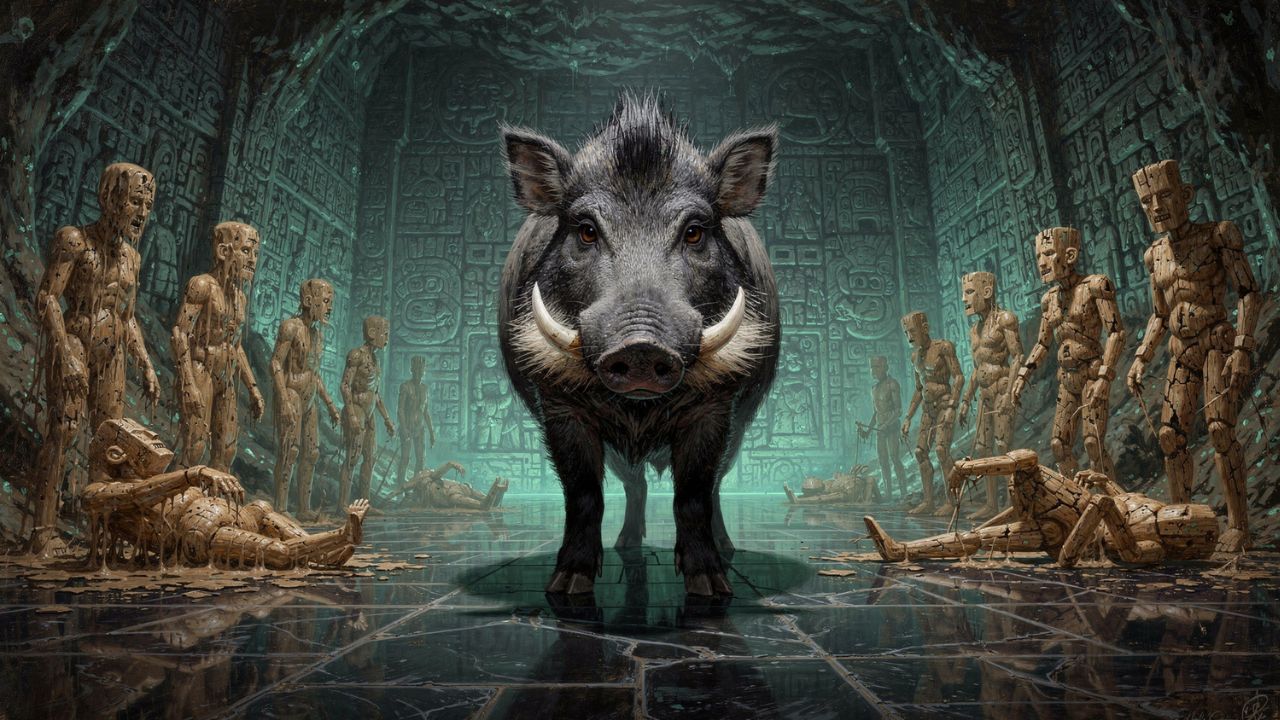
The story comes from the Popol Vuh, the sacred text of the K’iche’ Maya of the Guatemalan highlands, which preserves a much older cosmogony. In it, the creator gods Tepeu and Gucumatz, the Feathered Serpent, a deity the Maya shared in essence with other Mesoamerican peoples (the Mexica called it Quetzalcoatl: half quetzal, the most sacred bird of the region, half coatl, serpent, a creature that united sky and earth in a single being), faced a problem that any ambitious person knows well: they had the entire universe built, but they lacked someone to admire them. Someone to say their names out loud. Without worship, the gods existed in silence. And to exist in silence, for a Maya god, was almost like not existing.
So they began to experiment.
The first attempt was animals. The gods filled the world with deer, birds, jaguars, serpents, and peccaries. They could move, eat, and reproduce. But they could not speak. They could not say the names of their creators. The gods asked them to speak and the animals responded with roars, squawks, and grunts. Failure. The animals were condemned to live in the wild and to be food for the next attempt.
The second attempt was mud. The gods shaped a human figure from damp earth. The figure could speak, but its words made no sense. It dissolved in water. It could not walk straight, it crumbled, it had no memory. It was like building a house with wet sand. Failure.
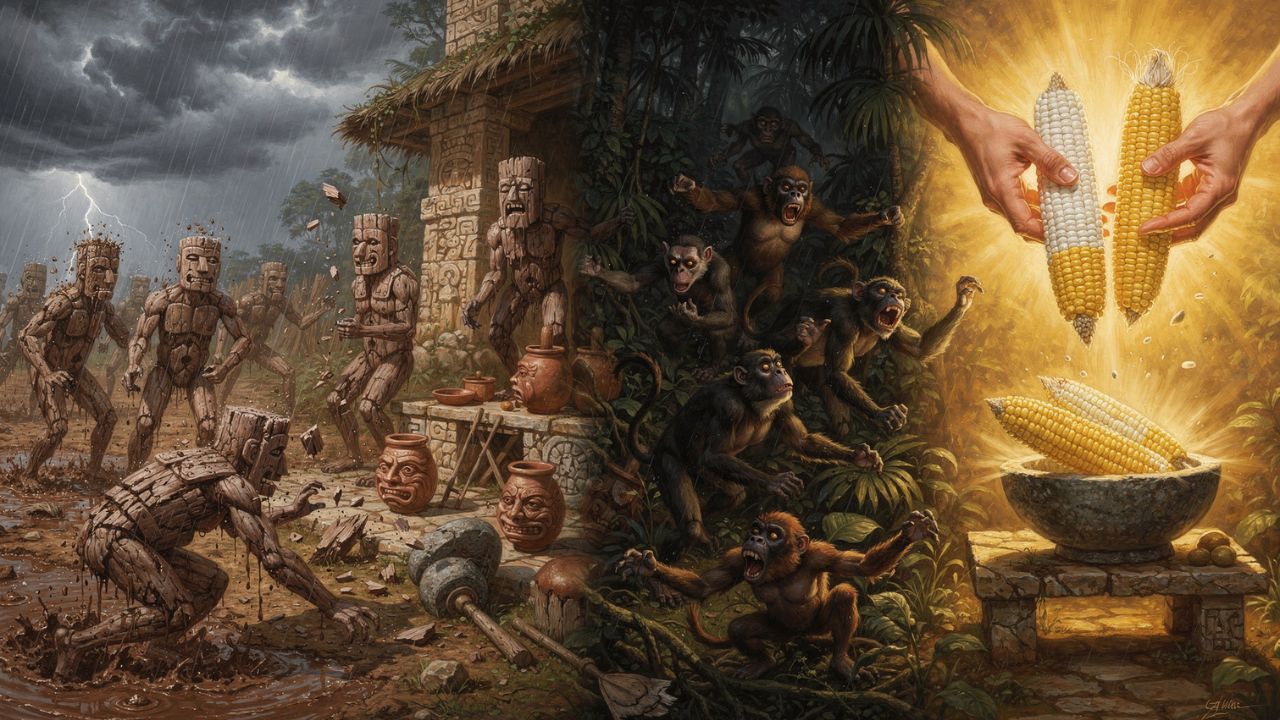
The third attempt was wood. The wooden men could speak, walk, and reproduce. They populated the earth and had children. It seemed like it was working this time. But the wooden men had no soul. They did not remember their creators. They felt no gratitude. They were functional but empty, like a machine that does everything it is supposed to do but with no understanding of why. The gods grew fed up and destroyed them. They sent a rain of boiling resin. The animals the wooden men had mistreated rebelled against them. Their own domestic utensils, the pots, the griddles, the grinding stones, rose up and attacked them, furious after years of mistreatment. The wooden men fled to the forest. Those, says the Popol Vuh, are the monkeys that exist today.
The fourth attempt was white corn and yellow corn, and that time it worked. The gods took corn dough, ground it, mixed it with water, and from that came the first true men. With memory, with gratitude, with the ability to say the names of their creators.
Present humanity is that fourth attempt.
The peccary appears in this context as one of the animals of the first failure, inhabitant of Xibalba, the Maya underworld, witness of all the failed creation attempts. While the Greeks saw in Leo an invincible Lion that immortalized the feat of their greatest hero, and the Egyptians saw the most destructive and most loving goddess at the same time, the Maya saw an underworld animal that silently remembered that before us there were three failures. That we are not the original plan. That we are the solution that finally worked.
A dead Lion, a drunk goddess, an underworld peccary. Same stars.
✦ ✦ ✦
The star at the heart of Leo is spinning so fast it could tear itself apart
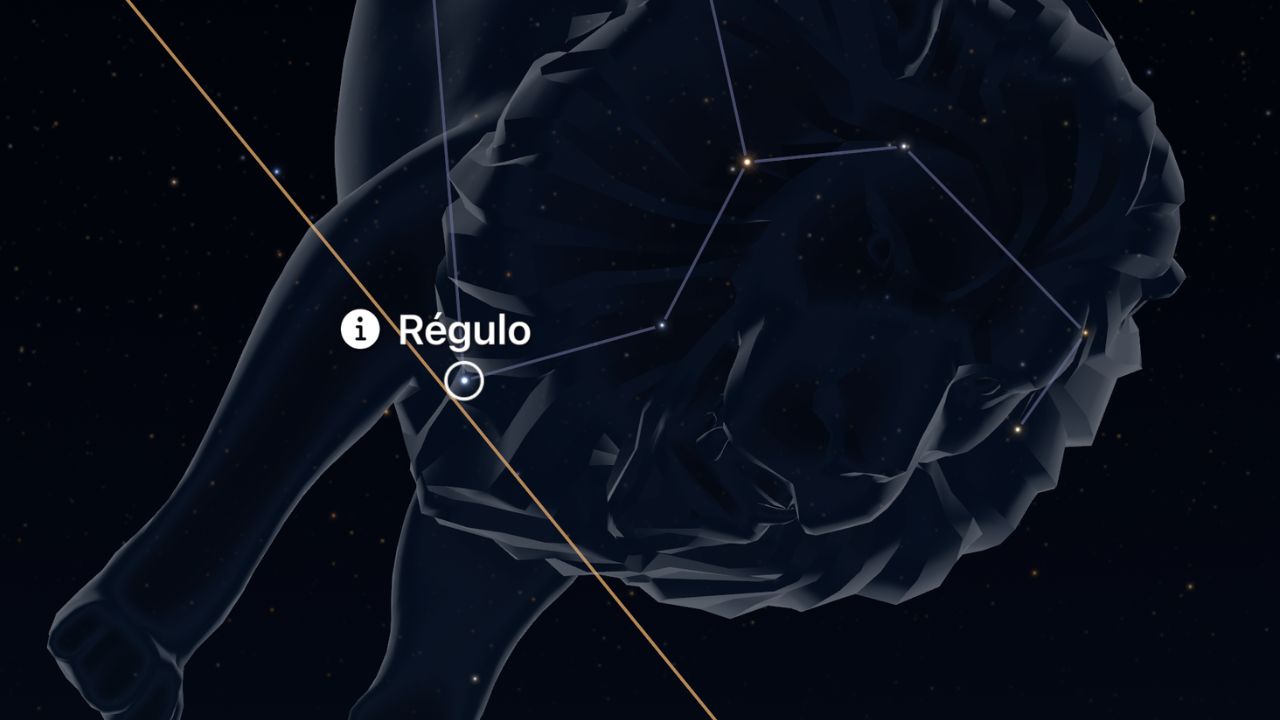
Regulus. Alpha Leonis. The brightest star in Leo, the point that marks the heart of the Lion, has been there for thousands of years, quiet and bright, while Greeks, Egyptians, Mayans, and Chinese invented stories about it. But Regulus is not quiet. What it is doing is one of the most extreme things a star can do without destroying itself.
It is spinning.
Not the way Earth spins, taking 24 hours to complete one full rotation on its own axis, nor the way the Sun spins, taking about 25 days. Regulus completes one full rotation every 15.9 hours. Its equator moves at 320 kilometers per second. To give that scale: Earth spins at 0.46 kilometers per second at its equator. Regulus spins almost 700 times faster than our planet.
At that speed, gravity begins to lose the battle against centrifugal force. The result is that Regulus is not a sphere. It is an oblate spheroid: flattened at the poles and bulging at the equator, as if you took a ripe orange and squeezed it between your palms until the sides pushed out. Its equatorial radius is 32% greater than its polar radius.
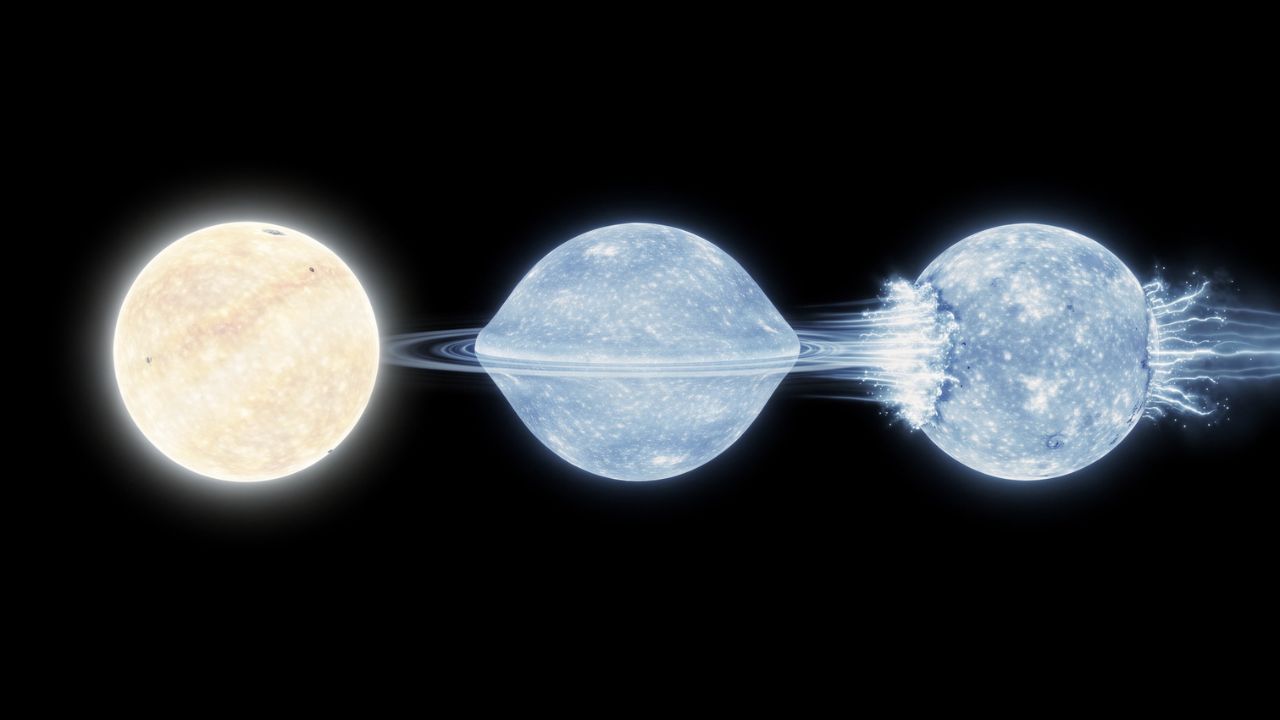
Regulus is spinning at 84% of the speed at which it would disintegrate. If it sped up just 16% more, gravity would stop winning the fight for good. The star would fragment. It would scatter into space. Regulus has been at the edge of its own destruction for thousands of years, and we down here have been naming it after kings and emperors without knowing any of this.
It is also the brightest star closest to the ecliptic, the apparent path the Sun travels across the sky throughout the year. So close that it lies less than half a degree from that path. To give you scale, the disk of the full Moon measures approximately half a degree in the sky. Regulus is so close to the ecliptic that the Moon, in its monthly orbit, covers it completely on a periodic basis. Not dims it, not comes close. Covers it. Regulus disappears behind the disk of the Moon and reappears on the other side minutes later. That is called an occultation and it is visible to the naked eye from anywhere in the world where it is night at that moment.
And speaking of civilizations: while Hercules and Sekhmet were starring in their respective dramas, astronomers of the Han dynasty were observing that same ecliptic with the same attention, and in these stars they saw neither a Lion nor a lioness warrior. They saw Xuanyuan, the Yellow Dragon, one of the four celestial creatures that divided the Chinese sky into quadrants. And Regulus specifically had its own name within that system: Huangdi. The Yellow Emperor.
Huangdi was no minor character in Chinese mythology. He was the mythical ancestor of all civilization, the legendary founder credited with inventing writing, medicine, the compass, the wheel, and the calendar. He was so important to Chinese identity that his name became the title used by all real emperors for millennia: Huangdi, the Son of Heaven.
His star was Regulus.
So the same star that for the Greeks was the heart of a Lion killed by Hercules, and that for the Chinese was the eternal founder of a civilization looking down from the firmament, is actually spinning so fast it could fragment at any geological moment. None of the cultures that named it knew this. All of them saw something true in it anyway.
Now lower your gaze a little from Regulus, toward the south and east of Leo, and you will find something no mythology ever mentioned because no mythology could see it: three galaxies in the same field of view, each with hundreds of billions of stars.
The Leo Triplet: three galaxies at 35 million light-years
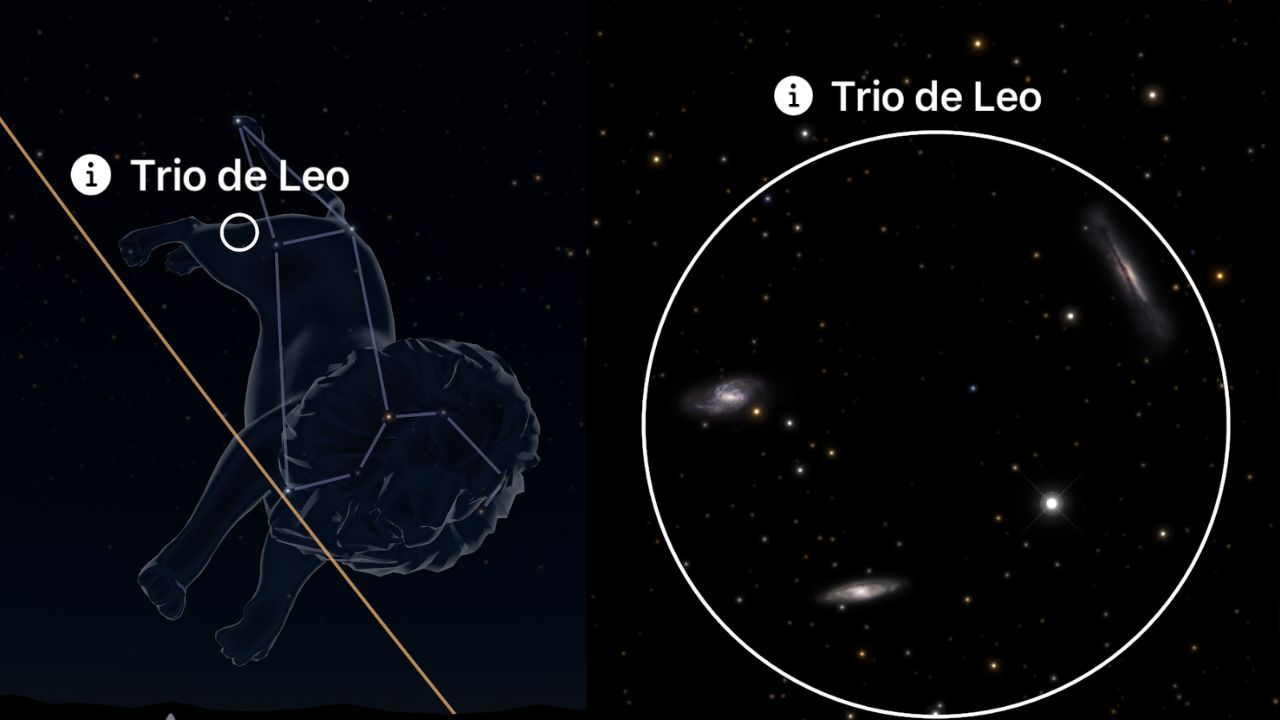
M65 and M66 are spiral galaxies, similar to the Milky Way in structure, so close in perspective from Earth that a powerful binocular shows them both in the same field of view. With the CELESTRON SkyMaster 15×70 (Mexico | United States | Spain) you can see both together on a moonless night with dark skies. What you will see are two small oval smudges, gray and fuzzy, barely distinguishable from the background. It is not spectacular to the eye. But when you understand what you are looking at, something shifts in your head.
The light reaching your eyes in that moment left those galaxies 35 million years ago. At that time no human being existed on Earth, nor anything resembling one. The first hominids would not appear for another 33 million years. The light from the Leo Triplet has been traveling longer than our species has existed, and it just finished its journey in your eye.
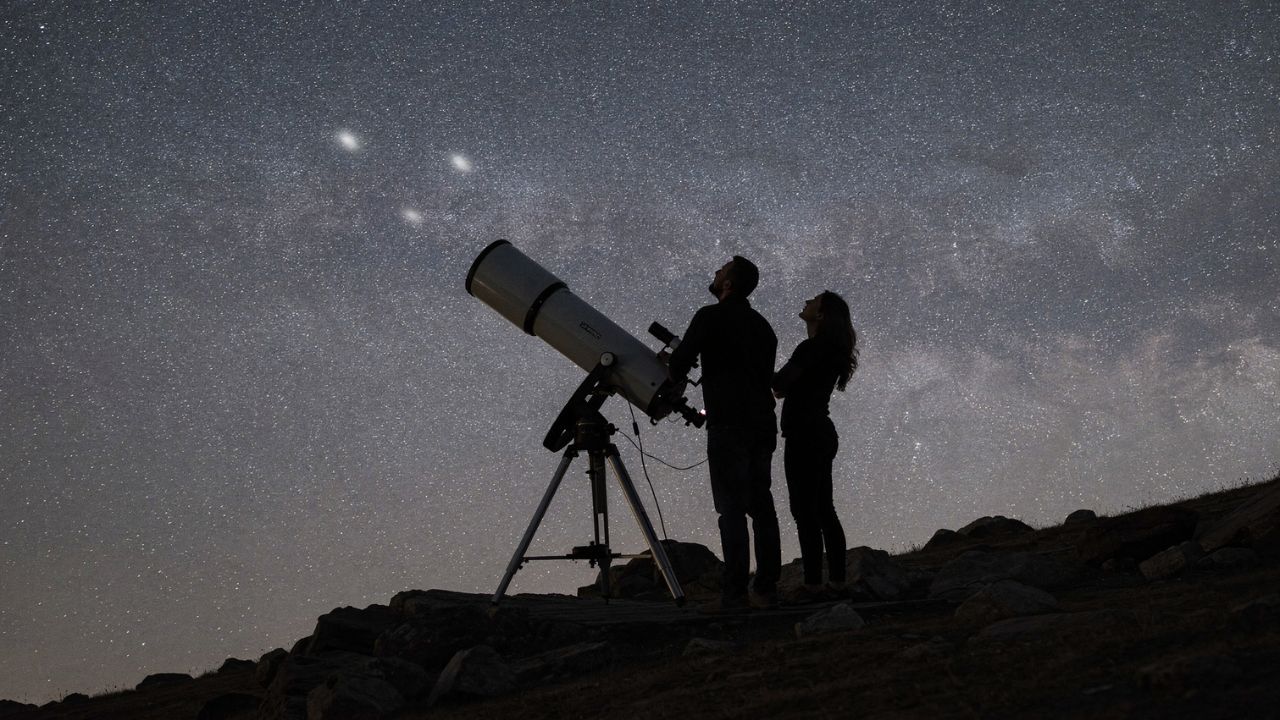
The third galaxy in the triplet, NGC 3628, is a spiral galaxy seen completely edge-on, which gives it an elongated narrow shape that astronomers informally call the Hamburger Galaxy. It is notoriously harder to see than its two neighbors because its surface brightness is very low. For objects like this, the darkness of the sky matters more than the aperture of the telescope. A large instrument under a light-polluted sky will give worse results than a smaller one under a clean rural sky. If you have the chance to get away from the city to observe the Leo Triplet, do it. The difference is not small.
With the SKY-WATCHER FlexTube 300P (Mexico | United States | Spain) the Leo Triplet from a dark sky is a different experience entirely. M65 and M66 show their oval shape clearly and you can begin to distinguish the difference in inclination between the two. NGC 3628 remains a challenge, faint and elongated, but with patience and averted vision it appears. Struggling with NGC 3628 even with good aperture is normal; it is not a failure of the equipment, it is the physics of the object.
For imaging, the ZWO Seestar S50 (Mexico | United States | Spain) completely changes the equation. The automatic image stacking pulls out details of the Leo Triplet that no human eye can see directly: the spiral arms of M66, the dark dust lane crossing NGC 3628 from side to side, and the faint halo surrounding M65. The image below was taken from my rooftop in Guadalajara. You do not need an observatory.
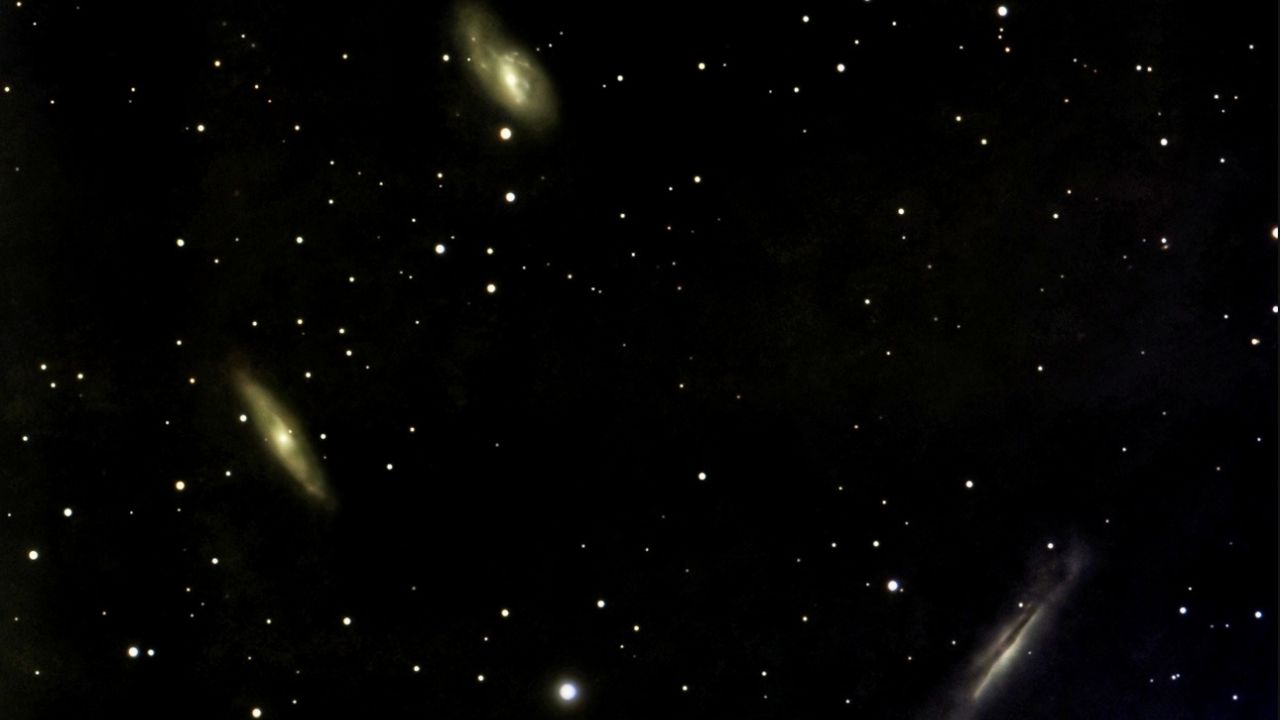
The Leo Triplet is visible in the night sky mainly from February to May, when Leo reaches its greatest height. In June it is still observable in the first hours of the night, though already lower toward the western horizon. Leo borders to the east with Virgo and to the west with Cancer; if you already know those constellations, Leo is exactly between the two.
The Lion that outlasted everything
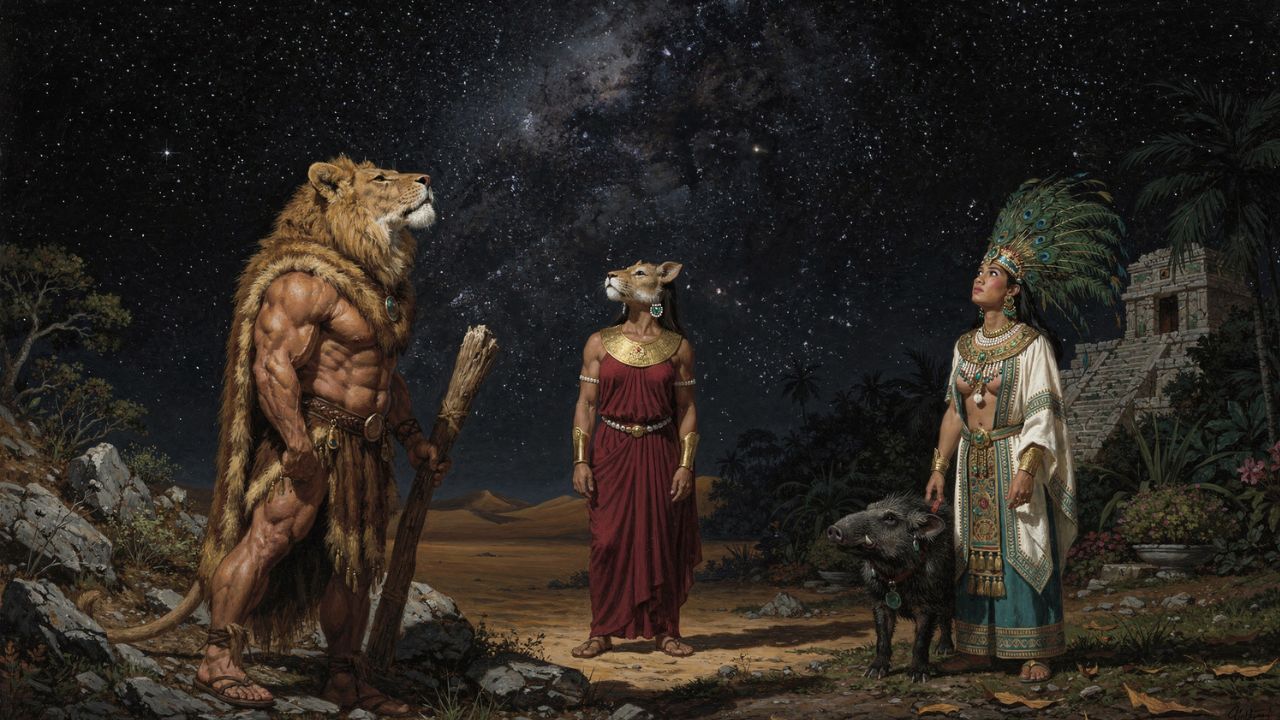
Four cultures. None knew the others. None shared language, religion, or geography. But all of them looked toward the same corner of the sky in spring, saw the same group of stars, and put there what mattered most to them. The Greeks put their greatest hero and their first lesson about how to turn tragedy into identity. The Egyptians put the most destructive and most loving force they could imagine, and gave both the same face. The Maya put the memory of the failures that preceded our existence, a silent reminder that we are not the original plan but the solution that finally worked. The Chinese put the founder of their civilization, eternal and imperial, looking down from the firmament.
And at the center of all of that is a star that knows nothing about any of this. Regulus only spins. It spins at 320 kilometers per second, flattened at its poles, at 84% of the speed at which it would fragment, indifferent to the myths we have built on top of it for millennia. The light leaving it takes 79 years to reach here. When you see it shining at the heart of Leo, you are seeing what that star looked like before you were born.
That is Leo. Not a drawing in the sky. A mirror in which all of humanity looked for thousands of years and saw different things, all true, all incomplete, all larger than any one of us.
If you want to keep looking up with us, find us as ASTRONOMIKA TV on YouTube, Instagram and TikTok. And if this article left you wanting more cosmic drama, the Hercules article has the twelve labors in full, the death by poisoned tunic, and M13, the cluster Carl Sagan sent a message to that is still traveling through space.
✦ ✦ ✦
Frequently asked questions about the Leo constellation
When can you see the Leo constellation in the sky?
Leo is visible in the northern hemisphere between February and May, with its optimal point in April, when it reaches its greatest height above the horizon after dark. In Latin America, between latitudes 0° and 30° north, it is well placed during those months. In June it is still observable in the first hours of the night, but already starting to drop toward the western horizon.
What star is Regulus and why is it special?
Regulus is Alpha Leonis, the brightest star in the Leo constellation, located 79 light-years from Earth. It is special for two reasons: it is the brightest star closest to the ecliptic, causing the Moon to periodically cover it completely in events called occultations visible to the naked eye, and it rotates so fast on its own axis (320 km/s) that its shape is not spherical but an oblate spheroid. It is spinning at 84% of the speed at which it would disintegrate.
What is the Leo Triplet and how can I see it?
The Leo Triplet is a group of three galaxies, M65, M66, and NGC 3628, located approximately 35 million light-years from Earth. M65 and M66 are visible with powerful binoculars like the CELESTRON SkyMaster 15×70 under dark skies, though they appear as faint gray smudges. NGC 3628 is harder due to its low surface brightness; dark sky matters more than aperture for seeing it. With a smart telescope like the ZWO Seestar S50 all three can be photographed with considerable detail.
What is the Greek myth of the Leo constellation?
The Leo constellation represents the Nemean Lion, the first of the twelve labors of Hercules. The Lion was the offspring of Typhon and Echidna, the most fearsome monsters in the Greek pantheon, and its hide was impenetrable to any weapon. Hercules killed it bare-handed by strangling it in its cave, then used the Lion’s own claws to skin it. The hide became his iconic armor.
Why did Hercules have to perform the twelve labors?
The twelve labors were imposed by the oracle at Delphi as penance for killing his wife Megara and his children. The crime was not voluntary: the goddess Hera, Hercules’s enemy since birth because he was Zeus’s illegitimate son, sent a temporary madness that caused him to commit the act without knowing what he was doing. The labors are technically a sentence for a crime that Hera herself provoked.
What does Leo represent in Egyptian mythology?
In Egyptian mythology, the stars of Leo are associated with Sekhmet, the lioness goddess daughter of Ra. According to the myth, Ra sent her to punish humanity for its arrogance, but Sekhmet interpreted the order as total massacre. Ra stopped her by getting her drunk on 7,000 jars of red-dyed beer. Sekhmet subsequently transformed into Hathor, the goddess of love, music, and joy.
What did the Maya see in the Leo constellation?
In some Maya traditions of the Classic period, the stars of Leo were associated with the figure of the peccary, an American mammal similar to the wild boar linked to the underworld Xibalba and to the failed attempts to create human beings according to the Popol Vuh. While Greeks and Egyptians saw a powerful feline, the Maya saw an animal witnessing the three creation failures before the gods managed to make humans from corn.
What is a stellar occultation and can I see one with Leo?
A stellar occultation occurs when the Moon, in its monthly orbit, passes in front of a star and covers it completely for several minutes. Regulus, being the brightest star closest to the ecliptic, is one of the stars most frequently covered by the Moon. The event is visible to the naked eye: the star disappears suddenly behind the dark edge of the Moon and reappears on the other side minutes later. The exact dates of upcoming Regulus occultations can be found on the IAU website or in apps like Sky Guide.
How many stars does the Leo constellation have and what are the main ones called?
The Leo constellation has 9 main stars that form its characteristic silhouette. The brightest is Regulus (Alpha Leonis), the heart of the Lion, at 79 light-years. Next are Denebola (Beta Leonis), the Lion’s tail, at 36 light-years; and Algieba (Gamma Leonis), a double system in the Lion’s neck that is one of the most beautiful objects to observe with a small telescope. Other named stars include Zosma, Chertan, Adhafera, and Ras Elased, which complete the animal’s profile in the sky.
This article contains affiliate links. If you purchase through them, I receive a small commission at no additional cost to you.
Sources and recommended reading
Books
Allen, R. H. (1899). Star Names: Their Lore and Meaning. Dover Publications. The classic reference for the origin of star names and their cultural history. Essential for any constellation article.
Burnham, R. (1978). Burnham’s Celestial Handbook, Vol. 2. Dover Publications. The most complete observing manual in classic amateur astronomy. Technical data on Regulus and the Leo Triplet verified here.
Apollodorus. Bibliotheca (The Library), Book II. Greek primary source from the 2nd century AD. The most systematic source on the twelve labors of Hercules, including the Nemean Lion.
Tedlock, D. (trans.) (1985). Popol Vuh: The Definitive Edition. Simon & Schuster. The most respected academic translation of the K’iche’ Maya sacred text. Foundation of the entire section on creation and the peccary.
Digital sources
NASA / SIMBAD Astronomical Database. Regulus (Alpha Leonis). simbad.u-strasbg.fr. International astronomical database. Technical data on rotation, distance, and morphology of Regulus verified here.
Pinch, G. (2002). Egyptian Mythology: A Guide to the Gods, Goddesses, and Traditions of Ancient Egypt. Oxford University Press. Academic reference for the myth of Sekhmet, Ra, and the transformation into Hathor.
Aveni, A. (1980). Skywatchers of Ancient Mexico. University of Texas Press. The most complete work on Mesoamerican archaeoastronomy. Foundation for the Maya identification of the peccary with the stars of Leo.
International Astronomical Union. Leo Constellation. iau.org. Official boundaries, abbreviation, and reference data for the Leo constellation.