
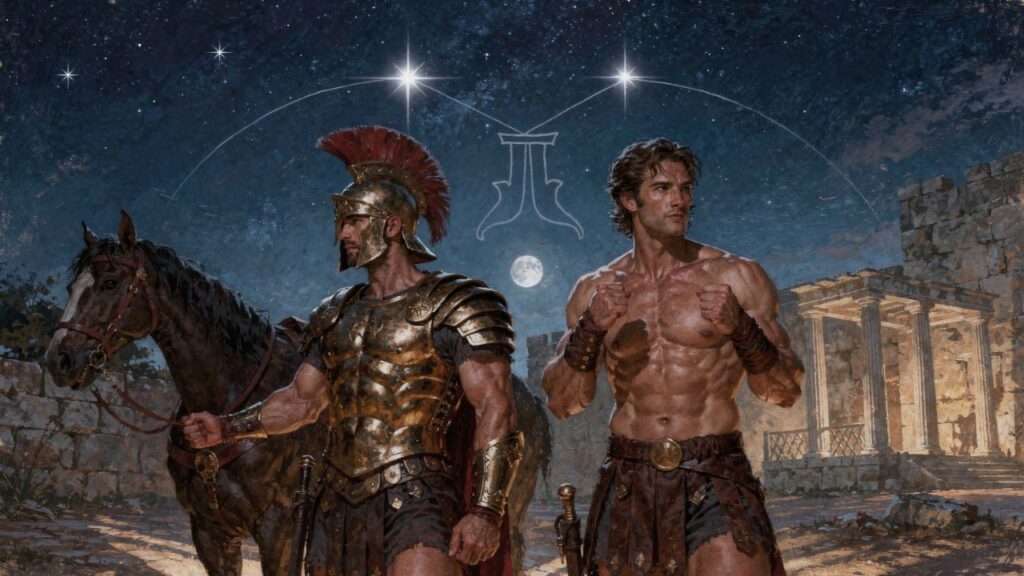
The most human drama in all of Olympus, plus the duality that Mayans and Polynesians saw in the very same sky
By Juan Pablo Martín | ASTRONOMIKA TV | May 2026
Greek mythology is full of pure chaos: gods transforming into animals, betrayals that make no sense, punishments wildly out of proportion. And then there’s the story of Castor and Pollux, which is something else entirely. It’s the story of two brothers who were born different, lived as if they were one, and when death tried to separate them, one of them simply refused to accept it. What’s striking is that this negotiation with death ended up fixed in the sky, and one of those two stars you see together tonight isn’t a star at all. It’s six. But before getting there, you need to understand why they started out fighting eternity itself.
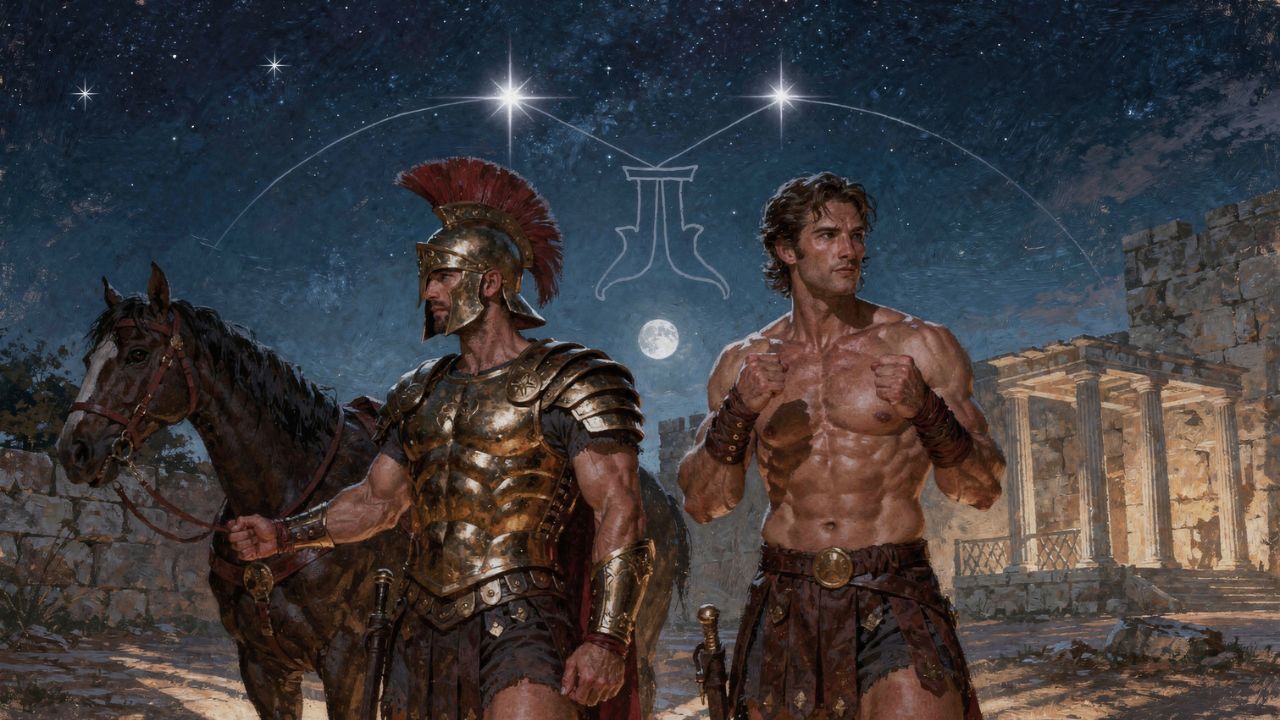
Illustration: GP Cassini | ASTRONOMIKA TV
Pollux was immortal. Castor was not. And that changed everything.
To understand the drama you have to start at the beginning. And the beginning of this story already comes with a question that nobody in two thousand years of mythology has dared to answer satisfactorily.
Leda, queen of Sparta, wife of King Tyndareus, was according to all ancient texts a woman of extraordinary beauty. That explains why Zeus noticed her. What it doesn’t quite explain is the tactical decision he made next.
Zeus transformed himself into a swan.
Not into an impressive warrior. Not into a radiant god descending from Olympus amid thunder. Into a swan. A long-necked waterfowl known mainly for biting children in parks. The obvious question, the one nobody has answered in two thousand years, is why. And mythologists have only one halfway credible explanation: Zeus pretended to be chased by an eagle to awaken Leda’s compassion, and she embraced him to protect him, and in that embrace everything happened. Which, it must be said, remains a story that’s quite difficult to tell at a family dinner.
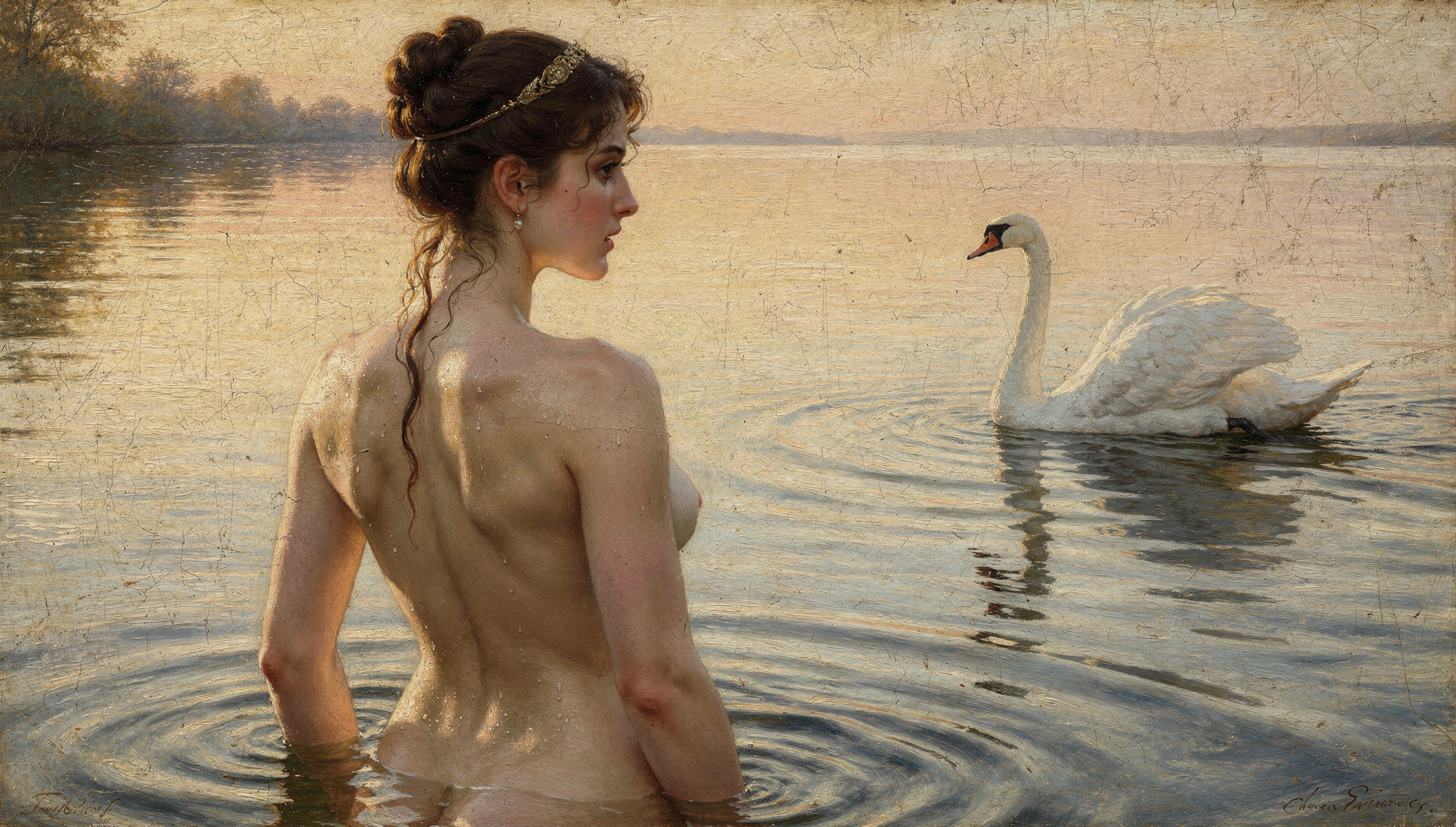
Illustration: GP Cassini | ASTRONOMIKA TV
What is recorded with considerable consistency across all sources is what happened that night in Sparta: Leda slept with her mortal husband Tyndareus and also with Zeus in swan form, both on the same night. The result was that Leda laid two eggs. She didn’t give birth. She laid eggs. From one came Pollux and Helen, divine children of Zeus. From the other came Castor and Clytemnestra, mortal children of Tyndareus.
Four children. Two fathers. Two eggs. One night.
If at any point in this account you feel the need to pause and process, that’s completely normal. The Greeks have been making the same face for twenty-five centuries.
What is fascinating, beyond the reproductive logistics, is what that double origin implies: Castor and Pollux were born from the same womb, grew up together, looked identical, but one had eternity guaranteed and the other had an expiration date. And neither of them chose it. That is the real tragedy of this story, and it begins before the twins even open their eyes.
Castor and Pollux grew up as the Dioscuri: “the sons of Zeus,” even though technically only Pollux was. The nickname stuck to both of them, which says a lot about their dynamic. Castor was the horse tamer, the practical man, the one who kept his feet on the ground. Pollux was the divine boxer, the best fighter in the Greek pantheon. A job title that frankly should appear more often on resumes.
Together they were an unstoppable team. And history put them to the test more than once before the end.
The Argonauts: the most dangerous crew in antiquity
When Jason assembled his expedition to steal the Golden Fleece from the other end of the known world, he summoned the best warriors in Greece. Castor and Pollux were on the list, and not just as filler. During the voyage of the Argo, the ship landed in the territory of the Bebryces, a people ruled by King Amycus, who had a rather particular foreign policy: any stranger who set foot on his shores had to fight him in a boxing match. No exceptions. And Amycus never lost.
Pollux accepted the challenge.
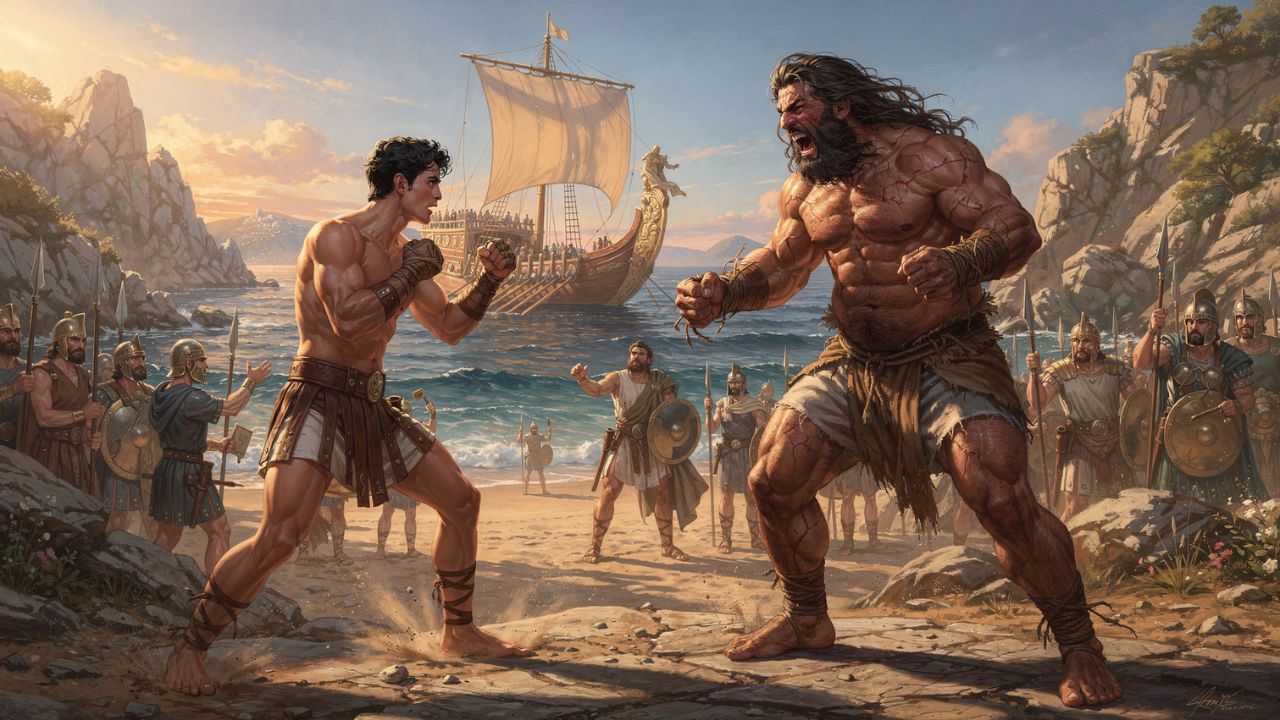
Illustration: GP Cassini | ASTRONOMIKA TV
What followed was, according to all sources, an epic beating. Pollux dodged, measured his opponent and knocked him out with a combination the Greeks described as definitive. Amycus fell. The Argonauts continued. And from that day on, nobody questioned what use a divine boxer was on the crew.
Later, during a storm on the Aegean that threatened to sink the Argo, Orpheus played his lyre and prayed to the gods of Samothrace. The storm relented. And at that moment, according to witnesses, flames appeared above the heads of Castor and Pollux. Two flashes of light, one per twin. The sailors interpreted them as a divine sign of protection.
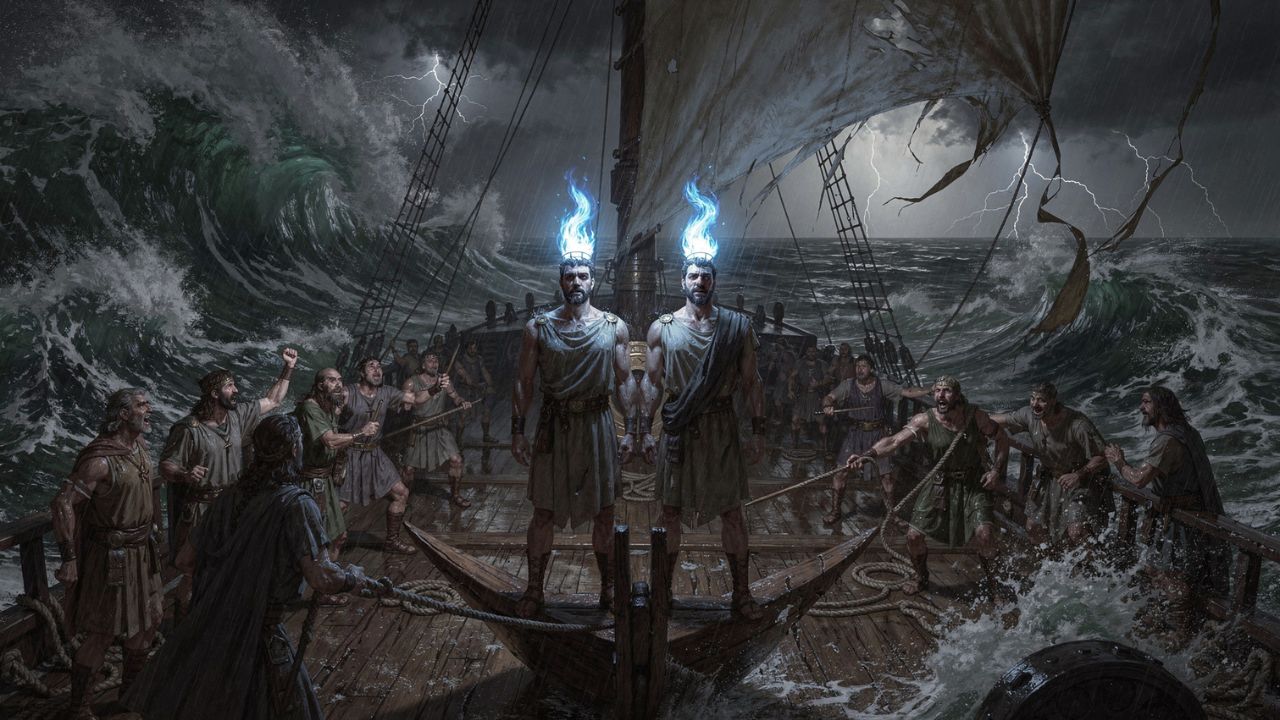
Illustration: GP Cassini | ASTRONOMIKA TV
That image stayed etched in the Greek collective memory for centuries: from then on, when sailors saw electric lights dancing on the masts of their ships during storms, they called it the fire of Castor and Pollux. Today that phenomenon has a scientific name. We call it St. Elmo’s Fire, ionized plasma that appears on pointed objects during electrical storms. Two millennia of history condensed in every electric discharge on a mast.
The Argonauts reached Colchis, stole the Golden Fleece and returned alive. Mission accomplished. And that Fleece, by the way, has its own place in the sky: it was the skin of the golden ram Zeus used to save Prince Phrixus, and when the animal died, Zeus immortalized it as a constellation. Today we know it as Aries. The same voyage that turned Castor and Pollux into protectors of sailors started with a ram’s skin that ended up becoming a neighboring constellation.
The rescue of Helen and the trouble with their cousins
But the twins were not exactly the flawless heroes that official history would prefer them to be.
When Theseus kidnapped their sister Helen and hid her in Athens while he descended into the underworld on another adventure, Castor and Pollux gathered a Spartan army, took the city with little resistance and rescued her. An orderly, proportionate response, with a certain poetic sense of justice.
But the twins were no saints either. Phoebe and Hilaeira, the two daughters of Leucippus, king of Messenia, were engaged to their cousins Idas and Lynceus. On the wedding day, with guests already seated, Castor and Pollux showed up, grabbed the brides and took them to Sparta.
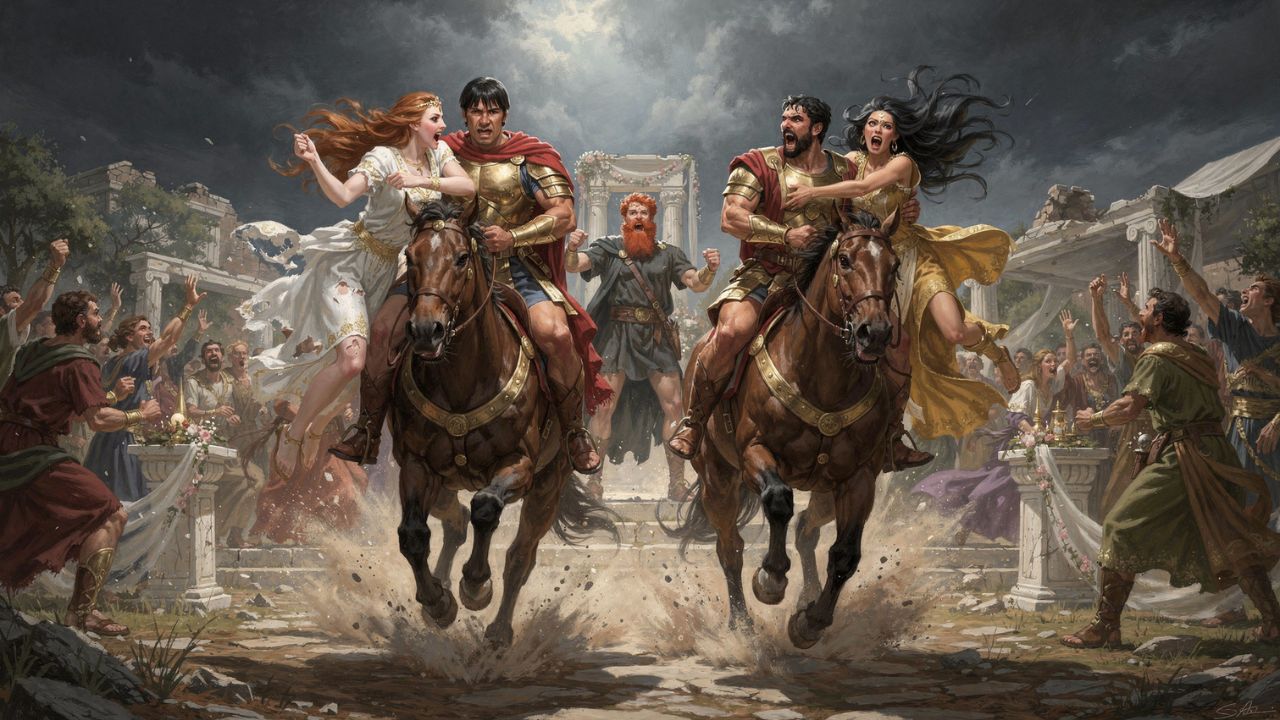
Illustration: GP Cassini | ASTRONOMIKA TV
Just like that. Idas and Lynceus had every reason in the world to be furious, and months later came the revenge: during a nighttime cattle counter-raid, Castor climbed into a hollow tree to stand guard. What he hadn’t counted on was that Lynceus had a sight capable of seeing through total darkness, and pointed Idas to exactly where to drive his spear through the trunk.
Castor fell, mortally wounded.
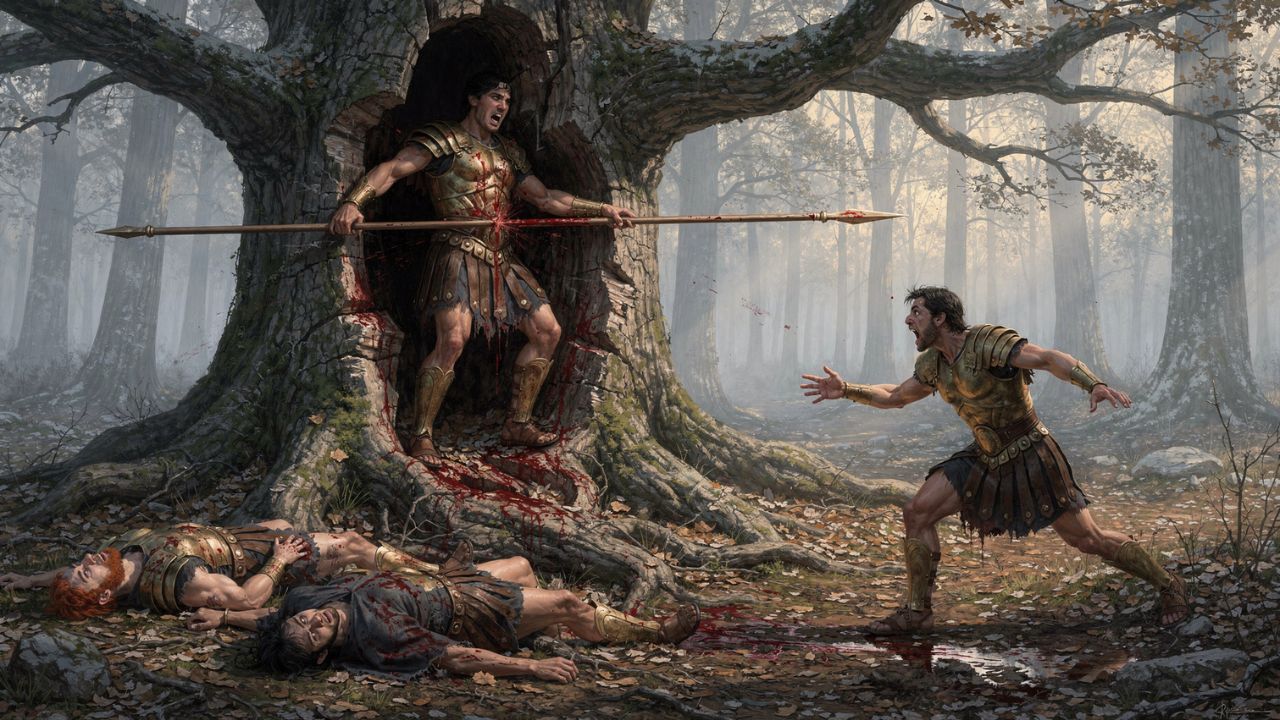
Illustration: GP Cassini | ASTRONOMIKA TV
Pollux came running and killed Lynceus on the spot. Idas, driven mad by seeing his brother fall, grabbed the gravestone from his father’s tomb to crush Pollux with it. At that moment Zeus intervened from the sky: a direct lightning bolt struck Idas dead before he could release the stone.
Four men entered the conflict. Only one walked out alive. And that one was the immortal. The one who technically couldn’t die.
Pollux stood over three bodies, including his brother’s, with his immortality intact and no one to share it with.
The decision that changed the rules of Olympus
What he did next is what placed him in the sky.
He begged Zeus not to leave him immortal without Castor. He didn’t ask for revenge. He didn’t ask for riches. He asked not to have to remain alone with an eternity that no longer made sense. Zeus, who could do many things but couldn’t simply split immortality like a piece of fruit, found the only possible solution: both would share existence alternately. One day in Olympus. The next in the underworld. Together in destiny, never in the same place at the same time.
Pollux accepted.
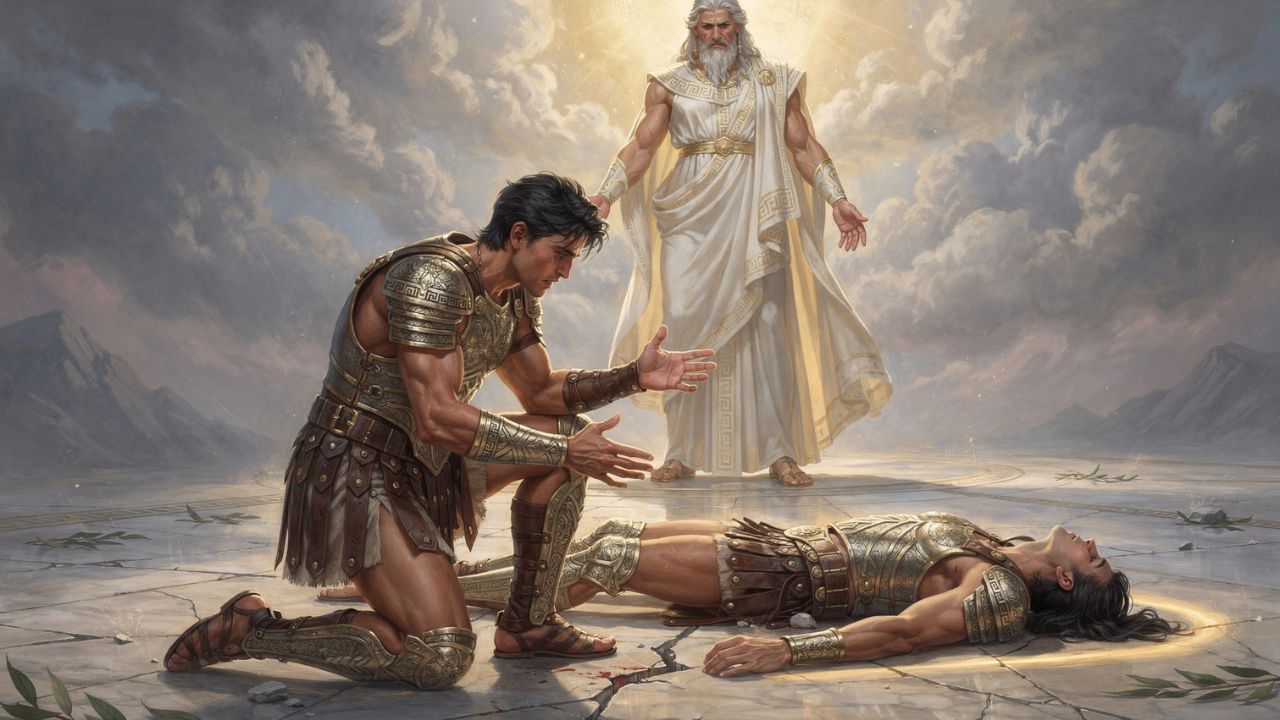
Illustration: GP Cassini | ASTRONOMIKA TV
Zeus placed them in the sky. And the universe fixed them there forever as the two brightest stars of Gemini, 34 and 51 light-years from Earth respectively, separated from each other by about 18 light-years, always visible together from any point on the planet, always at the same distance from one another.
Never in the same place. Never separated.
The cruelest detail of the ending is the timing. According to some versions of the myth, Castor and Pollux died shortly before Paris of Troy crossed the Mediterranean, sat down to dinner at the palace of Sparta and took Helen away. The only two men in the world who would have gone to find her without a second thought were not there. And from that absence the Trojan War was born. Ten years of war, thousands of dead, Troy in flames. All of it connected, ultimately, to an interrupted wedding and a hollow tree in Arcadia.
Even in the New Testament, in the Acts of the Apostles, Saint Paul boards a ship in Malta whose figurehead bears the image of Castor and Pollux. The twins’ protection crossed centuries, cultures and religions without anyone planning it.
The same sky, a completely different story
The Greeks were not the only ones who looked at those two stars and saw brothers, but what other peoples saw in that exact same pair of points of light bears no resemblance to the tragedy of Castor and Pollux. The Mayans turned them into a weapon against death itself. And in Hawaii, those same two stars helped catch the Sun.
The Hero Twins: the ones who actually beat death
Before entering the story you need a little context, because if you don’t know Mayan mythology, Xibalba sounds like the name of a fusion restaurant rather than the most terrifying place a human mind has ever conceived.
Xibalba is the Mayan underworld. It is not the Christian hell where bad people go. It is the place where all the dead go, good or bad, regardless of how they lived. It is governed by a council of twelve lords of death with names that tell you everything you need to know: Pus Master, Bone Master, Skull Master, Blood Gatherer. These are not metaphors. They are literally the gods of putrefaction, jaundice, misery and sudden death. A council designed specifically to make you suffer in every possible way before keeping you there forever.
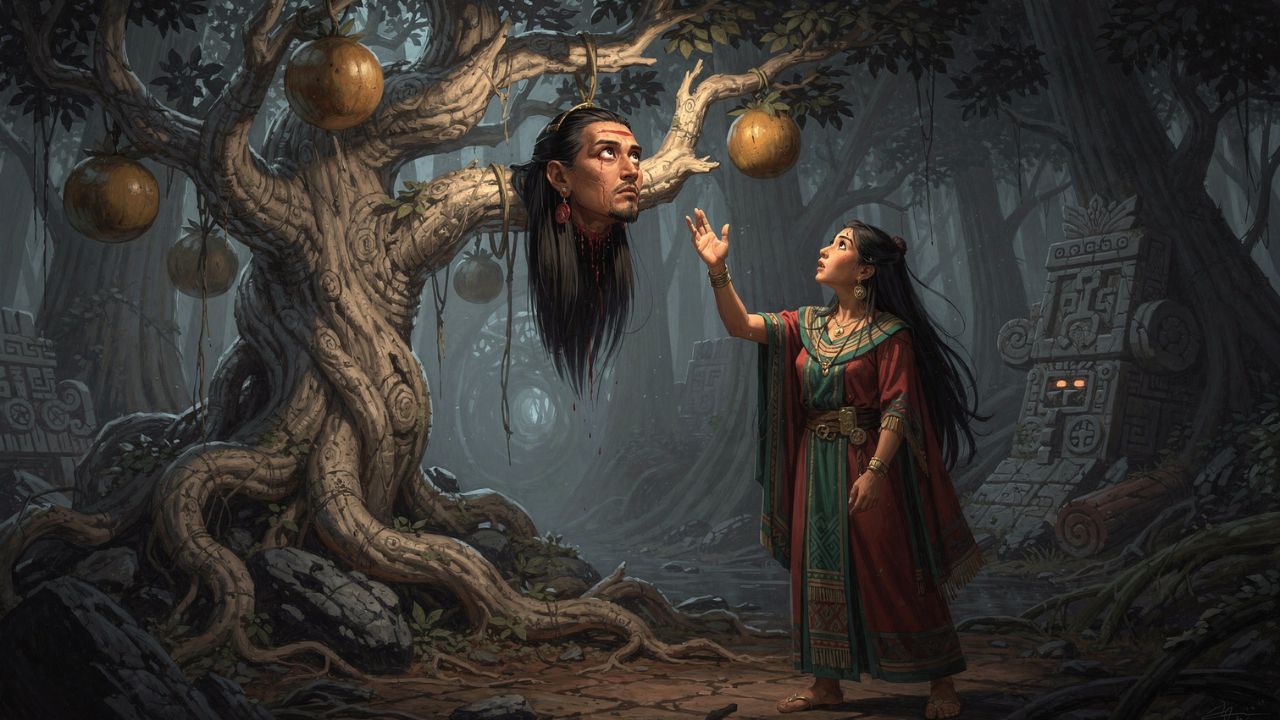
Illustration: GP Cassini | ASTRONOMIKA TV
The Popol Vuh, the K’iche’ sacred book written in the sixteenth century but based on centuries of oral tradition, tells the story of Hunahpu and Ixbalanque, the Hero Twins. Their origin is already loaded with drama: their father, Hun Hunahpu, had been summoned to Xibalba to play a ball game against the Lords of Death. They summoned him with deception, humiliated him, sacrificed him and, to top it off, hung his severed head in a tree as a warning to anyone who dared challenge them.
What the Lords of Death didn’t calculate was that that head still had unfinished business.
The daughter of one of the lords of the underworld passed near the tree, the head spat into her hand and she became pregnant. From that conception, no less unconventional than Leda’s though with fewer feathers involved, Hunahpu and Ixbalanque were born.
The twins grew up knowing exactly what had been done to their father. Hunahpu, whose name in K’iche’ literally means “the one who uses a blowgun,” was the active one, the impulsive one, the one who acts first and thinks later. Ixbalanque, whose name translates as “Jaguar of the Sun,” was the strategist, the one who thinks three moves ahead, the one who improvises when his brother makes a mistake. When the Lords of Death summoned them to Xibalba too, they didn’t descend in terror. They descended with a plan.
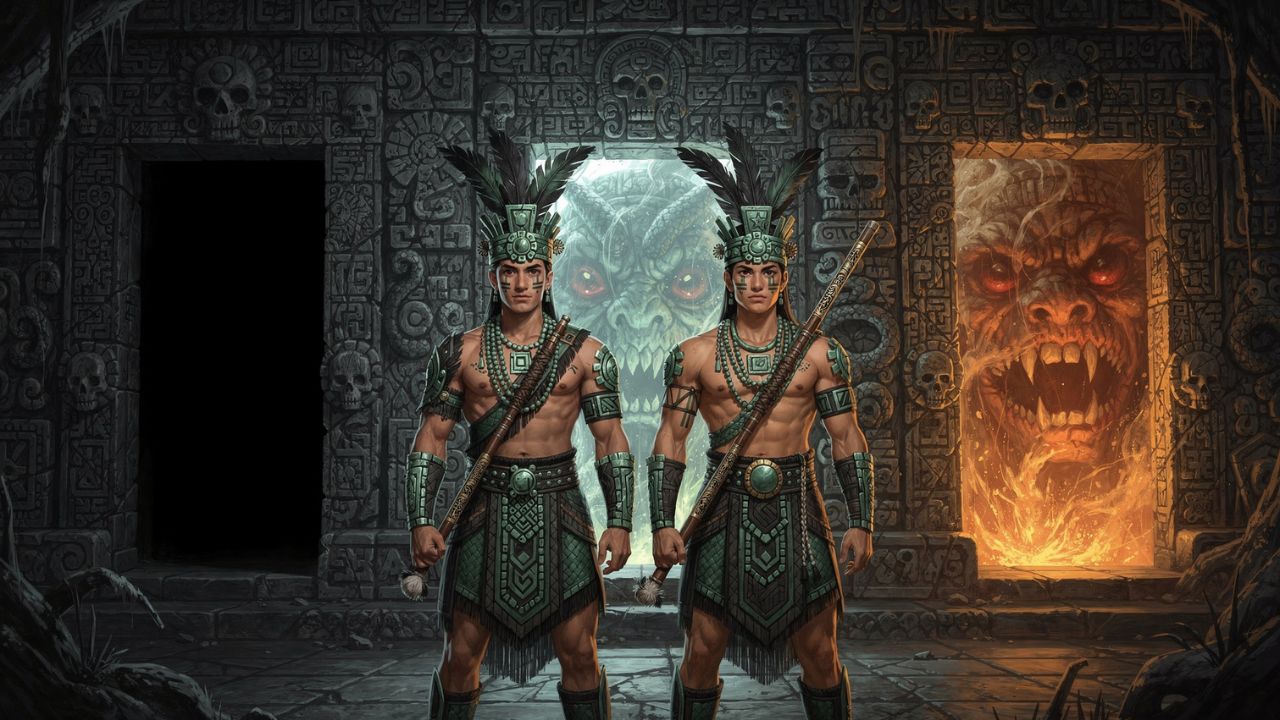
Illustration: GP Cassini | ASTRONOMIKA TV
What they found below was this:
The first was the Dark House, where absolute darkness reigned. The test was simple and perverse: the Lords handed them a lit torch (a crude firebrand, essentially a resin-soaked branch used for lighting in darkness) and a cigar, and in the morning they wanted them back intact and unburned. Impossible if you use them for light. Impossible if you don’t and go blind. The twins solved the problem by placing red macaw feathers on the tip of the torch so it glowed like a flame without burning down, and at the tip of the cigar they placed fireflies. The guards saw light all night and in the morning the torch and cigar were returned intact. First test, passed.
The second was the Cold House, where an unbearable icy wind blew without stopping. The twins burned ocote logs, a resinous wood that burns intensely even when wet, all night for warmth. Second test, passed.
The third was the Jaguar House, full of hungry jaguars that growled and laughed. Because yes, in Xibalba jaguars laugh, and that is more terrifying than if they didn’t. The twins arrived with animal bones and threw them to the jaguars before they could attack. Third test, passed.
The fourth was the Razor House, full of sharp blades moving on their own in every direction. The twins spoke to the blades. They told them that their flesh was not what they should cut, but the flesh of their enemies in the future. The blades stopped moving. Convincing knives to have patience is exactly as absurd as it sounds, but it worked.
The fifth was the Fire House, full of burning embers. The twins came out without a scratch.
And then they reached the Bat House.
This was the home of Camazotz, the bat god, a creature with a man’s body, leather wings and a very specific specialty: decapitation. To survive the night, the twins resorted to something that in any other universe would sound absurd but in Xibalba is perfectly reasonable: they shrank themselves with magic to the size of a dart and slept inside their own blowguns, completely hidden inside the tube, while Camazotz and his bats fluttered and screeched in the darkness searching for them without finding them. In Xibalba, making yourself small is not surrendering. It’s strategy.
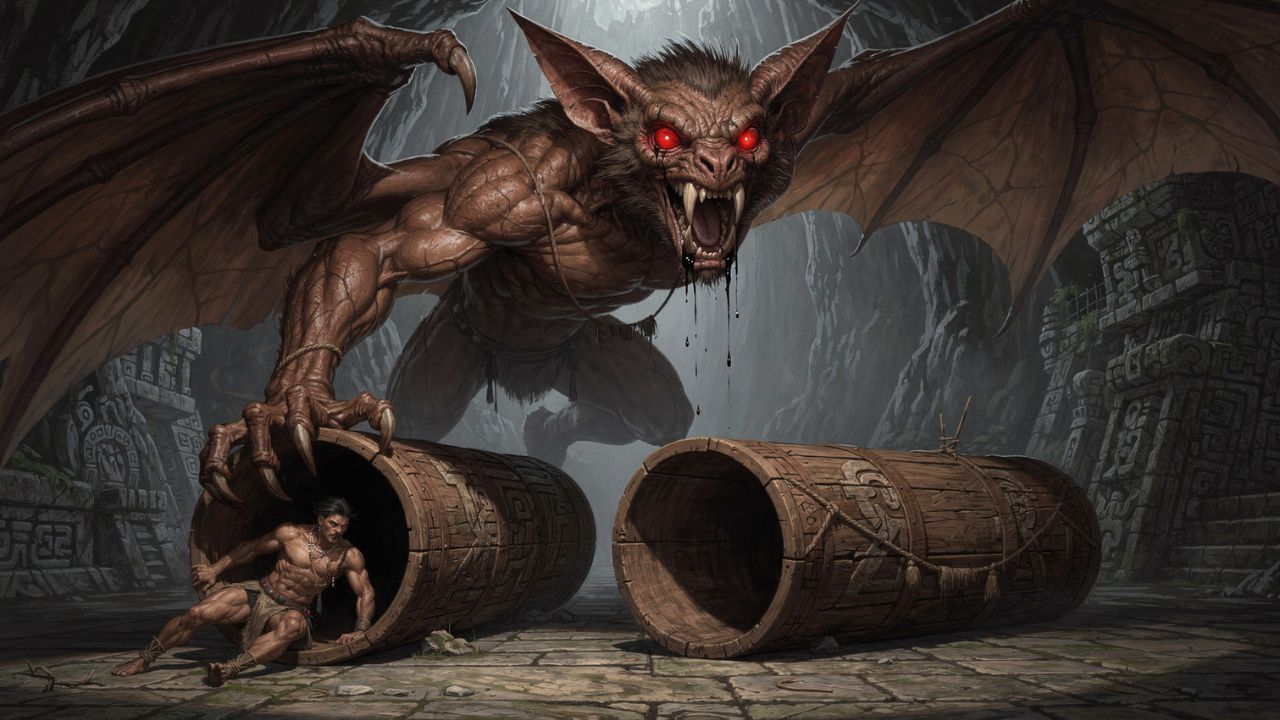
Illustration: GP Cassini | ASTRONOMIKA TV
Hunahpu, the impulsive one, made the mistake of peering out of the blowgun to see if dawn had come. Still the size of a dart, his head barely protruded from the tube. Camazotz passed at that exact moment and bit it off with almost no effort.
Ixbalanque did not panic. First he made himself large again. Then he gathered all the animals of the forest, asked them to bring their favorite food, and together the fauna of Xibalba improvised a gourd head carved with his brother’s features. They placed it on Hunahpu’s neck. The ball game against the Lords of Death continued the next day with Hunahpu using a gourd as a head, and the most incredible part is that it worked because in Xibalba nobody questioned anything that was strange enough. A rabbit, strategically recruited by Ixbalanque, ran off at the exact moment of the ball game to distract the lords of the underworld while they recovered Hunahpu’s real head. In Xibalba, the rabbit is the anonymous hero of this story and nobody gives it the credit it deserves.
After all that, the twins executed the boldest move in the myth. They let themselves be killed voluntarily. The Lords of Death sacrificed them, ground their bones and threw them into the river. The bones became fish, and from the fish the twins emerged again disguised as dancers nobody recognized. They traveled through Xibalba doing tricks: sacrificing animals and resurrecting them, one brother decapitating the other and bringing him back to life. The Lords of Death, fascinated, asked to have the trick done to them.
The twins decapitated them. And did not bring them back.
The Popol Vuh says it with an economy of words that is more brutal than any detailed description: “Then they rose to the sky. One became the Sun and the other the Moon.” Hunahpu, the impulsive one, became the Sun. Ixbalanque, the strategist, became the Moon. There was no negotiation, no pleading with Olympus. They simply ascended, because the cosmos recognized that two beings capable of defeating death with pure ingenuity deserved to illuminate the world forever.
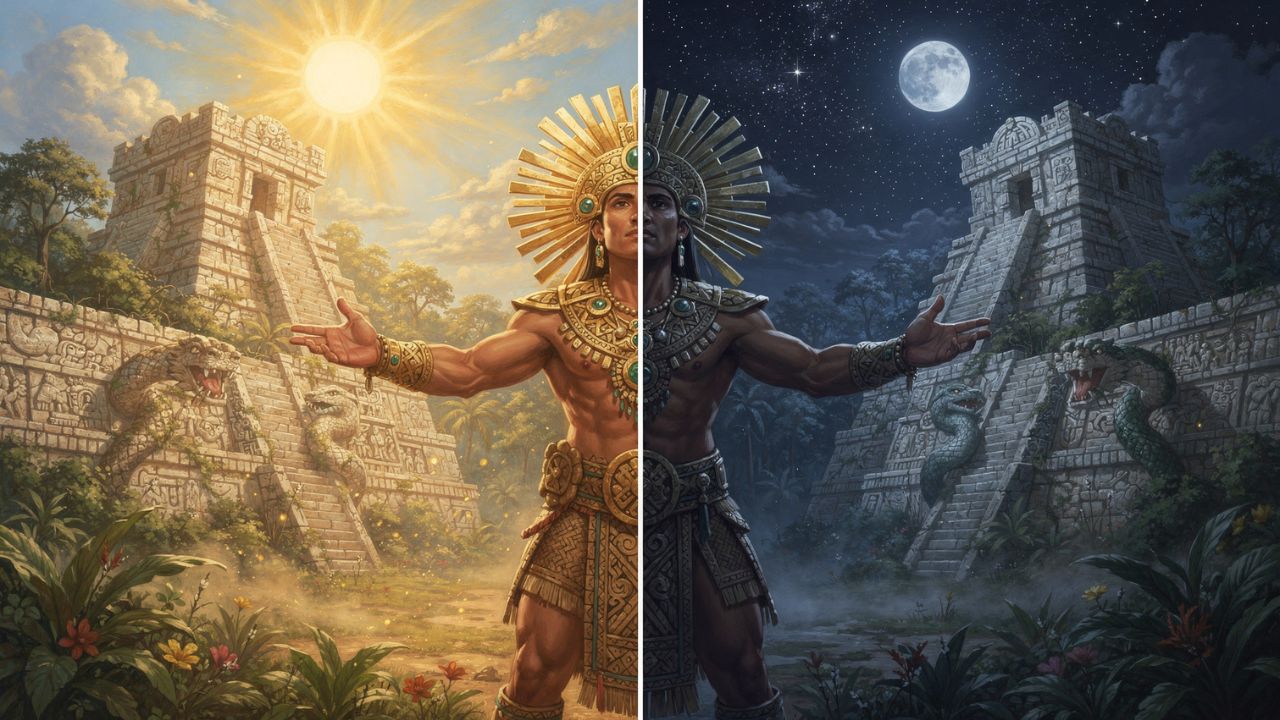
Illustration: GP Cassini | ASTRONOMIKA TV
The contrast with the Greek version could not be more stark. For the Greeks, the duality of Gemini is a sentence negotiated with Olympus. For the Mayans, it is the weapon with which death is destroyed without breaking any rules. Same stars. Completely opposite philosophy.
Nā Mahoe and the man who arm-wrestled the sun
To understand why the two stars of Gemini mattered so much to the Polynesian navigators of Hawaii, you first need to understand Maui. Not the Disney Maui, though Disney did a surprisingly good job. The real Maui of Hawaiian mythology is a trickster demigod, a braggart, extraordinarily ingenious and with a family history that no modern psychologist would want to receive as a patient.
Let’s start at the beginning because the beginning is already a scandal.
Maui was born premature and his mother Hina, convinced the baby would not survive, wrapped him in a lock of her own hair and threw him into the ocean. Literally. She threw him into the sea. The baby survived, raised by the water spirits and Pacific currents, and when he was old enough he went back to find his family. His own brothers at first didn’t believe he was their brother. His mother took a long time to recognize him. First character note about Maui: he was the kind of person who survives being thrown into the ocean as a newborn, grows up without a family, comes back years later and instead of eternal resentment decides he’s going to perform great deeds to earn everyone’s love.
Hina, his mother, was according to Hawaiian mythology the goddess of the moon, guardian of the night and patron of nighttime travelers. A woman who made kapa, the sacred cloth made by pounding the bark of the wauke tree into soft sheets. The problem was concrete and frustrating: the sun crossed the sky too fast. The days were so short that the cloth couldn’t dry before night fell.
Hina didn’t ask Maui to fix the problem. Maui decided to fix it on his own, probably to impress her. And when Hina found out about the plan, she warned him not to mess with the sun because it was a powerful god. Maui didn’t listen. Maui never listened to warnings. That’s also a family trait: Hina threw him into the ocean as a baby and he grew up to be exactly the kind of person who ignores warnings about furious solar gods. The apple didn’t fall far from the tree.
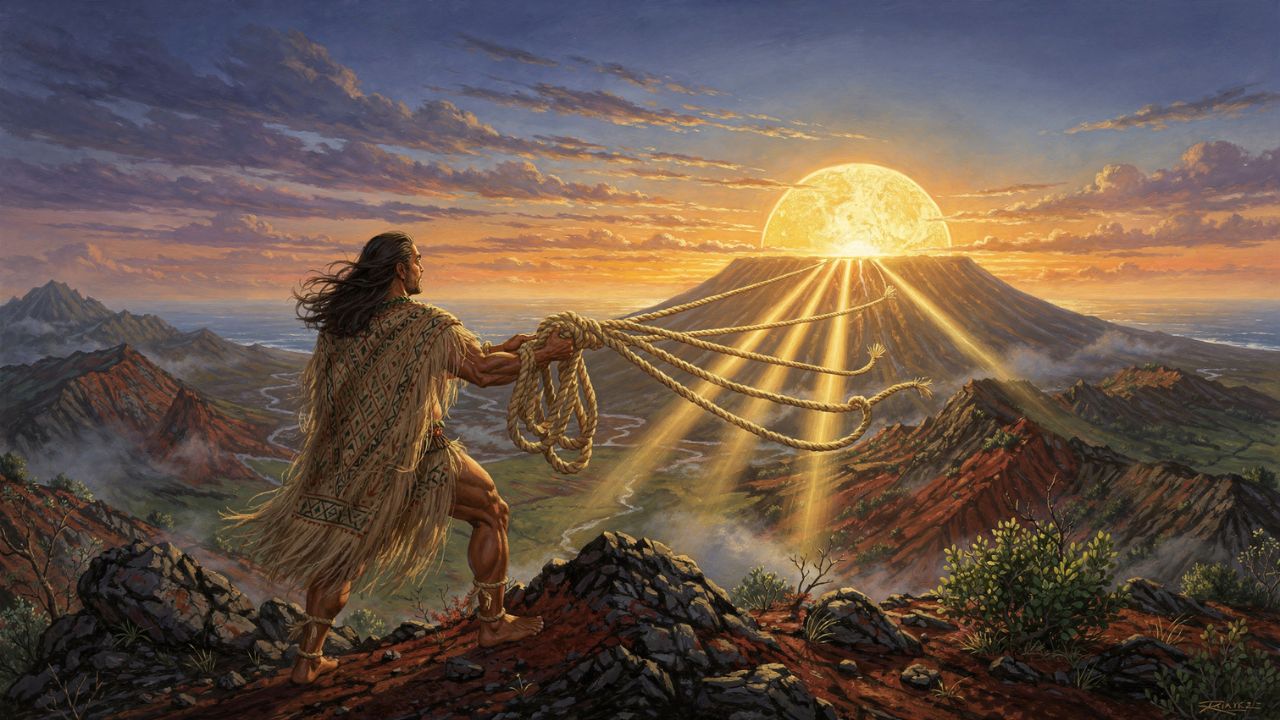
Illustration: GP Cassini | ASTRONOMIKA TV
What followed was preparation that says a lot about Maui being, beneath all the bravado, also a process engineer. He spent days observing the sun’s trajectory from different points on the island, calculating angles, measuring timing. He determined that the exact spot was the crater of the Haleakala volcano, whose name in Hawaiian means “the house of the sun.” He climbed at night, with a net of lassos braided from Hina’s hair, because the hair of the women in his family had mana, sacred power, and a regular rope would never hold a god.
When the first rays of the sun began to climb over the edge of the volcano, he threw his first rope and caught one. The sun pulled with all its force. The rope, made of his mother’s hair, held. Maui threw another. And another. Catching each ray like someone trapping the legs of a giant animal trying to escape. Sixteen rays caught, sixteen ropes pulled taut, the sun pinned at the edge of its own house.
The sun threatened. Maui didn’t let go. The sun negotiated. Maui still didn’t let go. Finally the sun asked what exactly that stubborn human perched on its crater at five in the morning wanted. Maui asked for longer days. For his mother, for the farmers, for everyone who needed more light to live. The sun agreed.
And this is where Nā Mahoe, Castor and Pollux, enter the story.
Hina, Maui’s mother, governed the nights. And in those nights, the Polynesian navigators crossing the Pacific would raise their eyes to the sky that Hina illuminated and look for their reference points. They called them Nā Mahoe, “The Twins.” Castor they named Nana-mua, meaning “Looks forward.” Pollux they called Nana-hope, “Looks back.” Together they formed part of a larger asterism called Ke Ka o Makali’i, “The Canoe Bailer of Makali’i,” which also included Capella, Procyon and Sirius, and which served as a navigation system for crossing the Pacific.
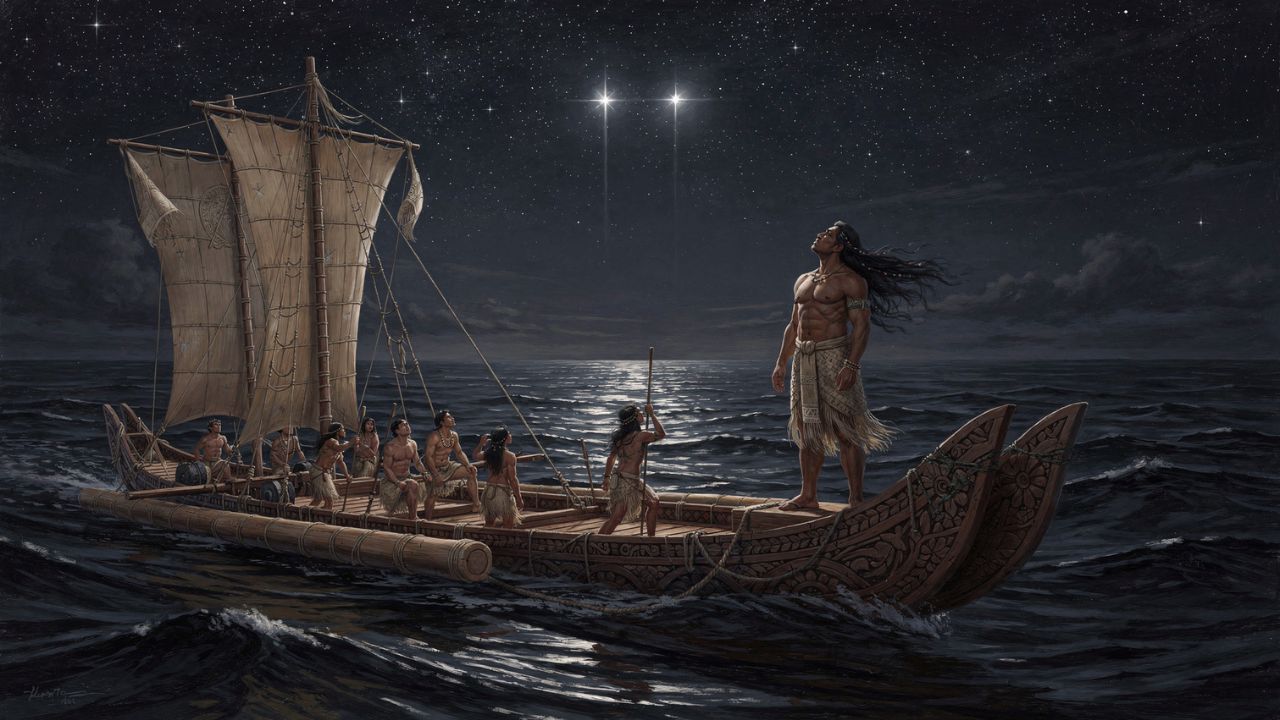
Illustration: GP Cassini | ASTRONOMIKA TV
Think about it for a moment. The Pacific Ocean covers a third of the planet’s surface. It has no signs, no horizon references, nothing but water in every direction for weeks. Polynesian navigators crossed thousands of kilometers in canoes without modern instruments, without a compass, without GPS, using only the stars as a map. And among those stars, Nā Mahoe was one of the anchors of the system. One pointed forward, the other confirmed from behind. Together they said: you’re going the right way, keep going.
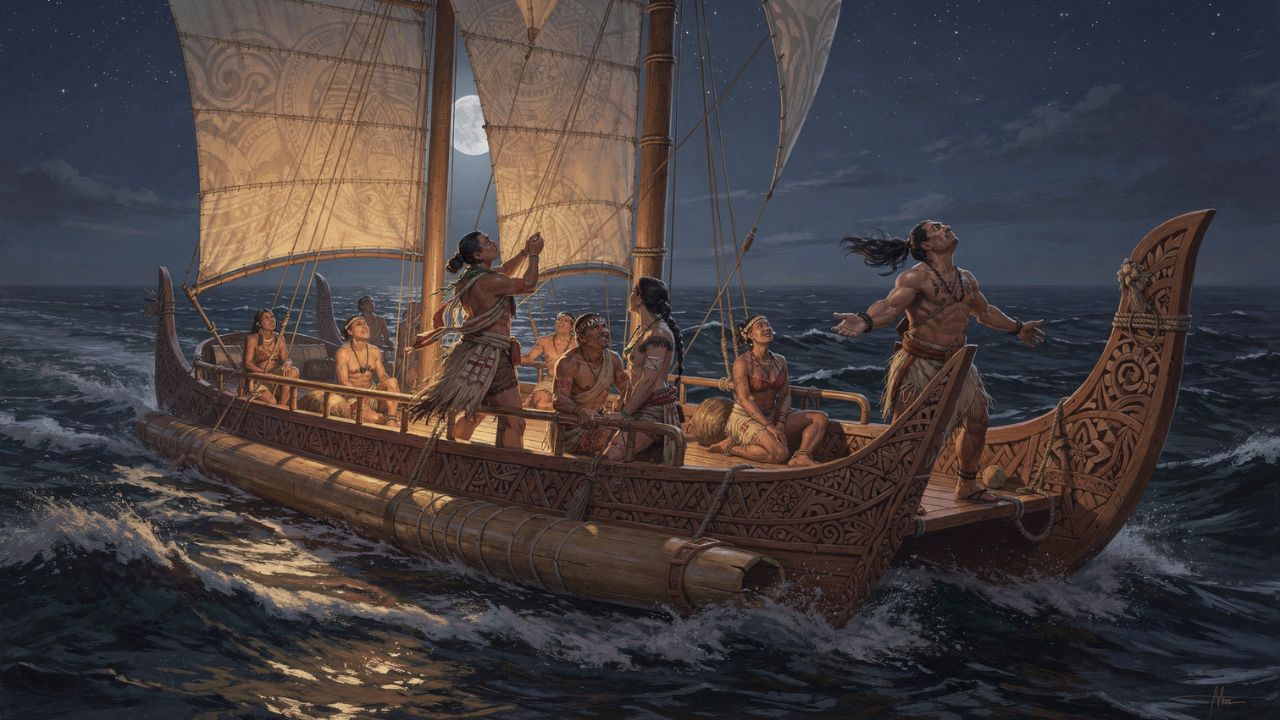
Illustration: GP Cassini | ASTRONOMIKA TV
In 1976, when Hawaiian culture was in real danger of extinction, fewer than a hundred native Hawaiian language speakers remained on all the islands. In that context, a group of Hawaiians built a replica of a traditional canoe called Hōkūle’a and sent it to cross the Pacific to Tahiti using only celestial navigation.
A young Hawaiian named Nainoa Thompson decided he would learn the ancient techniques on his own. He spent years studying astronomy at the Bishop Planetarium in Honolulu, alone at night, reconstructing with paper and pencil the navigation systems his ancestors had used centuries before. In 1980, he sailed the Hōkūle’a from Hawaii to Tahiti, 4,300 kilometers of open ocean, using only the stars. Nā Mahoe, Castor and Pollux, were part of his reference system that night. He was the first Hawaiian in six centuries to make that crossing without modern instruments.
But Thompson didn’t stop there. Between 1985 and 1987 he led the “Voyage of Rediscovery,” traveling to islands throughout Polynesia. From 2014 to 2017 he organized a complete world voyage on the Hōkūle’a: 41,000 nautical miles, 322 ports, 27 nations. And when that voyage ended, he said something that summarizes everything: “Before the Hōkūle’a, there were fewer than a hundred native Hawaiian speakers. Now there are more than 22,000.”
One canoe. The stars of Gemini. And an entire culture that came back from the edge of extinction.
For the Greeks, Nā Mahoe are the monument to a fraternal love that had to negotiate with eternity. For the Mayans, they are the twins who destroyed death with cunning. For the Polynesians, they are the compass that Hina lit so that the children of Maui could cross the ocean and then, centuries later, so that Nainoa Thompson could give his people back the memory of who they were.
The same pair of stars. Three civilizations. Three completely different ways of saying that two is always better than one.
That star you can see right now has a planet orbiting it
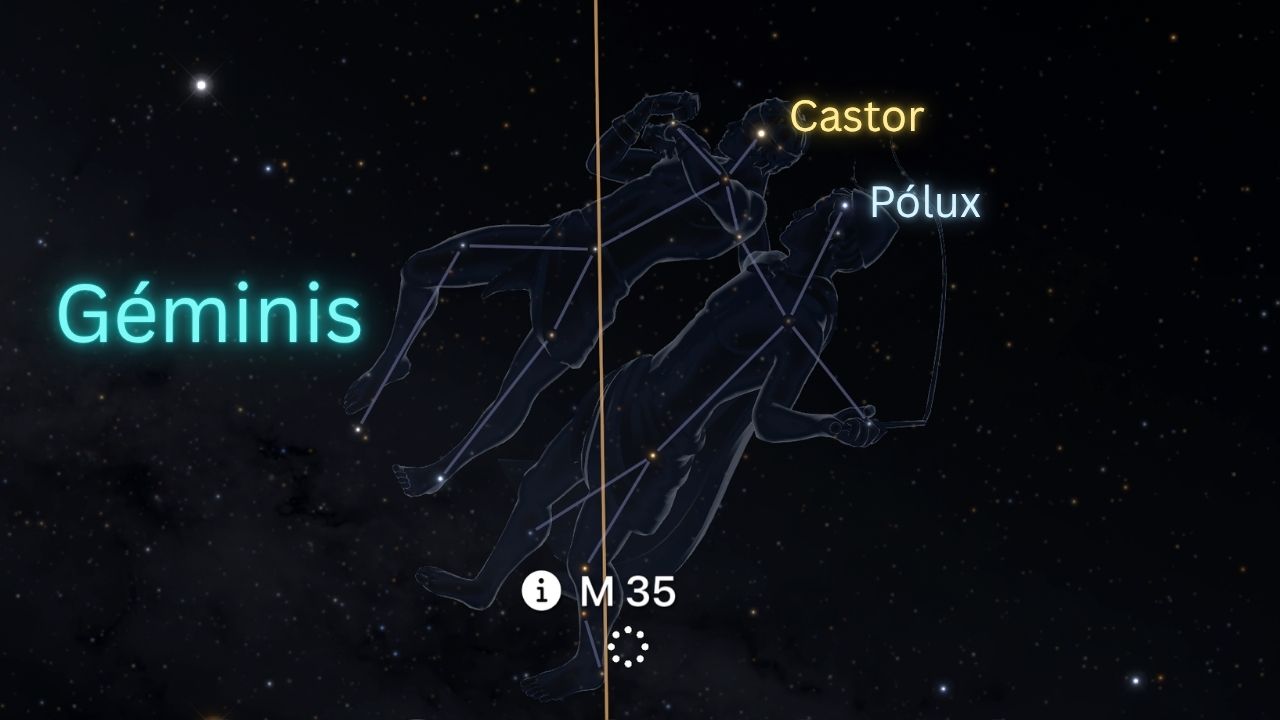
Find the two brightest stars in the constellation. The ones that always appear together, separated by just the width of three full moons placed in a row. The one on the right, glowing with a warm golden tone, is Pollux. The one on the left, slightly cooler and whiter, is Castor. And here begins the first fact that blows your mind: although Castor carries the “alpha” name of the constellation, which in astronomy should mean it’s the brightest, Pollux outshines it in magnitude. A historical classification error that nobody corrected because correcting astronomical nomenclature is a bureaucratic process that would make any self-respecting engineer cry.
Screenshot: Sky Guide App | ASTRONOMIKA TV
But the fact that really stops the reader cold is this: Pollux has a planet.
In 2006, a team of astronomers led by Artie Hatzes confirmed the existence of a planet orbiting Pollux. They named it Thestias, a name approved by the International Astronomical Union in 2015. It has a minimum mass of 2.3 times that of Jupiter and takes 590 days to complete an orbit. To put it in perspective: Mars takes 687 days to orbit the Sun. The year on Thestias is almost identical to a Martian year, only orbiting an orange giant star 34 light-years from here. That star you can see with the naked eye has a Jupiter-sized planet orbiting it right now, as you read this.
The original name proposed for the planet was Leda, in honor of the twins’ mythological mother, but it was already taken by a moon of Jupiter and an asteroid. Even in exoplanets, Leda’s reproductive logistics continue to cause problems.
Castor is not a star. It’s an entire family.
If Pollux with its exoplanet is already enough to pause and process, Castor outright changes your definition of what it means to look at a “star.”
To the naked eye, Castor is a point of light. Through a small telescope it resolves into two points of light. With more precise instruments, the story gets more complicated: Castor is actually a system of six stars gravitationally bound to each other. Six suns, three binary pairs orbiting each other in a gravitational dance that has been going on for billions of years.
What appears to be a single point of light in the sky is actually six suns dancing together 51 light-years away. It’s like looking from a distance at a single lit window and upon getting closer discovering that inside there are six different families living in the same apartment, each with their own routines, none of them interfering with the others.
M35: when binoculars change everything
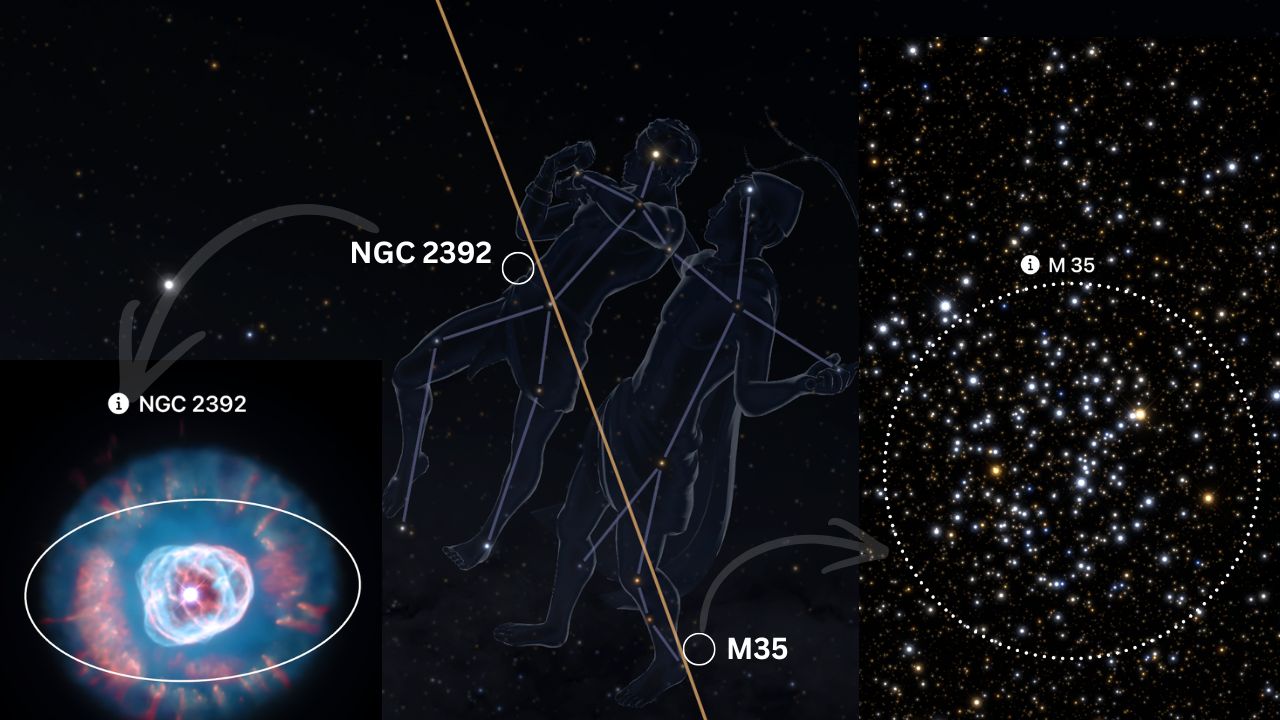
About 2,800 light-years away, floating near the “left foot” of Gemini, is M35, one of the most spectacular open clusters in the winter sky. To the naked eye it looks like just a diffuse patch, a dot that can’t quite make up its mind.
Screenshot: Sky Guide App | Graphic: ASTRONOMIKA TV
With the CELESTRON SkyMaster 15×70 the story changes completely. The cluster resolves into dozens of individual stars spread across an area of sky almost as large as the full Moon, 28 arcminutes in diameter. Several hundred stars at 2,800 light-years from here, all young in stellar terms, with barely 100 million years of age when our Sun is already 4,600 million years old. They are, literally, baby stars.
With averted vision and dark skies, the CELESTRON SkyMaster 15×70 allows you to glimpse NGC 2158, a much more distant and compact background cluster that appears as a diffuse smudge clinging to the edge of M35. Two clusters in the same field of view, even though one is four times farther away than the other.
The ZWO Seestar S50 and DWARFLAB Dwarf 3 turn M35 into a processed spectacle: dozens of resolved stars with real colors, from the blue-white of young hot stars to the orange tones of the more evolved ones.
NGC 2392: the object that tests your equipment
Inside Gemini there is an object that doesn’t appear on beginner lists, and for that very reason has something special: NGC 2392, a planetary nebula 6,500 light-years away, the expanding corpse of a star similar to the Sun that died about ten thousand years ago.
Screenshot: Sky Guide App + archive images | ASTRONOMIKA TV
It was historically known as the Eskimo Nebula for its appearance in high-resolution photographs. NASA discontinued that nickname in 2020 for being considered offensive. Today it is simply called NGC 2392. What’s inside is a white dwarf with a surface temperature of between 40,000 and 75,000 kelvin. For comparison, the Sun’s surface is at 5,778 kelvin. That central star is between seven and thirteen times hotter than our Sun, and all the gas and dust surrounding it was expelled by the star itself thousands of years ago when it was a red giant in its final days.
With binoculars, NGC 2392 is invisible. Its angular size of just 48 arcseconds makes it undetectable in any pair of binoculars.
With the ZWO Seestar S50 and DWARFLAB Dwarf 3 the story changes: in stacked images of several minutes, the general shape of the nebula, its bright central nucleus and outer structure are perfectly distinguishable, with its characteristic blue-green color.
With the SKY-WATCHER FlexTube 300P or any 12-inch aperture telescope, NGC 2392 becomes an entirely different object. With 300mm of aperture and 1,500mm of focal length, the FlexTube collects 1,840 times more light than the naked eye. It’s our favorite for this type of object because its retractable mechanism allows it to collapse and take up considerably less space, making it the easiest large-aperture instrument in the collection to transport.
The entry-level eyepiece for finding it is the 25mm Plössl, which gives 60x magnification. At that power the nebula appears as a slightly greenish diffuse patch. With a 10mm eyepiece, giving 150x, the nebula begins to reveal its structure: the bright central disk visually separates from the dimmer outer envelope. Two distinct layers become visible. At 200-250x, its two concentric layers are clearly distinguishable. An OIII filter significantly improves contrast against the sky background from light-polluted sites; it’s the difference between seeing something interesting and seeing something breathtaking.
When and from where to observe it
Gemini is a northern hemisphere winter constellation. Its best months run from December to April, with the optimal point in January and February when it crosses the meridian at midnight.
For the majority of ASTRONOMIKA TV’s audience living in Latin America, the good news is that Gemini is perfectly visible from the entire tropical and equatorial belt. From Mexico, Colombia, Ecuador, Guatemala and Peru the constellation rises to a good height in the winter sky and Castor and Pollux are easily identifiable even from cities with moderate light pollution.
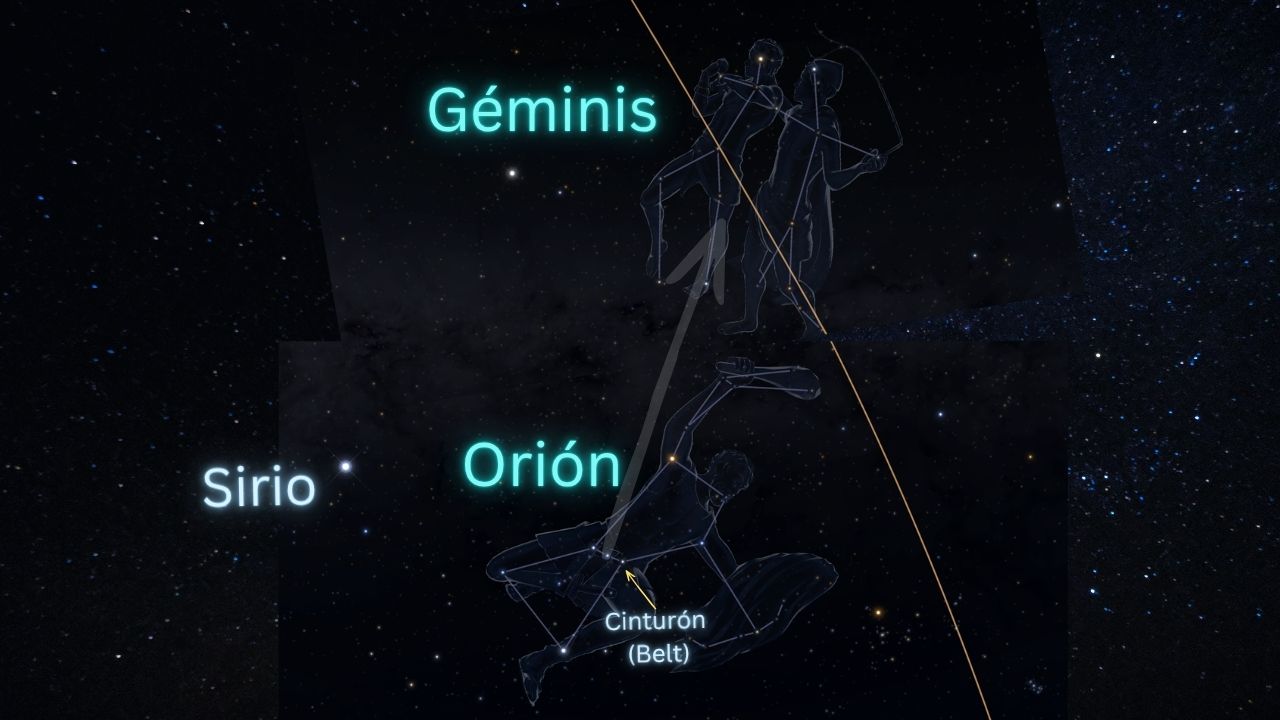
The quick trick for finding it: look for Orion, the most recognizable constellation in the winter sky with its three stars in a row. Follow the line those three stars form upward and to the left. The two bright stars you find there, always together, always at the same distance from each other, are Castor and Pollux. Nana-mua and Nana-hope. The Twins. And now you know exactly what story each one carries.
Gemini is not a sign. It’s a question.
Every civilization that looked at those two stars asked the same question in different words: what does it mean to be bound together but different? The Greeks answered with a tragedy negotiated on Olympus. The Mayans answered with a tactical victory in the underworld. The Polynesians answered with a compass that crossed the largest ocean in the world. And science answered with a sextuple system of six suns that look like one, and a giant planet orbiting in silence 34 light-years away while you read this.
None of those answers contradicts the others. All of them look at the same sky.
If you want to keep exploring the universe with this perspective, ASTRONOMIKA TV publishes astronomy content on YouTube, Instagram and TikTok every week: from stellar mythology to observation guides with smart telescopes and real optical equipment. No filters, no marketing, with the honesty of someone who goes out to observe at eleven at night to verify in person what they’re telling you.
Frequently asked questions about the Gemini constellation
Where is the Gemini constellation in the sky?
Gemini is located in the northern hemisphere winter sky, between the constellations Taurus to the west and Cancer to the east. The easiest way to find it is by using Orion as a reference: follow the line formed by Orion’s three Belt stars upward and to the left and you will find two bright stars always together. Those are Castor and Pollux, the two main stars of Gemini.
What is the brightest star in Gemini?
Pollux, also known as Beta Geminorum, is the brightest star in the constellation with an apparent magnitude of 1.14. Although it carries the “beta” name, which in astronomy should indicate it is the second brightest, it actually outshines Castor, the “alpha.” A historical classification error that nobody corrected and has been sitting there for centuries without anyone doing anything about it.
What is the difference between Castor and Pollux?
They are neighbors in the sky but physically very different. Pollux is a solitary orange giant 34 light-years away with a confirmed exoplanet. Castor is actually a system of six gravitationally bound stars 51 light-years away. Pollux has a surface temperature of about 4,666 kelvin giving it that warm golden tone, while Castor appears visually whiter and cooler. In Greek mythology Pollux was the immortal and Castor the mortal. In real astronomy, Castor turned out to be six times more complex than anyone imagined.
Does Gemini have confirmed exoplanets?
Yes. Pollux has a confirmed planet called Thestias, with a minimum mass of 2.3 times that of Jupiter and a year of 590 days, similar to a Martian year. It was confirmed in 2006 and its name was approved by the International Astronomical Union in 2015. The originally proposed name was Leda, in honor of the twins’ mythological mother, but it was already taken by a moon of Jupiter and an asteroid. Even in exoplanets, Gemini’s mythology complicates logistics.
What is M35 and how do you observe it?
M35 is an open cluster of several hundred stars located about 2,800 light-years away, near the left foot of Gemini. With an apparent magnitude of 5.3 it is technically visible to the naked eye from dark skies, though it appears as a simple diffuse patch. With the CELESTRON SkyMaster 15×70 it resolves into dozens of individual stars in a field almost as large as the full Moon. With the ZWO Seestar S50 or DWARFLAB Dwarf 3 it becomes a spectacle: resolved stars with real colors and the background cluster NGC 2158 clearly separated.
What is NGC 2392 and can I see it with a telescope?
NGC 2392 is a planetary nebula 6,500 light-years away, the expanding corpse of a Sun-like star that died about ten thousand years ago. Its central star has a surface temperature of between 40,000 and 75,000 kelvin. With binoculars it is not visible. With the ZWO Seestar S50 and DWARFLAB Dwarf 3 its shape and blue-green color are captured in stacked images. With the SKY-WATCHER FlexTube 300P or any 12-inch aperture telescope, at 150-250x magnification, its two concentric layers are clearly distinguishable.
What months is the Gemini constellation visible?
Gemini is visible from December through April in the northern hemisphere, with its optimal point in January and February when it crosses the meridian at midnight. From Mexico, Colombia, Ecuador, Guatemala and Peru the constellation rises to a good height in the winter sky and Castor and Pollux are easily identifiable even from cities with moderate light pollution.
What does Gemini symbolize in Greek mythology?
Gemini represents the twins Castor and Pollux, the Dioscuri of Greek mythology. Castor was mortal, son of King Tyndareus of Sparta. Pollux was immortal, son of Zeus. When Castor died in a fight with their cousins, Pollux begged Zeus not to leave him immortal without his brother. The solution was for both to share existence alternately: one day in Olympus, the next in the underworld. Together in destiny, never in the same place at the same time. Zeus placed them in the sky as the two brightest stars of the constellation.
How do the Hero Twins of the Popol Vuh relate to Gemini?
Hunahpu and Ixbalanque, the Hero Twins of the K’iche’ Mayan sacred book, are associated with the Gemini constellation in Mayan tradition. Their story is that of two brothers who descended into Xibalba, the Mayan underworld, and defeated the Lords of Death using ingenuity and teamwork. At the end they ascended to the sky: Hunahpu became the Sun and Ixbalanque the Moon. The same two stars, a completely different story.
Why did Polynesian navigators give importance to Castor and Pollux?
Hawaiian navigators called Castor and Pollux Nā Mahoe, “The Twins,” and used them as orientation anchors to cross the Pacific Ocean without modern instruments. Nana-mua, “Looks forward,” was Castor. Nana-hope, “Looks back,” was Pollux. Navigator Nainoa Thompson revived these techniques in the twentieth century and in 1980 sailed from Hawaii to Tahiti, 4,300 kilometers of open ocean, using only the stars. The same two stars the Greeks placed in the sky as a symbol of brotherly love continue to guide vessels safely across the Pacific today.
Sources and recommended reading
Books
- Allen, R. H. (1899). Star Names: Their Lore and Meaning. Dover Publications.
The most complete dictionary of the history and etymology of star names. Essential for understanding why stars are named as they are and which cultures named them first. - Christenson, A. J. (trans.) (2007). Popol Vuh: Sacred Book of the Quiché Maya People. University of Oklahoma Press.
The most rigorous academic translation of the original K’iche’ text. Direct primary source for everything related to Hunahpu, Ixbalanque and Xibalba. - Condos, T. (1997). Star Myths of the Greeks and Romans: A Sourcebook. Phanes Press.
The most complete work on the myths of the 48 classical constellations. Includes the only surviving ancient sources on Greek and Roman stellar mythology, with detailed academic commentary. - Low, S. (2013). Hawaiki Rising: Hōkūle’a, Nainoa Thompson, and the Hawaiian Renaissance. University of Hawaii Press.
The definitive chronicle of the Hōkūle’a project and navigator Nainoa Thompson. The complete story of how a people recovered their culture by sailing by their ancestors’ stars, including Nā Mahoe.
Digital sources
- NASA Exoplanet Archive. Pollux b / Thestias. exoplanetarchive.ipac.caltech.edu
NASA’s official database with all confirmed parameters of the exoplanet Thestias: mass, orbital period, distance and confirmation date. - Polynesian Voyaging Society / Hōkūle’a Archive. Hawaiian Star Lines and Names for Stars. hokulea.com
Primary source for the Hawaiian nomenclature of Nā Mahoe, Nana-mua and Nana-hope, and for the complete history of the Hōkūle’a project and modern Polynesian stellar navigation. - EarthSky. Pollux: The Brighter Twin Star. earthsky.org
Rigorous and up-to-date science communication about the physical characteristics of Pollux and its position as the nearest orange giant to the Sun.