
The Greek myth, the Babylonian version, and what the Incas saw when they looked at the Andes sky
By Juan Pablo Martín | ASTRONOMIKA TV | May 2026
Credit: ASTRONOMIKA TV / Flux 2 Pro
Aries is the first sign of the zodiac, the official starting point of the astrological calendar, and probably the constellation with the best excuse for being where it is. Behind the name there is a golden ram, a stepmother with a manipulation plan worthy of a prestige TV series, two children who fled with nothing but the clothes on their backs, and one of the most brutal ironies in all of Greek mythology.
The official story says the ram was a hero. What nobody mentions as often is what happened to it after being one.
The Ram That Escaped Sacrifice… and Got Sacrificed Anyway
There is an unwritten rule in Greek mythology: if someone does you an enormous favor, chances are you will repay it badly. Phrixus, prince of Boeotia, confirmed that rule with an efficiency that still stings.
But to understand why a golden ram ended up as a constellation, you have to start with the real villain of this story. And the villain is not who you think.
Nephele was a minor goddess, literally made of cloud, first wife of King Athamas of Boeotia, a region in central mainland Greece northwest of Athens. It still goes by the name Boeotia today and is part of modern Greece; its most famous city was Thebes, which still exists under the same name. This is not metaphor: Nephele was a cloud shaped like a human that Zeus fashioned to deceive Ixion, and who ended up married to a mortal king because the gods had a rather particular sense of humor. King Athamas and Nephele had two children: Phrixus and Helle.
King Athamas decided at some point that being married to a cloud was not satisfying enough, and found himself a second wife made of flesh and blood. His choice was Ino, daughter of Cadmus, founder of Thebes. Ino had ambition, intelligence, and zero patience for the children of the first marriage.
Ino’s plan was as simple as it was brutal. She convinced the women of Boeotia to secretly roast the wheat seeds before planting. The harvest failed. Famine arrived. King Athamas, desperate, sent emissaries to the oracle at Delphi for guidance. Ino intercepted the messengers, bribed whoever needed bribing, and the answer that came back was this: the famine will only end if you sacrifice your son Phrixus.

Credit: ASTRONOMIKA TV / Flux 2 Pro
The famine served its purpose. King Athamas, desperate and out of options, was exactly where Ino wanted him. Then came the second blow.
Ino was not satisfied with the political sentence alone. She knew a charge based on an agricultural crisis could be undone over time, that a remorseful king could change his mind, that the death sentence needed something more solid to hold. So she added a second accusation, this time personal: she told King Athamas that Phrixus had tried to seduce her. In ancient Greece, that charge required no evidence. It was enough for the king’s wife to say it out loud. King Athamas, who had already demonstrated on repeated occasions that he was not the most perceptive father in the ancient world, believed her without question.
At that moment Phrixus and Helle stopped being inconvenient children from a previous marriage. They became fugitives under a death sentence fabricated by someone who had spent years waiting for exactly the right opportunity.
Credit: ASTRONOMIKA TV / Flux 2 Pro
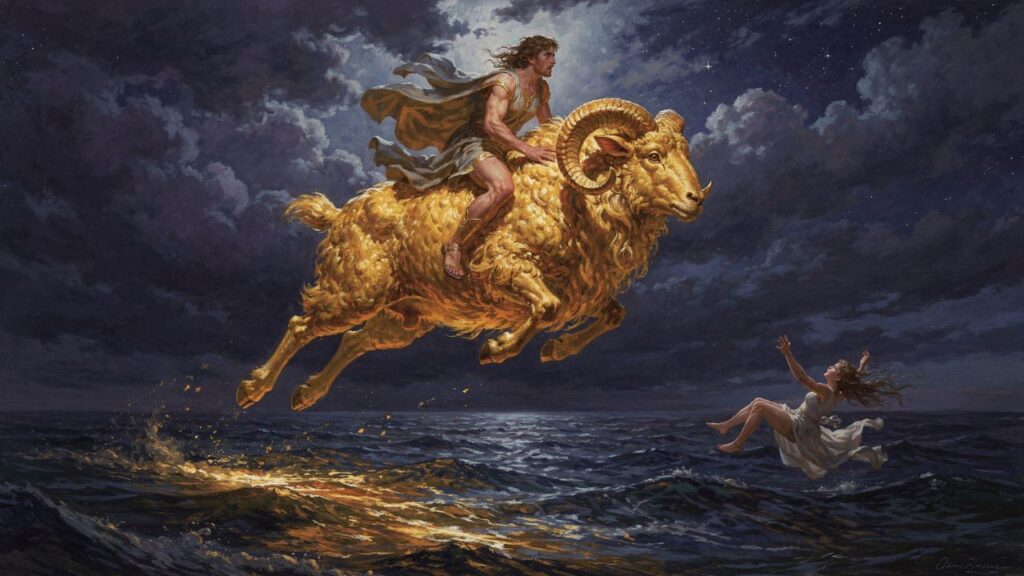
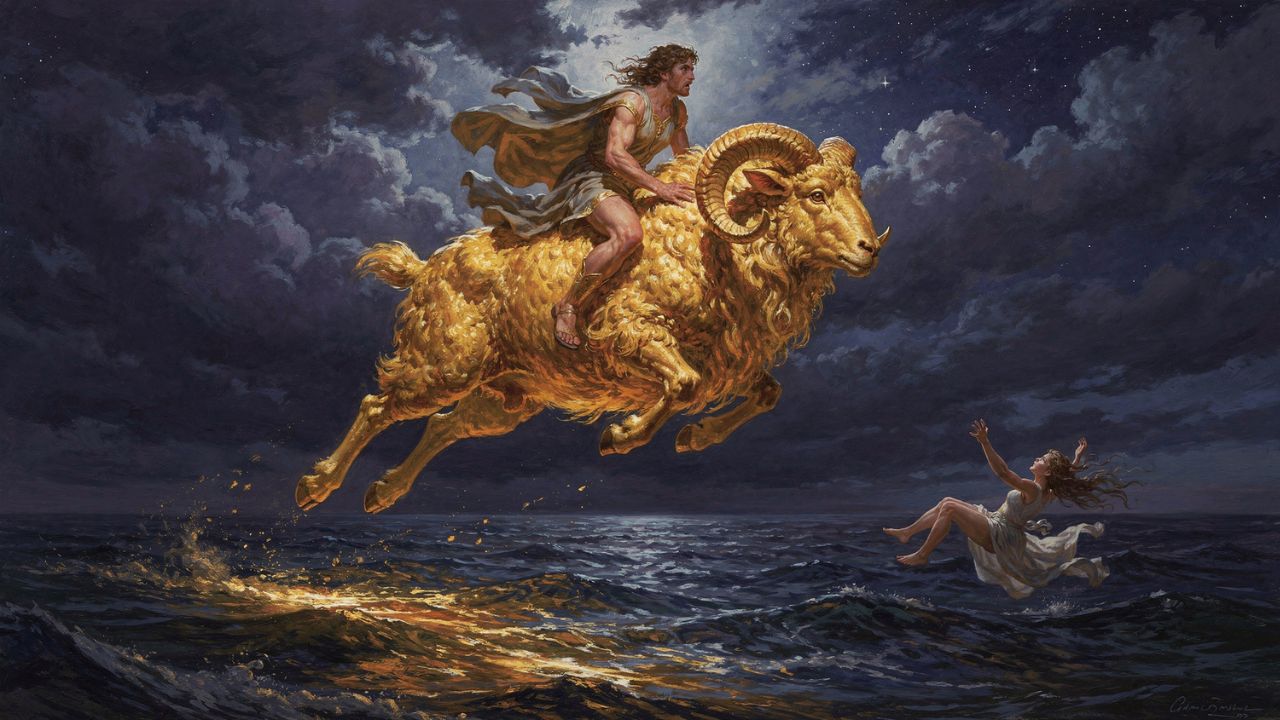
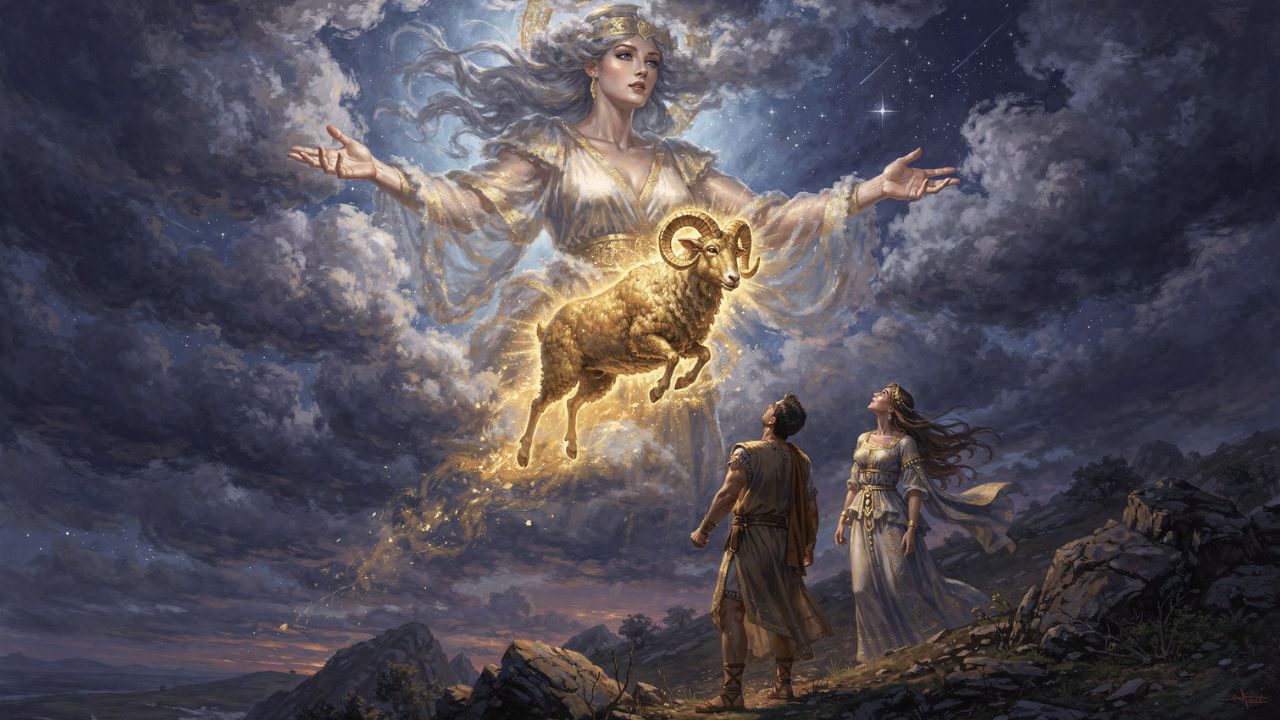
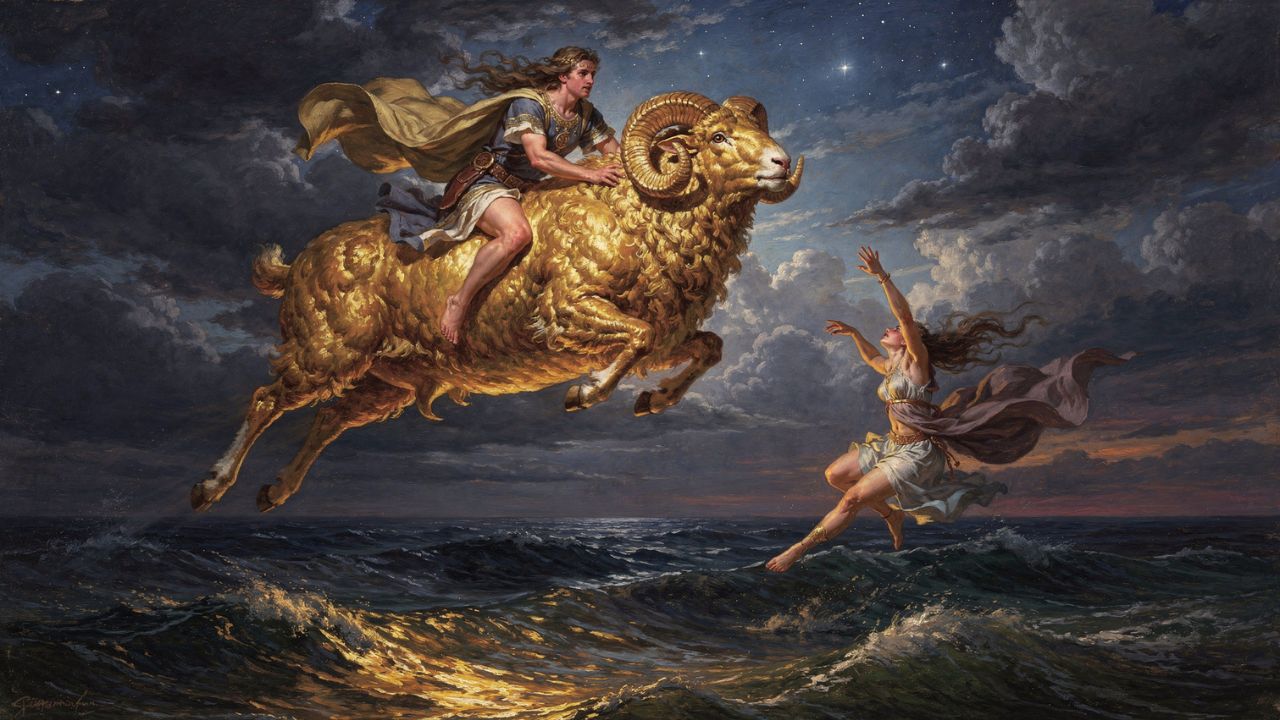
What happened next depends on the version. In some, it was Nephele who sent the ram from the sky, unable to watch her children die. The cloud mother King Athamas had abandoned for Ino was not as far away as everyone thought. In others, it was Hermes on Zeus’s orders. In all versions, the result was the same: a ram with pure golden wool appeared before Phrixus and his sister Helle with a fairly clear implicit message. Get on.
Credit: ASTRONOMIKA TV / Flux 2 Pro
The flight began over Boeotia and continued eastward, crossing the sea that today separates Europe from Asia. This is where the story turns sad. Helle lost her grip somewhere over the strait, fell into the water, and died. That body of water has been called the Hellespont ever since, which in Greek means, literally, “the sea of Helle.” Every time someone says Hellespont, without knowing it, they are naming a girl who fell from a flying ram three thousand years ago.
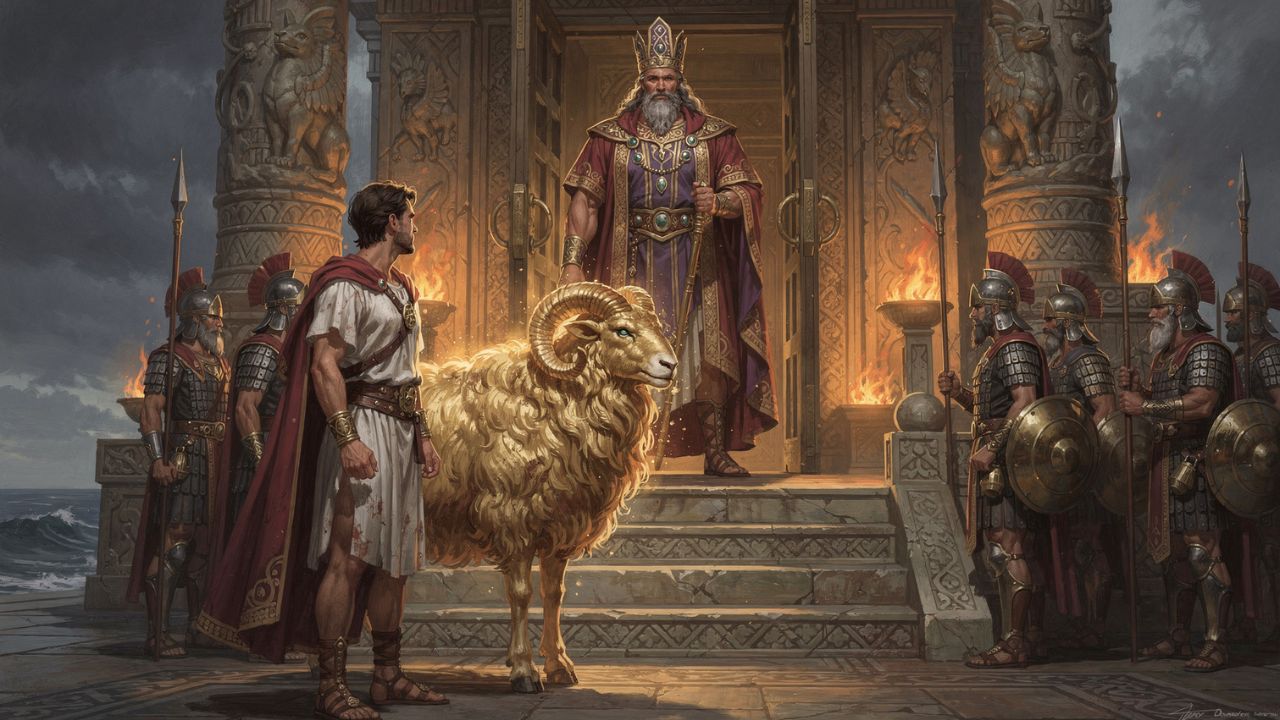
Phrixus arrived alone at Colchis, on the eastern shore of the Black Sea, in what is now Georgia, the Caucasus country that borders Russia to the north and Turkey to the south. This is not an invented place: the Greeks actively traded with that region, and many historians believe the Golden Fleece myth has roots in real exploration expeditions into the Black Sea.
Credit: ASTRONOMIKA TV / Flux 2 Pro
Phrixus arrived alive, arrived safe, arrived thanks to the ram.
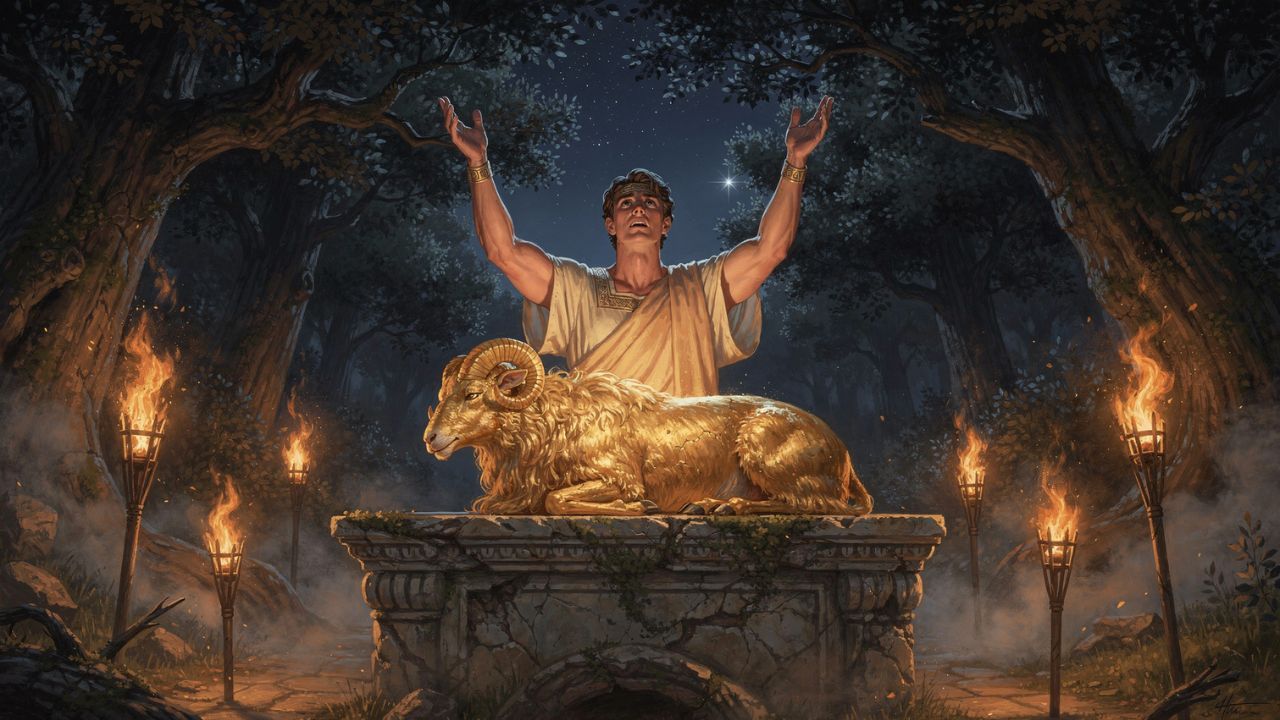
And then he did something Greek mythology never quite managed to explain satisfactorily: he sacrificed the ram as an offering of gratitude to Zeus. The animal that saved him. The only being in this entire story who acted with dignity. He sacrificed it.
Credit: ASTRONOMIKA TV / Flux 2 Pro
Zeus, according to some versions, was angry. According to others, he was moved by the gesture, though moved in that uncomfortable way you are moved by something you also find profoundly stupid. Either way, he took the ram and placed it among the stars. With its face looking backward, toward the Pleiades, as if it were still searching for Helle on the road it could no longer retrace.
The ram’s hide, the skin with golden wool, remained in the hands of King Aeetes. He hung it in a sacred grove consecrated to Ares, guarded by a dragon that never slept. It was not a trophy. It was the most coveted object in the ancient world.
Why did everyone want that hide?
The Golden Fleece was not decorative. In the Greek worldview it held real powers: healing, fertility, divine legitimacy. Whoever possessed it did not just have wealth; they had the visible backing of the gods. In modern terms, it was the combination of a crown, a central bank, and a certificate of sainthood in a single object.
That is why Pelias, the usurper king of Iolcus, sent his nephew Jason to find it. Not because he believed Jason would succeed, but precisely because he did not believe Jason would succeed. It was a suicide mission wrapped in the packaging of a heroic adventure. Pelias wanted to get rid of Jason, who had more legitimate claim to the throne than he did, and the Fleece was the perfect excuse.
What happened when Jason arrived in Colchis, who actually got the Fleece and at what cost, involves one of the most complex women in all of Greek mythology and a betrayal that makes Ino’s plan look amateur. The Argonauts have their own chapter coming. If you have already read the Gemini article, you know that Castor and Pollux were on that ship. But that is another story.
The Greeks placed the ram in the sky with its face looking backward. Never entirely clear whether it is nostalgia or reproach. Probably both.
When the Ram Stopped Being a Ram
When the Greek ram crossed the Mediterranean and kept traveling, it stopped being a tragic hero and became something else entirely. In Babylon it became a clock. In the Andes it was never a ram at all.
Babylon: The Ram That Was a Calendar
The Babylonians did not need drama to give importance to the sky. It was enough for it to be useful.
Around 2000 BC, astronomers of the Babylonian Empire were building the most precise celestial observation system that existed at the time. The result was the MUL.APIN, a series of clay tablets cataloguing stars, planets, and the movements of the Sun with a precision that would not be matched in the West for centuries. In that catalogue, the constellation we now call Aries had a different name: LUHUNGA, the agricultural worker, the day laborer of the sky. It was not a golden ram. It was a worker.
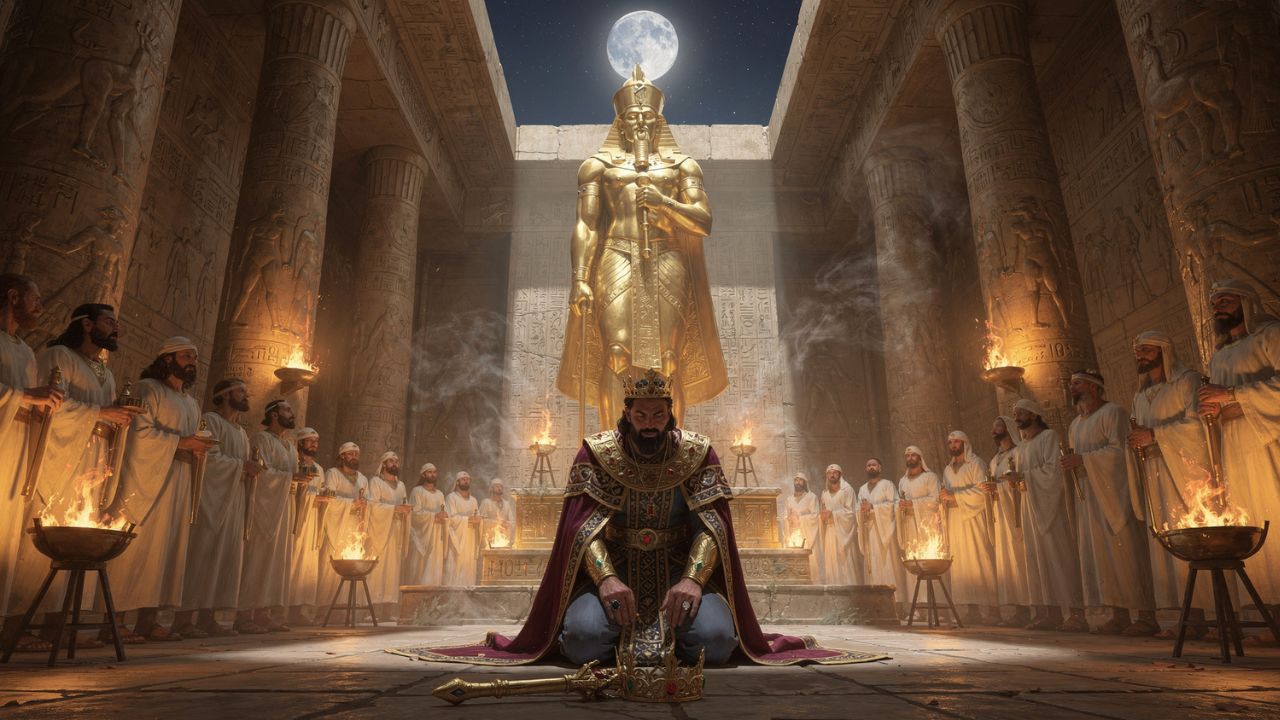
And its function was specific: to mark the spring equinox. When the Sun entered that region of the sky, the Babylonian New Year began. The date was celebrated with the Akitu, the most important ceremony in the Mesopotamian calendar. For twelve days, Babylon stopped. Markets closed, courts suspended their proceedings, and the king, the most powerful man in the empire, performed a ritual that would make any modern head of state deeply uncomfortable.
The high priest removed the king’s scepter, crown, and royal ring. He knelt him before the statue of the god Marduk. And in that position, the king had to declare out loud that he had not sinned, that he had not neglected his people, that he had not destroyed Babylon. If he said it with enough conviction, Marduk returned the royal attributes and the king ruled another year. That entire system, that architecture of political and religious power, began when the Sun entered what the Greeks would call Aries.
Credit: ASTRONOMIKA TV / Flux 2 Pro
The contrast with the Greek version is almost comic. In Greece, the ram is an individual with a story, a specific mission, an unjust death, and a deserved immortality. In Babylon there is no ram, no drama, no sacrifice. There is a point in the sky that tells the world when the year begins. It is cosmic bureaucracy elevated to sacred status.
And here is the fact that changes everything for anyone who follows astrology: that point is no longer in Aries.
The Earth does not spin perfectly fixed. Its axis traces a slow circle, like a top beginning to lose momentum, with a period of approximately 26,000 years. This causes the point where the Sun crosses the celestial equator at the spring equinox, the famous vernal point, to move slowly backward through the zodiac constellations. One degree every 72 years, in the opposite direction to the Sun’s annual path.
When the Babylonians built their system, around 2000 BC, that point was in Aries. That is why they named it there. That is why the New Year started there. It made complete sense.
When the Greeks inherited the system and codified it, the vernal point was still near Aries, though already moving. They noticed it, documented it, and still decided to leave the names as they were. It was more practical than renaming the entire zodiac. A reasonable decision for their time.
But the sky did not wait. Since 68 BC, the vernal point has technically been in Pisces. It has been there for more than two thousand years. And in the 21st century it is slowly crossing toward Aquarius, which some call the “Age of Aquarius,” though the exact date of the crossing depends on how you define the boundaries of each constellation, and astronomers do not fully agree on that.
What is clear is this: the zodiacal system we use today, both in historical astronomy and in astrology, was fixed approximately 2,000 years ago. At that time, the sign of Aries corresponded to the constellation of Aries. The sign of Taurus corresponded to the constellation of Taurus. There was a real alignment between what the calendar said and what was in the sky.
Today that alignment has a gap of nearly 30 degrees, the equivalent of one full constellation. When the Sun is astrologically “in Aries,” it is astronomically in Pisces. When it is “in Taurus,” it is in Aries. The map and the territory have been drifting apart in silence for twenty centuries.
What each person does with that information is a personal decision. But it is a question worth asking.
The Andes: When the Sky Is Made of Shadows, Not Stars
Europeans arrived in America convinced they knew how to read the sky. They brought their Greek zodiac, their twelve constellations, their system of points connected by imaginary lines. What they did not expect to find was a civilization that had been reading the sky in a completely different way for centuries, and that in several respects understood it better.
The Quechua peoples of the Andes, including the Incas at their peak, developed two parallel systems of astronomy. The first was based on stars, similar in concept to the European system though with different figures. The second had no equivalent in any other known culture at that time: the dark constellations.
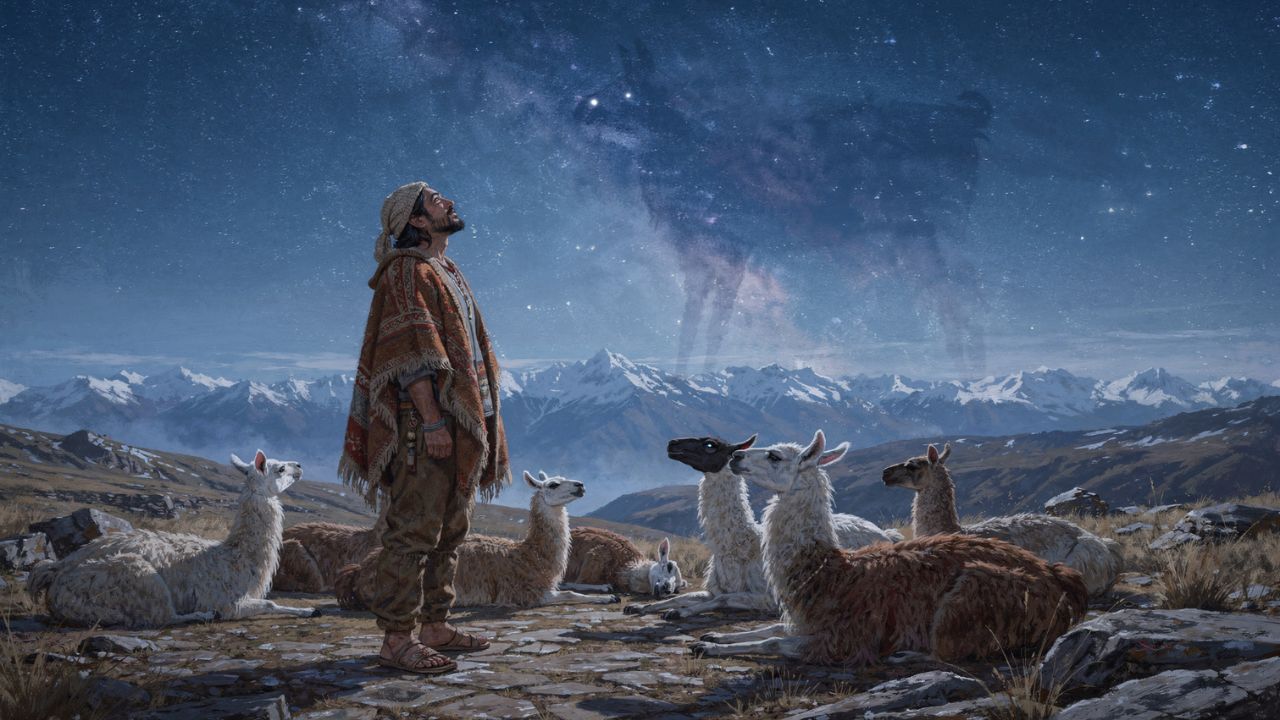
Instead of connecting points of light, Andean astronomers traced figures using the dark patches of the Milky Way, the regions where interstellar dust blocks the background starlight. To the trained eye in the Andes, with skies free of light pollution at 3,000 to 4,000 meters of altitude, those dark patches formed silhouettes as clear as any Western constellation. And the most important ones had the shape of animals.
The largest and most sacred was the Yacana, the celestial llama. It stretched along the Milky Way with its young beside it, perfectly visible on the nights of the June solstice from the southern hemisphere. It was not a decorative symbol. It had a specific and urgent cosmic function: according to Quechua tradition, the Yacana descended to Earth before dawn and drank the water of the sea. Without that act, the ocean would overflow and the world would flood.
Credit: ASTRONOMIKA TV / Flux 2 Pro
Andean shepherds who tended llamas and alpacas watched her with particular attention during the solstice. If the Yacana appeared clearly, the agricultural year would be good and the livestock would reproduce strongly. The contrast with the Greek ram could not be deeper: Phrixus is an individual with a name, a story, personal decisions, and personal consequences. The Yacana does not act out of loyalty, gratitude, or the command of any particular god. It acts because it is its nature, because without that act the world does not work. It is cosmic responsibility without ego.
And while 16th-century European missionaries actively prohibited Andean astronomical observation practices, labeling them idolatry, communities in Bolivia, Peru, Ecuador, and northern Argentina kept transmitting that knowledge orally. Five centuries later, researchers like Gary Urton documented that the system is still alive in rural highland communities, where shepherds still identify the Yacana in the sky before deciding the best time for livestock breeding. This is not folklore. It is an observation system that worked for millennia and survived the prohibition.
Three cultures, three readings of the same sky: a ram with a proper name that died for doing a favor, an astronomical point that told a king when to kneel, and a llama without ego that drank the sea so the world would not drown. Aries is the same direction. What each culture saw there says more about them than about the stars.
Hamal Is 96 Million Years Old and Already Fading. The Sun Is 4.6 Billion and Only Halfway Through.
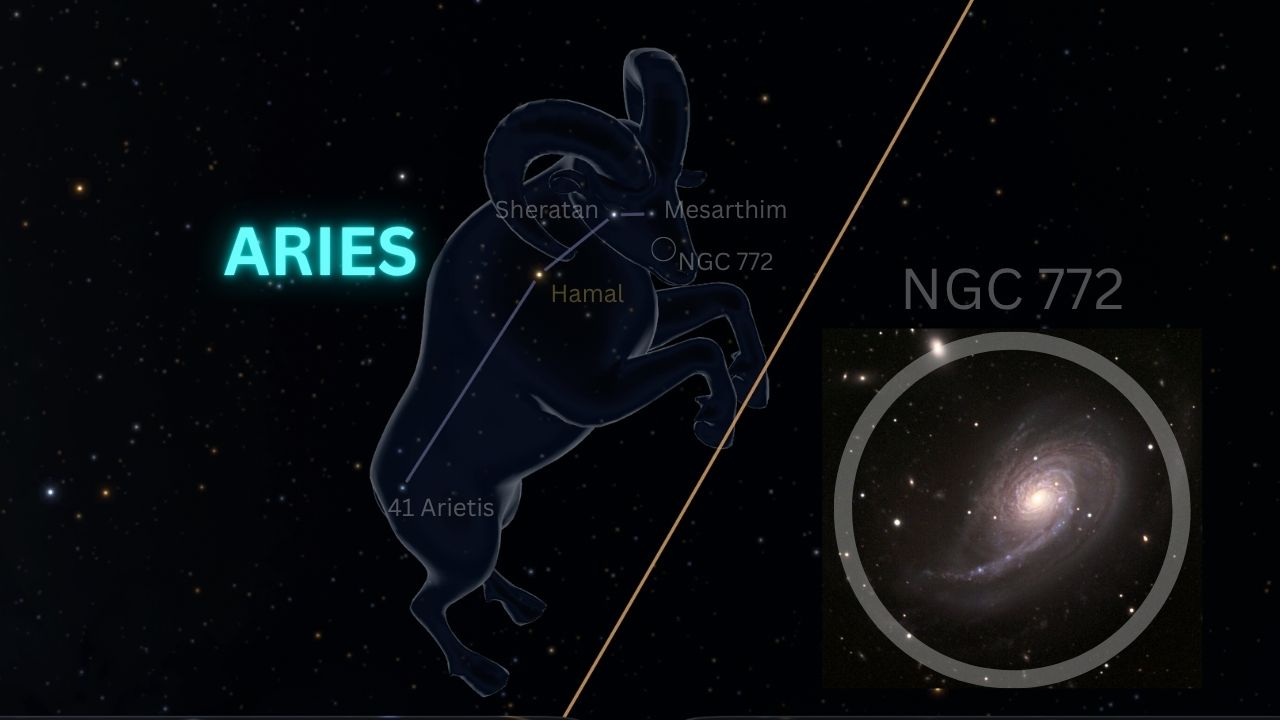
Aries is not the brightest constellation in the sky. It does not have the largest star or the most photogenic nebula. What it has is a star living out its final chapters in slow motion, and a galaxy that has been deformed by its neighbor for millions of years while we watch and can do nothing about it.
Capture: Sky Guide App | ASTRONOMIKA TV
Hamal: The Star That Burned Too Fast
The brightest star in Aries is called Hamal, from the Arabic for “head of the ram.” It sits 66 light-years away, which in cosmic terms is practically next door. If something changed in Hamal right now, we would find out in the year 2090.
Hamal is an orange giant. That sounds like a color description, but in stellar astronomy it is a diagnosis. Orange giants are stars that have already exhausted the hydrogen in their core, expanded, and are burning helium in outer layers while waiting for what comes next. It is the stellar equivalent of someone who has already finished their working life and is living off savings.
Hamal is 96 million years old. That sounds like a lot until you compare it with the Sun, which is 4.6 billion years old and has another 5 billion to go. Hamal is a star that was born massive, burned through its fuel at a disproportionate rate, and reached stellar old age before the first dinosaurs existed on Earth. It is a Formula 1 engine next to a freight truck diesel. Brutal power, short life.
Its final destiny is to become a white dwarf, the compressed core left behind when a medium-sized star finishes collapsing. No spectacular explosion, no supernova. Just a slow and silent cooling over billions of years.
With the CELESTRON SkyMaster 15×70 (Mexico | United States | Spain) on a clear night, Hamal is easy to find and its orange tint is perceptible compared to the white stars in the surrounding field. You do not need specialized equipment to see that something about that star is different.
NGC 772: The Galaxy Losing an Arm
At 130 million light-years away there is a spiral galaxy that has been in an uncomfortable situation for millions of years. NGC 772 has asymmetric spiral arms, one noticeably more developed and extended than the other, and the reason is its neighbor NGC 770, a compact elliptical galaxy that orbits too close and has been exerting gravitational pull that distorts NGC 772’s structure from within for millions of years.
130 million light-years is a distance that does not fit well in the human mind. The light you see today from NGC 772 left that galaxy when the first ancestors of crocodiles were just appearing on Earth. That light traveled all that time, crossed 130 million light-years of void, and ended up on the sensor of a smart telescope pointed at the night sky.
With the ZWO Seestar S50 (Mexico | United States | Spain) or the DWARFLAB Dwarf 3, NGC 772 is an achievable target from areas with moderate light pollution. In 30 to 45 minutes of integration the spiral arms begin to appear and the asymmetry produced by NGC 770 becomes visible. It is exactly the type of object smart telescopes were designed for: too faint for the naked eye, perfectly accessible with current technology.
When and Where to Observe
Aries is an autumn and winter constellation in the northern hemisphere. Its best window runs from October through February, with November and December as the optimal peak. From Mexico and the rest of Latin America, Aries transits high in the night sky during those months. From the southern hemisphere it is also visible, though it transits lower on the northern horizon.
Capture: Sky Guide App | Design: ASTRONOMIKA TV
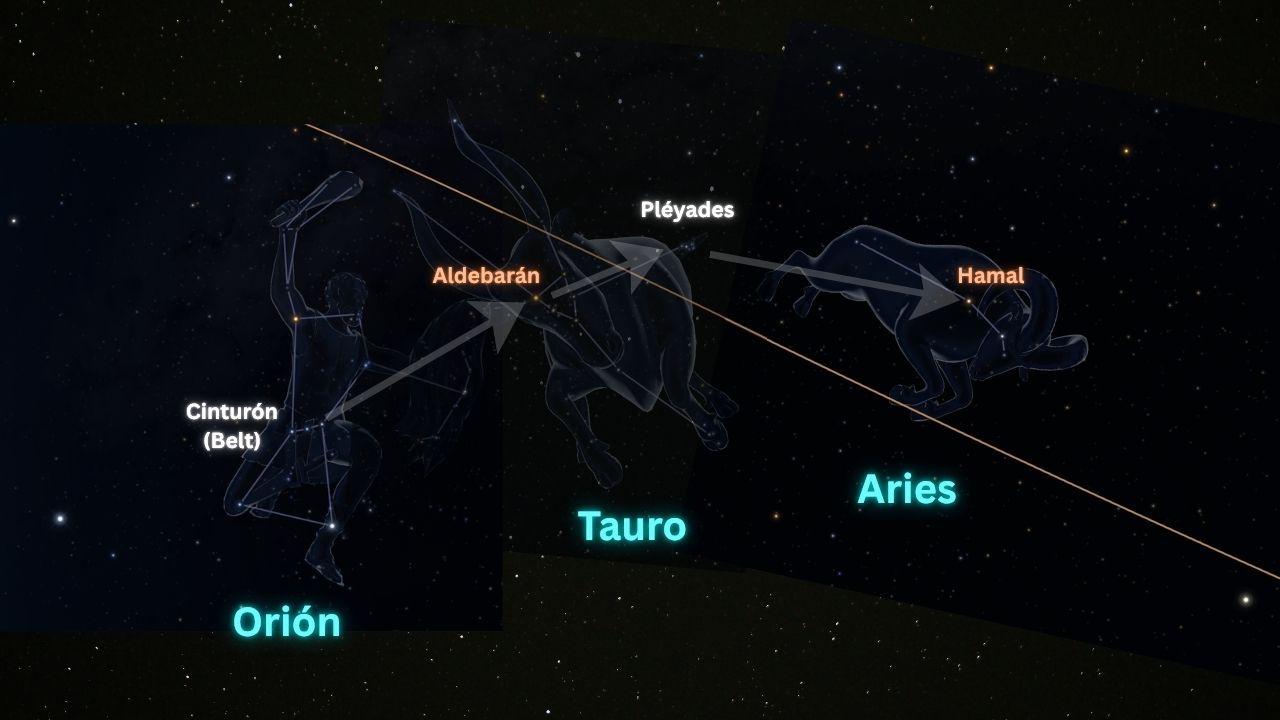
To find Aries without an app, the most reliable path starts at Orion, the most recognizable constellation in the winter sky. Find the Belt, those three perfectly aligned stars in a diagonal. From there trace an imaginary line toward where the Sun sets and follow it until you reach a star with a slightly orange tint. Along the way you will pass near Aldebaran, the red giant of Taurus, which works as a checkpoint to confirm you are on track. That orange star at the end of the path is Hamal. You have arrived at Aries.
If you can already identify the Pleiades, that compact group of blue stars that looks like a small bright cloud, the route is shorter: from the Pleiades look toward where the Sun sets, and Hamal appears almost immediately. It is the first bright star with an orange tint you will find on that path.
Aries is the first sign of the zodiac, the official starting point of the astrological calendar, and the most famous ram in ancient history. And yet, the star that gives it its name is already in its final stages, the point in the sky that made it important has been in another constellation for two thousand years, and the animal that inspired all of this died sacrificed by the very person it saved.
There is something poetically just about that. Not everything that starts something receives the credit it deserves.
If the ram’s myth left you wanting more, Aries First Light, First Fire by ASTRONOMIKA BEATS is the perfect soundtrack for your next night under the stars.
If you want to keep exploring the sky with us, find us on YouTube, Instagram, and TikTok as ASTRONOMIKA TV. More constellations, more cosmic drama, and more deep sky objects waiting for you.
Frequently Asked Questions About the Aries Constellation
What does the Aries constellation represent?
Aries represents the golden ram of Greek mythology, the animal sent by the gods to rescue Phrixus and Helle from an unjust death sentence. Zeus immortalized it in the sky after Phrixus sacrificed it as an offering of gratitude, in one of the most contradictory gestures in all of classical mythology.
Why is Aries the first sign of the zodiac if it is not the first constellation in the sky?
Because when the Babylonians and Greeks established the zodiacal system approximately 2,000 years ago, the vernal point, where the Sun crosses the celestial equator at the spring equinox, was in Aries. That point marked the start of the astronomical year, so Aries came first. Today that point has moved to Pisces, but the name stayed.
What is the Golden Fleece and what does it have to do with Aries?
The Golden Fleece is the hide of the Aries ram. After Phrixus sacrificed it in Colchis, King Aeetes hung the skin in a sacred grove guarded by a dragon that never slept. That object became the most coveted symbol of divine legitimacy in the ancient world, and was the reason for Jason and the Argonauts’ voyage.
When and from where can you see Aries?
Aries is visible from October through February, with November and December as the best window. From Mexico and the rest of Latin America it transits high in the night sky during those months. From the southern hemisphere it is also visible, though it transits lower on the northern horizon.
What is the brightest star in Aries?
Hamal, also known as Alpha Arietis. It sits 66 light-years away and is an orange giant in the process of stellar aging. Its slightly orange tint is perceptible to the naked eye on a clear night, especially compared to the white stars in the surrounding field.
What galaxy is in Aries and how can you observe it?
The most interesting one is NGC 772, a spiral galaxy 130 million light-years away with asymmetric arms. That asymmetry is produced by NGC 770, a compact galaxy that orbits too close and has been gravitationally deforming its structure for millions of years. It is photographable with smart telescopes like the ZWO Seestar S50 or the DWARFLAB Dwarf 3 in 30 to 45 minutes of integration from areas with moderate light pollution.
Why is the “first point of Aries” no longer in Aries?
Due to Earth’s axial precession. The Earth’s axis traces a slow circle of approximately 26,000 years, which causes the vernal point to drift backward through the zodiac constellations at one degree every 72 years. When the zodiacal system was established, that point was in Aries. Since 68 BC it has been in Pisces, and it is currently approaching Aquarius.
What did the Babylonians see in the Aries constellation?
Not a heroic ram but an agricultural worker. In the Babylonian star catalogue MUL.APIN, this constellation was called LUHUNGA, the day laborer of the sky. Its function was to mark the spring equinox and the start of the Babylonian New Year, celebrated with the Akitu, the most important ceremony in the Mesopotamian calendar, in which the most powerful king in the empire had to kneel before the god Marduk to renew his legitimacy.
How does Aries relate to Andean cosmology?
In the Andes, the equivalent was the Yacana, the celestial llama formed by the dark patches of the Milky Way. According to Quechua tradition, the Yacana drank the water of the sea before dawn to prevent the world from flooding. It was the protector of camelid livestock and its appearance in the June solstice sky indicated whether the agricultural year would be prosperous. This knowledge survived five centuries of colonial prohibition and remains alive in rural highland communities in Bolivia, Peru, and Ecuador.
This article contains affiliate links. If you purchase through them, I receive a small commission at no additional cost to you.
Sources and Recommended Reading
Books
- Grimal, P. (1951). The Dictionary of Classical Mythology. Blackwell.
The standard reference for classical mythology research. Covers the cycle of Phrixus, Helle, and the origin of the Golden Fleece in detail with textual variants. - Urton, G. (1981). At the Crossroads of the Earth and the Sky: An Andean Cosmology. University of Texas Press.
The most complete fieldwork available on Quechua astronomy and Andean dark constellations, including the Yacana. Urton documented these traditions directly in highland communities in Peru.
Digital Sources
- NASA Science. (2023). Hamal: Alpha Arietis. science.nasa.gov
Technical profile of Hamal with updated data on distance, spectral classification, and evolutionary status. The essential starting point for any data on this star. - Hunger, H. & Pingree, D. (1989). MUL.APIN: An Astronomical Compendium in Cuneiform. Österreichische Akademie der Wissenschaften. Summary available at britishmuseum.org
The original Babylonian star catalogue where LUHUNGA appears. The British Museum holds original tablets and offers accessible historical context online.