
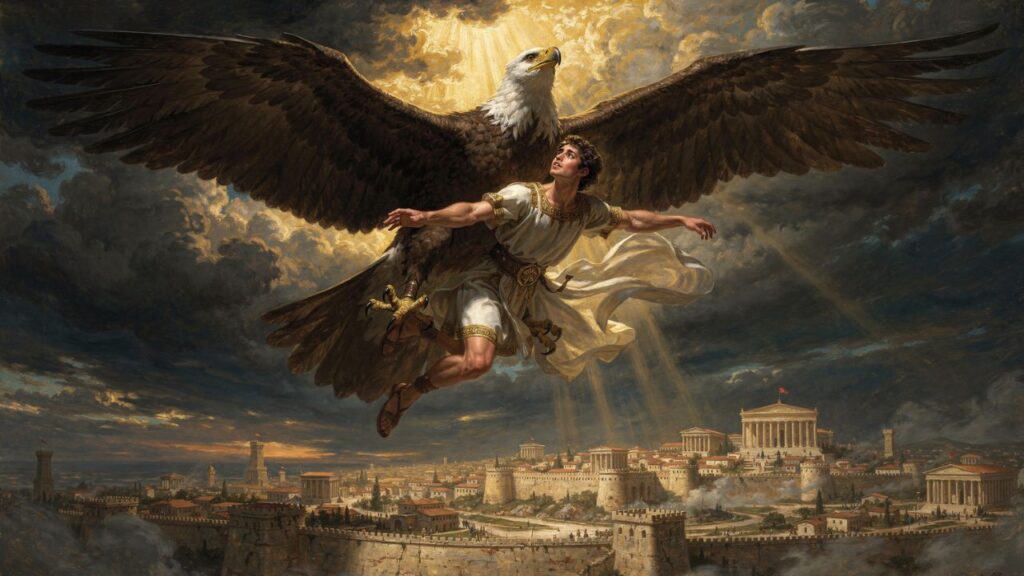
The Aquarius constellation hides one of mythology’s most scandalous stories and the nebula that reminds you the Sun also has an expiration date. By Juan Pablo Martín | ASTRONOMIKA TV.
The Greek myth, the Babylonian cosmogony, the Chinese omen, and the nebula that reminds you the Sun also has an expiration date.
By Juan Pablo Martín | ASTRONOMIKA TV | June 2026
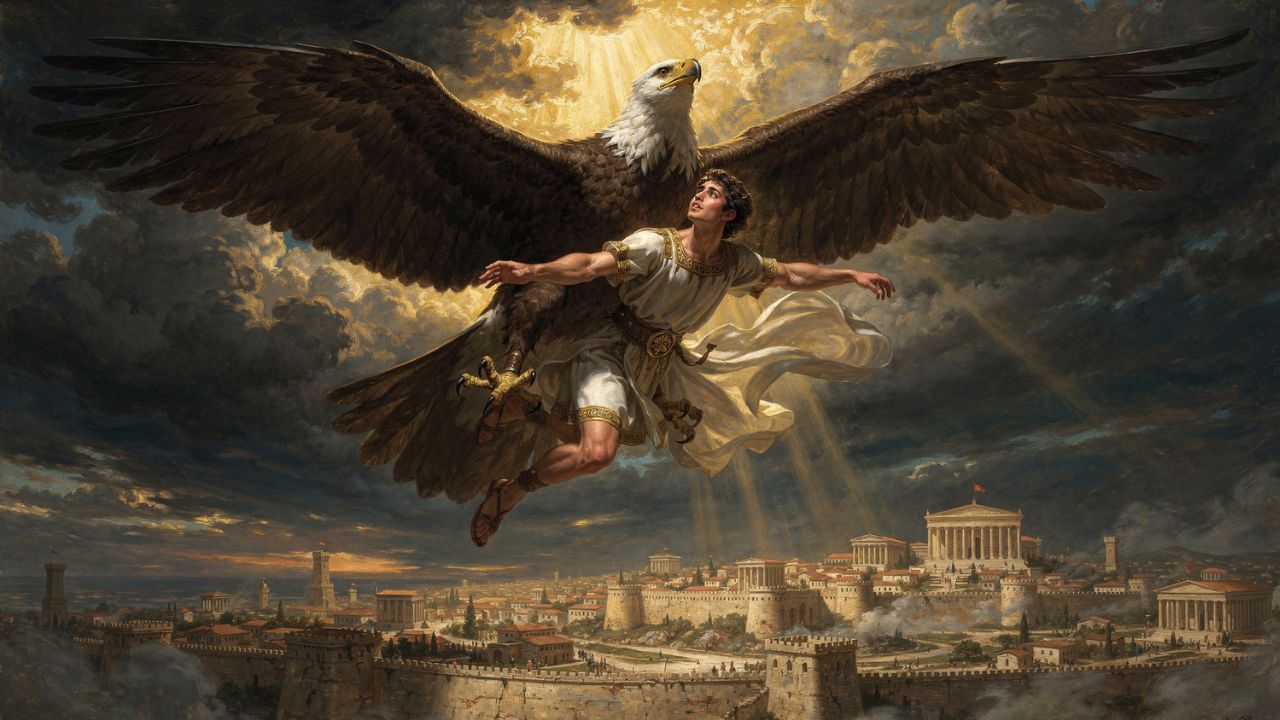
Credit: Image generated with Flux 2 Pro / ASTRONOMIKA TV
The Aquarius constellation carries a secret that textbooks skip over with remarkable elegance. This isn’t a story about heroes or defeated monsters. It’s the story of a human boy so impossibly handsome that the most powerful god in the universe decided he simply couldn’t go on living without him nearby. What he did to make that happen is, depending on how you look at it, either the most epic romance in mythology or the most outrageous abuse of divine power in the Olympian record.
Spoiler: probably both at the same time.
The Water Bearer Who Never Asked for the Job: Ganymede and the Most Scandalous Abduction on Olympus
Ganymede was a prince of Troy, the city we know today through its ruins on the Aegean coast in what is now western Turkey. He was the son of King Tros, from whom the city took its name, and according to the Greeks he was simply the most beautiful human being who had ever existed. Not “one of the most handsome.” The most handsome. No competition. With that kind of description on his file, what happened next was almost inevitable.
Zeus saw him.
The most widespread version of the myth says Zeus transformed into an eagle, descended from Olympus, grabbed the young man in his talons, and flew away. Other versions say he sent an eagle as a messenger to do the dirty work. Either way, Ganymede arrived on Olympus without asking to, without a layover and without luggage, holding only his new title: official cupbearer to the gods.
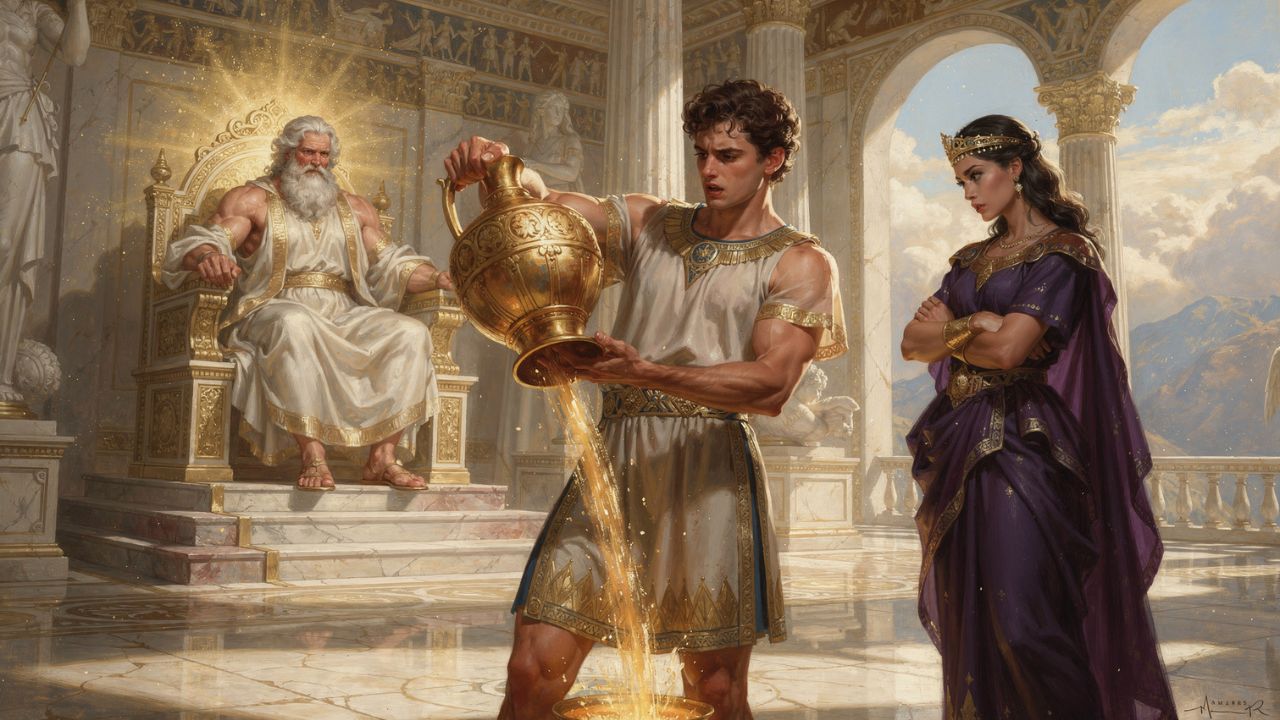
Cupbearer. The one responsible for serving nectar and ambrosia at divine banquets. A job of enormous responsibility that, conveniently, required being constantly close to Zeus, always available, always present.
Credit: Image generated with Flux 2 Pro / ASTRONOMIKA TV
Zeus brought him to Olympus under the official pretense that he needed a new cupbearer. Sure. The most handsome cupbearer in the universe, living in his house, immortal and without a contract. If this happened today, not even the HR department would buy the story. The Romans were more direct: they took Ganymede’s name, turned it into “catamite,” and used it to describe exactly the kind of relationship Zeus was pretending didn’t exist. Today we might call it “keeping things fresh,” but the idea is the same: young, firm, and at the boss’s service.
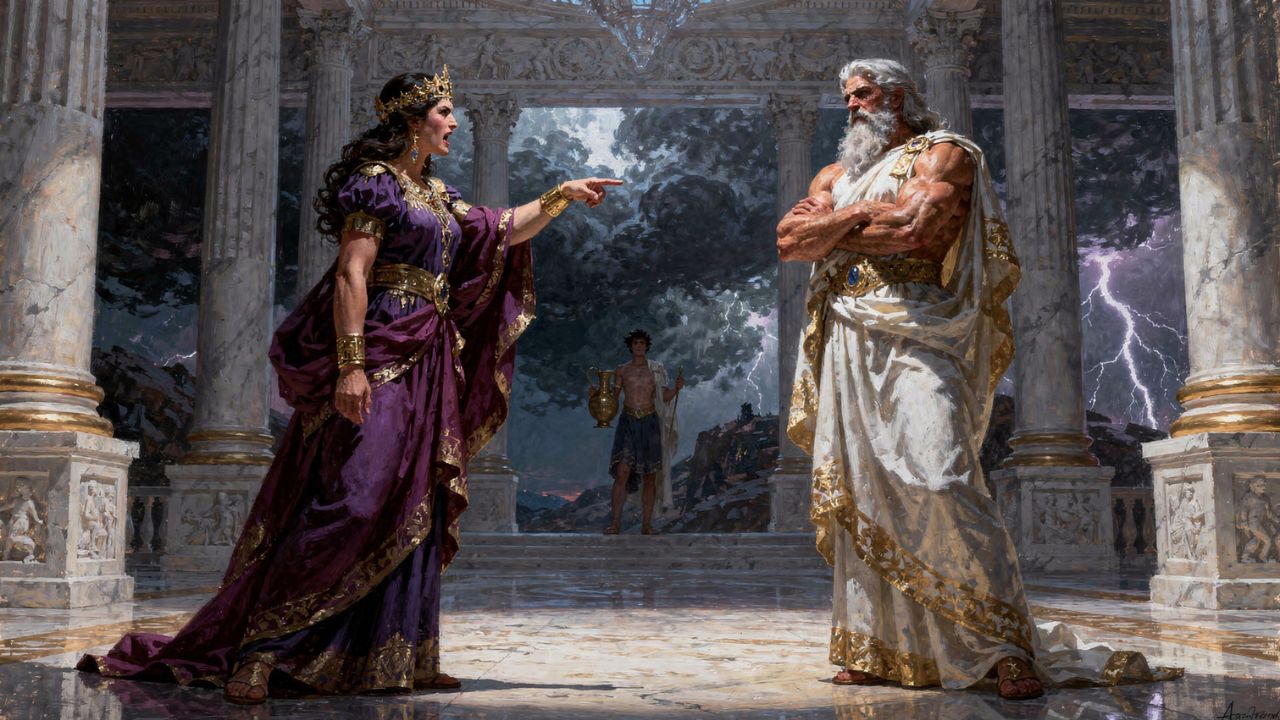
Hera, Zeus’s wife, didn’t buy the story for a second. She was used to her husband’s adventures, but this one had a new element that made her particularly furious: Ganymede had replaced Hebe, the goddess of youth, daughter of Zeus and Hera themselves, who had been the official divine cupbearer for centuries. Zeus didn’t just bring a lover home. He took the job away from his own daughter to give it to him.
Hera’s reaction to this is documented in several ancient sources and can be summarized as: first-class Olympian rage.
Credit: Image generated with Flux 2 Pro / ASTRONOMIKA TV
Ganymede’s father, King Tros, received two immortal horses in exchange for his son, a gift Zeus considered generous and sufficient. If at this point you feel something doesn’t quite add up in that transaction, you’re reading correctly.
Ganymede never returned to Troy. He was immortalized in the sky as the constellation we know today, his pitcher eternally tilted. According to some myths, his water feeds the river Eridanus, a nearby constellation, though that’s a thread we’ll pull in another article.
But Ganymede was not the first water bearer in the sky. Thousands of years before the Greeks put his name in these stars, another civilization had already placed one of their most powerful gods there. And the story they told is considerably more explosive.
When the Water Bearer Saved the World: Enki, the Flood, and the Greatest Loan in History
There is a story the Babylonians told thousands of years before the Book of Genesis existed. It’s called the Epic of Gilgamesh, and it was recorded on clay tablets in Mesopotamia, the region between the Tigris and Euphrates rivers in what is now Iraq. The complete flood story appears in Tablet XI, found in the ruins of Nineveh near the modern city of Mosul, and dates to approximately 2000 BC in its standard Akkadian version. Genesis, in its written form, was consolidated around the 6th century BC. There is more than a thousand years of difference between the two texts, and when you read them side by side, the conversation gets interesting.
The Babylonian protagonist is called Utnapishtim. And his story is going to sound very, very familiar.
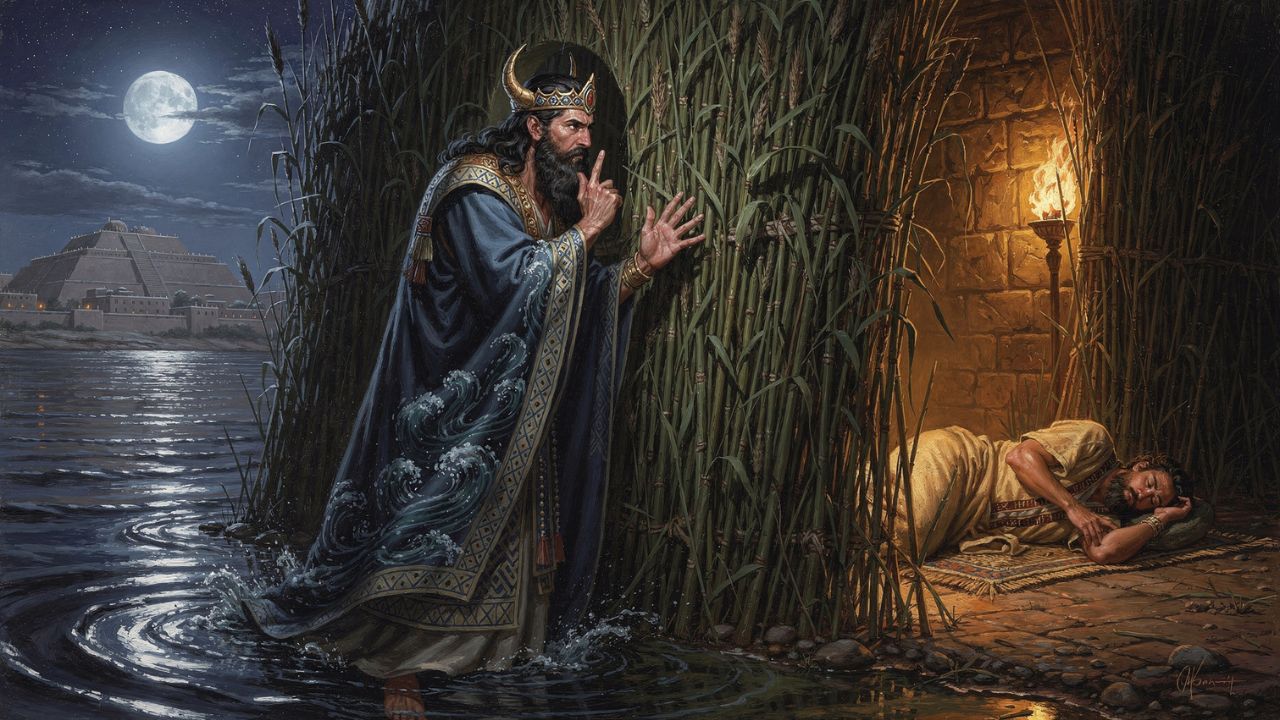
Credit: Image generated with Flux 2 Pro / ASTRONOMIKA TV
The gods of the Mesopotamian pantheon met in secret and decided to destroy humanity with a flood. The official reason, and here comes the best part: humans were making too much noise. The gods couldn’t sleep. Literally, that is the motivation in the original text. The god Enlil, the most powerful in the pantheon, was fed up with humanity’s constant racket and convinced the divine council to eliminate them. The agreement was that no god would warn any mortal. Everyone signed.
The problem was that Enki (known as Ea in Akkadian, the same god with a different name depending on the language), god of fresh waters, the very figure immortalized in the sky of Aquarius, had a different opinion.
Enki didn’t break the agreement directly. He found a technical loophole that would say a lot about him if he were a corporate lawyer: he walked up to the reed wall of Utnapishtim’s house and spoke to the wall. Technically he wasn’t speaking to the human. He was speaking to the building materials. The other gods couldn’t complain. The wall, however, listened perfectly.
The message was clear: build a vessel. Take your family. Take the craftsmen of the town. Take animals of every species. The flood comes in seven days.
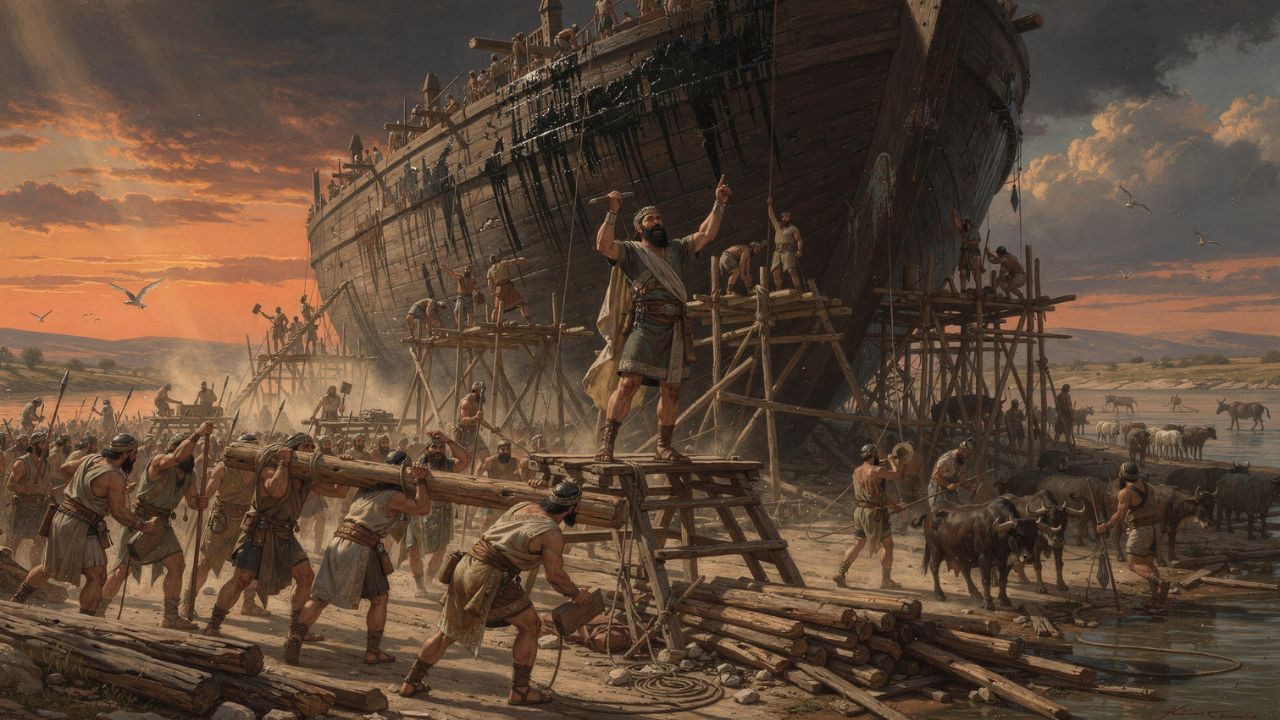
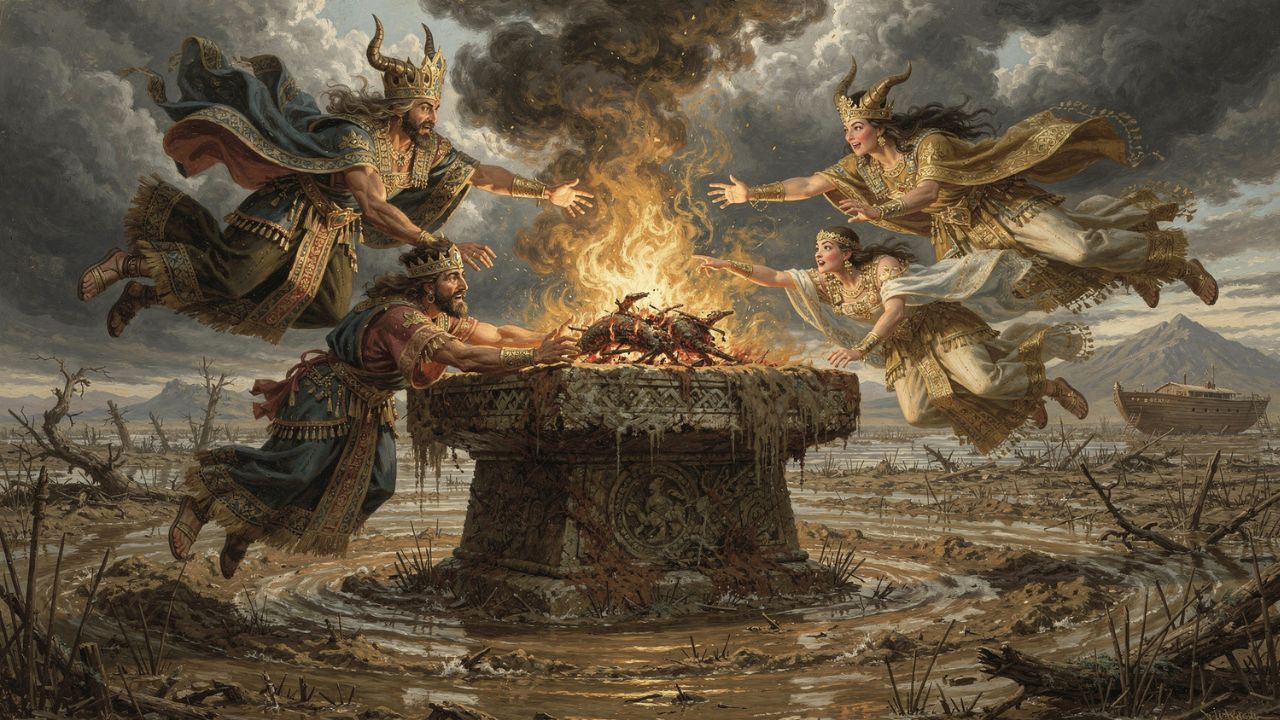
Utnapishtim builds the ark in seven days following precise divine instructions. He loads his family, the craftsmen, and representatives of all the animals. It rains for seven days and seven nights with an intensity that terrifies the gods themselves, who crouch on the heights like frightened dogs, the text says literally. The vessel runs aground on Mount Nisir in northern Iraq. Utnapishtim releases a dove that returns, then a swallow that also returns, finally a raven that does not return. They disembark. He makes an offering. The gods swarm over the sacrifice “like flies.” Enlil gets angry when he sees that someone survived. Enki confronts him. In the end, Utnapishtim and his wife receive immortality.
Credit: Image generated with Flux 2 Pro / ASTRONOMIKA TV
Credit: Image generated with Flux 2 Pro / ASTRONOMIKA TV
Now Genesis, chapters 6 through 9, for those who don’t have it fresh.
God finds Noah, the only righteous man of his generation, and tells him to build an ark, bring his family and a pair of every animal. It rains forty days and forty nights. The ark runs aground on Mount Ararat, on what is now the Turkey-Armenia border. Noah releases a raven, then a dove that returns with an olive branch, then the dove again and it doesn’t return. They disembark. Noah makes an offering. God promises never again to destroy humanity with a flood and places a rainbow in the sky as the sign of that covenant.
Both stories begin with a divine decision to destroy humanity with water. In both, a specific god warns a righteous human in secret. In both, he builds a vessel, loads family and animals, it rains a specific period, the vessel runs aground on a mountain, birds are released including a dove that returns and then one that doesn’t, an offering is made, and a divine covenant ends the story.
The list of similarities is not thematic. It’s specific details, in the same order, with the same narrative elements. The academic consensus is broad: the biblical flood narrative has its roots in the Mesopotamian tradition, passed on during the Babylonian captivity of the Hebrews in the 6th century BC.
And the flood is not the only loan. The Garden of Eden has a direct precedent in the Sumerian myth of Enki and Ninhursag, describing a perfect land called Dilmun. The creation of humans from clay appears in Sumerian texts centuries before Genesis. The serpent as agent of forbidden knowledge echoes Mesopotamian figures; in the Epic of Gilgamesh, a serpent steals the hero’s plant of immortality.
The differences matter. In Mesopotamia the gods are multiple, capricious, motivated by mundane reasons. In Genesis there is one God with a coherent moral plan. The rainbow is an eternal covenant, not a negotiated compensation. The narrative architecture is the same. The theology behind it is completely different. And that difference is exactly what makes it interesting.
And the god who moved the pieces in the oldest version of this story is still up there, pitcher eternally tilted. Enki, the one who spoke to the wall and saved humanity anyway. The water bearer of Aquarius.
The Sky as a Map of Fate: The Chinese Reading of Aquarius
On the other side of the ancient world, the astronomers of imperial China looked at this same corner of the sky and saw neither a beautiful cupbearer nor a wise god saving humanity. They saw a map. And not a particularly reassuring one.
Chinese astronomy divided the sky into 28 lunar mansions. Each mansion had a name, a meaning, and a list of specific omens reported directly to the emperor, who governed with the Mandate of Heaven. If something unusual happened above, the throne needed to know before anyone else.
The stars forming Aquarius covered four mansions: Nü, Xu, Wei, and Shi.
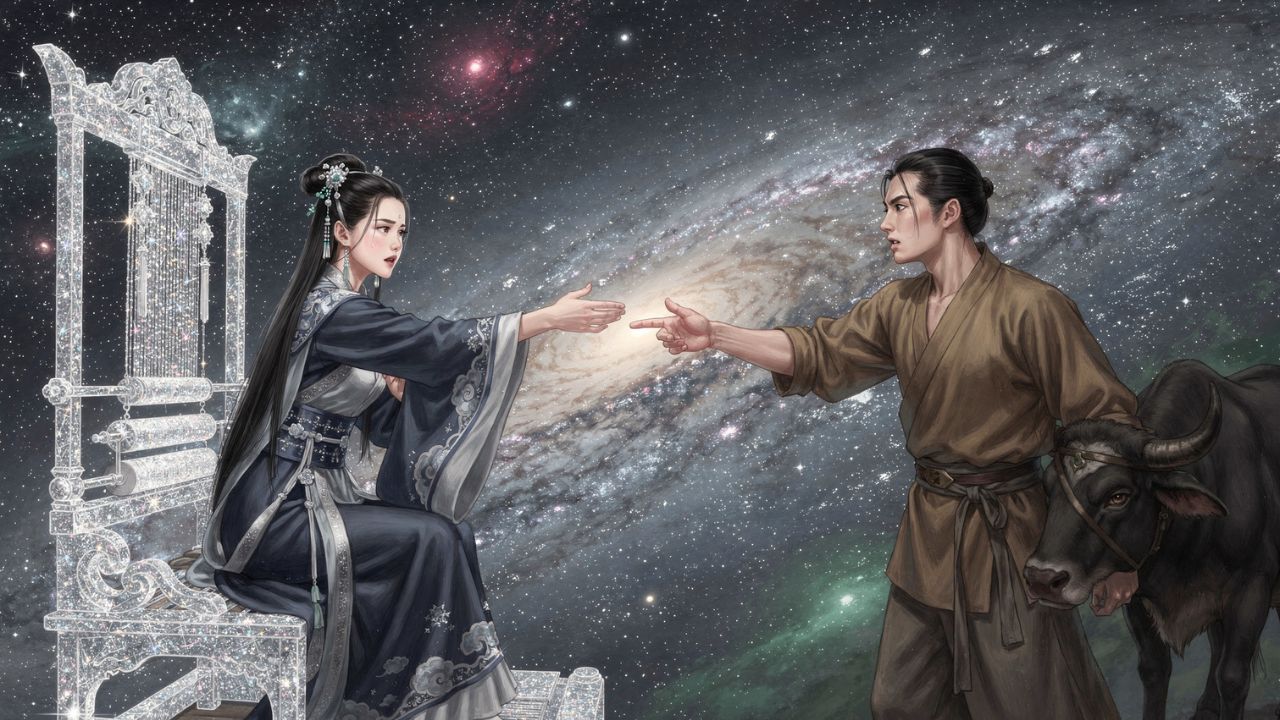
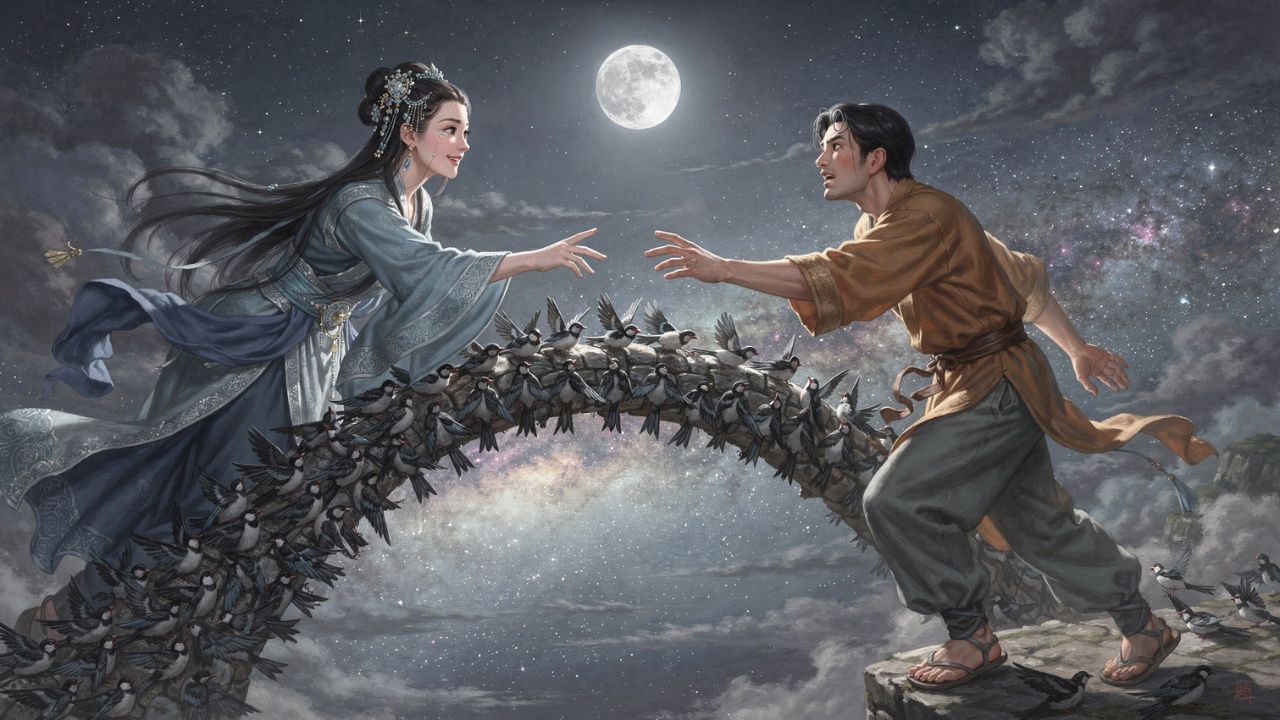
Nü, the Maiden, is connected to the tale of the Weaver Girl and the Celestial Cowherd, two lovers representing Vega and Altair, separated by the Milky Way and condemned to meet only once a year. The Weaver Girl was the daughter of the Jade Emperor and wove the clouds of sunset. The Celestial Cowherd tended oxen on Earth. They fell in love, married without permission, forgot their duties. The Jade Emperor separated them with the Milky Way as an impossible border. Once a year, a flock of magpies forms a bridge of feathers and they reunite for a single night.
Credit: Image generated with Flux 2 Pro / ASTRONOMIKA TV
Japan adopted this story in the 8th century and turned it into the Tanabata festival, celebrated in July or August depending on the region, with entire streets covered in tanzaku, colored paper strips where people write their wishes and hang them from bamboo branches. Its female protagonist still lives in this corner of the sky Westerners call Aquarius.
Xu, the Void, was one of the most feared lunar mansions, associated with grief and funerary rituals. More deeply, it was the astronomical portal for communication with ancestors. In Chinese cosmology, the dead remain present in a parallel plane. The Greeks placed a beautiful young man serving nectar at an eternal party at this point in the sky. The Chinese placed a portal to the world of the dead. Same sky, completely different conversations.
Credit: Image generated with Flux 2 Pro / ASTRONOMIKA TV
Wei and Shi, Danger and the Encampment, complete the map: Wei announced storms and floods, omens of catastrophe. Shi was the military encampment in waiting, soldiers sharpening swords without knowing when the order would come. Not active war. The anticipation, which often weighs more than the conflict itself.
Three civilizations without contact among themselves associated this same corner of the sky with water as a dual force. Enki warns of the flood. Ganymede pours the nectar of eternal life. Wei announces catastrophic floods. Three civilizations, three continents, the same corner of the sky. And thousands of years later, when someone decided to name an entire era of humanity, they chose precisely this constellation. That’s not an accident.
The Age of Aquarius: When It Actually Starts and Why Nobody Can Agree
If you’ve ever heard “we’re entering the Age of Aquarius” and never quite understood what it means or when it begins, it’s not your fault. The answer depends on who you ask, and astrologers and astronomers have been disagreeing for decades, not even on the century.
To understand what an astronomical age is, you need to understand the precession of the equinoxes: the Earth doesn’t spin perfectly upright. Its axis traces a slow circle, like a spinning top about to fall over that never quite does. One complete rotation takes approximately 25,772 years. The point where the Sun rises on the spring equinox moves slowly through all 12 zodiac constellations, spending approximately 2,160 years in each. That is what astrologers call an “age.”
About 2,000 years ago the Sun at the spring equinox pointed toward Aries. That’s why the astrological year still begins with Aries today. After Aries came Pisces. Next is Aquarius.
Astrologers can’t agree because constellations have no official borders in the traditional astrological system. Proposed dates range from 1447 to the year 2597. Some say it started in 1962, others in 2012.
The International Astronomical Union set precise boundaries in 1930: the vernal point will cross into Aquarius approximately in the year 2597. Astronomically we are still in the Age of Pisces.
The cultural image of the Age of Aquarius has a name and a face: “Aquarius/Let the Sunshine In,” by The 5th Dimension, released in 1969. It hit number 1 in the US for six weeks and won the Grammy for Record of the Year in 1970. If you don’t know it, look it up right now. It’s over 50 years old and it will still move your feet.
The irony is that this cultural image has its own coherent symbolic logic: Aquarius is the constellation of the water bearer who pours out knowledge, the god who saves humanity by warning of the flood, the sky the Chinese associated with love that persists despite separation. If you’re going to choose a constellation to symbolize a new chapter for humanity, Aquarius has plenty of arguments. Astronomically, though, we still have a while to wait.
What You See, What Exists, and Why Your Primate Eyes Are Lying to You
Screenshot: Sky Guide App
Your eyes are real-time light detectors. Excellent for what they were designed for: moving through the African savanna, detecting motion, distinguishing shapes with sunlight available. For astronomy, however, they have a fundamental limitation: they don’t accumulate light. Whatever your retina doesn’t capture in a fraction of a second is gone forever.
There’s something we’ve all experienced that illustrates this: when you get up at night to use the bathroom without turning on the light, everything looks black and white. It’s not that the room has no color. It’s that in low light your cones, the color receptors, shut down and your rods take over. Rods are more sensitive to dim light but don’t distinguish colors. In astronomy it works exactly the same way: no matter how long you stare at a nebula through an eyepiece, the colors you see in photographs are completely invisible to you.
A visual telescope like the SKY-WATCHER FlexTube 300P (12 inches) multiplies the amount of light reaching your eye but doesn’t change the nature of how that eye processes it. With 300 millimeters of aperture you’re capturing approximately 1,800 times more light than with your fully dilated pupil. But that light still reaches your retina in real time, without accumulation.
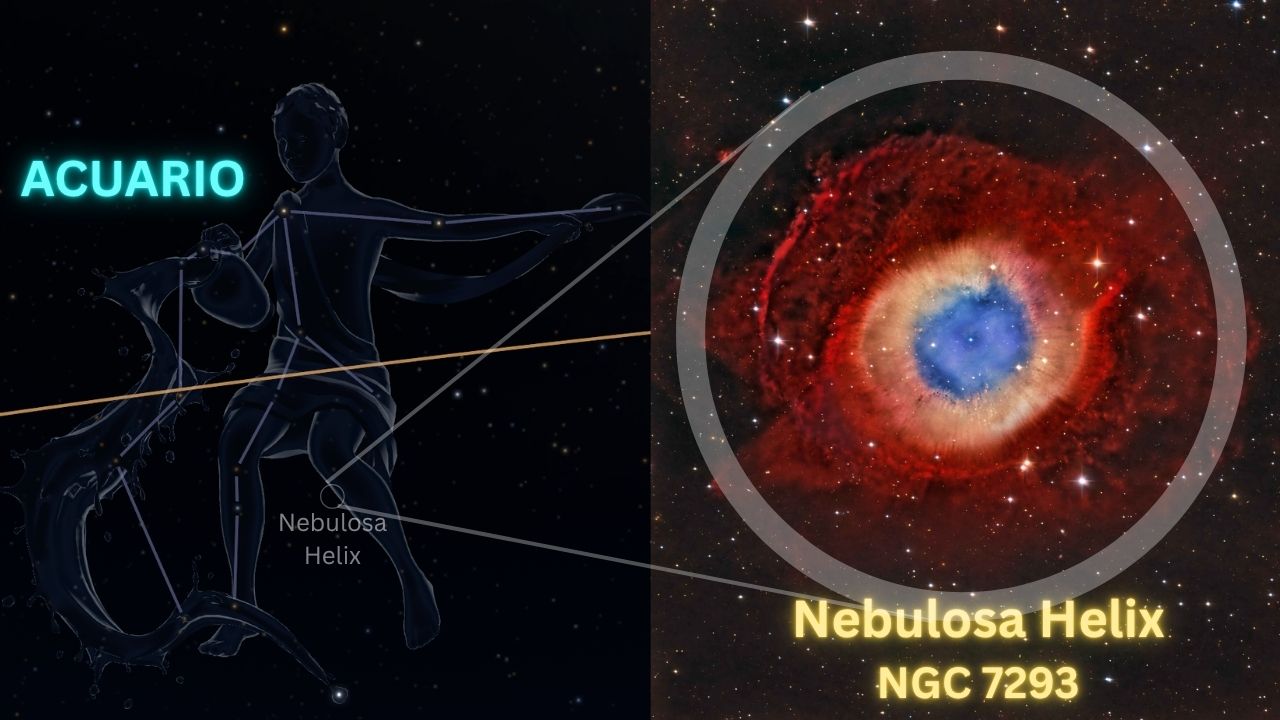
Under a truly dark sky, with the FlexTube 300P and a wide-field eyepiece, the Helix appears as a faint, ghostly circular disk with a slight brightness gradient toward the center. On a night of good atmospheric transparency, with the eye well adapted to darkness after at least 20 minutes without white light, it’s an experience you won’t easily forget. But the colors are completely invisible. Everything turns to shades of gray, just like the hallway of your house at three in the morning.
The ZWO Seestar S50 works in a radically different way. The sensor accumulates photons. The process is called stacking: software adds dozens of captures, cancels random noise, and reinforces the real signal. With 20 to 30 minutes of total integration, things start to appear that simply don’t exist for the visual observer: the outer hydrogen ring in red, the inner oxygen zone in blue-green, the filaments, the white dwarf at the center. It’s not a pretty photograph. It’s real information from the universe that your primate eyes simply can’t process without help.
Neither approach is superior. They are different experiences. Watching the Helix through the eyepiece on a dark night has something no photograph can replicate: the awareness that that ghostly light traveled 650 years to reach exactly your retina at that moment. Astrophotography with the Seestar gives you the complete structure through a screen. The best observers do both.
And the Helix isn’t the only object Aquarius has to offer.
Credit: NASA / JPL-Caltech / Screenshot: Sky Guide App / Composition: ASTRONOMIKA TV
M2: The Cluster Where Darkness Never Falls
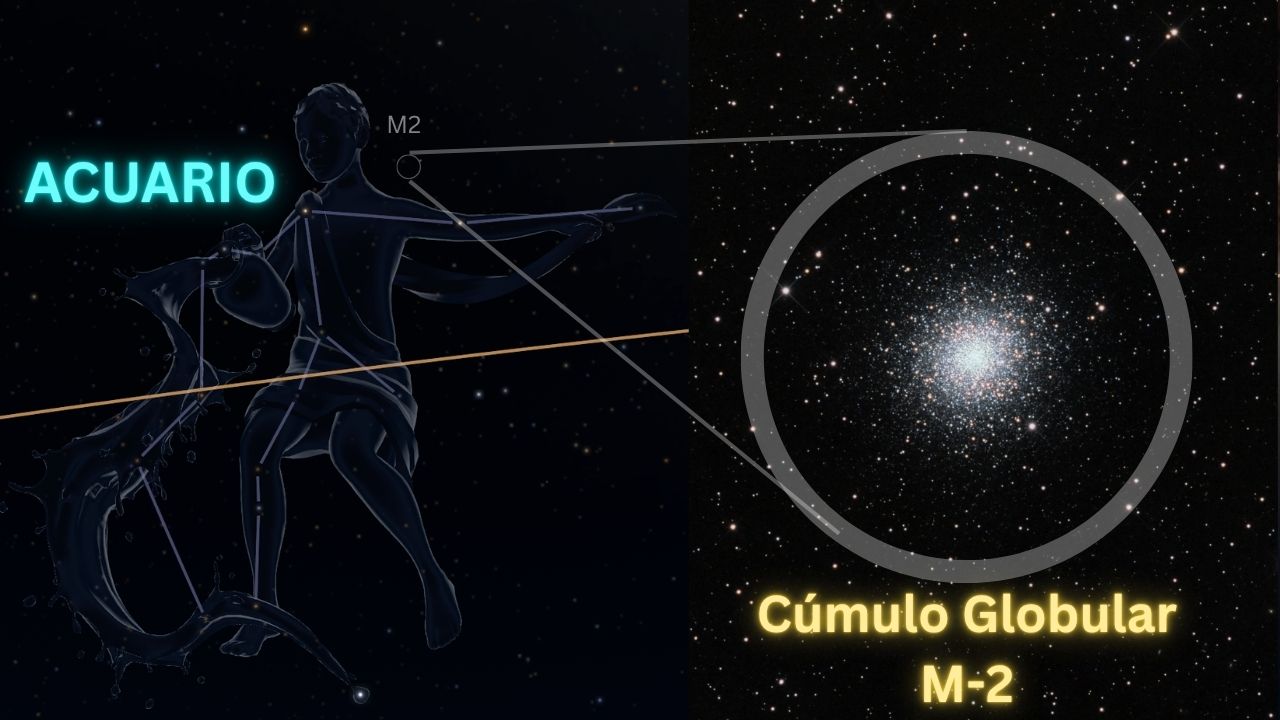
About 37,500 light-years away, Messier 2 is one of the largest and richest globular clusters in the night sky. It contains approximately 150,000 stars packed into a sphere about 175 light-years in diameter. If you lived on a planet inside M2, the night sky would have thousands of stars as bright as Venus. There would be no dark night. Ever.
Credit: NASA / Screenshot: Sky Guide App / Composition: ASTRONOMIKA TV
Through large binoculars it appears as a round, compact smudge, clearly non-stellar. With the SKY-WATCHER FlexTube 300P it begins to resolve into individual stars at the edges. It’s one of those objects where more telescope always delivers more reward.
NGC 7009: The Nebula That Looks Like Saturn Through the Eyepiece
About 2,000 light-years away, NGC 7009 is a compact and bright planetary nebula. It has two symmetrical lateral extensions that in large-aperture telescopes resemble the rings of Saturn viewed edge-on. With the SKY-WATCHER FlexTube 300P (12 inches) and a high-magnification eyepiece around 250x, those extensions are visible directly to the eye under good conditions, something uncommon for deep sky objects. Unlike the Helix, NGC 7009 shows its characteristic blue-green color directly at the eyepiece. The ZWO Seestar S50 resolves it clearly with just a few minutes of integration.
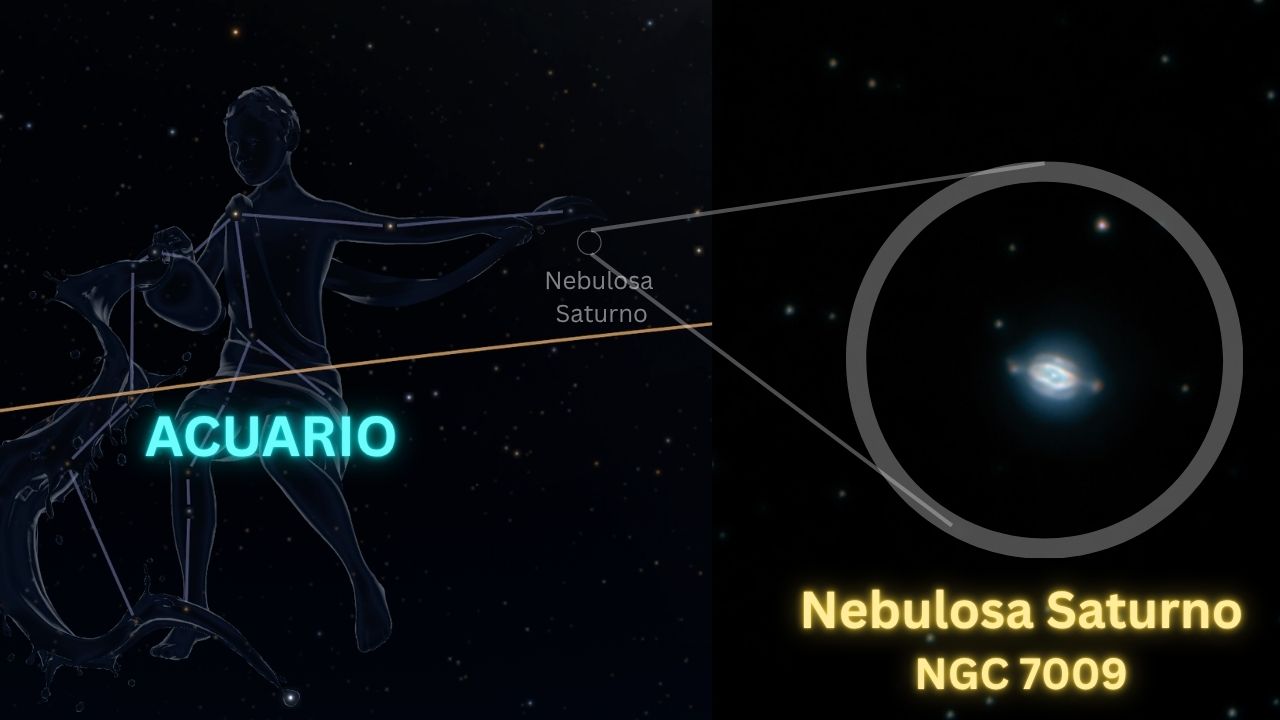
Credit: NASA / ESA / Screenshot: Sky Guide App / Composition: ASTRONOMIKA TV
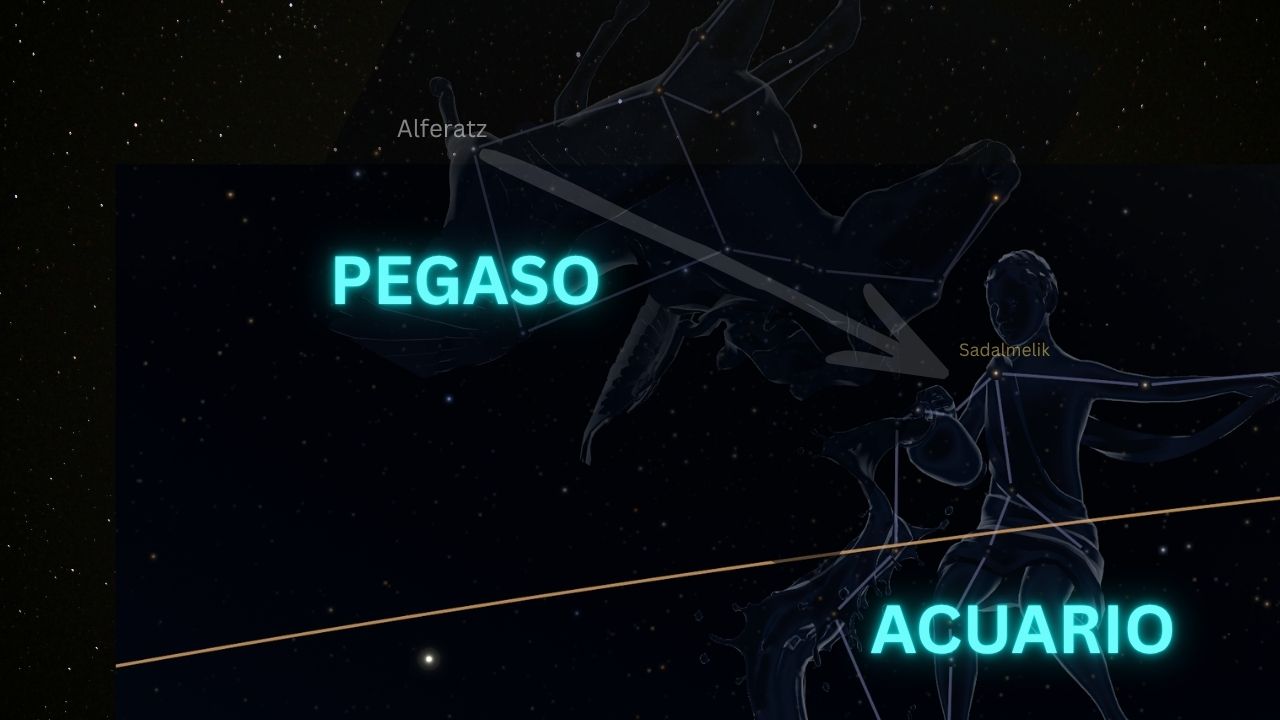
Illustration: ASTRONOMIKA TV based on Sky Guide App screenshot
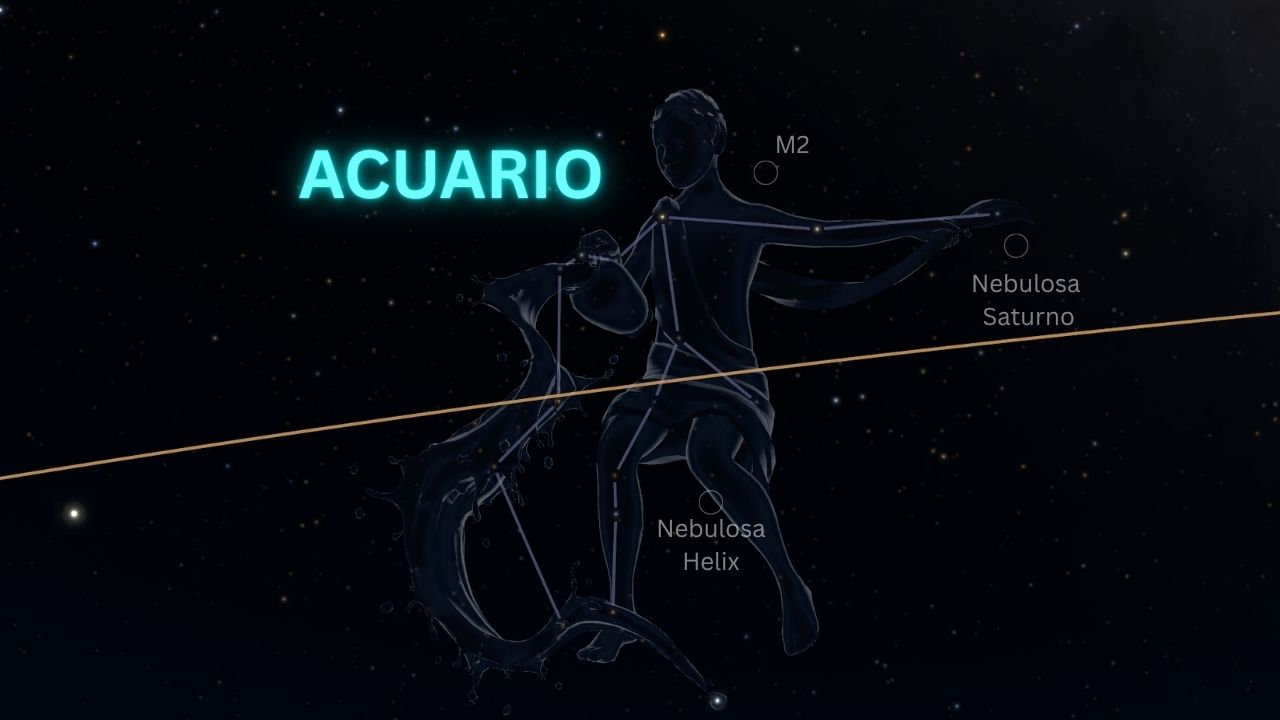
To find Aquarius, first locate the Great Square of Pegasus. From its lower-left vertex, drop your gaze toward the southern horizon and you’ll find a region of sky notably sparse in bright stars. That quiet region is Aquarius. The Helix Nebula lies at its southern end.
If you want to explore more of the zodiac sky, don’t miss our article on the Sagittarius constellation and the galactic center, Aquarius’s most dramatic neighbor in the night sky.
The Eternal Water Bearer
Aquarius is one of the oldest constellations in the human record, mentioned in Babylonian tablets more than 3,000 years ago. It survived the collapse of Mesopotamia, the fall of Greece, the rise and fall of Rome, and reached us with the same tilted pitcher. What it pours doesn’t change depending on which culture looks up at it: always something essential. Water, knowledge, warning. Always something humans need to survive.
And deep in that quiet constellation with no brilliant stars, there is an eye that has been watching in our direction for more than ten thousand years. It reminds us, without drama and without hurry, that stars also end. And that what remains afterward can be one of the most beautiful things in the universe.
Find more about the sky on YouTube, Instagram, and TikTok as ASTRONOMIKA TV.
Frequently Asked Questions About the Aquarius Constellation
What does the Aquarius constellation represent?
The Aquarius constellation represents a human figure pouring water from a jug. In Greek mythology it is identified with Ganymede, the Trojan prince Zeus abducted to make the eternal cupbearer of the gods. In the Mesopotamian tradition it represents Enki, god of fresh waters and wisdom: not a servant of the gods but a primordial deity who uses his power to protect humans.
Who was Ganymede in Greek mythology?
Ganymede was a prince of Troy, son of King Tros, considered the most beautiful human being of his time. Zeus abducted him transformed into an eagle and brought him to Olympus, where he made him the eternal cupbearer and granted him immortality. In doing so he displaced Hebe, his own daughter with Hera, from the position she had held for centuries. The Romans created the word “catamite” from Ganymede’s name to describe exactly the kind of relationship Zeus was pretending didn’t exist.
Are the Babylonian flood and the Genesis flood the same story?
They are different stories with an almost identical narrative architecture. The Epic of Gilgamesh, written around 2000 BC, tells how Enki warns Utnapishtim of a flood, orders him to build an ark, bring family and animals, and survive. The same specific elements appear in the same order in Genesis, written more than a thousand years later. Scholars attribute the similarity to cultural contact during the Babylonian captivity of the Hebrews in the 6th century BC. The key difference: in Mesopotamia the gods destroy humanity because it makes too much noise; in Genesis the motivation is moral.
What is the Helix Nebula and why is it called the Eye of God?
The Helix Nebula (NGC 7293) is a planetary nebula in Aquarius, approximately 650 light-years from Earth. It is the planetary nebula with the largest apparent size in the night sky. It formed about 10,600 years ago when a star similar to the Sun reached the end of its life and expelled its outer layers of gas, leaving a white dwarf at the center. Its popular nickname comes from its appearance in photographs: a giant iris of blue and red gas with a white pupil at the center.
Why can’t you see the colors of nebulae with the naked eye?
Because in low light the human eye shuts down the cones, the color receptors, and activates the rods, which are more sensitive to dim light but don’t distinguish colors. It’s the same phenomenon as walking to the bathroom at night without turning on the light: everything in black and white. Astrophotography solves this by accumulating exposures over minutes, adding signal until it reveals colors and information the eye could never process in real time.
When does the Age of Aquarius begin according to astronomy?
According to the official constellation boundaries set by the International Astronomical Union in 1930, the vernal point will cross from Pisces into Aquarius approximately in the year 2597. Astronomically we are still in the Age of Pisces. The cultural image of the Age of Aquarius comes from the 1969 song “Aquarius/Let the Sunshine In” by The 5th Dimension, which hit number 1 in the US and won the Grammy for Record of the Year in 1970.
What other interesting objects are in Aquarius besides the Helix Nebula?
Aquarius has two deep sky objects worth knowing. Messier 2 is one of the richest globular clusters in the northern hemisphere, with approximately 150,000 stars packed into a sphere 175 light-years in diameter. NGC 7009, the Saturn Nebula, has symmetrical lateral extensions that resemble Saturn’s rings viewed edge-on; unlike the Helix, it shows blue-green color directly through the eyepiece of a 12-inch telescope.
Where is Aquarius in the sky and when can it be seen?
Aquarius is visible in the northern hemisphere from August through November, peaking in October. In the southern hemisphere from July through December, peaking in September-October. To find it, locate the Great Square of Pegasus and drop your gaze toward the southern horizon from its lower-left vertex. That dim, sparsely starred region is Aquarius.
Is Aquarius a zodiac constellation?
Yes. Aquarius is one of the 12 zodiac constellations. The Sun transits through it approximately between February 16 and March 11. In astrology the Aquarius sign corresponds to January 20 through February 18, dates that don’t match the actual astronomical transit due to the precession of the equinoxes, the same phenomenon that explains why the astronomical Age of Aquarius won’t arrive until the year 2597.
Which ancient civilizations associated Aquarius with water as a destructive force?
The three main civilizations: the Mesopotamians through Enki who warns of the flood that will erase civilization; the Greeks through Ganymede who pours the nectar of eternal life; the Chinese through the lunar mansion Wei, Danger, associated with storms and catastrophic floods. Three cultures with no contact among themselves arrived at the same symbol from completely different angles.
Sources and Recommended Reading
Books
Condos, T. (1997). Star Myths of the Greeks and Romans: A Sourcebook. Phanes Press.
Translation and analysis of ancient sources on Greek and Roman stellar mythology; includes the complete account of Ganymede and its variants.
Jacobsen, T. (1976). The Treasures of Darkness: A History of Mesopotamian Religion. Yale University Press.
Fundamental academic reference on Enki and the role of fresh waters in Sumerian and Babylonian cosmology.
George, A. R. (2003). The Babylonian Gilgamesh Epic: Introduction, Critical Edition and Cuneiform Texts. Oxford University Press.
The definitive academic edition of the Epic of Gilgamesh, including Tablet XI with the complete flood account.
Digital Sources
NASA Science. (2023). Saturn Nebula Caldwell 55 (NGC 7009). science.nasa.gov
Official technical data on the structure, composition, and observation guide for the Saturn Nebula.
NASA / JPL-Caltech. (2023). Helix Nebula (NGC 7293). jpl.nasa.gov
Official technical data on the distance, composition, and structure of the Helix Nebula.
International Astronomical Union. (2024). IAU Constellation Boundaries: Aquarius. iau.org
Official boundary data, abbreviation, and named stars for the Aquarius constellation.
The 5th Dimension. (1969). Aquarius/Let the Sunshine In [recording]. Soul City Records. Available on Spotify and YouTube.
The song that turned the Age of Aquarius into a massive cultural image. Listen to it at least once.