
How the same corner of the sky was a sacred portal for the Babylonians, a mythological accident for the Greeks, and a rain announcement for the Incas.
By Juan Pablo Martín | ASTRONOMIKA TV | May 2026
There is a creature, half goat and half fish, that has been in the sky for more than 4,000 years. It didn’t get there by being powerful or beautiful. It got there because its god panicked at the worst possible moment and the transformation came out wrong. That is Capricorn: the zodiac constellation with the most chaotic origin, the most gossip-worthy myth, and a deep-sky object that has been consuming itself for 13 billion years.
Credit: ASTRONOMIKA TV / Flux 2 Pro
The day the entire Olympus panicked and Pan became the strangest creature in the zodiac
Before we talk about the half-goat half-fish creature that has been in the sky for 4,000 years, we need to talk about who Pan was. Because without understanding Pan, the story of Capricorn makes no sense at all.
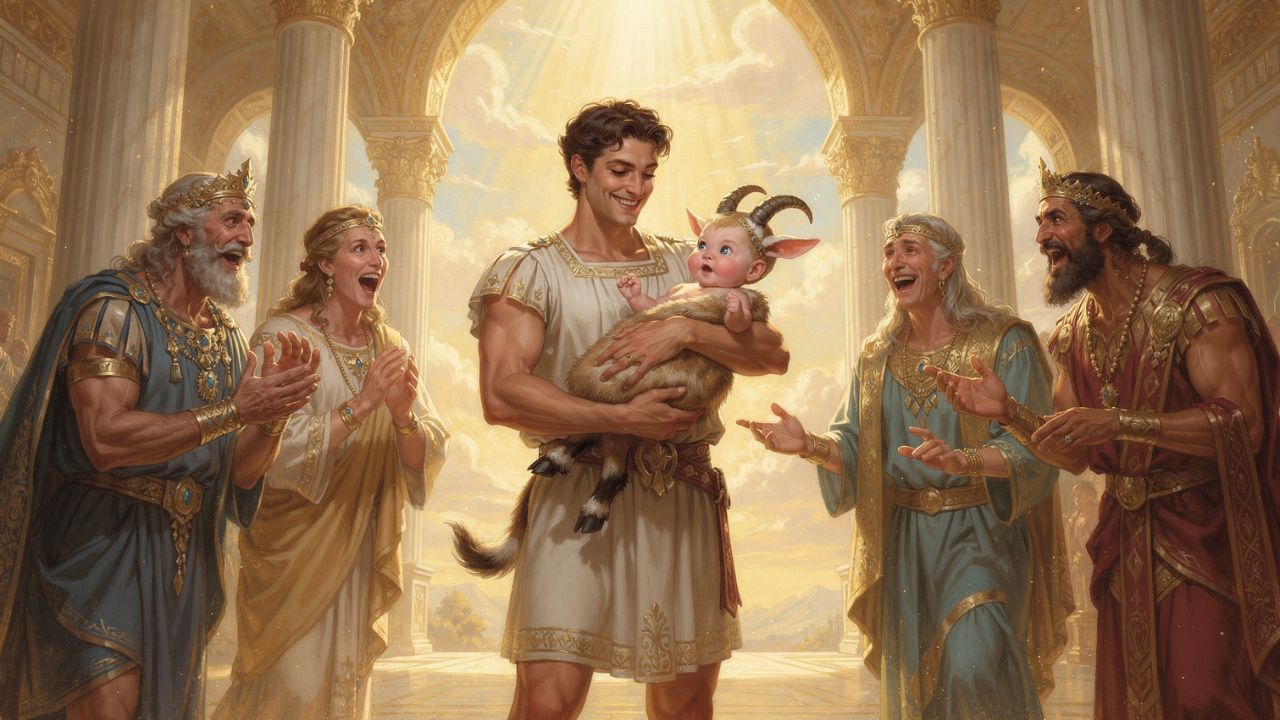
Pan was the god of shepherds, flocks and wild nature. Son of Hermes, born of a forest nymph who took one look at her newborn and fled without glancing back. Some sources, with a certain irony, say that mother was Penelope, the supposedly faithful wife of Odysseus. The Greeks couldn’t even agree on that. Hermes picked up the child, wrapped him in a hare skin and carried him to Olympus. All the gods were so delighted to see him that they named him Pan, which in Greek means “all.” The god rejected by his mother on the day he was born was welcomed with a party by the entire pantheon.
Credit: ASTRONOMIKA TV / Flux 2 Pro
Pan was born with horns, goat legs, a tail and a face covered in hair. He didn’t live on Olympus. He had no palace, no consecrated temple. He preferred the forests and mountains of Arcadia, the pastoral region at the heart of the Peloponnese in southern mainland Greece, where shepherds led their flocks along unnamed paths and where the darkness of the night was complete and without witnesses.
And those forests, at night, produce sounds. Branches cracking. Echoes with no visible source. Footsteps that don’t match any known animal. The Greeks decided those sounds were Pan, and that when someone interrupted his nap, he would shriek from the darkness, freezing anyone who heard it with fear: no visible threat, no concrete danger, no rational reason for the terror. Just the sound, the darkness, and a racing heart.
That was panic. The word comes directly from his name.
This wasn’t a metaphorical connection. It was literal: the Greeks called it panikón, sudden and irrational fear, because Pan caused it. The same god who protected flocks from wolves was the one who terrified shepherds who ventured too deep into the woods. Two faces of the same territory. And that power, which worked perfectly in the forests of Arcadia, turned out to be useful in much larger places.
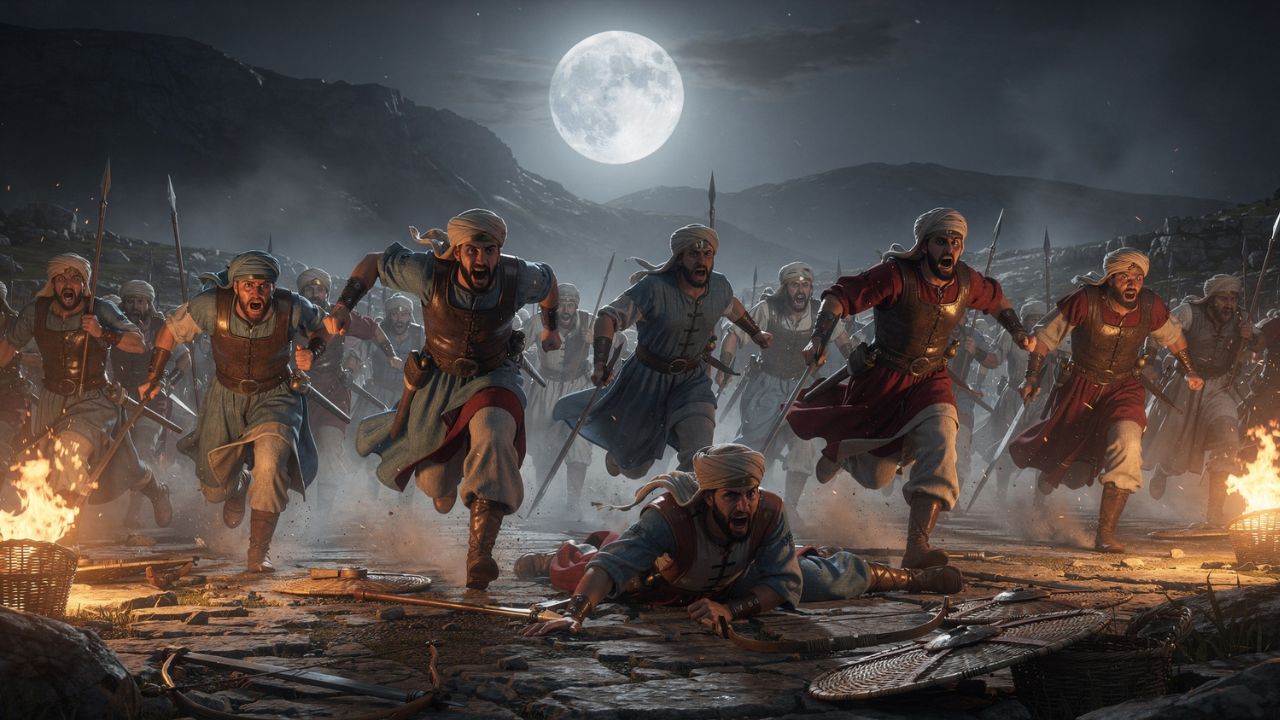
In 490 BCE, during the Battle of Marathon, the Persian forces suffered a sudden and inexplicable panic in the middle of combat that sent them fleeing in chaos. Herodotus documents that days before the battle, an Athenian messenger named Pheidippides encountered Pan on the road to Sparta, and the god promised his help. The Athenians, who won that battle against all odds, took it seriously: they dedicated a cave on the north slope of the Acropolis to him and decreed an annual festival in his honor. Pan, the rustic god no one invited to Olympus, became an official deity of Athens for having terrified an entire army.
Credit: ASTRONOMIKA TV / Flux 2 Pro
He is also the father of Crotus, the centaur archer Zeus immortalized in the constellation of Sagittarius, Capricorn’s immediate neighbor in the zodiac. If you’ve already read our Sagittarius article, you know the son. Now comes the story of the father.
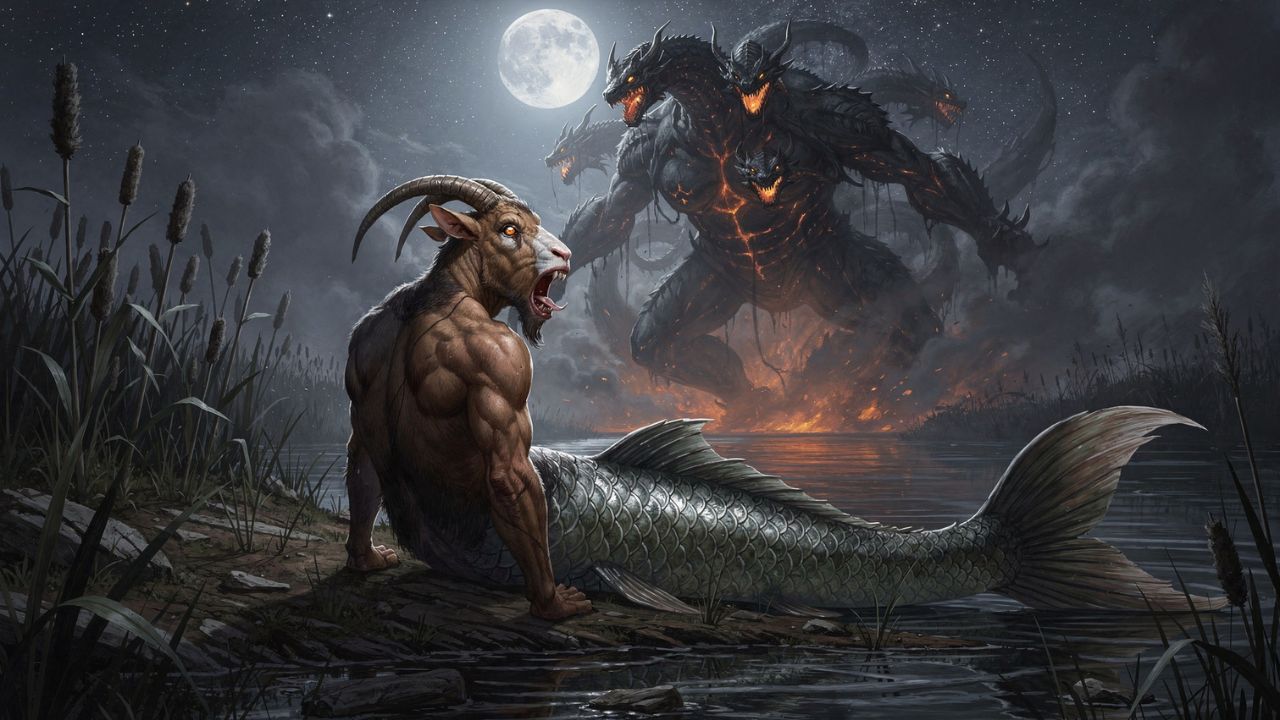
Typhon was no ordinary monster. He was the son of Gaia, goddess of the Earth, and Tartarus, the primordial abyss. Gaia had created him with a specific purpose: to destroy Zeus and all the Olympians who had defeated her previous children, the Titans. He was so enormous that his head brushed the stars; he had a hundred dragon heads that breathed fire, and from the waist down his body was a writhing mass of serpents. When he appeared marching toward Olympus, Zeus, who had defeated his own father and chained the Titans, was afraid.
And he was not alone.
Every Olympian god panicked simultaneously. Hera turned into a white cow. Apollo into a raven. Artemis into a cat. Hermes into an ibis. Aphrodite and Eros threw themselves into the river as fish, the origin of the constellation Pisces. Zeus himself transformed into a ram. The entire Olympus turned momentarily into a zoo of terrified gods fleeing toward Egypt.
And in the middle of that chaos was Pan, the god of panic, panicking.
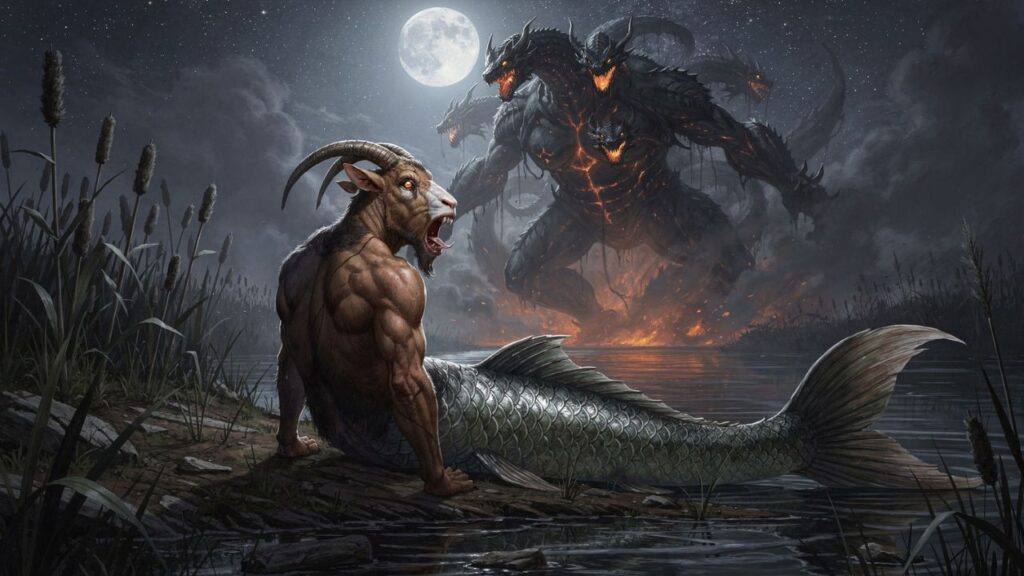
He threw himself into the Nile with so little preparation that his transformation came out wrong. The part of his body that touched the water became a fish. The part that stayed above the surface remained a goat. The result was the strangest figure in the zodiac: half goat, half fish, one hundred percent divine improvisation under pressure.
But here comes the twist that most summaries leave out.
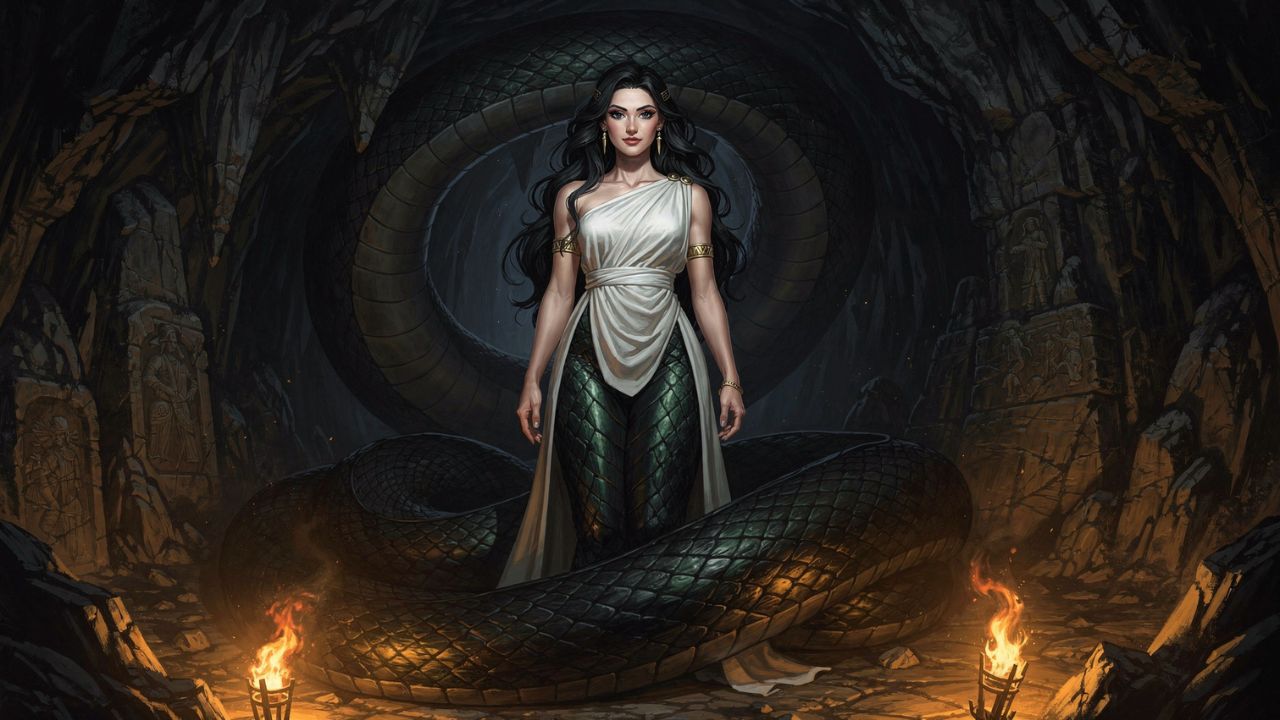
While the other gods were hiding, Typhon accomplished something no one had ever managed: he captured Zeus, severed the tendons of his arms and legs with a steel sickle, and left him immobilized in the Corycian Cave, in Cilicia, on the southern coast of what is now Turkey. He hid the tendons inside a bear skin and left them under the custody of Delphyne.
Credit: ASTRONOMIKA TV / Flux 2 Pro
Delphyne was a dracaena: woman from the waist up and serpent from the waist down, who guarded sacred places by divine command. She was, in other words, the ideal being to watch over something no one was meant to touch. The king of Olympus lay on the floor of a cave, paralyzed and tendonless, while Typhon roamed the world with his stolen thunderbolts.
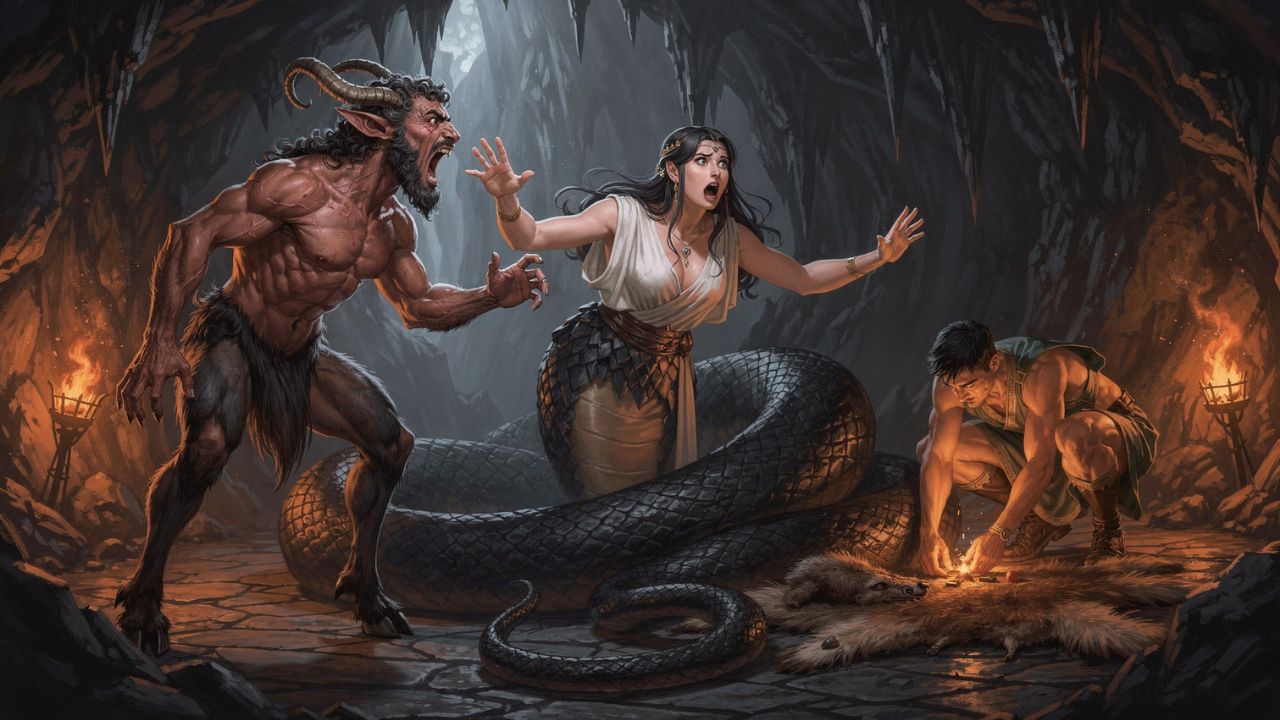
It was Pan who organized the rescue.
He entered the cave with Hermes and let out his shriek, the same one that had scattered Persian armies, aimed directly at Delphyne. While she recovered from the shock, Hermes retrieved the tendons from the bear skin and returned them to Zeus. The god of panic used his own power as a weapon of distraction. Zeus regained his mobility, returned to battle, struck Typhon down with his thunderbolts and buried him under Mount Etna, in Sicily, where, according to the Greeks, his convulsions continued to cause volcanic eruptions.
Credit: ASTRONOMIKA TV / Flux 2 Pro
As a gesture of gratitude, Zeus placed Pan in the sky exactly as he had been during his escape: in his hybrid form of goat and fish, so that no one would ever forget the day the god of panic saved Olympus.
An alternative version connects the constellation to Aegipan, a hybrid goat-fish creature who, according to the Roman poet Germanicus, was Zeus’s foster brother. Another links it to Amalthea, the goat who nursed Zeus in secret on Crete while he hid from his father Cronus, whose broken horn became the cornucopia still depicted in illustrations of abundance today. But the version that stuck, the one Eratosthenes recorded in his Catasterisms, is Pan’s.
The god who frightened everyone else, the one who embodied irrational terror, panicked when something truly terrifying arrived, solved the problem using his only real power, and was immortalized at exactly that moment.
And here is the detail almost no one tells you: the Christian image of the devil, horns, goat legs, human torso, does not come from the Bible. The Bible describes Satan in no such way in any passage. That iconography comes directly from Pan. When Christianity expanded across the Greco-Roman world between the 2nd and 4th centuries, the first theologians needed a visual image of evil that would resonate with populations who already knew Pan. They took his figure: the horns, the legs, the goat beard, the hybrid appearance between man and animal they associated with moral deformity. After the Council of Nicaea in 325 CE, that transformation was consolidated. The old god of shepherds didn’t die. He was reinvented as a villain and installed in hell. Pan earned immortality twice: once in the sky, once in the underworld.
The same symbol the Babylonians had placed in that corner of the sky centuries earlier carried a completely different meaning. And in the Andes, no one connected that region of the sky with panic or with goats. They saw something different, with a logic entirely their own.
Before Pan: the creature the Babylonians put in the sky 3,000 years earlier
The Greeks borrowed the goat-fish symbol from a civilization that had been using it for millennia. And when they took it, they changed its meaning entirely.
Mesopotamia: the god who invented Capricorn
Long before Pan existed, long before any Greek looked at that corner of the sky, the Sumerians of Mesopotamia, in the territory that is today Iraq, had already placed a half-goat half-fish creature there. They called it Suhur-Mash-Ha: the goat-fish. And it wasn’t born from a myth of panic or an emergency transformation. It was born from the observation of something perfectly real.
The Sumerians lived in a world of marshes and rivers, the delta of the Tigris and Euphrates, where fresh water and land blended in ways that were sometimes impossible to separate. And on those banks they had observed the mountain ibex, an animal that surprised them: a goat capable of crossing mountain lakes swimming with ease. A creature that belonged to two worlds at the same time. The symbol wasn’t invented. It was observed.
Credit: ASTRONOMIKA TV / Flux 2 Pro
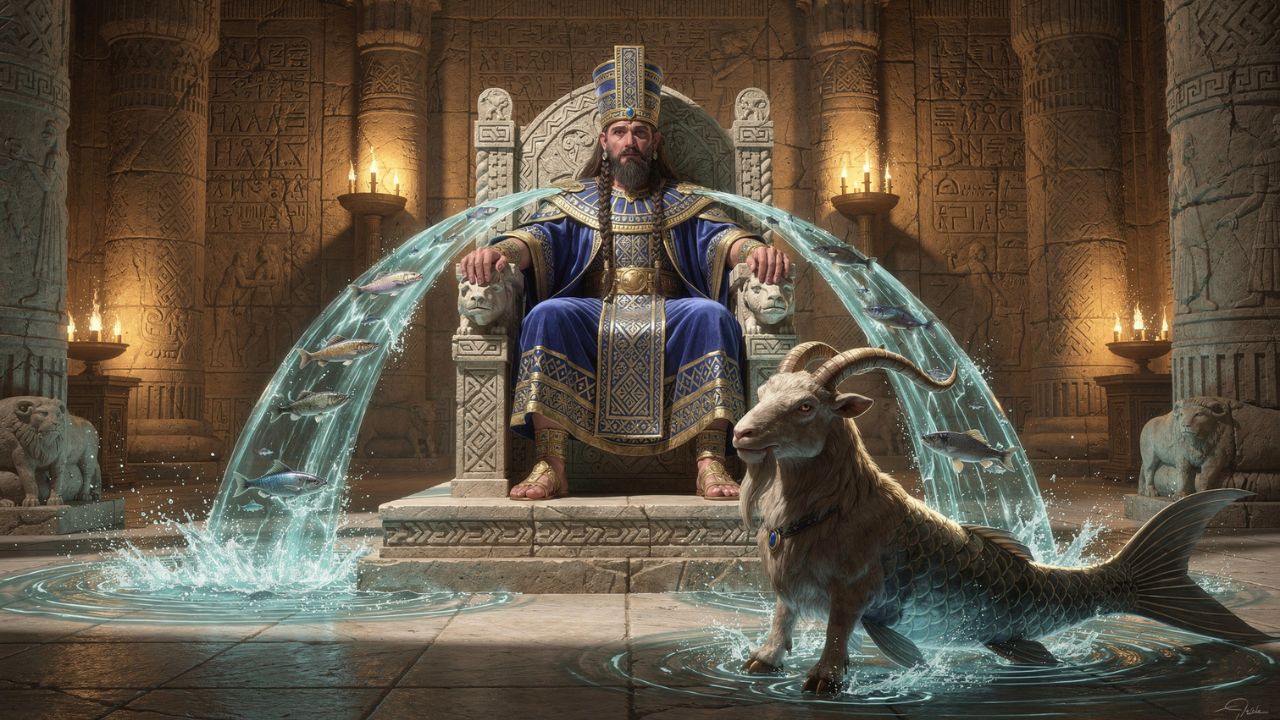
The creature became the emblem of Enki, one of the three most important gods of Sumerian civilization, and his Babylonian equivalent, Ea. Enki was the lord of the primordial waters, the god of wisdom, magic and creation, who lived in the Apsu, the realm of fresh water that, according to the Sumerians, flowed beneath the surface of the earth and fed everything that grew. His symbols were the goat and the fish, and over time the two fused into a single beast: the Suhur-Mash, the goat-fish that represented the duality of two worlds joined. Not the panic of a frightened god. The wisdom of one who understands both the depths and the heights.
Enki wasn’t merely wise. He was humanity’s benefactor. When Enlil, the storm god, decided to destroy humanity with a flood because they made too much noise, it was Enki who secretly warned a just man named Atrahasis to build a boat and save his family and the animals. A story scholars recognize as a direct predecessor of Noah’s flood in the Bible, written more than a thousand years later.
The Babylonians inherited the symbol and recorded it in the MUL.APIN tablets, around the 12th century BCE, one of the oldest astronomical records in existence. There appears MUL.SUHUR.MAŠ, the goat-fish constellation, marking the beginning of the winter solstice. This was not a story of accidental transformation. It was the gate of the sky: the point in the year when darkness was at its peak and from which the return of light began. The Babylonians called Capricorn “the gate of the gods,” the threshold through which souls ascended to the divine plane. Its opposite, Cancer, was “the gate of men,” through which they descended into the material world.
Pan panicked and was frozen in the sky by accident. Enki placed his creature there with intention. They occupy the same point in the firmament. They say entirely different things about whoever put them there.
The Andes: the toad no one else was watching
While Babylonians and Greeks were tracing figures connecting points of light, thousands of kilometers away the astronomers of Tawantinsuyu, the Inca empire centered in Cusco in what is today Peru, were developing a completely different system. They didn’t connect stars. They read the shadows.
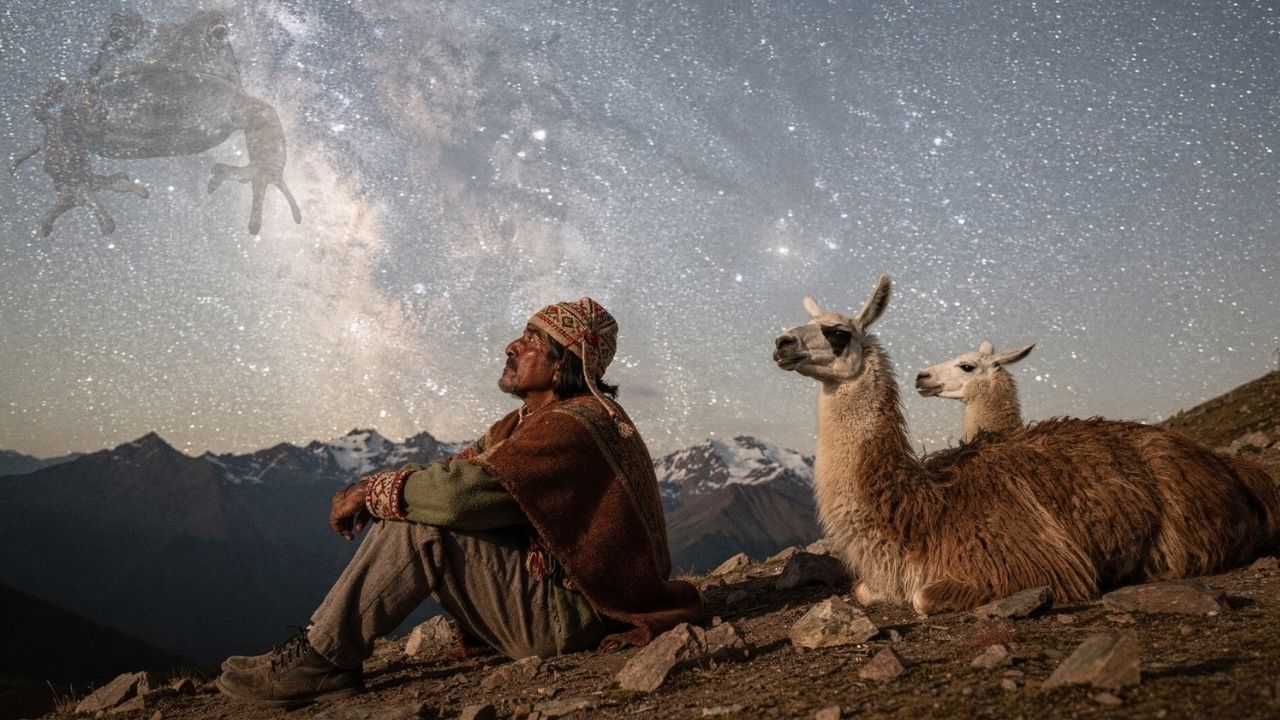
The dark patches of the Milky Way, those regions where interstellar dust blocks the light of background stars, formed silhouettes for them as clear as any Western constellation. From the Andes, at 3,000 or 4,000 meters of altitude, with skies free of light pollution and the Milky Way stretching from horizon to horizon, those patches took precise shapes. And the Incas named them, studied them, and built on them an agricultural calendar of remarkable precision.
Credit: ASTRONOMIKA TV / Flux 2 Pro
They called this system the dark constellations, and each animal they saw in those shadows served a function. If you’ve already read our Aries article, you already know the Yacana, the celestial llama that drinks the sea before dawn so the world doesn’t flood. But the Yacana was not alone in that dark sky. Just ahead of her, in the procession of sacred animals that Inca priests followed night after night, was the Hanp’atu.
The toad.
The Hanp’atu was a dark constellation the Incas associated directly with rainfall and soil fertility. In the Andes, the toad is no ordinary animal. It is the announcer of rain: when toads begin calling in the ravines, the water is coming. Highland farmers, who depended on the rain cycle for everything, learned to read that call with the same precision we read a weather forecast today. And when the Hanp’atu appeared clearly in the night sky, in that region of the Milky Way that roughly overlaps with the area of Capricorn and Aquarius, it was a signal: the rainy season was approaching. The land was about to wake up.
The Incas did not have an exact equivalent of the Western zodiac. The Hanp’atu was not “Capricorn” in the same way that Pan or the Suhur-Mash were. Their dark constellations followed the Milky Way, not the ecliptic. But that region of the sky, that point where Babylonians and Greeks felt something cosmologically significant, was also watched carefully by Andean astronomers. They just weren’t looking at the stars. They were looking at the space between them.
Steven Gulberg, of the University of Colorado, who has spent years following this system in rural communities on the altiplano, describes the procession as a reading of a living calendar: Mach’acuay the serpent, then Hanp’atu the toad, then Yacana the llama. Each appearance marked a season, an agricultural activity, a moment in the relationship between earth and sky. It wasn’t folklore. It was a system that functioned for centuries, and that communities in Bolivia, Peru and northern Argentina still use today to decide when to plant.
Three cultures, three readings of the same sky. A Sumerian god of wisdom who united the goat and the fish into one eternal symbol. A Greek god of panic frozen in his worst moment for eternity. And an Andean toad that no one else was watching, quietly announcing that the water was on its way. Capricorn is the same direction. What each one saw there says more about them than about the stars.
M30: the cluster consuming itself
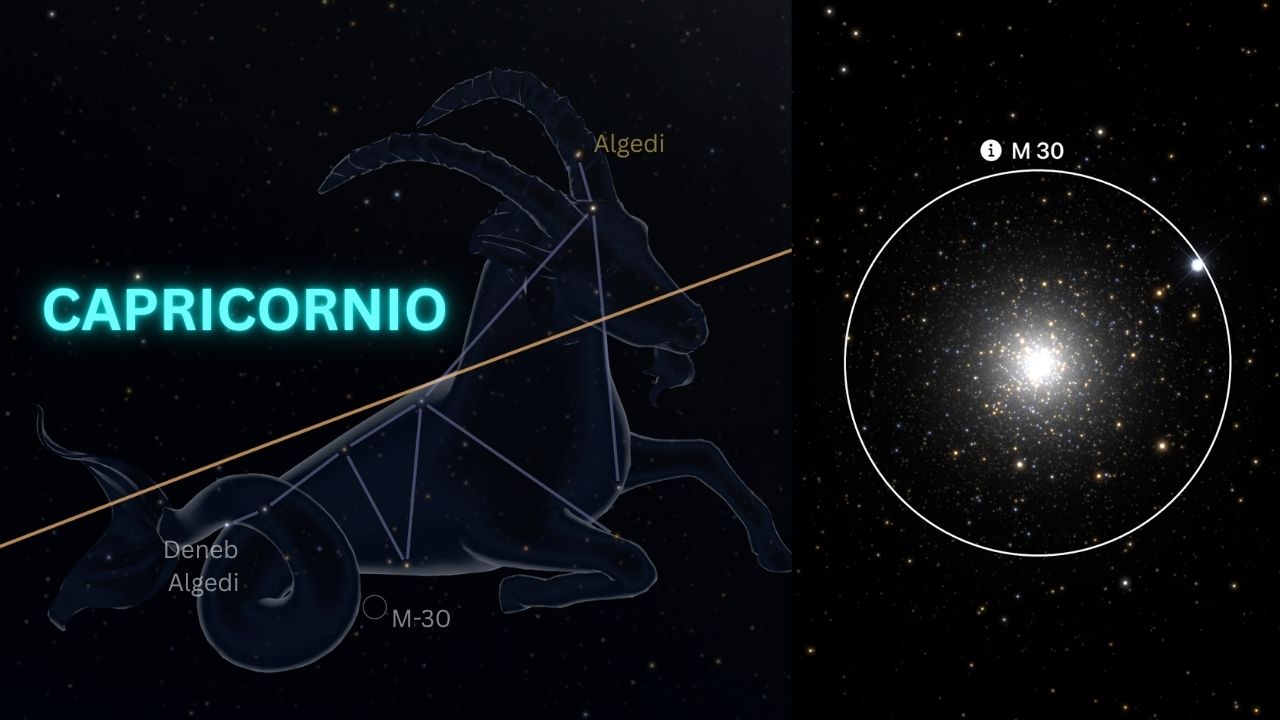
Capture: Sky Guide App
Capricorn is not the most spectacular constellation in the zodiac at naked-eye level. Its stars are faint, its figure doesn’t impress, and compared to the drama of Scorpius or the showmanship of Orion, it goes mostly unnoticed. But it hides something most constellations don’t: a deep-sky object with behavior that astronomers have spent decades studying, because they still haven’t fully figured it out.
It’s called M30, also catalogued as NGC 7099, and it sits about 26,000 light-years from us. To put that distance in perspective: traveling at the speed of light, you would take 26,000 years to get there. The light you see when you point a telescope at M30 left it when humans had not yet invented writing.
M30 is a globular cluster, a sphere of hundreds of thousands of stars bound by gravity, orbiting together for about 13 billion years. Almost as old as the universe itself. But what makes M30 special is not its age. It’s what is happening at its center.
Its core collapsed.
In most globular clusters, the density of stars increases gradually toward the center. In M30, that process reached a point of no return: the internal gravity won and the core contracted dramatically. Half of M30’s entire mass is compressed into a sphere just 8.7 light-years in radius. To put that in context: that is roughly the distance between us and Sirius, the brightest star in the night sky. All that mass in that volume.
Only about 21 globular clusters out of the 157 known in the Milky Way have gone through this process. M30 is one of the most studied cases. When you observe it with the ZWO Seestar S50 (Mexico | USA | Spain) or the DWARFLAB Dwarf 3 in imaging mode, that central compression translates into a core that glows with an intensity wildly disproportionate to the rest of the cluster. It doesn’t look like a smooth sphere. It looks like something squeezing inward.
Charles Messier discovered it in 1764 and wrote in his notes that it was “a nebula without any star.” He logged it and moved on, looking for comets, which was his actual job. William Herschel, nineteen years later, pointed a more powerful telescope at it and for the first time resolved the individual stars at the edge. Today the Hubble has photographed its core at a resolution Herschel couldn’t have imagined, and what it shows is a stellar density so extreme that stars collide with each other, merge, and create hybrid objects astronomers call blue stragglers: stars that appear younger than they should be because they formed from the collision of two old ones. The oldest cluster in Capricorn is creating new stars in the most violent way possible.
Algedi: the sky’s most elegant optical illusion
Before you get to M30 in the sky, you’ll pass through one of the zodiac’s most elegant optical illusions.
Algedi, the Alpha star of Capricorn, looks like a double star to the naked eye. Two yellow points of light, very close, perfectly aligned. Medieval Arab astronomers named it that way centuries ago, and many amateur observers enjoy it through binoculars believing they’re looking at a binary system, two stars orbiting each other.
They have nothing to do with each other.
The brighter of the two sits 109 light-years from us. The other is at 690. Between them lie 581 light-years of interstellar void. They appear together by pure coincidence of perspective, like when two buildings of very different heights align perfectly when viewed from a certain angle and appear to be the same size. The universe doesn’t connect them. Only our line of sight does.
How to find Capricorn
Capricorn is best searched between July and October in the northern hemisphere, when it rises high in the night sky. In the southern hemisphere, visibility is excellent during the austral winter, between June and September, when it appears nearly at the zenith from cities like Buenos Aires, Santiago or Lima.
The easiest route starts from Sagittarius. Locate the Teapot of Sagittarius, that group of stars forming the handle and spout of a teapot. Find its brightest star, Kaus Australis, at the bottom tip of the handle. From there, follow toward the left about three fist-widths at arm’s length. Capricorn is right there, its triangular figure pointing downward like the tail of the goat-fish.
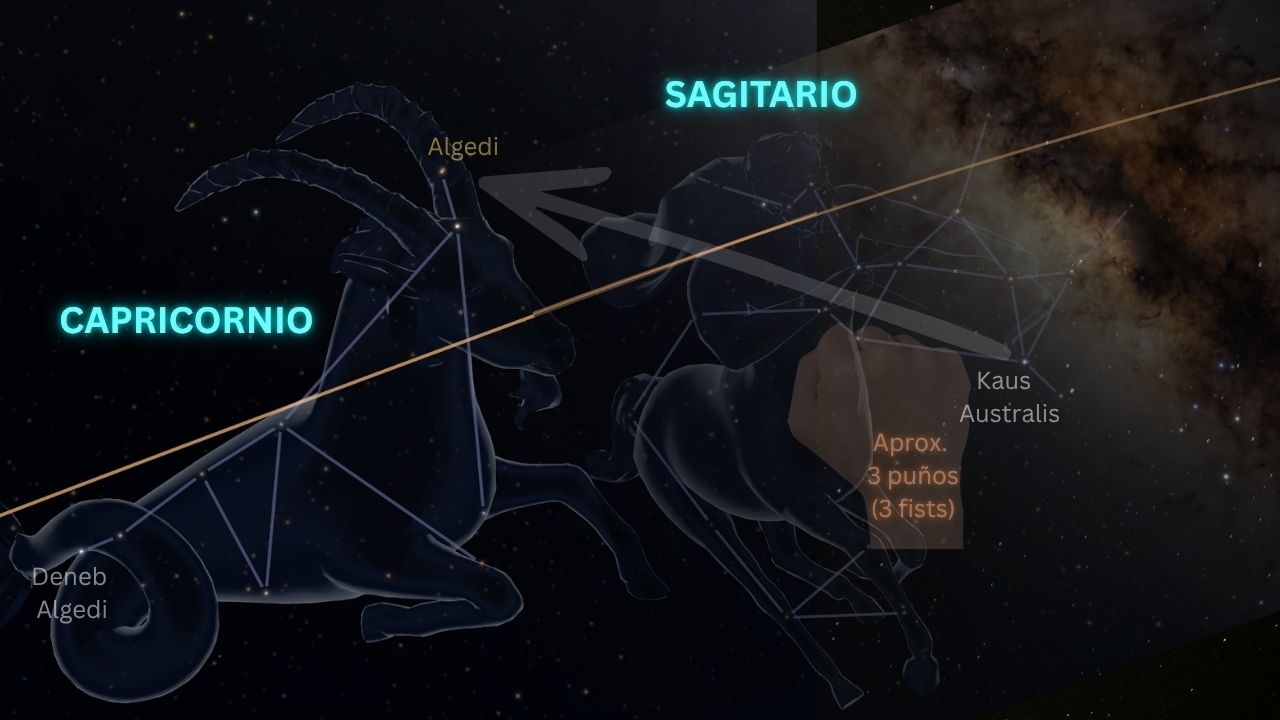
Capture and design: ASTRONOMIKA TV / Sky Guide App
To find M30, locate Deneb Algedi, the brightest star at the tail of Capricorn, at the lower right of the constellation. M30 is right next to it, about one binocular field to the southwest. With the CELESTRON SkyMaster 15×70 (Mexico | USA and Spain) you’ll see a fuzzy patch with a clearly brighter center, enough to locate it and understand where you’re looking. To see its real structure you need imaging: the ZWO Seestar S50 or the DWARFLAB Dwarf 3 will show you on screen the compressed core, the outer halo, and the chains of stars radiating from the cluster like spider legs. M30 is one of those objects that sounds unremarkable in description and leaves you speechless in an image.
4,000 years looking at the same point
Pan panicked and was frozen in the sky with goat legs and a fish tail. The Babylonians placed their wisest creature there, the emblem of the god who saved humanity from the flood. And in the Andes, a toad with no name in Western textbooks kept announcing the rains from that same region of the sky, century after century, in communities that never stopped watching it.
Capricorn is not the most spectacular constellation in the zodiac. Its stars are faint and its figure doesn’t impress at first glance. But it hides more history per square centimeter of sky than almost any other: 4,000 years of different civilizations looking at the same point and seeing completely different things. And inside it, a cluster of stars that has been consuming itself for 13 billion years with no sign of stopping.
Find it in the sky this summer, between Sagittarius and Aquarius. Bring binoculars. And if you already have a smart telescope, point it at M30 before you go to sleep. Some things are hard to forget.
Find us on YouTube, TikTok and Instagram as ASTRONOMIKA TV, and on Spotify as ASTRONOMIKA BEATS if you prefer the universe with a soundtrack.
Frequently asked questions about the Capricorn constellation
What does the Capricorn constellation represent?
Capricorn represents a mythological creature that is half goat, half fish. In the most widely known Greek version, that creature is the god Pan, who became trapped in that hybrid form when he fled the monster Typhon by throwing himself into the Nile River in a blind panic. The Babylonians had already used that same symbol centuries earlier to represent their god of wisdom, Enki, whose emblematic creature fused a mountain goat and a fish into a single being.
Why does Capricorn have a goat head and a fish tail?
Because of a mythological accident. According to Greek sources, Pan transformed into an animal to escape Typhon, but he did it so fast that the part of his body that touched the water became a fish while the part that stayed above remained a goat. Zeus immortalized him in the sky exactly like that, frozen in that moment of divine improvisation under pressure.
When can you see Capricorn in the sky?
In the northern hemisphere, the best time to look for it is between July and October, with optimal visibility in August and September when it reaches its highest point in the night sky. In the southern hemisphere the best time is the austral winter, between June and September, when it appears nearly at the zenith from latitudes like Buenos Aires, Santiago or Lima.
What is the brightest star in Capricorn?
Deneb Algedi, also called Delta Capricorni, at magnitude 2.85. The name comes from Arabic and means “the tail of the goat.” It sits just 39 light-years from us, shines eight times brighter than the Sun, and is an eclipsing binary: a companion star crosses in front of it roughly every 24 hours, causing its brightness to vary slightly on a regular schedule.
What is Algedi and why does it look double?
Algedi, the Alpha star of Capricorn, looks like a double star to the naked eye. But it is an optical illusion: the two stars have no physical relationship whatsoever. One is 109 light-years away and the other is 690. There are 581 light-years of interstellar void between them. They appear together by pure coincidence of perspective.
What deep-sky object does Capricorn have?
Its main object is M30, also known as NGC 7099, a globular cluster about 26,000 light-years away. It has a rare characteristic: its core collapsed, compressing a massive concentration of stars into an incredibly small volume. It is one of only about 21 clusters out of the 157 known in the Milky Way to have gone through this process.
What does a collapsed core in M30 mean?
It means that the cluster’s internal gravity won the battle billions of years ago and the core contracted dramatically, concentrating half of the entire cluster’s mass into a sphere just 8.7 light-years in radius. The stars at the center are so close together that they collide, merge, and create hybrid objects astronomers call blue stragglers: stars that appear younger than they should be because they formed from the collision of two old stars.
How do you find Capricorn in the sky without a telescope?
First locate Sagittarius, which looks like a teapot with its stars forming the handle and the spout. Capricorn is right next door, following the arc of the Milky Way to the left when the teapot is in front of you. Its stars are faint, but once you find the pointed triangle that forms its body, you won’t lose it. The best time is when the sky is completely dark, far from artificial light.
What is the connection between Capricorn and the Tropic of Capricorn?
The Tropic of Capricorn is the imaginary line marking the latitude where the Sun reaches directly overhead during the December solstice. When ancient astronomers defined that line, the Sun was in the constellation Capricorn during that solstice. That is no longer the case today: due to the precession of the equinoxes, the Sun in the December solstice now sits in Sagittarius. But the name Tropic of Capricorn stuck, as a reminder of when astronomy and geography shared the same map.
How old is the Capricorn constellation?
Capricorn is one of the oldest constellations on record. The earliest representations of the goat-fish appear on Mesopotamian seals from the late third millennium BCE, more than 4,000 years ago. The Babylonians recorded it in the MUL.APIN tablets around the 12th century BCE. Ptolemy included it in his catalog in the 2nd century CE, and it has not left the official sky map since.
Is Capricorn connected to any other zodiac constellations?
Yes, quite directly: the god Pan, the main character in the Greek myth of Capricorn, is the father of Crotus, the centaur archer Zeus immortalized in the constellation Sagittarius, Capricorn’s immediate neighbor in the zodiac. Father and son have been up there side by side for thousands of years.
If you want to hear Capricorn’s universe while you read or while you observe, The Sea Goat’s Solitude is the piece I composed for this constellation on ASTRONOMIKA BEATS.
This article contains affiliate links. If you purchase through them, I receive a small commission at no additional cost to you.
Sources and recommended reading
Books
- Eratosthenes. Catasterisms (3rd century BCE). The most important primary source for the mythology of the Greek constellations. Documents the version of Pan as the origin of Capricorn.
- Apollodorus. The Library (2nd century CE). Primary source for the episode of Typhon, the rescue of Zeus and the figure of Delphyne.
- Hyginus. Fabulae (1st century BCE). Alternative versions of the Capricorn myth, including connections to Aegipan and Amalthea.
- Urton, Gary. At the Crossroads of the Earth and the Sky (1981). University of Texas Press. The reference research on the Andean dark constellation system, including the Hanp’atu.
Digital sources
- The British Museum. MUL.APIN tablets. Babylonian astronomical catalog from the 12th century BCE where the Suhur-Mash is recorded. britishmuseum.org
- NASA / ESA. Images and data on M30 (NGC 7099). hubblesite.org
- SEDS Messier Database. Complete technical file on M30 with data on distance, radius and collapsed core characteristics. messier.seds.org
Did this article leave you wanting more?
Find us on YouTube, TikTok and Instagram as ASTRONOMIKA TV.
Universe music on Spotify: ASTRONOMIKA BEATS.
Everything in one place: www.astronomika.net