
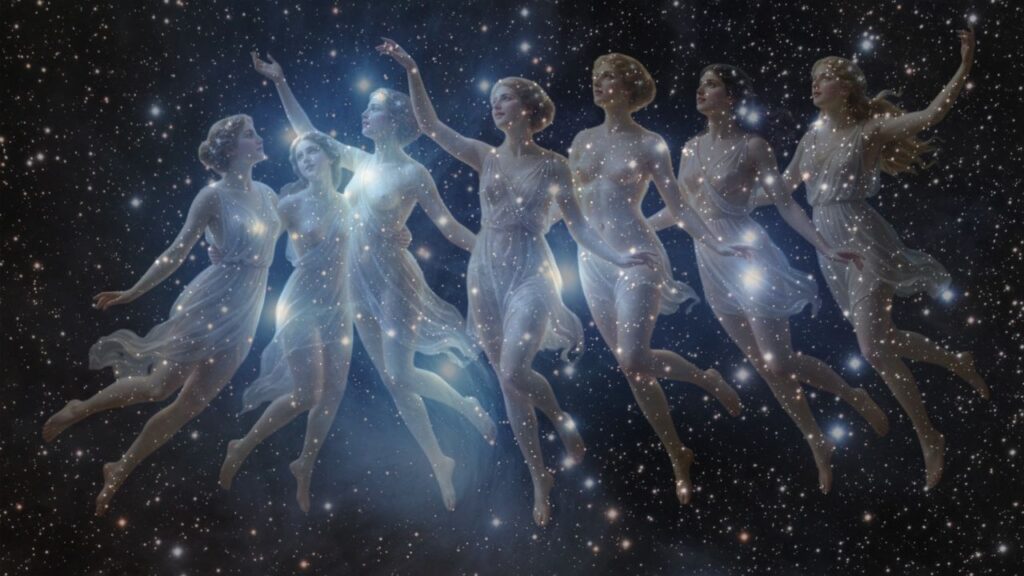
The Pleiades: goddesses, planets and the scandal nobody told you about
By Juan Pablo Martín | ASTRONOMIKA TV | June 2026
Seven immortal sisters, an eternal pursuit, Matariki, the Incas and what science says about M45. The complete story.
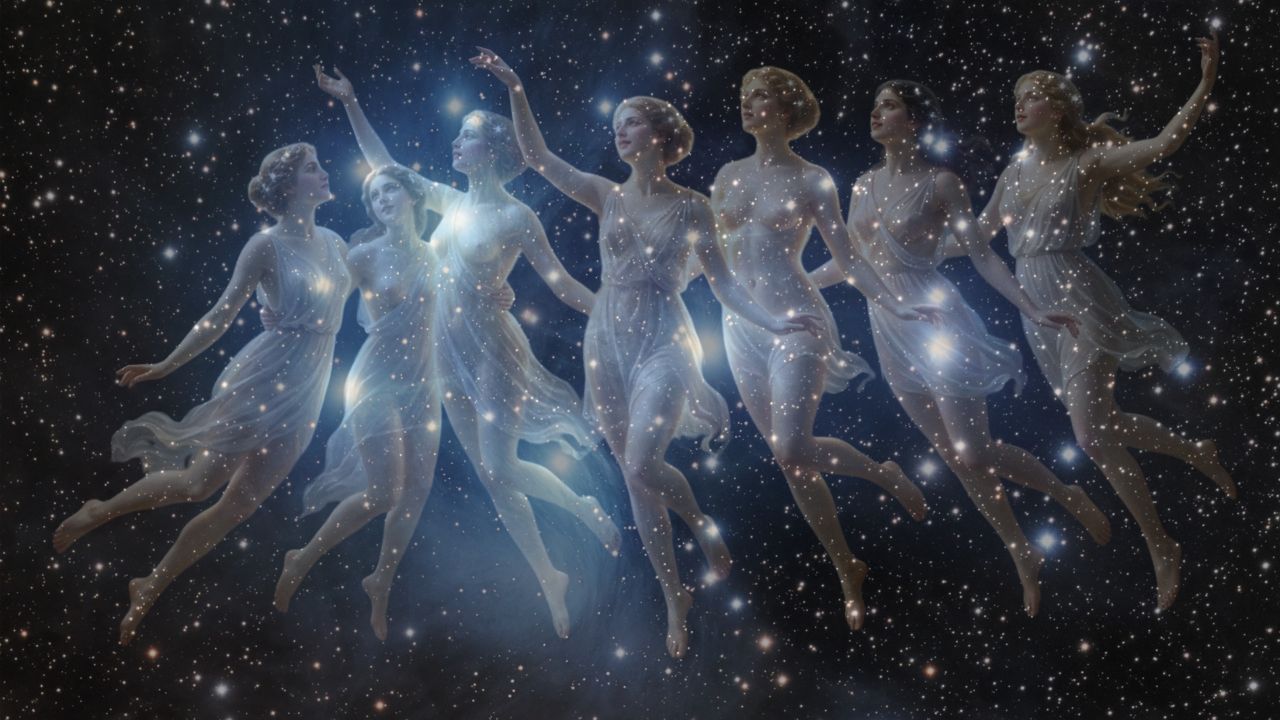
Image: ASTRONOMIKA TV / GP Cassini
Behind that small cluster of stars that anyone can point to in the winter sky lie seven individual stories, each with its own drama, its own gods and its own consequences. One of them connects to Mercury. Another to Neptune. Another to Mars. One more to the fall of Troy. And the last one simply chose a mortal and never apologized for it.
These are the Pleiades. Not the cluster. The people.
The family before the stars
Atlas did not choose to carry the sky. It was forced upon him.
He was a Titan, son of Iapetus and the Oceanid Clymene, and he had fought on the wrong side in the Titanomachy, the war Zeus waged against the previous generation of gods to seize control of the universe. This matters: Atlas belonged to the generation before Zeus. Older than the king of Olympus, older than Hera, older than all the gods we recognize by name today. And his daughters too.
The Titans lost. Zeus distributed the punishments with his characteristic creativity: Atlas was sentenced to hold the celestial vault on his shoulders forever, standing at the western edge of the world, in the mountains that bear his name today in northwest Africa, in what is now Morocco and Algeria. Not as a decorative figure. As a permanent condemnation.
Pleione was an Oceanid, daughter of the Titan Oceanus and Tethys, one of the three thousand nymphs who according to Hesiod inhabited the rivers, seas and springs of the known world. She protected sailors. That matters because her daughters inherited that function: the Pleiades became navigation guides for Mediterranean peoples for millennia, and their appearance and disappearance on the horizon marked when it was safe to set sail and when it was not.
From Atlas and Pleione were born seven daughters. They were nymphs, not goddesses in the strict sense, but not mortals either. They did not age. That means that when Zeus pursued them, when Orion harassed them for seven years, when each one lived her own stories with gods and demigods, they did so with the same face and the same body they had been born with. Immortal forever, and that meant carrying all the consequences.
They grew up on Mount Cyllene, in the northern Peloponnese, the same region you can visit today in central mainland Greece. They were part of the retinue of Artemis, the goddess of the hunt the Romans called Diana, which meant a life of forests, cold rivers and a freedom quite real by the standards of the ancient world. They hunted, ran, swam and lived with the discretion Artemis required of all who accompanied her.
The problem was that seven immortal nymphs, daughters of a famous Titan, did not go unnoticed. Not by the gods of Olympus. And the gods of Olympus, when they set their eyes on someone, rarely accepted no for an answer.
Each one experienced it in her own way. But before meeting them there is one detail the Greeks left unresolved.
The Pleiades are called the seven sisters in practically every culture that named them. But in the sky, with normal eyes and in reasonable conditions, most people can distinguish six. The seventh is always right on the edge, there but not quite.
The Greeks had an explanation for that. The problem is they had three and never chose one. According to some sources, the lost star is Merope, the only one who married a mortal, who shines less from shame at having chosen a man when her sisters had gods. According to others, it is Electra, who extinguished her light when she saw Troy burn, the city her son had founded. And according to others still, it is Celaeno, the darkest and most silent of the seven, whose star was always the faintest without anyone giving it a particularly dramatic reason.
All three versions have their logic, and all three sisters appear here with their complete story. In the end, you decide which one convinces you. The Greeks never did.
Maia: the eldest, the discreet one, mother of the most elusive god on Olympus
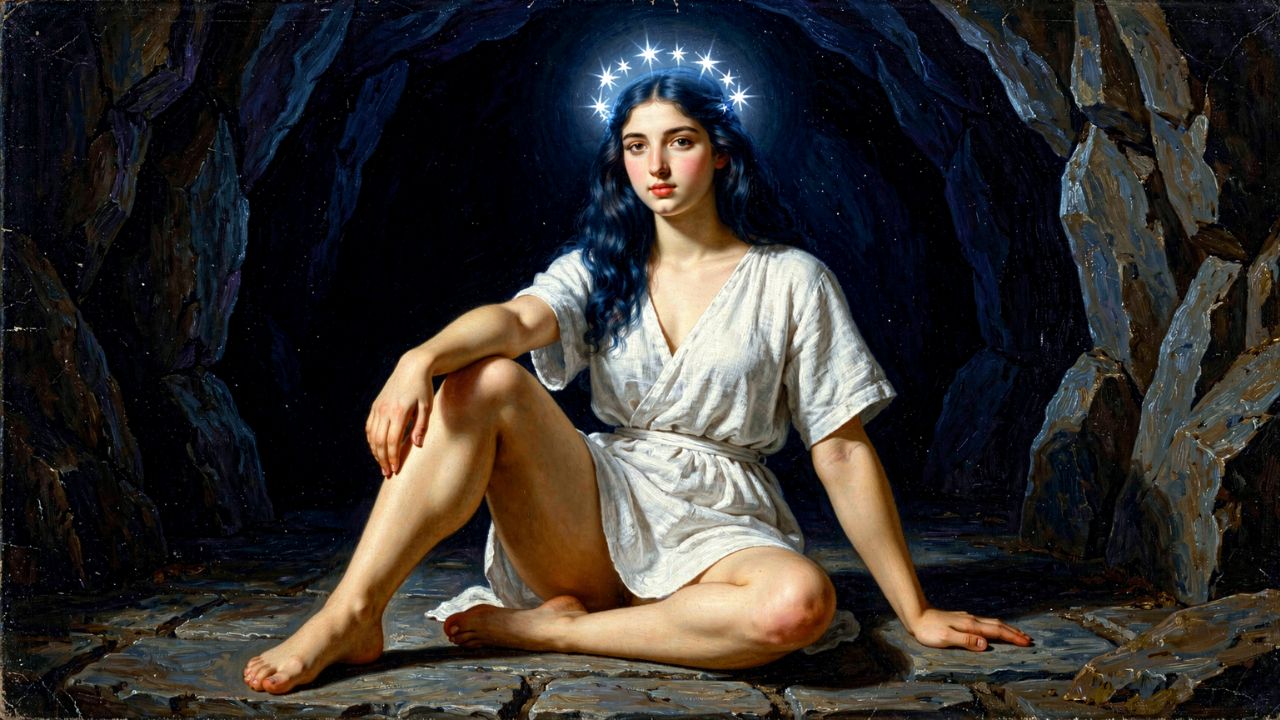
Image: ASTRONOMIKA TV / GP Cassini
Maia was the eldest of the seven and, according to most sources, the most beautiful, though that is always a matter of debate among the Pleiades. She appeared to be around 20 years old, with that expression of absolute calm that only people who have long been the eldest of something develop, having learned not to waste energy on what is not worth it.
She lived in seclusion in a deep cave on Mount Cyllene. She did not seek trouble. She did not attend celebrations. She did not provoke anyone. She was exactly the type of woman that Zeus, king of Olympus, whom the Romans called Jupiter, found irresistible.
We must be honest about what the texts say and what they do not say. Zeus went to find her at night, while Hera slept. No ancient source records that Maia rejected him, but none records that she sought him out either. The Greek texts simply narrate that Zeus “joined her”, with the same neutrality with which they describe the weather. A woman’s consent rarely appears in these accounts when Zeus is the one acting. What is clear is that once the situation occurred, Maia made a very specific decision: get the best possible result and make no noise. She had been in the world longer than Zeus himself, even if he was the king.
The result was Hermes, god of commerce, travelers, thieves, messengers and souls crossing to the underworld. An unusually broad range of responsibilities for a single god, but Hermes was always a special case. And he was from day one.
Hermes came into the world at dawn. By midday he had already crawled out of the cave, found a tortoise, hollowed it out with surgical patience, stretched strings across the shell and invented the lyre. By afternoon he had walked to Pieria, in northern Macedonia, stolen fifty cattle from Apollo’s sacred herd, made them walk backwards to confuse the tracks, hidden them in a cave in Arcadia and returned to his cradle as if nothing had happened. All on his first day of life.
Apollo, god of the Sun and the arts, whom the Romans also called Apollo because the name seemed good enough not to change, was not someone you wanted to steal cattle from. When he found Hermes, a one-day-old baby in his cradle wrapped in swaddling clothes, and accused him directly, Hermes denied everything with the calm conviction of someone with no prior record. Zeus intervened, saw the situation, and instead of punishing his newly discovered son he laughed. Hermes offered the lyre as compensation. Apollo accepted delightedly. That is how the god of the Sun also became the patron of music, and Hermes was acquitted of his first theft before turning 24 hours old.
Maia raised Hermes alone, in silence, buying time with her discretion so that Hera could do nothing when she finally found out. By the time Hera knew, Hermes was already the official messenger of Olympus, guide of souls to the underworld and the only god with free access to all realms: Olympus, Earth and Hades. Too useful to touch. Maia had played her cards well, as always.
The connection to the sky is direct. Hermes is Mercury to the Romans, and Mercury is the fastest planet in the solar system: it completes its orbit in just 88 days, appears and disappears on the horizon before you notice, always close to the Sun, always slipping away. The name fit perfectly. The mother chose the cave and discretion. The son chose speed and cunning. Both survived Olympus in exactly the same way.
Electra: the one who extinguished her star, the mother of Troy
Electra appeared to be around 19 years old, with a beauty that made people look twice, but with something in her eyes that made you not want to ask too many questions. The second of the Pleiades, and the one who carried the heaviest story of all.
Zeus came to Electra the same way he came to Maia: at night, without much preamble. The texts do not ask what Electra wanted. What they do record is what came after, which in this case was considerable.
From that union were born two sons: Dardanus, the mythical founder of Troy, and Iasion, who had the idea of falling in love with Demeter, goddess of the harvest the Romans called Ceres, and consummating that love in a thrice-plowed field. Zeus found out, struck him with a thunderbolt, and Iasion died before his story had time to get any more complicated. Electra lost her second son practically before he started.
But Dardanus lived. And he built.
Dardanus crossed the Aegean Sea from Samothrace, a Greek island in the northern Aegean, to the coasts of what is today northwestern Turkey, and there founded a city. That city in time became Troy, in the historical region of the Troad, about 30 kilometers from the Dardanelles strait, which bears his name to this day. And in case anyone doubts it: Troy is not just mythology. The ruins are there, in the province of Çanakkale in Turkey, excavated since the 19th century and open to visitors today. Nine layers of city stacked on top of each other, each built on the rubble of the previous one.
Dardanus was the first of a line that passed through Ilus, Laomedon, Priam and ended with Hector and Paris. Electra was, in direct terms, the great-grandmother of the man who triggered the longest war in Greek mythology by taking Helen from Sparta.
For centuries Electra watched from her place among the stars as that line grew. She saw the walls rise. She saw the city flourish. She saw Priam and his fifty sons born. And then, in the tenth year of the war, she saw everything burn.
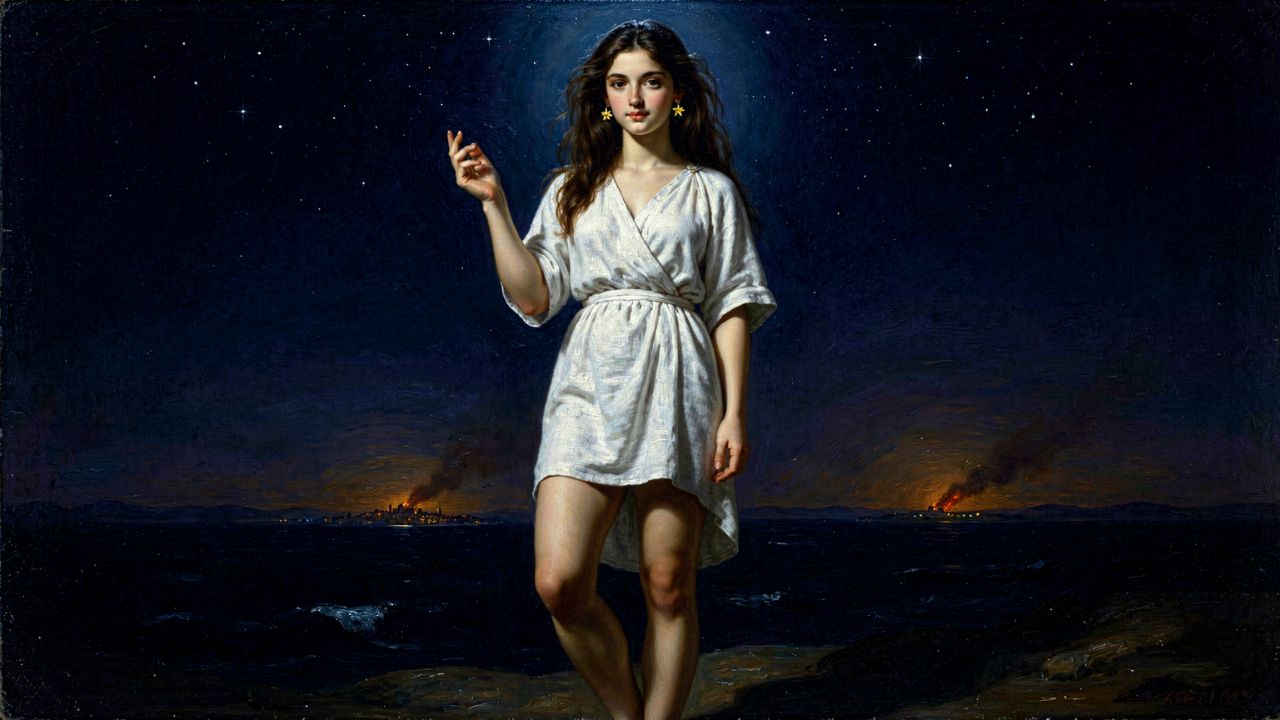
Image: ASTRONOMIKA TV / GP Cassini
When the walls of Troy fell, Electra could not stay in her place. She abandoned the sky. According to some sources she became a comet, that wandering light that crosses the sky without a fixed direction, belonging nowhere. According to others she simply extinguished her light and never relit it. This is one of three versions explaining why only six Pleiades shine clearly in the sky, as you already know.
The complete story of how Orion pursued the Pleiades until Zeus turned them into stars is told in full in the Orion article. The constellations of Perseus and Cassiopeia also cross this mythological universe and have their own articles coming soon.
Orión: el mito completo (Español) | Orion: the full myth (English)
Alcyone: the one who gave her name to the calmest days of the year

Image: ASTRONOMIKA TV / GP Cassini
Alcyone appeared to be around 21 years old, the most serene of the seven at first glance, with that energy of someone always in their element, as if the world adjusted to her rhythm rather than the other way around. That calm had a story behind it, and like everything in Atlas’s family, it was not simple.
Before getting into her story, something needs to be clarified that the ancient sources never bothered to resolve: in Greek mythology there are two Alcyones. One is the Pleiad, daughter of Atlas and Pleione, sister of Maia and Electra. The other is the daughter of Aeolus, god of the winds, protagonist of a completely different myth. The name was the same, the stories had nothing to do with each other, and the Greeks eventually merged them into a single character without leaving a footnote. Here we tell them separately.
The Pleiad: Atlas’s daughter
Poseidon, god of the sea whom the Romans called Neptune, saw her and decided he had to meet her. From that union were born several children: Hyrieus, who founded the city of Hyria in Boeotia, the region in central mainland Greece northwest of Athens; Hyperenor; and Aethusa. None of them starred in particularly dramatic stories, which in Greek mythology almost counts as an achievement.
The planetary connection is direct: Poseidon is Neptune to the Romans, the most distant planet in the solar system, taking 165 years to complete a single orbit around the Sun. So far that from its surface the Sun appears as little more than a bright star, not very different from the rest. The coldest planet, the bluest, the most inaccessible.
The other Alcyone: Aeolus’s daughter
This is a different story starring a different person who had the bad luck of sharing a name with a Pleiad. The Greeks merged them. Here we keep them separate.
This Alcyone was the daughter of Aeolus, god of the winds, and was married to Ceyx, son of Eosphorus, the morning star. They were happy, which in Greek mythology is almost always a sign that something is about to go very wrong very soon.
The problem was arrogance. Alcyone and Ceyx called themselves Zeus and Hera. Not as a loving nickname between spouses. As a title. Out loud. In front of people.
Zeus and Hera found out, and reacted exactly as one might expect.
Ceyx died in a shipwreck while crossing the Aegean Sea. It was no accident: Zeus hurled a thunderbolt at his ship in the middle of a storm. Alcyone, waiting on land with no idea what had happened, begged Hera for news of her husband. Hera sent Iris, goddess of the rainbow, to the kingdom of sleep so that Morpheus could take the form of Ceyx and appear to Alcyone while she slept to tell her the truth.
Alcyone woke knowing Ceyx was dead. She ran to the seashore and found his body floating near the coast. At that moment she threw herself into the water.
The gods transformed them both into kingfishers, those birds with brilliant blue and orange plumage that skim the surface of the sea. And here comes the detail that survived for millennia: Aeolus calmed the waters for fourteen days every winter so that his daughter’s eggs would not be swept away by the waves. Those fourteen days of calm in the depths of winter were called halcyon days.
The expression has survived intact to this day. When someone speaks of an unexpected period of tranquility in the middle of chaos, they are unknowingly using the name of a woman who lost her husband at sea and whose father stopped the wind to protect her eggs. Ancient Greek had that habit of turning tragedies into metaphors so beautiful that no one remembers where they came from.
Taygeta: the huntress who preferred to be a doe
Taygeta appeared to be around 20 years old, athletically built with an independent expression, the most similar to Artemis of all the sisters in character and way of life. Not by chance: of the seven, she had the closest relationship with the goddess of the hunt, and paid the highest price for that devotion when Zeus decided he was interested.
Zeus saw her and wanted her. Taygeta did not want him. That difference of opinion between an omnipotent god and an immortal nymph had few possible outcomes, and Taygeta knew it.
She ran to Artemis, goddess of the hunt whom the Romans called Diana, her protector. Artemis could not confront Zeus directly, but she could do something: she transformed Taygeta into a white doe with golden horns to hide her in the forests of the Peloponnese.
It did not fully work. Zeus found the doe and covered her anyway, not knowing or not caring that it was Taygeta transformed. When Artemis returned Taygeta to her original form, she was already pregnant.

Image: ASTRONOMIKA TV / GP Cassini
From that union was born Lacedaemon, the mythical founder of Sparta, the warrior city-state located in the southern Peloponnese, about 210 kilometers southwest of Athens. Lacedaemon gave his name to the entire region: Lacedaemonia, which the Romans Latinized as Laconia. From there comes the word “laconic”, because the Spartans were famous for speaking little and to the point. Taygeta was, in direct terms, the mythical grandmother of the most austere and most militarized culture in ancient Greece.
As an act of gratitude toward Artemis for trying to protect her, Taygeta dedicated to the goddess the Ceryneian Hind, a doe with golden horns and bronze hooves. That same doe appears centuries later in the labors of Hercules: the third labor imposed on him by King Eurystheus of Mycenae was to capture the Ceryneian Hind alive and unharmed. Hercules spent an entire year accomplishing it.
Of all the Pleiades who had encounters with Zeus, Taygeta is the only one whose resistance is explicitly narrated in the ancient texts. The others appear without any context of consent or resistance. Taygeta ran. She asked for help. And still could not avoid it. The Greeks told that story without apparent discomfort, but they told it completely.
The constellation Hercules bears the name of the hero who pursued the hind that was born from Taygeta’s story. A thread connecting a Pleiad to one of the most famous labors in Greek mythology.
Celaeno: the dark one, the one almost nobody remembers

Image: ASTRONOMIKA TV / GP Cassini
Celaeno appeared to be around 18 years old, the youngest in appearance of the seven, with a beauty that did not ask for attention but was simply there, like a well-defined shadow. Her name in ancient Greek means dark, black, the one who does not shine. It was not an insult. It was a description.
Celaeno is the Pleiad with the least material in the ancient sources, and that in itself says something. In a pantheon where every god, nymph and demigod has at least three contradictory versions of their story, silence is unusual.
Poseidon, whom the Romans called Neptune, also came to her. From that union were born Lycus and Nycteus, two brothers who would end up playing a role in the story of Thebes, the Greek city-state located in Boeotia, in central mainland Greece. Lycus became regent of Thebes. Nycteus was the father of Antiope, whose story crosses with that of Zeus and with the mythical founder of the city. A chain of consequences starting with Celaeno and ending several centuries later within the walls of a city that has nothing to do with her.
Other versions attribute to her a son with Prometheus, the Titan who stole fire from the gods to give it to humanity, also called Prometheus by the Romans. Prometheus ended up chained to a rock in the Caucasus, the mountain range between the Black Sea and the Caspian Sea, with an eagle eating his liver every day for all eternity. Whether the son he had with Celaeno inherited anything of his father’s character was never recorded.
Her star, Celaeno or 16 Tauri in modern nomenclature, sits right at the limit of what the human eye can distinguish under normal conditions. It is there, but you have to look for it. It is one of the three candidates for the lost star of the Pleiades, though in her case the Greeks gave it no dramatic reason: it was simply always the hardest to see. There is a poetic coherence in that which the Greeks probably did not calculate: the Pleiad with the least story is also the hardest to find in the sky.
Sterope: the lightning one, mother of the most cunning king in Greece
Sterope appeared to be around 19 years old, with something in her skin that seemed different from the others, as if light bounced off her in a slightly different way, more alive, more electric. Her name in ancient Greek means lightning or flash of light. It was no coincidence: her whole story revolves around fire, war and a man who turned deception into an art.
Ares, god of war whom the Romans called Mars, came to Sterope with the same subtlety that characterized everything he did, which was none. Ares was the most violent of the Olympian gods, the one who threw himself into combat without strategy or plan, pure brute force with divine pretensions. Aphrodite loved him, the rest of Olympus tolerated him with difficulty. But he was the son of Zeus and Hera, which gave him a status no one could ignore.
From Ares and Sterope was born Oenomaus, king of Pisa, a city-state in the Greek Peloponnese located near Olympia, the same place where the original Olympic Games were held in honor of Zeus. Oenomaus inherited his father’s strength and something more: an obsession that destroyed him.
Oenomaus had a daughter, Hippodamia, and also an oracle that told him he would die at the hands of his son-in-law. The solution he devised was as brutal as it was effective: no suitor could marry Hippodamia without first beating him in a chariot race. Oenomaus started second, gave his rival a head start, then caught up with his divine horses, a gift from his father Ares, and killed the suitor with a spear from behind. He had twelve dead suitors when Pelops arrived.
Pelops was the son of Tantalus, grandson of Zeus, and had experience with extreme situations: his own father had cooked him and served him as a banquet to the gods to test whether they were omniscient. The gods were, they refused to eat, and Zeus brought him back to life with an ivory shoulder instead of the original because Demeter, distracted by the pain of losing Persephone, had eaten a piece without noticing. Pelops arrived at the race with that history and a plan.
He bribed Myrtilus, Oenomaus’s charioteer and son of Hermes, to sabotage the king’s chariot by replacing the wheel pins with beeswax instead of metal. In exchange he promised him half the kingdom and the first night with Hippodamia. During the race Oenomaus’s wheels came loose, the king fell and died tangled in the reins.
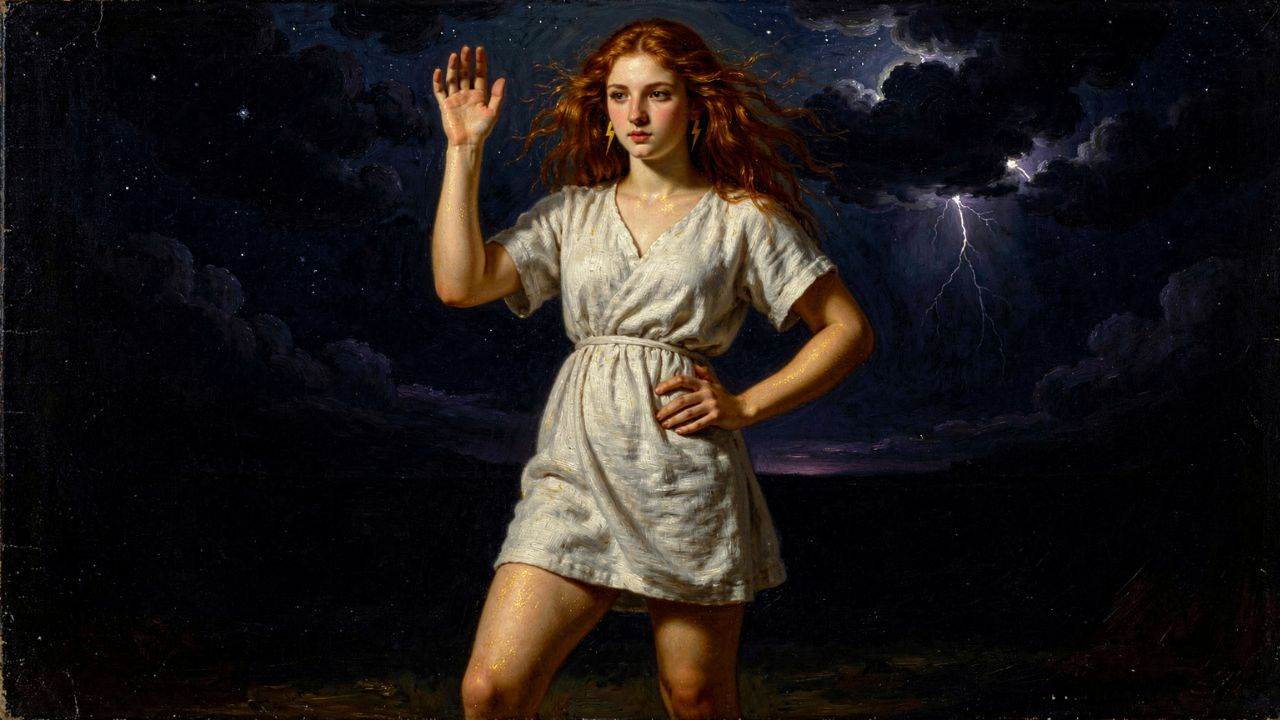
Image: ASTRONOMIKA TV / GP Cassini
Pelops won Hippodamia and the kingdom. Then he threw Myrtilus into the sea to avoid fulfilling his part of the deal. Myrtilus fell cursing Pelops and all his blood. Some versions say the gods turned him into a constellation. Which one exactly, the Greeks never quite agreed on, though some point toward Auriga.
That curse is known as the curse of the House of Atreus, and it explains everything that came after: Agamemnon, Clytemnestra, Orestes, the human Electra, not the Pleiad, the entire chain of betrayals and deaths that the Greeks turned into their most famous tragedies. Sterope was the grandmother of all of it.
The planetary connection is direct: Ares is Mars to the Romans, the red planet, the fourth in the solar system. The color of its surface, caused by iron oxide, gave it that association with blood and combat that its name confirmed.
Merope: the dimmest one, the only one who was not ashamed to love a mortal
Merope appeared to be around 22 years old, the oldest in appearance after Maia, with a warm and earthy beauty that made her look more approachable than her sisters. She did not have Electra’s distance or Taygeta’s fierceness or Celaeno’s mystery. Merope seemed the most human of the seven, and it was no coincidence: she was the only one who chose a mortal over a god. And she chose him knowingly.
Sisyphus was king of Ephyra, the city that would later become Corinth, located on the isthmus connecting mainland Greece with the Peloponnese, in what is today north-central Greece. He was the most cunning man in all of Greek mythology, which is a tough competition given the general level of the field. He founded his city, accumulated wealth, and developed a relationship with the gods that was less about devotion and more about permanent negotiation.
Merope fell in love with him. It was not a chance encounter, nor a divine trap, nor a pursuit. Merope saw him, wanted him, and married him. Her sisters had divine lovers: Zeus, Poseidon, Ares. Merope chose a mortal king with a reputation for cunning. The ancient sources do not explain why. They simply narrate it and move on, as if it were the most natural thing in the world.
The problem was not the marriage. The problem was Sisyphus.
Sisyphus had a list of offenses against the gods that had accumulated over the years with admirable consistency. He revealed the location of a nymph Zeus had abducted, in exchange for the river god giving water to his city. He chained Thanatos, god of death, so he would not die, which had the side effect that during that time no one in the world could die. Ares had to free him personally because his wars had lost all meaning.
When Sisyphus finally died and descended to the underworld, he told Merope not to perform the funerary rites, so he could argue before Persephone, queen of the underworld whom the Romans called Proserpina, that his body was unburied and that he needed to return to the world of the living to fix it. Persephone let him go. Sisyphus returned, refused to go back, and kept living for several more years before Hermes, whom the Romans called Mercury, had to go personally to retrieve him.
Zeus assigned him the most famous punishment in all of Greek mythology: pushing an enormous rock uphill in Tartarus, the deepest region of the underworld. Every time the rock neared the top of the hill, it rolled back down. Forever.
Merope knew who she was marrying. That did not exempt her from the consequences.
For having joined a mortal, and one with that particular track record, Merope is according to this version the dimmest star of the Pleiades. The other six shine with the light of their divine loves. Merope shines with the light of having chosen freely.

Image: ASTRONOMIKA TV / GP Cassini
Some read that as a punishment. Others read it as exactly the opposite: the only one of the seven who made her own decision without any god imposing it on her, and who paid the price with the same conviction with which she made it.
Look for the Pleiades tonight. Count the ones you can see. The one you cannot find, or the one you barely sense at the edge of your vision, that could be Merope. The only one who chose.
The day the seven fled together
Until now the stories of each sister have been individual. Maia in her cave. Electra watching Troy burn. Alcyone on the seashore. Taygeta in the forest. Celaeno in her silence. Sterope with the storm behind her. Merope choosing who she wanted. Seven separate lives, seven different destinies, seven ways of carrying the burden of being Atlas’s daughter in a universe governed by gods who did not ask permission.
But there was a moment when all seven shared exactly the same problem. And that problem had a name: Orion.
Orion was the son of three gods, Zeus, Poseidon and Hermes, born from a buried ox hide in Boeotia, in central mainland Greece. He was not a giant in the supernatural sense. He was a man of around two meters, extraordinarily well proportioned, with an skill with the bow no mortal could match and the inherited gift from Poseidon of walking on water as if it were solid ground. He had been in the world perhaps two decades when he saw them. And he approached them with the quiet certainty of someone who had never heard the word no.
He wanted all seven. Without asking them.
Here is an irony the Greeks left without comment: Alcyone, one of the seven, was technically Orion’s grandmother through the line of Poseidon. For seven years Orion pursued his own grandmother without knowing it. Greek mythology was that twisted, and it did not apologize for it.
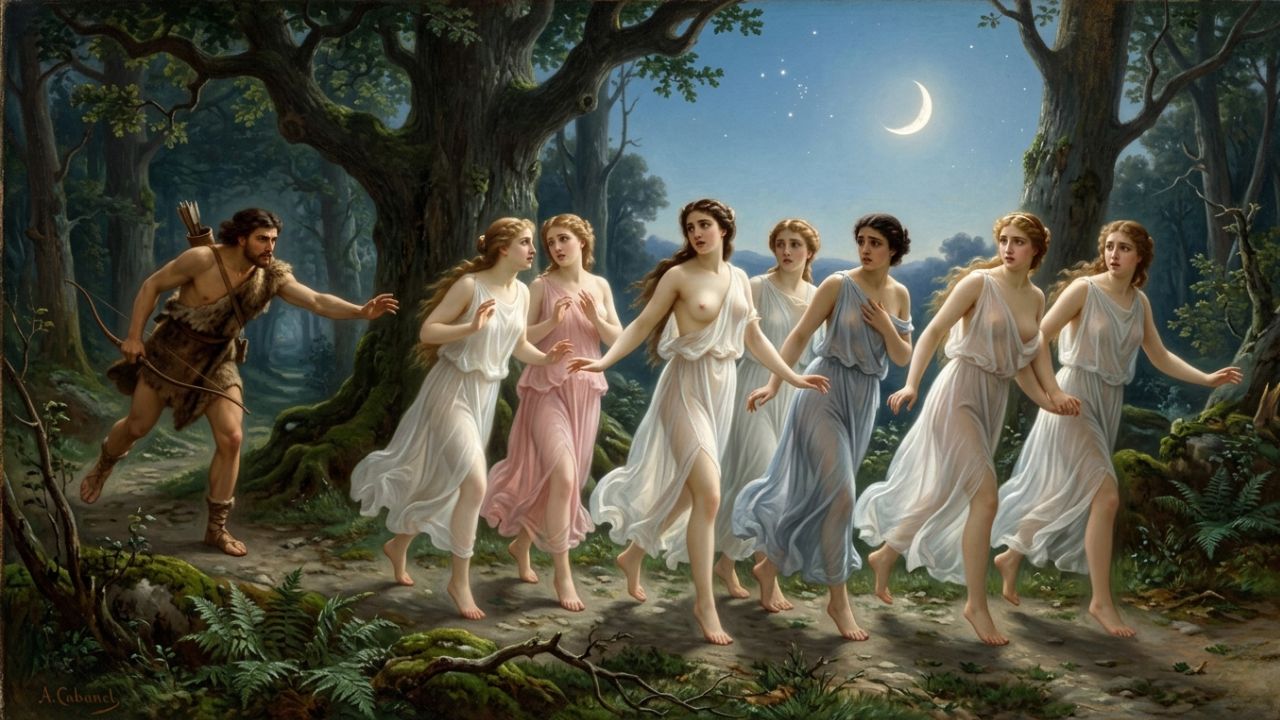
Image: ASTRONOMIKA TV / GP Cassini
The Pleiades fled. Orion pursued them for seven years across mountains, forests and islands without catching them, not because he was slow but because they had been around since before the world was recognizable and knew every corner of the territory better than any mortal hunter. They were immortal nymphs with millennia of advantage. Orion was twenty years old and had considerable arrogance.
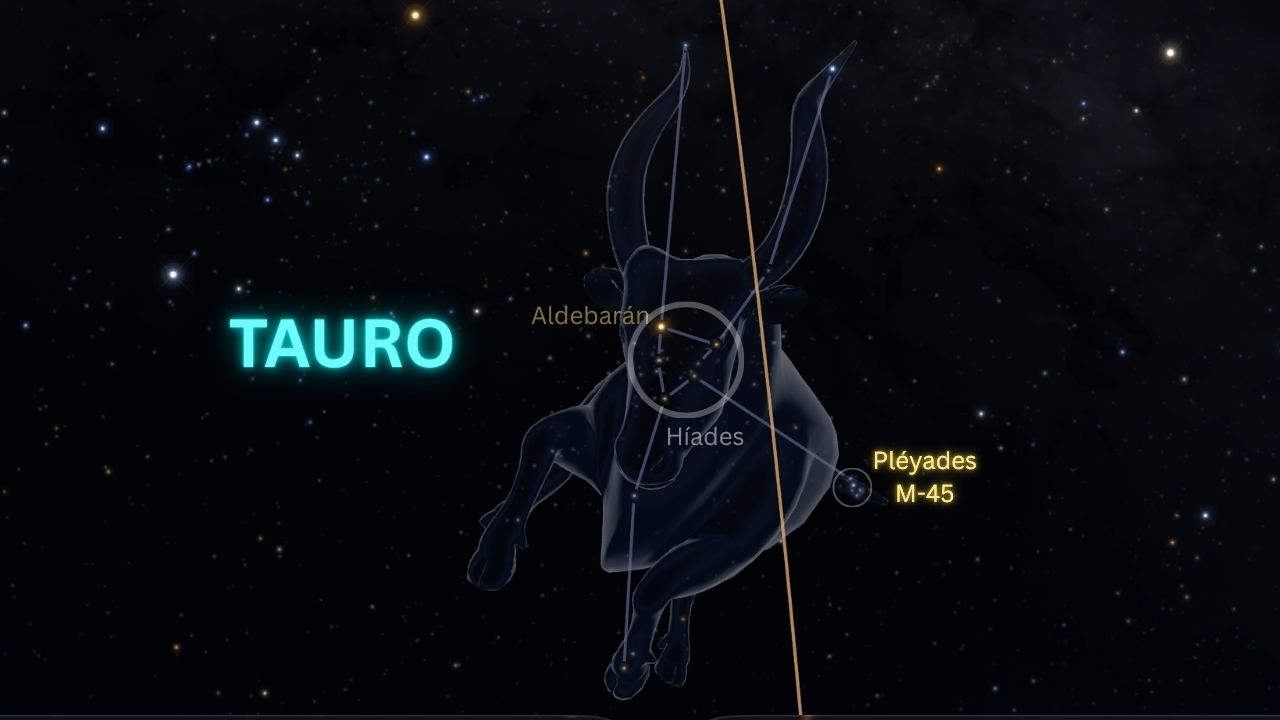
Zeus finally intervened. He first turned them into doves so they could fly away from Orion, and then into stars. But he did not place them in just any corner of the sky. He placed them on the back of the bull in the constellation Taurus, so that that bull, burdened with history and debts, would protect them.
Orion also ended up in the sky, turned into a constellation. The complete story of how he got there, including his blinding on Chios, his encounter with Artemis in Crete and his two possible deaths, is told in the Orion article.
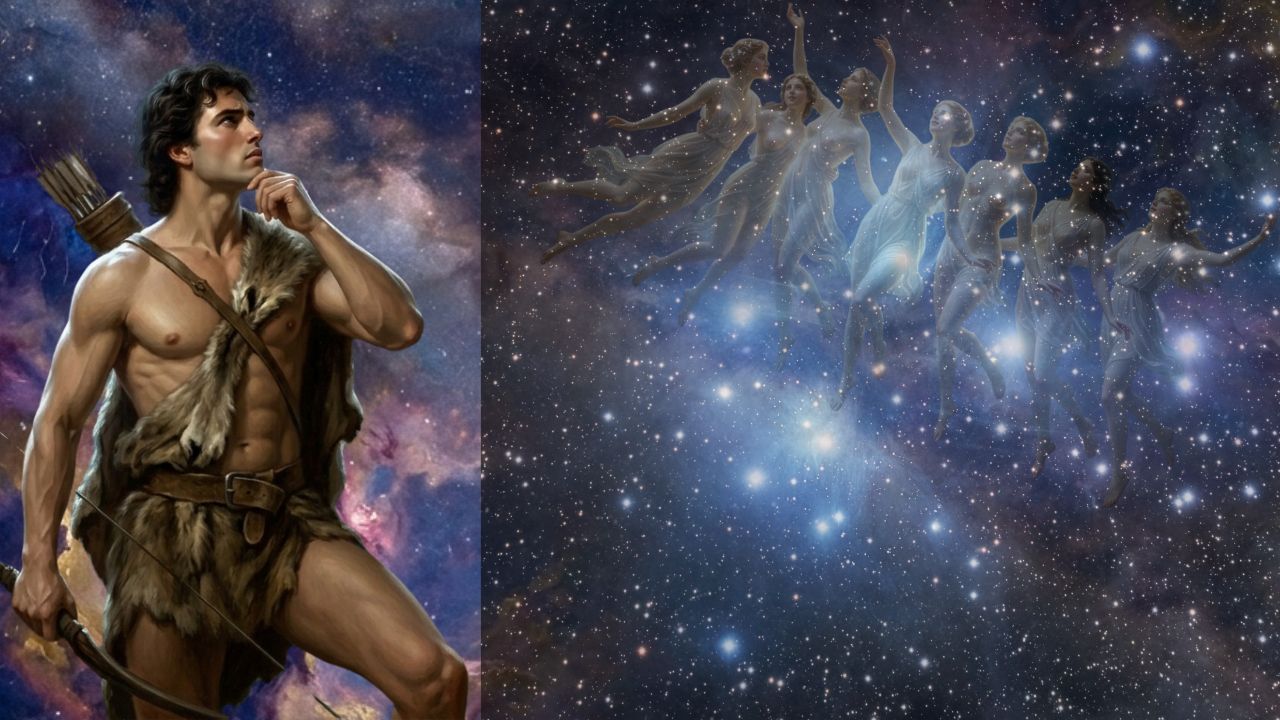
Image: ASTRONOMIKA TV / GP Cassini
And there the pursuit continues. Night after night, for all eternity, Orion advances toward the Pleiades. The bull intervenes. The Pleiades are always ahead, always sheltered behind those horns. He never catches them. He never gives up.
The Greeks did not explain it as justice. They drew it as celestial geometry. But the geometry tells the same story.
The complete story of Orion, including his birth from three gods, his blinding on Chios and what happened in Crete with Artemis, is in his own article.
Constelación de Orión: el mito completo (Español) | Orion Constellation: the full myth (English)
The same sky, completely different stories
The Greeks saw family drama, pursuit and shame. But the same group of stars was observed independently by cultures in every corner of the world, and almost none of them saw the same thing. Two examples that could not be more different from each other, or from the Greek version.
The Maori: the ancestors who return every year
The Maori of New Zealand call the Pleiades Matariki, a name that translates roughly as “eyes of the god” or “tiny eyes of the sky”, depending on the interpretation. For them the cluster does not represent seven sisters fleeing a hunter. It represents the dead.
When Matariki appears on the horizon at dawn in early June, after having been absent from the night sky for several months, the Maori interpret that return as the moment when the spirits of those who died during the previous year ascend to the sky and become stars. It is not an astronomical event. It is a reunion.
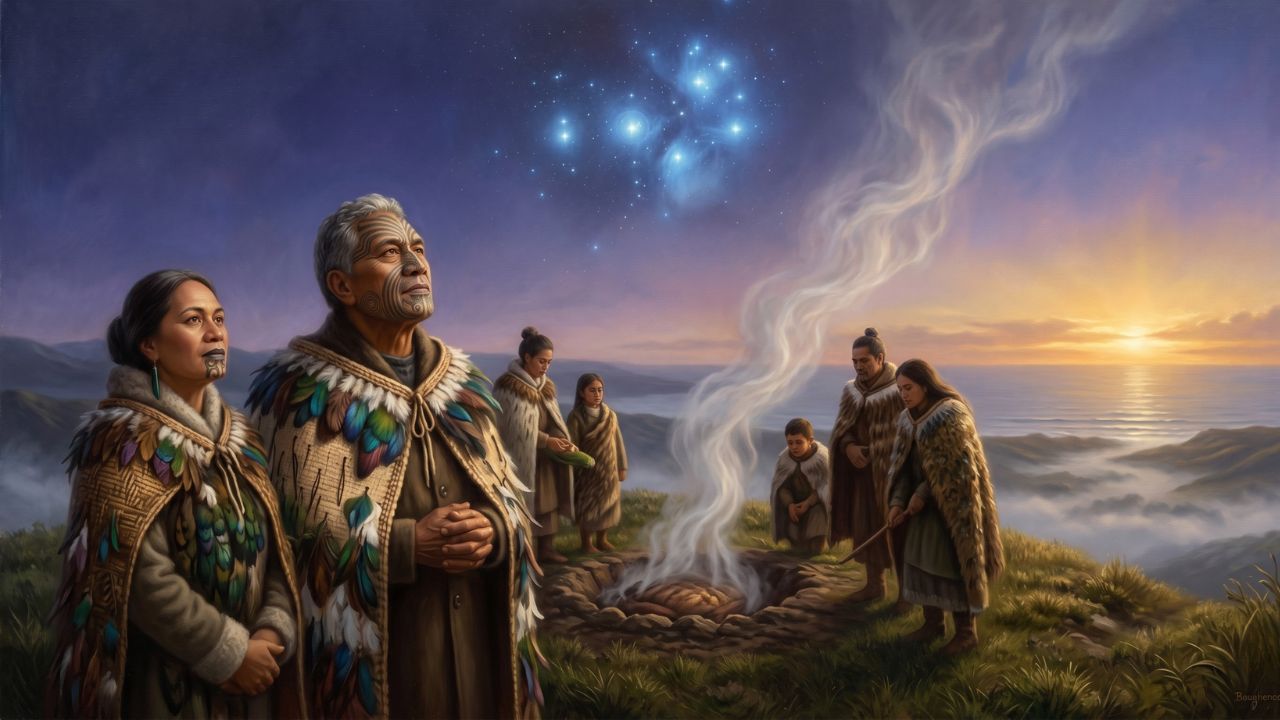
Image: ASTRONOMIKA TV / GP Cassini
The celebration of Matariki is the Maori New Year: a time to remember the dead, give thanks for the land, and plant the seeds of what is to come. Each of the nine main stars of the cluster, because the Maori distinguish more than the Greeks, has its own name and a specific responsibility over some aspect of the natural world: the sea, rivers, agriculture, winds, cultural identity.
In 2022, New Zealand made Matariki an official national holiday, becoming the first country in the world to create a public holiday based on an indigenous astronomical event. The same stars the Greeks placed in the sky to protect seven nymphs from a hunter are today the reason for a national celebration on the other side of the planet.
The contrast with the Greek version could not be clearer: for the Greeks, the Pleiades are victims who need protection. For the Maori, they are ancestors who return to take care of the living.
The Incas: the granary that predicted the future
Thousands of kilometers from New Zealand, in the Andes of what is today Peru, Bolivia and Ecuador, the Incas looked at the same stars and saw something completely different: an agricultural prediction system.
The Incas called the cluster Collca, meaning granary or storehouse. And they used it exactly for that, as an indicator of the year ahead. Each year in June, Andean farmers observed the brightness and apparent size of the Pleiades with meticulous attention. If the cluster appeared large and bright, the following year’s potato harvest would be abundant. If it appeared small and faint, there would be scarcity, and the amount planted and stored needed to be adjusted.
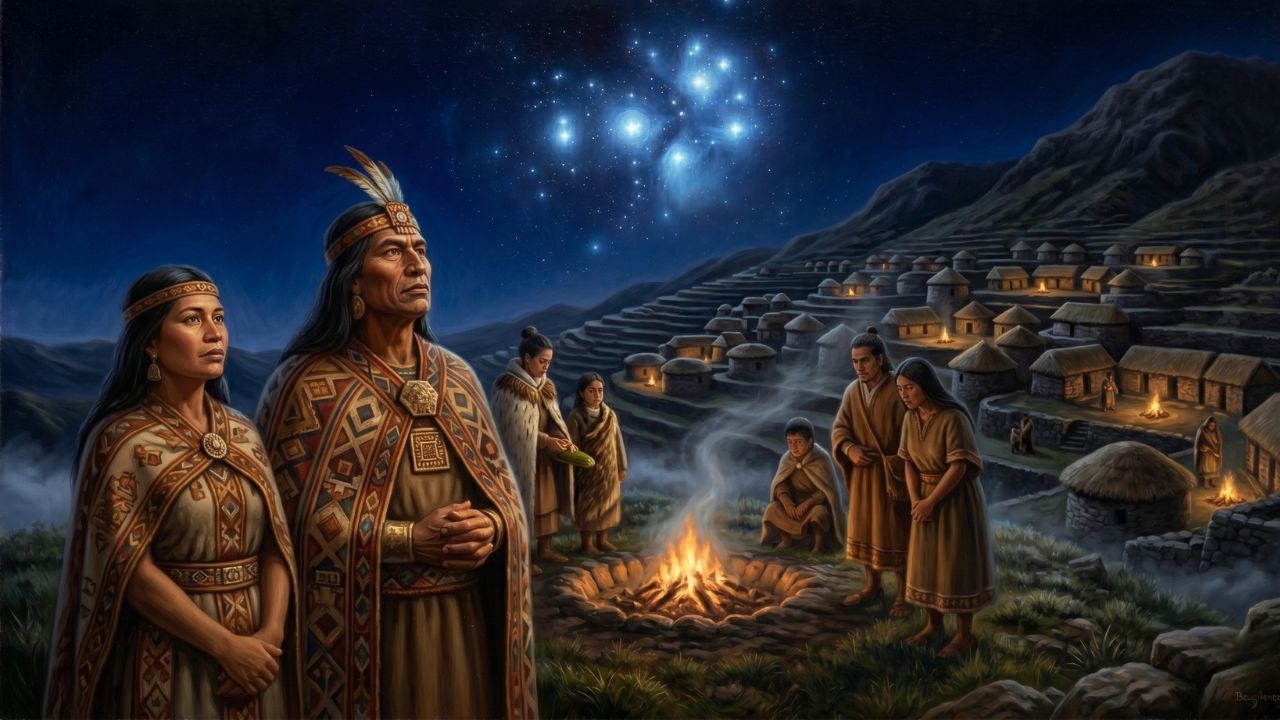
Image: ASTRONOMIKA TV / GP Cassini
What the Incas were measuring without knowing it, according to modern researchers, was atmospheric humidity. In El Niño years, when rainfall in the Andes is irregular and the harvest tends to be poor, the atmosphere contains more water vapor that disperses and blurs the cluster’s light, making it appear smaller and less bright. The Pleiades were, in practice, a long-range barometer encoded in the sky.
A climate prediction system of considerable precision, developed over centuries of careful observation, disguised as mythology.
For the Greeks the Pleiades were drama. For the Maori they were ancestors. For the Incas they were data. The sky is the same. What each culture decided to see there says more about them than about the stars.
The facts that blow your mind
Capture: Sky Guide App / ASTRONOMIKA TV
The Pleiades are not seven. They never were.
With the naked eye, in a moderately dark sky, most people distinguish six. Those with sharper vision reach seven under perfect conditions. But the real cluster, the one that exists beyond what the human eye can process, contains more than 1,000 confirmed stars, all born from the same gas approximately 100 million years ago and traveling together through space in the same direction and at the same speed. To put that in perspective: when that gas collapsed and ignited those stars, dinosaurs did not just exist, they had already been walking the Earth for over 100 million years.
Mind-blowing fact: In November 2025, NASA published a study using TESS telescope data that triples the known size of the cluster, identifying more than 3,000 stars associated with the Pleiades spread across an arc of 1,900 light-years. What we knew as the Pleiades is barely the core of something much larger.
They are so young in cosmic terms that they still shine with that intense blue characteristic of massive young stars, those that burn their fuel fast and live briefly. In about 250 million years the cluster will have lost cohesion and its stars will have dispersed throughout the galaxy. What is today a recognizable group will be invisible, dissolved into the stellar background of the Milky Way.
The blue nebulosity is not what it seems
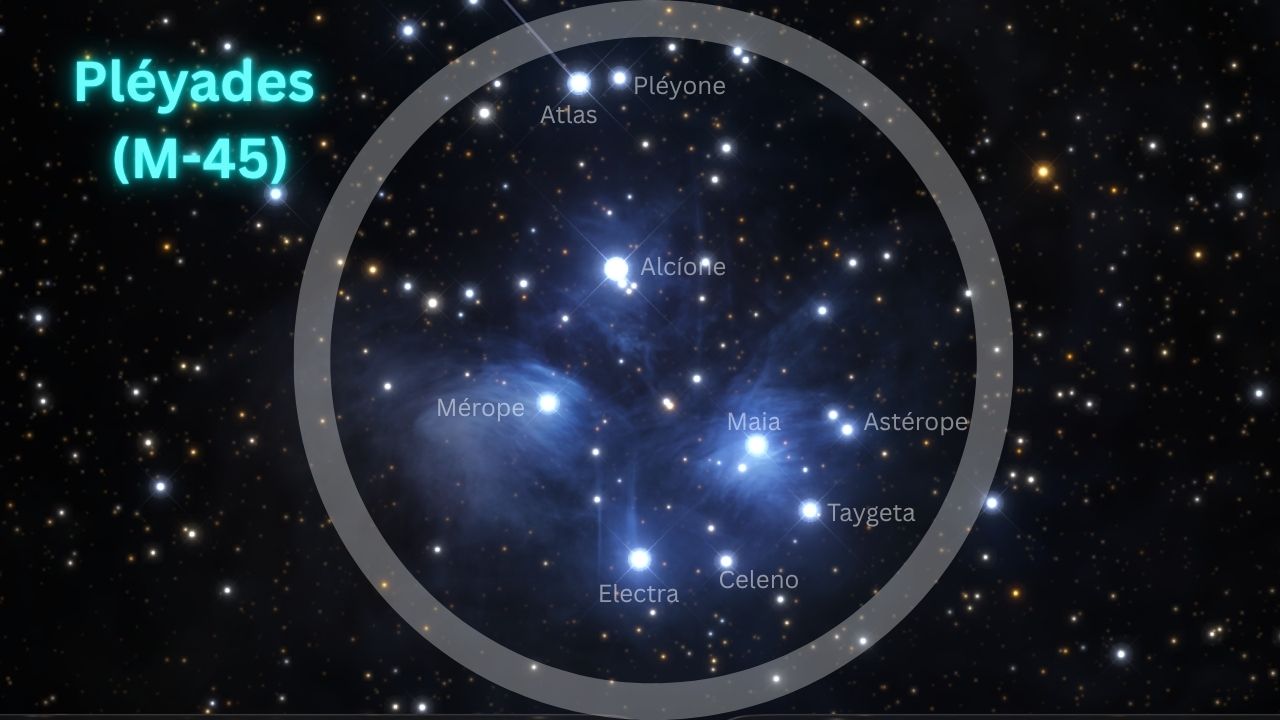
Image: ASTRONOMIKA TV over public domain photograph
Long-exposure photographs of the Pleiades show a spectacular blue nebulosity surrounding the main stars. For a long time it was thought to be the original gas from which the stars were born, leftover material from their formation. It is not.
It is a completely independent cloud of interstellar dust that the cluster is passing through by sheer coincidence of trajectory. The Pleiades did not create that cloud. They found it along the way and are illuminating it as they pass through. In a few thousand years the cluster will have come out the other side and the nebulosity will disappear from photographs. A cosmic accident that lasts long enough for us to see it and call it beautiful.
Aldebaran does not belong to the group
When you look for the Pleiades from your backyard, the natural path passes through Aldebaran, that intense orange star that marks the eye of the bull in the constellation Taurus. Aldebaran seems to be in the same neighborhood as the Pleiades. It is not.
The Pleiades are about 444 light-years from Earth. Aldebaran is only 65. Less than half the distance. What appears to be a compact group in the sky is actually a coincidence of perspective: a nearby star that ended up in the line of sight of a much more distant cluster. Like when in an urban photo a small nearby building appears to touch the top of a distant skyscraper.
How to find them and what to expect to see
Elaboration: ASTRONOMIKA TV over Sky Guide App capture
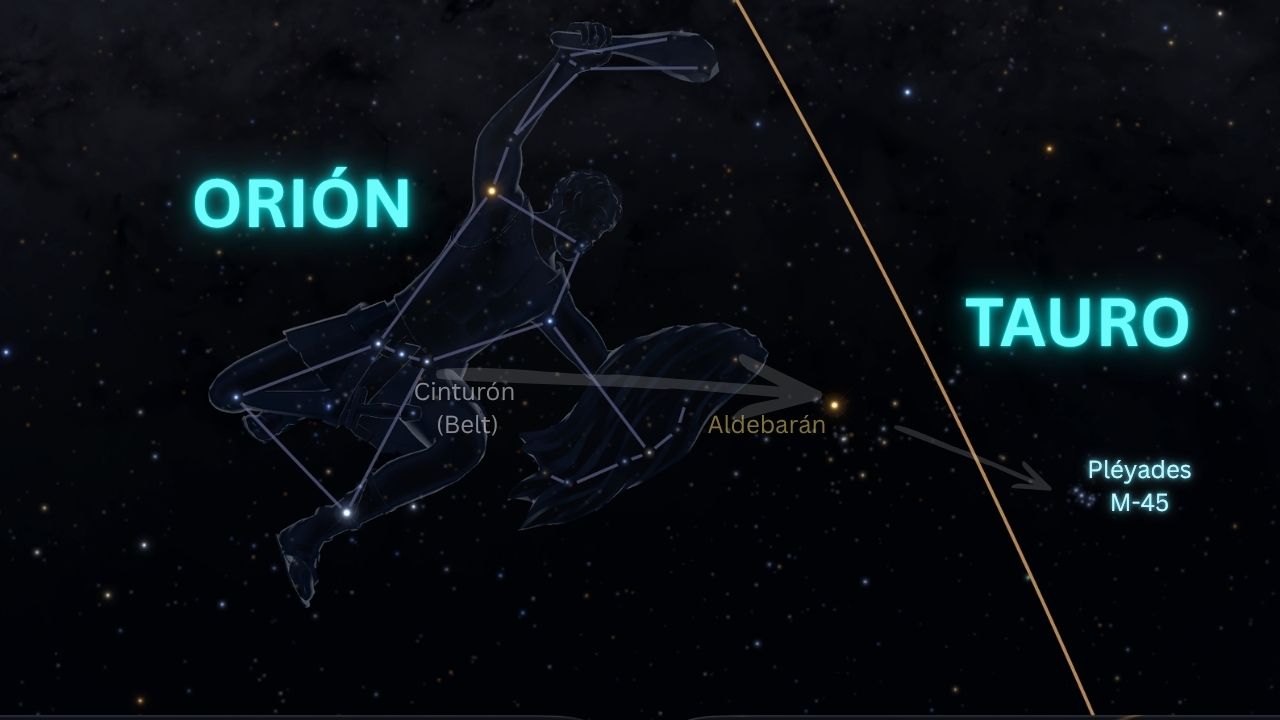
Find Orion’s belt, those three perfectly aligned stars that dominate the winter sky in the northern hemisphere. Follow them toward where the Sun rises each morning. The first brightly colored orange star you find is Aldebaran. Keep going in the same direction and you will find that small tight cluster that looks like a bright little cloud: the Pleiades.
With the CELESTRON SkyMaster 15×70 (Mexico | United States | Spain) the spectacle changes completely: more than a hundred stars fill the field of view, surrounded by that faint blue nebulosity that is not formation gas but interstellar dust the cluster is passing through. The field of view barely contains the cluster, which overflows at the edges with stars in every direction.
With a smart telescope like the ZWO Seestar S50 (Mexico | United States | Spain) or the DWARFLAB Dwarf 3, after just a few minutes of live stacking the blue nebulosity begins to appear around the brightest stars. You do not need a perfectly dark sky or technical knowledge. The cluster is so bright and so large that any smart telescope finds it in seconds.
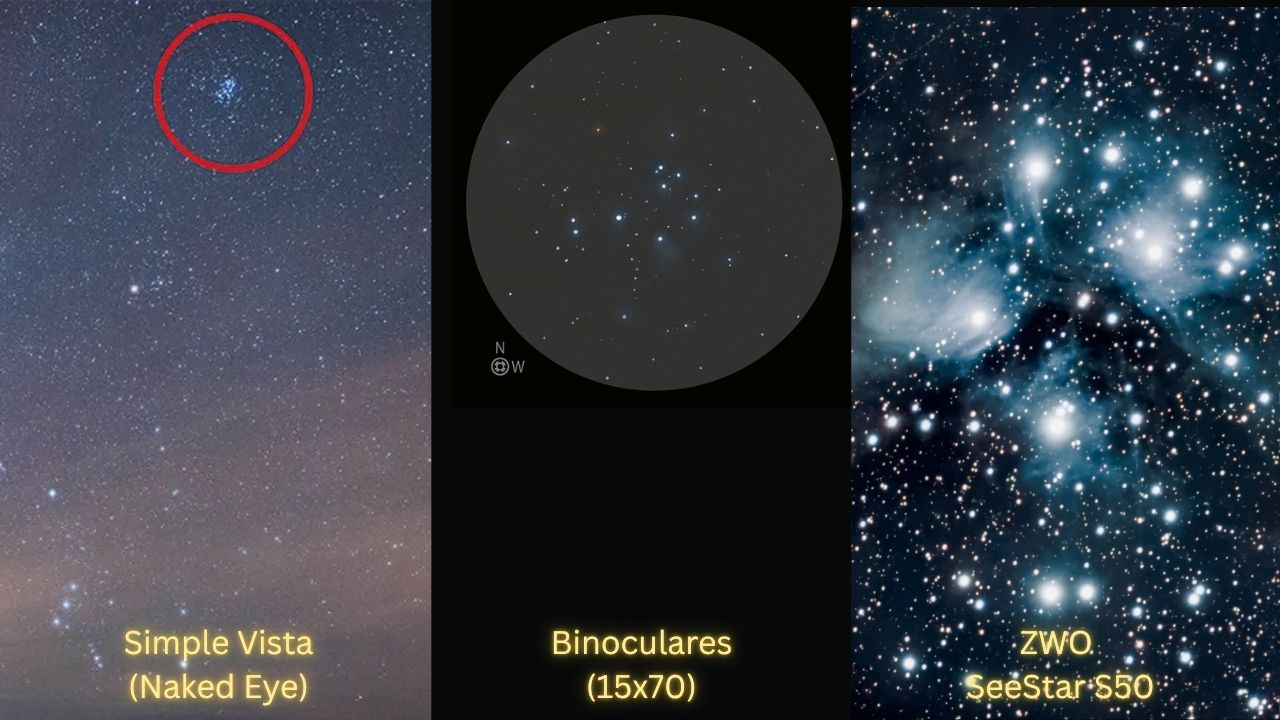
Elaboration: ASTRONOMIKA TV
The Pleiades are visible in the northern hemisphere between October and April, with November and December as the best months: they culminate at midnight and dominate the night sky all night long. In the southern hemisphere they can be observed between April and October, equally accessible from temperate latitudes.
Starseeds, Pleiadians and Taygeta: what nobody tells you
If you arrived at this article looking for information about beings from the Pleiades, Pleiadians, starseeds or the connection between this cluster and humanity, this section is for you.
The modern belief in Pleiadians as extraterrestrial beings has a fairly specific origin: Billy Meier, a Swiss farmer who in 1975 claimed to have had physical contact with beings who said they came from the Pleiades. Meier described humanoids indistinguishable from Scandinavians, tall, blonde, spiritually advanced and with technology thousands of years ahead of ours. Their alleged contacts lived on a planet called Erra, orbiting a star they called Tayget.
Which is, exactly, Taygeta. The same Pleiad whose complete story you just read. The huntress who preferred to become a doe rather than yield to Zeus.
In the late 1980s the New Age movement adopted the idea and expanded it. Channelers in various countries began receiving messages from “Pleiadian beings”, and since then the mythology has grown into one of the most popular currents within contemporary spirituality. Today there are entire communities of people who identify as Starseeds, souls who believe they incarnated on Earth from the Pleiades to assist in humanity’s collective awakening.
There is a detail within that same mythology that almost nobody mentions, and which turns out to be curious: Meier himself said his contacts clarified from the beginning that the real Pleiades are too young to harbor intelligent life. That the cluster is barely around 100 million years old, not enough time for a civilization to evolve. That they actually came from a parallel system called Plejares, not from the cluster visible from Earth. In other words: the man who popularized the idea admitted from the start that the Pleiades could not be the real origin. Most of his modern followers do not know that.
Science agrees with that part of the story. The Pleiades are indeed around 100 million years old, which makes them extraordinarily young in cosmic terms. For context: life on Earth took more than 3,000 million years to produce complex multicellular organisms. A cluster 100 million years old has not had nearly enough time for anything like that, at least around its brightest stars.
What is real, and this requires no special faith, is that the Pleiades have served as a spiritual reference point for cultures on every continent for thousands of years. The Maori see their ancestors there. The Incas saw the future of their harvests there. The Greeks saw seven immortal sisters with their own stories there. The idea that these stars have a special connection with humanity is not new or exclusive to the New Age. It is, in a way, one of the few things all the world’s cultures have agreed on since human beings first looked up at the sky.
What each person decides to see there is already a personal matter.
To close
Seven immortal sisters, older than Zeus himself, who lived their stories without anyone asking if they wanted to live them. One raised alone the most elusive god on Olympus. Another extinguished her light when she saw burn what her blood had built. One gave her name to the calmest days of the year. One preferred to become a doe rather than yield. One carried her silence with more dignity than many who spoke. One ignited a curse that crossed generations. And one chose a mortal and never apologized for it.
None of them asked to be in the sky. All of them ended up there anyway.
Look for them tonight. You do not need a telescope or an app or coordinates. Find Orion’s belt, those three perfectly aligned stars that anyone recognizes in the winter sky, and follow them toward where the Sun rises. The first intense orange star you find is Aldebaran. Keep going in that same direction and there they are: that small tight cluster that looks like a bright little cloud, too close together to be a single star, too bright to ignore.
Count the ones you can see. If you reach six, you already know which one is missing and why. If you reach seven, you have better eyesight than most, and you just found Merope.
If you want to keep exploring the sky with us, find us on YouTube, Instagram and TikTok as ASTRONOMIKA TV.
Frequently asked questions about the Pleiades
What are the Pleiades and where are they?
The Pleiades are an open cluster of more than 1,000 stars located in the constellation Taurus, about 444 light-years from Earth. They are the nearest star cluster to us and the easiest to identify with the naked eye in the night sky. They are also known as the Seven Sisters and as M45 in the Messier catalog.
Why are they called the seven sisters if only six are visible?
The Greeks never agreed on which of the sisters is the lost star. There are three versions: Merope, who shines less from shame at having married a mortal; Electra, who extinguished her light when she saw Troy burn; and Celaeno, whose star was always the faintest without a particularly dramatic reason. All three versions coexist in the ancient sources without any having been chosen as official.
How many stars do the Pleiades actually have?
The Pleiades contain more than 1,000 confirmed stars, though with the naked eye only six or seven can be distinguished. With binoculars more than a hundred can be seen in a single view. A NASA study using TESS telescope data published in 2025 identified more than 3,000 stars associated with the cluster spread across an arc of 1,900 light-years, tripling the previously known size.
When and where can the Pleiades be seen?
In the northern hemisphere the Pleiades are visible between October and April, with November and December as the best months, when they culminate at midnight and dominate the night sky all night long. In the southern hemisphere they can be observed between April and October. They are visible from any point on the planet with moderately dark skies.
How do you find the Pleiades in the sky without a telescope?
Find Orion’s belt, the three perfectly aligned stars that dominate the winter sky. Follow them toward where the Sun rises each morning. The first brightly orange star you find is Aldebaran. Keep going in that same direction and you will find a small tight cluster that looks like a bright little cloud: those are the Pleiades. No app or coordinates needed.
Who were the Pleiades in Greek mythology?
The Pleiades were seven immortal nymphs, daughters of the Titan Atlas and the Oceanid Pleione: Maia, Electra, Alcyone, Taygeta, Sterope, Celaeno and Merope. They formed part of Artemis’s retinue and lived on Mount Cyllene, in the northern Peloponnese. Each had love affairs with Olympian gods, except Merope, who chose to marry a mortal. Zeus turned them into stars to protect them from the hunter Orion, who had pursued them for seven years.
Why does Merope shine less than her sisters?
According to the most widely told Greek version, Merope is the dimmest star of the Pleiades because she was the only one who married a mortal, King Sisyphus of Ephyra, instead of having a divine lover like her sisters. Her dimmer light is interpreted as shame over that choice. However, other versions attribute the lost star to Electra or Celaeno, so the Greeks never officially resolved which is the seventh star.
What is the relationship between the Pleiades and Orion?
Orion was the greatest hunter in Greek mythology and pursued the seven Pleiades for seven years without them being able to escape. Zeus intervened, first turning them into doves and then into stars, placing them on the back of the bull Taurus to protect them. Orion was also turned into a constellation, and in the sky the pursuit continues forever: Orion advances toward the Pleiades, the bull intervenes, and the Pleiades are always ahead. The complete story of Orion is in his article on ASTRONOMIKA TV.
What is Matariki and what does it have to do with the Pleiades?
Matariki is the Maori name for the Pleiades and marks the new year in Maori culture in New Zealand. Their appearance on the horizon at dawn in early June signals the moment when the spirits of those who died during the previous year ascend to the sky and become stars. In 2022 New Zealand made Matariki an official national holiday, becoming the first country in the world to create a public holiday based on an indigenous astronomical event.
What is the blue nebulosity of the Pleiades?
The blue nebulosity surrounding the brightest stars of the Pleiades is not leftover gas from their formation, as was believed for a long time. It is a completely independent cloud of interstellar dust that the cluster is passing through by coincidence of trajectory. The Pleiades did not create that cloud: they found it along the way and are illuminating it as they pass. In a few thousand years the cluster will have come out the other side and the nebulosity will disappear from photographs.
How old are the Pleiades?
The Pleiades are approximately 100 million years old, which makes them extraordinarily young in cosmic terms. For context: when these stars were born, dinosaurs had already been walking the Earth for over 100 million years. The cluster has an estimated lifespan of about 250 million years before dispersing throughout the galaxy, meaning we are seeing the Pleiades in the first half of their existence as a group.
Where do Pleiadians say they come from?
The modern belief in Pleiadians as extraterrestrial beings was popularized starting in 1975 with the case of Billy Meier, a Swiss man who claimed contact with beings from the Pleiades who lived on a planet called Erra, orbiting a star they called Tayget, the English name for Taygeta. In the Starseed community, Taygeta is the most cited star of origin. Meier himself indicated that his contacts clarified that the real Pleiades are too young to harbor intelligent life, a fact science confirms: at barely 100 million years old, the cluster has not had nearly enough time for a civilization to evolve.
This article contains affiliate links. If you purchase through them, I receive a small commission at no additional cost to you.
Sources and recommended reading
Books
Graves, R. (1955). The Greek Myths. Penguin Books. The most complete compilation of Greek myths in a single volume, with analysis of primary sources for each variant. Covers in detail the stories of the Pleiades, Atlas, Orion, Sisyphus, Minos and all the characters appearing in this article.
Hesiod. (ca. 700 BC / trans. West, M. L., 1988). Theogony and Works and Days. Oxford University Press. Essential primary source. Hesiod is the oldest reference naming the Pleiades as daughters of Atlas and Pleione, and describing their function as navigation and agricultural guides in the ancient Mediterranean world.
Homer. (ca. 800 BC / trans. Lattimore, R., 1951). The Iliad. University of Chicago Press. Primary source for the Trojan connections of Electra and Dardanus, and for the general context of the Greek mythological world in which the Pleiades lived.
Allen, R. H. (1963). Star Names: Their Lore and Meaning. Dover Publications. Classic reference on the origin of star and constellation names across cultures. The chapter on Taurus and the Pleiades covers the Greek, Arabic, Mesopotamian and Asian traditions in detail.
Apollodorus. (ca. 2nd century BC / trans. Hard, R., 1997). The Library of Greek Mythology. Oxford University Press. One of the most complete primary sources on Greek genealogies and myths. Essential for tracing the lineages of each Pleiad and verifying the versions of their stories.
Ovid. (ca. 8 AD / trans. Raeburn, D., 2004). Metamorphoses. Penguin Classics. Primary source for several of the transformations narrated in this article, including the conversion of the Pleiades into stars and the stories of related characters.
Kerényi, C. (1951). The Gods of the Greeks. Thames and Hudson. Deep analysis of the psychology and structure of Greek myths, with particular attention to nymphs and their relationship with the Olympian gods.
Condori, C. M. & Ticona, R. (1992). Pacha: El Tiempo y el Espacio en la Cultura Aymara. HISBOL. One of the few sources in Spanish documenting Andean astronomy from an indigenous perspective, including the role of the Pleiades as an agricultural indicator in Altiplano cultures.
Krupp, E. C. (1991). Beyond the Blue Horizon: Myths and Legends of the Sun, Moon, Stars and Planets. Oxford University Press. Comparative study of cultural astronomy across world civilizations. The chapter on the Pleiades examines their presence in cultures on five continents.
Harris, P. & Matamua, R. (2013). Matariki: The Star of the Year. Huia Publishers. The most accessible reference in English on Matariki and its meaning in Maori culture, written in collaboration with Maori scholars. Covers the astronomy, calendar and rituals associated with the cluster.
Digital sources
NASA Science. (2025). TESS Spacecraft Triples Size of Pleiades Star Cluster. The most recent study on the cluster, published November 2025, identifying more than 3,000 stars associated with the Pleiades spread across an arc of 1,900 light-years.
science.nasa.gov
NASA/Hubble Heritage Team. Messier 45: The Pleiades. Images and data of the cluster obtained with the Hubble Space Telescope, including documentation of the interstellar dust nebulosity.
science.nasa.gov
European Southern Observatory (ESO). The Pleiades. Technical description of the cluster with emphasis on the nature of its blue nebulosity as an independent interstellar dust cloud.
eso.org
Instituto Nacional de Antropología e Historia (INAH). Pre-Hispanic astronomy. Official documentation on astronomy in Mesoamerican and Andean cultures.
inah.gob.mx
Sky & Telescope. (2014). Resolving the Pleiades Distance Problem. Science communication article explaining the controversy over the cluster’s distance and how it was resolved through radio interferometry, fixing the distance at 444 light-years.
skyandtelescope.org
The Electronic Text Corpus of Sumerian Literature, University of Oxford. Access to cuneiform texts in transcription and translation for references to Mesopotamian mythology related to the Pleiades.
etcsl.orinst.ox.ac.uk
Great content! Keep up the good work!