
Hercules killed his wife and children before he turned thirty. He also crushed a many-headed hydra, slept with fifty women in a single visit, and ended up dressed as a servant by a queen who bought him as a slave. And even with all of that, what actually killed him in the end was no monster. It was a love gift hiding a years-old lie.
By Juan Pablo Martín | ASTRONOMIKA TV | June 2026
✦ ✦ ✦
The hero who killed his family, and whose own death was the cruelest joke of all
The child who was never a child
Let’s start at the beginning, because the beginning of Hercules is already a tragedy shaped like a comedy.
Hera, Zeus’s wife, did not know that the baby she had just nursed was her husband’s illegitimate son. The moment she realized it, she pulled him from her breast so hard that the milk shot across the night sky. That milk, according to the Greeks, became the Milky Way. The word “galaxy” comes from gala, milk in ancient Greek. And the real punchline of all this is that Hera, without meaning to, had just done the baby the biggest favor of his life: the divine milk of an Olympian goddess gave him a superhuman strength that no mortal could have obtained any other way. So the next time you look up on a clear night and see that diffuse band crossing the sky, you know what it is: the most expensive tantrum in history, and a counterproductive one at that.
Hera did not keep her rage bottled up. She sent two serpents to the baby’s crib to try to kill him directly. Hercules, not yet a year old, strangled them laughing, one in each hand. His family found him playing with the corpses as if they were rattles.
If you thought that made it clear the boy wasn’t normal, wait until he grows up a little. His uncle Amphitryon gave him Linus, brother of Orpheus himself, as a music teacher, so he could learn to play the lyre like any well-bred young man. Linus scolded him, or struck him, depending on the version, for playing badly. Hercules responded by breaking the lyre over his head. Literally. He killed him on the spot. They acquitted him citing a law that allowed self-defense against an unjust blow, but the message was clear to everyone who came near him afterward: you don’t correct Hercules, you endure him.
Twelve labors, one punishment
What came next cost him his sanity entirely, and we already told that story when we talked about the Nemean Lion: how Hera drove him mad as an adult, how he killed his wife Megara and his children without knowing what he was doing, and how the oracle at Delphi imposed twelve impossible tasks as penance. The Greeks called him Heracles. Hercules is the name the Romans gave him, and the one that stuck for posterity. That part is already told there. Here we go labor by labor.
Labor 1: the Nemean Lion
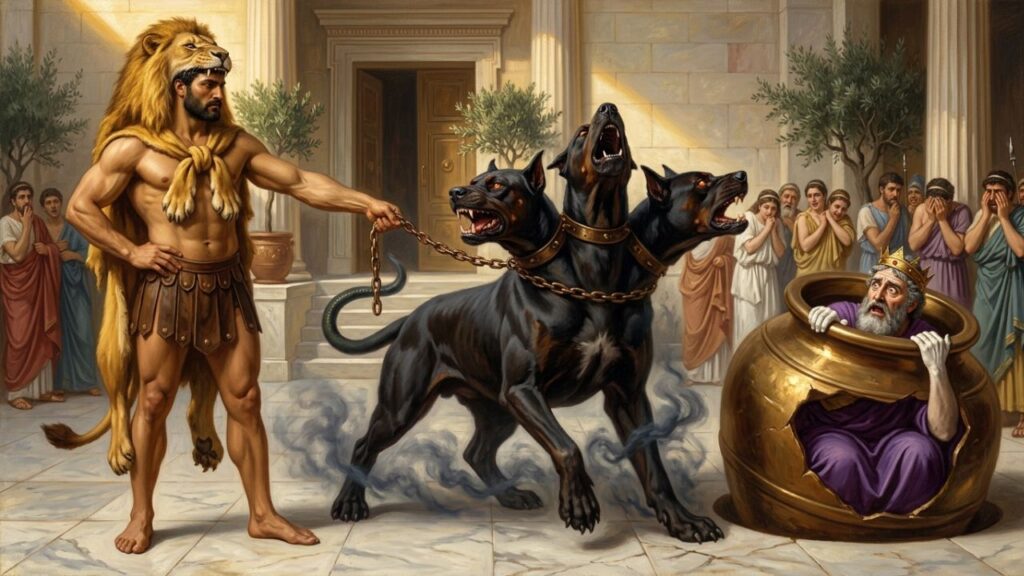
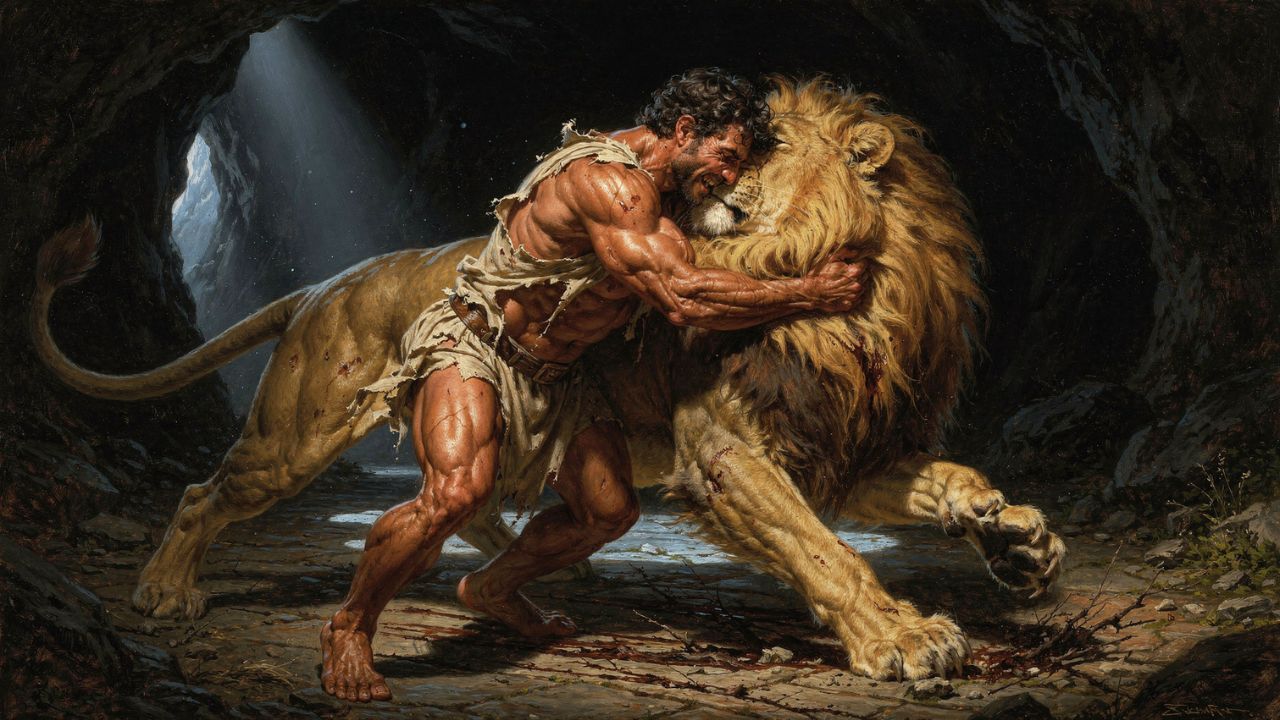
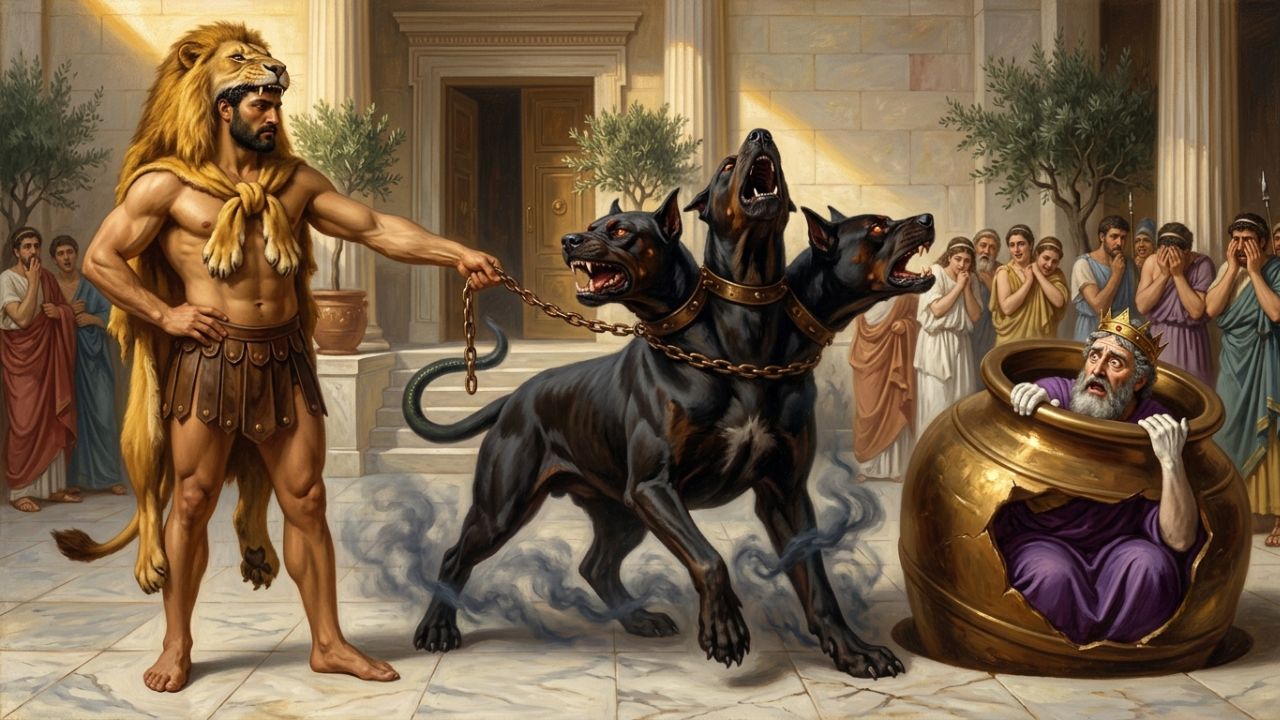
King Eurystheus, Hercules’s cousin and the one who imposed the twelve punishments, sent him on the first task to deal with a lion terrorizing the region of Nemea, with a hide impossible to pierce with any weapon of the time. Hercules tried arrows first, with no result, and ended up cornering it in a cave with two entrances. He blocked one, entered through the other, and strangled it with his bare hands. Then, with no sword capable of cutting its hide, he used the lion’s own claws to skin it, and kept that hide as armor for the rest of his life. When Eurystheus saw him return wearing the skin of the animal that was supposed to kill him, he was so frightened that he had a half-buried bronze jar built as his personal hiding place every time Hercules came back from a task. He would use it many more times.
Labor 2: the Lernaean Hydra
A serpent with many heads and a brutal design flaw: every time you cut one off, two new ones grew back. Hercules had to ask his nephew Iolaus to cauterize each neck with fire before the new head finished growing. While this was happening, Hera sent a giant crab to bite his foot and distract him. Hercules crushed it without thinking. That same Hera, in recognition of the crab for its effort even though it was a total failure, sent it up to the sky. Today we know it as Cancer.

Labor 3: the Ceryneian Hind
This task has an origin few people know in full. Generations earlier, Zeus had pursued Taygete, one of the seven Pleiades nymphs, daughters of the Titan Atlas. To protect her, Artemis transformed her into a hind with golden antlers and bronze hooves, similar enough to the rest of her sacred herd that Zeus could not tell her apart from the animals. When the danger passed, Taygete, back in her own form, dedicated that same hind to Artemis as a thank-you offering for saving her. The goddess set it free, and it became her sacred animal from then on, running alone through the world for years, long before anyone spoke of Hercules. That same Taygete, as a woman, would later have her own chapter when the hunter Orion began pursuing the seven Pleiades sisters together. Two separate stories sharing the same origin.
That is the hind Eurystheus sent to find as the third task, knowing perfectly well it was Artemis’s territory and that any harm to it would unleash a goddess’s fury. Hercules chased it for an entire year, without firing a single arrow, until he exhausted it near a river and carried it alive over his shoulders. On the way he came face to face with Artemis and Apollo. The goddess, furious to see her sacred animal captured, was about to refuse him forgiveness, until Hercules explained that everything was penance forced on him by the madness Hera had inflicted. Artemis let him go on the condition that he return it afterward, and Hercules kept his word, though to do so he had to trick his own boss: he let Eurystheus try to take the hind’s rope with his own hands, and at that exact moment let it go. The animal ran back to freedom, and Hercules was free of all blame for the escape.
Labor 4: the Erymanthian Boar
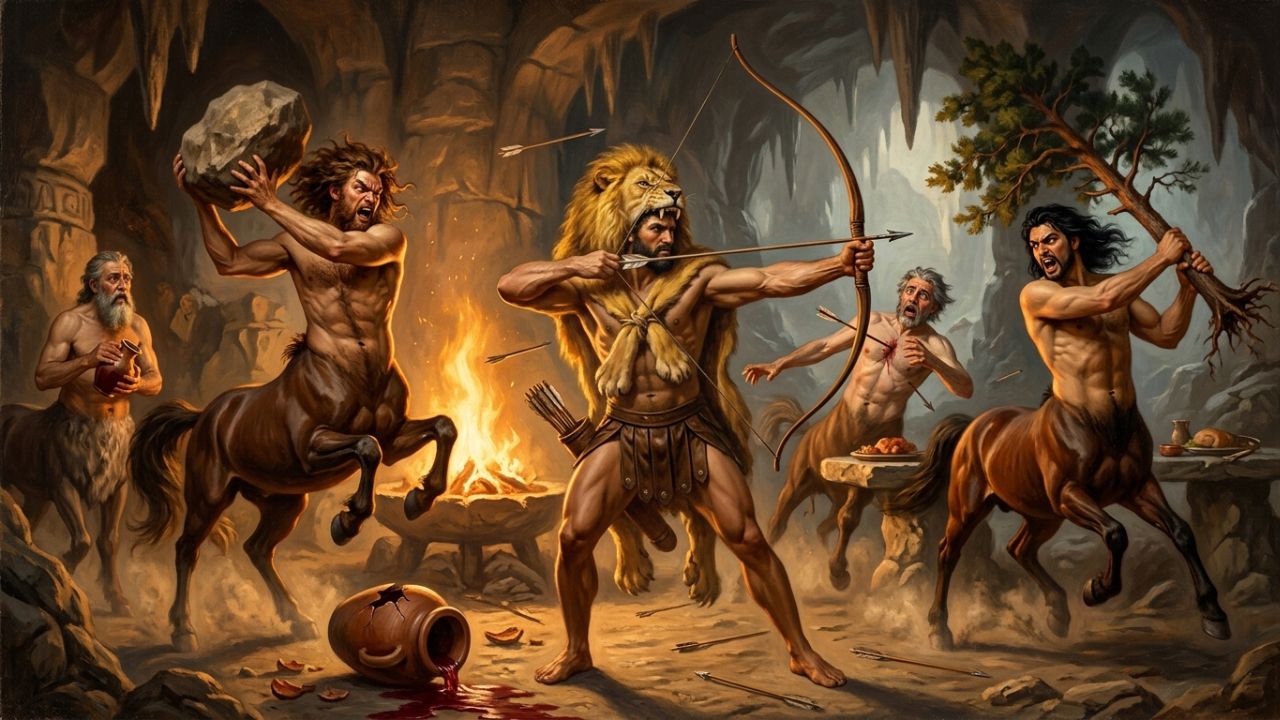
The real drama happened before he even reached the mountain. On the way, Hercules stayed overnight at the home of the centaur Pholus. The wine Pholus had stored was no ordinary wine: it was a sacred gift from Dionysus to all the centaurs as a community, not even to be opened for several centuries. Hercules insisted so much that Pholus, not wanting to be a bad host, opened it anyway. What followed was the most expensive night of drinking in the history of mythology: Hercules drank alone, in a single night, the equivalent of what fifty men would have taken to finish, barrel after barrel of the most sacred wine in existence. By morning, the accumulated aroma of that feast had traveled across the mountain to the caves of the other centaurs, who understood exactly what had happened: someone had opened what belonged to everyone without anyone’s permission, and had finished it off alone. They arrived furious, armed with rocks and branches, and attacked Hercules without asking questions. He defended himself with arrows, the same ones poisoned with Hydra blood he had saved from the previous task, and the surviving centaurs fled toward the cave of Chiron, the wise centaur who had been his own teacher when young.
Pholus, while all this was happening, stood looking at the corpses of his own kinsmen, puzzled by how such a small arrow could kill something so large. He pulled one from the body of one of the dead centaurs to examine it up close. It slipped from his hands, fell on his foot, and he died instantly. Hercules, having never meant to kill him at all, found him like that when he returned. He buried him with his own hands and continued the hunt with his spirits low. The boar itself ended up being almost a formality after all that: he chased it shouting until it was exhausted, drove it into a deep snow field where the animal got stuck, and carried it alive back to Mycenae. Eurystheus, seeing him arrive with the beast still alive, growling and furious, ran to hide in that same bronze jar he already knew well.
Labor 5: the Augean Stables
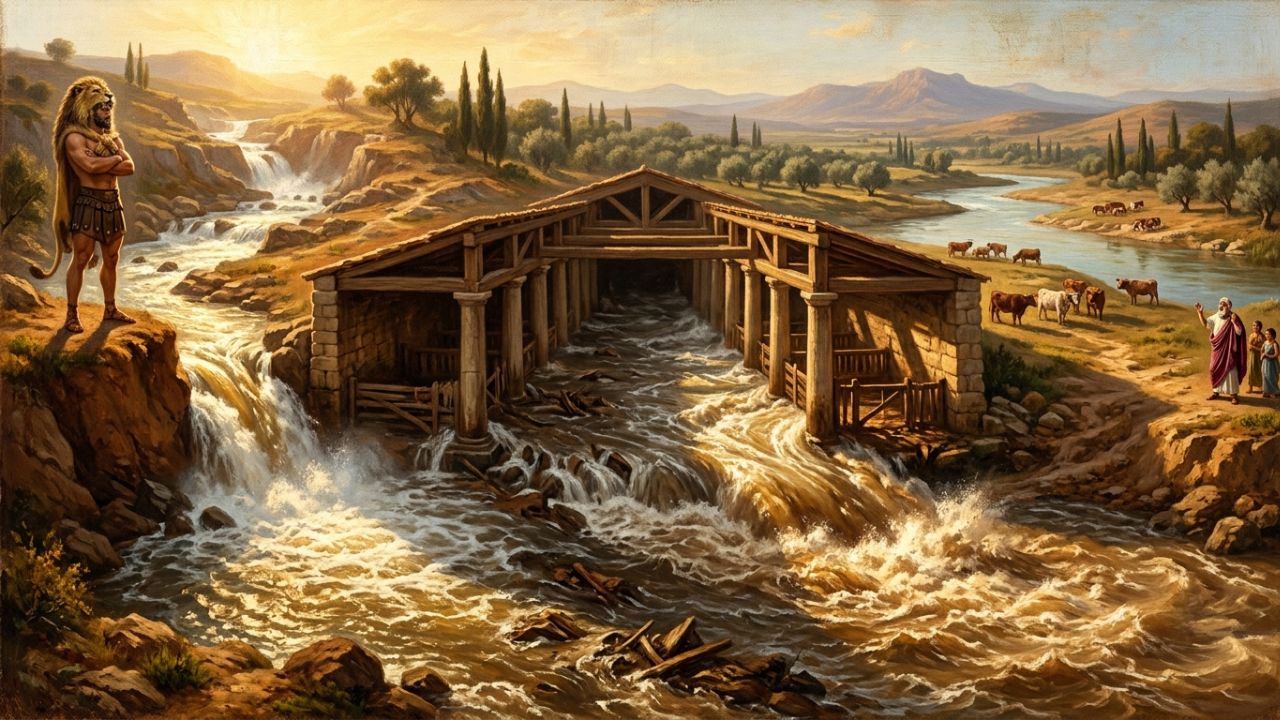
Augeas owned 3,000 cattle and stables that had never, in years, been cleaned. The task was to clean them in a single day, designed as humiliation, not a physical challenge. Hercules didn’t pick up a single shovel. He diverted two entire rivers, the Alpheus and the Peneus, and let the water do the work in hours. Without Eurystheus knowing, Hercules had made a side deal with Augeas himself: clean everything in exchange for a tenth of his cattle. Augeas, certain it was impossible, agreed. When Hercules delivered, the king learned he was already obligated to do it by Eurystheus’s orders, and used that as an excuse to pay him nothing. Augeas’s own son, Phyleus, contradicted him in front of everyone at the trial that followed, and Augeas, furious at being caught in his own trap, ended up banishing them both.
Labor 6: the Stymphalian Birds
A flock of birds with bronze feathers so sharp they used them as projectiles in flight, and droppings so toxic they destroyed entire harvests. They lived on a lake surrounded by a marsh so thick that even Hercules couldn’t approach on foot without sinking. The solution wasn’t strength, it was noise: Athena gave him bronze castanets forged by Hephaestus himself, designed specifically for the task. Hercules climbed a nearby hill and shook them so hard that the birds, terrified, all flew out together in a stampede. From there, with them in the air and nowhere to hide, he shot them down with arrows one by one.
Labor 7: the Cretan Bull
The same bull that King Minos had promised to sacrifice to Poseidon in exchange for becoming king, but decided to keep because of how beautiful it was, sacrificing another in its place. Poseidon, furious at the deception, drove the bull completely wild, and as extra punishment, made Minos’s wife fall madly in love with the beast, which eventually produced the Minotaur. Hercules arrived in Crete with orders to capture that same maddened bull. He tamed it with his bare hands, and carried it swimming on its back all the way to mainland Greece. Once there, Eurystheus wanted to sacrifice it to Hera, but the goddess refused because the sacrifice would bring glory to Hercules. With nobody to claim it, the bull ran free and ended up wandering to the plain of Marathon, near Athens, where it terrorized the local farmers for years. That same bull, now renamed the Bull of Marathon, would later be hunted by another Greek hero, Theseus, as a young man, before becoming king of Athens. Years later, already as king, that same Theseus would go down to Crete to face the Minotaur, in the story of the labyrinth and Ariadne’s thread. Two separate episodes, one hero, years apart. We tell the full story with the bull when we cover Taurus.
Labor 8: the Mares of Diomedes
Diomedes, king of the Bistonians in Thrace, a region in northern present-day Greece, owned four mares that didn’t become man-eaters by accident: he trained them himself, feeding them the flesh of any foreigner unlucky enough to visit his kingdom, a border security system with teeth. Hercules arrived with a group of young men to help him control them, including a companion named Abderus, whom he left in charge while he faced Diomedes directly. The king attacked him when he saw someone trying to steal his animals, and Hercules killed him in the fight. In the most widely cited version, he fed Diomedes himself to his own mares, which finally calmed them down. While that was happening, the mares, still not fully tamed, attacked and devoured young Abderus, who had been left alone watching them. Hercules, devastated by the loss of his companion, founded a city in his honor, Abdera, before continuing his journey with the now-calm mares toward Mycenae. That city still exists today in northern Greece, in the region of Thrace, with the same name it has had since antiquity.
Labor 9: the Belt of Hippolyta
The belt was no simple accessory: Ares, the Greek god of war, had given it to his daughter Hippolyta, queen of the Amazons, as a symbol that she was the most powerful among all the warriors of her people. The task came to Hercules by caprice: Eurystheus’s own daughter, a princess named Admete, simply wanted it for herself. When Hercules arrived at Themiscyra, the Amazon capital on the Black Sea coast, what happened was almost the opposite of a battle. Hippolyta, impressed by his reputation, came aboard his ship ready to talk, heard the story of his tasks, and agreed to give him the belt without any resistance. The problem was, once again, Hera, who disguised herself as an Amazon, blended into the crowd of warriors, and spread the rumor that the recently arrived foreigners were actually planning to kidnap their queen. The Amazons, alarmed, mounted their horses and attacked Hercules’s ship without anyone explaining anything. Hercules, seeing an entire army charging at him right after closing a peaceful deal, assumed the worst: that Hippolyta had betrayed him. In that burst of panic, he killed her before she could say a single word, took the belt from her body, and fought off the rest of the Amazons until he could flee. A queen who never betrayed him, dead because of a lie that wasn’t even aimed at her. It is the first sign, within this same story, of a pattern that will repeat: Hercules destroying, without meaning to, an innocent woman because of a fear he never should have had.

Labor 10: the Cattle of Geryon
Geryon was a giant with three complete bodies fused at the waist, owner of a herd of intensely red cattle, practically sacred, who lived on Erytheia, an island at the far western edge of the known world, where the coast of Cadiz in southern Spain is today. The cattle were guarded by a herdsman, Eurytion, and a two-headed dog named Orthrus, direct brother of Cerberus, the same dog Hercules would face in the final task. Before reaching the island, Hercules had to cross the continent, and tradition says that at the point where Africa and Europe almost touch, he split a mountain in two to open a passage. That strait is, today, the Strait of Gibraltar, and the two mountains on either side have been known since antiquity as the Pillars of Hercules. Already on the island, he killed the dog and the herdsman with one blow each, and when Geryon arrived to defend his cattle, he brought him down with a single arrow that passed through all three torsos at once, in a straight line. Hercules killed a three-bodied giant, a two-headed dog, and a nameless herdsman, and the biggest problem of the whole task turned out to be that the cows kept getting away. The universe has a sense of humor.
Labor 11: the Apples of the Hesperides
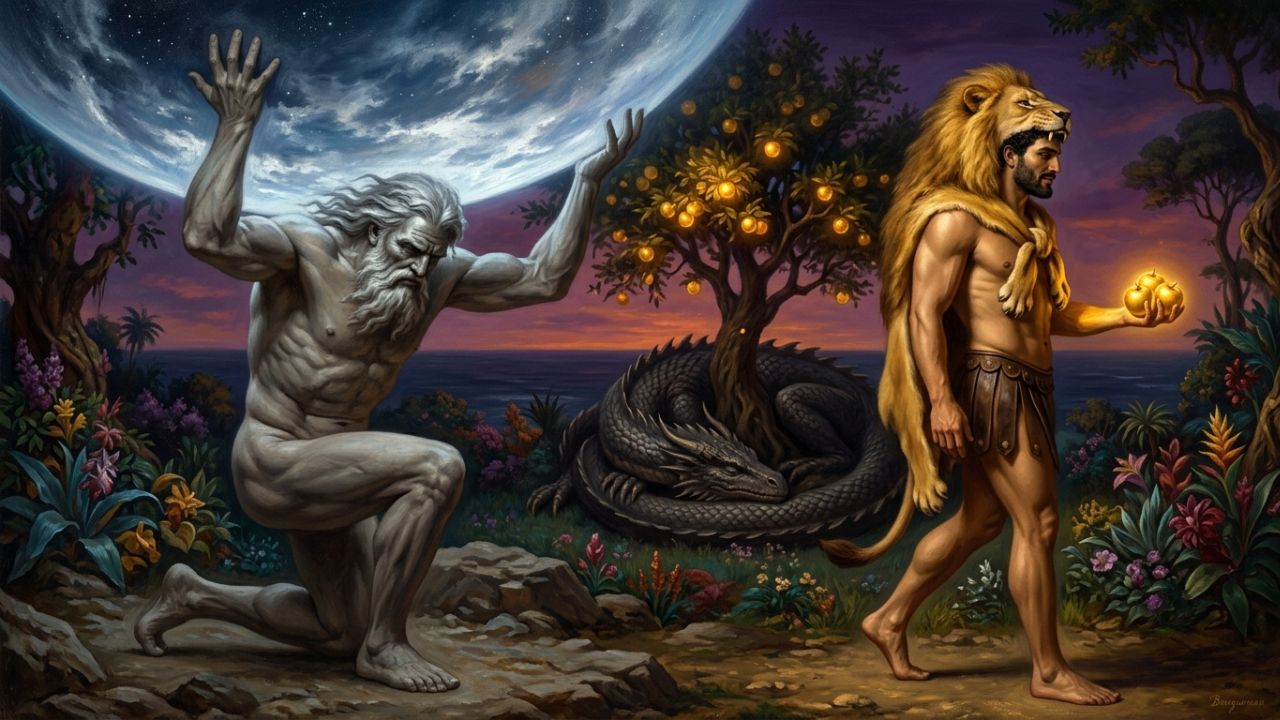
This task took Hercules to a garden at the western edge of the world, belonging to the Hesperides, nymphs daughters of the night who guarded a golden apple tree. The tree wasn’t decorative: it was a wedding gift that the Earth had given to Hera, so the apples were, at bottom, personal property of the goddess who had spent the entire story trying to get Hercules killed. To keep anyone from stealing them, the garden was guarded by a hundred-headed dragon named Ladon, coiled around the trunk. The real problem with this task wasn’t the dragon, it was that nobody knew exactly where the garden was. Hercules had to hold down the sea god Nereus while he kept changing shape trying to escape, until he forced the location out of him. The path led him to Atlas, the Titan condemned to carry the full weight of the sky on his shoulders for all eternity. Hercules offered him a deal: if Atlas went for the apples using his Titan strength, he would hold the sky in the meantime. Atlas, desperate for a rest he hadn’t had in centuries, agreed. When he came back with the apples, enjoying having nothing on his shoulders too much, he told Hercules he would take them to Mycenae himself, trying to leave the weight of the sky with Hercules forever. Hercules, thinking fast, asked him to hold the sky “just one more moment” while he adjusted an improvised cushion on his shoulders. Atlas, suspecting nothing, took the sky back. At that instant, Hercules grabbed the apples and walked away, leaving the Titan exactly where he’d found him.
Labor 12: Cerberus
The final task. Hades, god of the underworld, agreed to lend his three-headed guardian dog on one condition: that Hercules capture it without using any weapon, only with his bare hands, and that after showing it as proof, he return it intact. On the way to the gates of Hades, Hercules found Theseus and Pirithous, condemned there by the gods themselves for attempting to kidnap the goddess Persephone. He managed to free Theseus with a single pull, but when he tried to do the same for Pirithous, the earth shook so violently he had to leave him there forever. Already facing Cerberus, he wrestled it down with his bare hands until it had no fight left, exactly as he had promised. He carried it to the world of the living to show Eurystheus, who in fright, once again, nearly ran to his favorite bronze jar. With the proof delivered, Hercules returned the dog to the underworld exactly as he had sworn, closing his twelve labors without having broken a single condition.
The bonus nobody asked for: Thespius and his fifty daughters
This episode doesn’t count as one of the twelve labors, but it earns its place here because the real star of the gossip isn’t Hercules. It’s his host. King Thespius had fifty daughters and one very clear ambition: he wanted grandchildren from the strongest demigod in Greece, and the method didn’t concern him much. While Hercules was hunting a lion that was ravaging the herds of the region, Thespius invited him to stay fifty nights at his palace, one for each daughter. Tradition says a different sister each night, though some versions, even more generous with the imagination, say it all happened in a single marathon night. The result, in either version, was fifty sons, known afterward as the Thespiades. Neither Tinder nor any modern dating algorithm has ever achieved a conversion rate that high in that few nights.
And perhaps there lies the question that really matters, beyond the gossip: how many of Hercules’s problems were actually never his fault, but the result of someone else using him for their own plans? Thespius used him for grandchildren. Hera used him to take revenge for an affair that wasn’t the child’s fault. And, as we are about to see, even his death would come from someone else’s plan, not something he himself provoked. The strongest hero in the world, it turns out, was also one of the most manipulated.
Omphale, the queen who bought him
Hercules ended up sold as a slave to a woman. And before this story is over, he will end up wearing a dress.
The crime that got him there was another burst of fury, years after closing his twelve labors: he killed in a fit of rage a close friend named Iphitus. He went to Delphi seeking purification, but the oracle refused to purify him, and the frustration made him lose control again: he tried to destroy the entire temple and steal the sacred tripod from which the Pythia delivered her prophecies. Only then did the oracle speak, and the sentence was brutal in its irony: one full year as a slave, sold to the highest bidder, with the sale money as compensation for Iphitus’s father. The father refused to accept a single coin. He didn’t want money. He wanted to see his son’s killer humiliated.
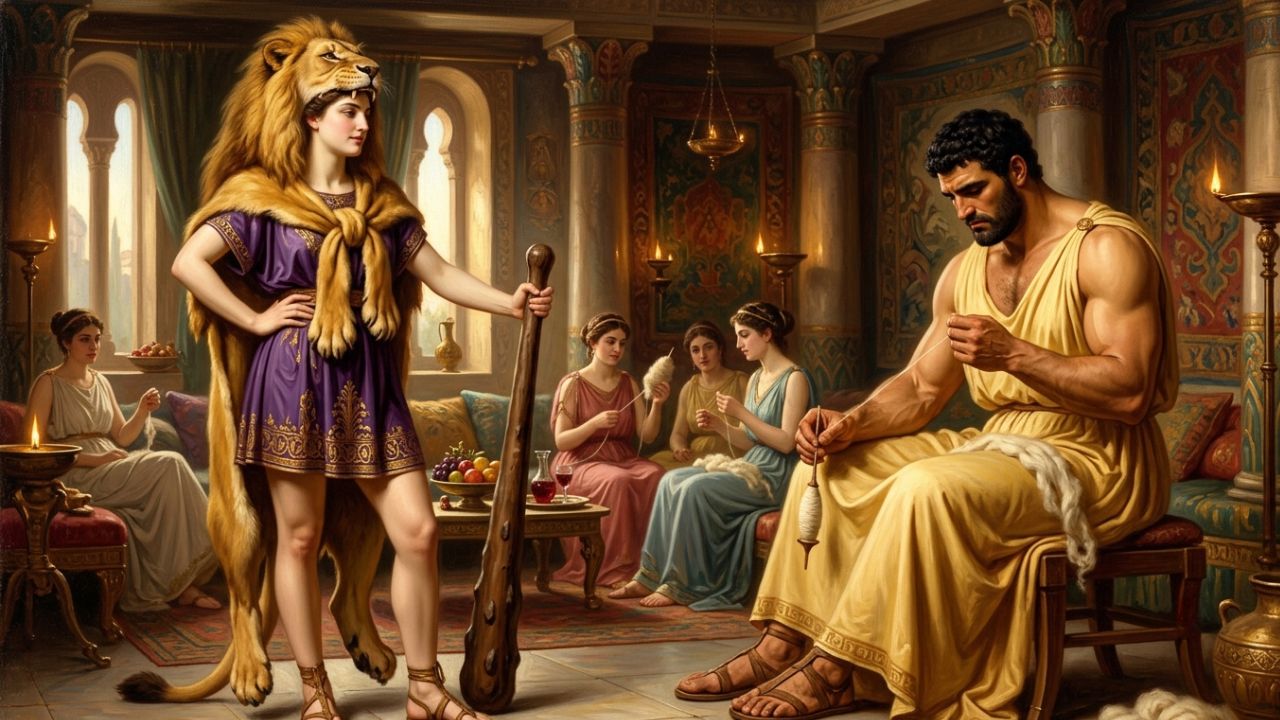
The buyer turned out to be a woman. Omphale, queen of Lydia, a region in western present-day Turkey, had inherited the throne from her husband Tmolus and ruled alone. She paid the equivalent of three silver talents for Hercules, a fortune, not yet knowing she was buying the strongest man in the known world. What followed was a role reversal that the Greeks told with laughter and scandal in equal parts: Omphale kept the Nemean lion skin and Hercules’s club for herself, symbols anyone would recognize instantly as his, and dressed him in women’s clothing, seated spinning wool alongside the palace servants, exactly the work any common woman of the era did every day.
While serving his sentence, Hercules didn’t entirely stop being Hercules. He captured the Cercopes, a gang of thieves who preyed on travelers near Ephesus, in the western coast of present-day Turkey, and dealt with Syleus, a landowner who forced any foreigner passing through his land to work his vineyards. He also found, stranded on an island, the body of Icarus, the young man who had flown too close to the sun on wax wings made by his father Daedalus, and buried him with his own hands. The island is still called Icaria, in his honor.
The sentence was supposed to last one year. He stayed three. At some point during that time, the power shifted from owner and slave to something else entirely, and Omphale ended up freeing him and marrying him. The wedding night brought the most absurd moment in the whole story: sleeping in a bed covered with Omphale’s clothing, while she slept nearby wearing Hercules’s lion skin, the god Pan, wanting to take advantage of the queen in the darkness, climbed into the wrong bed. Hercules, feeling someone on top of him, threw him to the floor with one blow and burst out laughing when he discovered the mistake. The god of panic, literally, ended up humiliated by confusing a hero dressed as a woman with the woman he was actually looking for.
From that relationship came several children, including Tyrrhenus, to whom tradition attributes leading his people to Italy and inventing the trumpet, and Agelaus. Yes, the direct ancestor of the legendary King Croesus of Lydia. That Croesus, the one behind the expression “rich as Croesus.” It turns out that the most proverbial fortune in ancient history has, somewhere in its family tree, a night when the god Pan got the wrong bed.
Hercules eventually left Omphale and returned to Greece, where he would marry once more, this time a woman named Deianira. That was, without either of them knowing it yet, the wedding that would end up killing him.
The river, the centaur, and the lie that took years to detonate
Hercules was in agony, and no monster from his twelve labors had ever brought him this close to death. A tunic, a simple gift, was burning his skin from the inside like liquid fire. There was no enemy, no battle, nothing to hit. To understand how the man who survived a many-headed hydra ended up like this, you have to go back years, to the bank of a river.
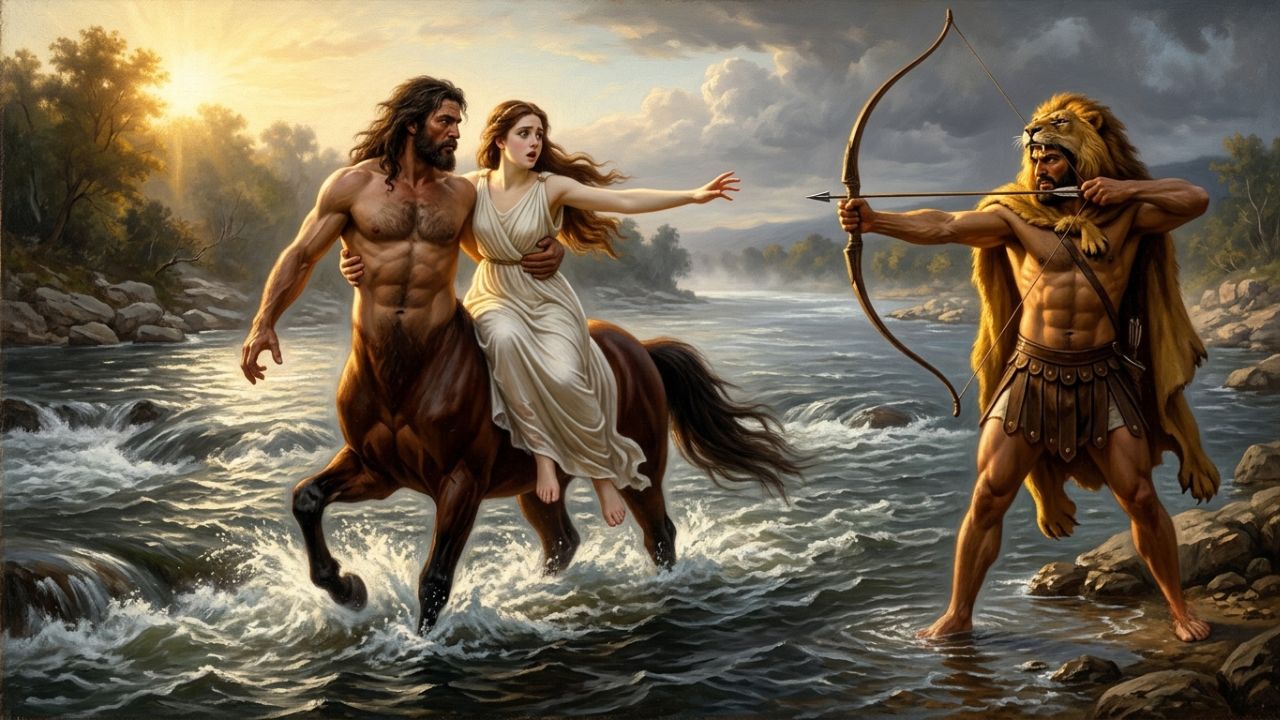
Hercules and Deianira were traveling together when they reached the river Evenus, swollen and dangerous to cross. Working there as a ferryman was a centaur named Nessus, who offered to carry travelers from one bank to the other for a fee, claiming that the gods themselves had given him that concession for his good conduct. Hercules crossed the river alone, swimming, needing no help. But Deianira, for safety, he allowed to ride on Nessus’s back to be carried across.
Halfway across the river, Nessus attempted to assault her.
Hercules, from the opposite bank, heard his wife’s screams and fired without hesitation one of his arrows, the same ones that had been soaked for years in venomous Hydra blood since his second labor. The arrow pierced Nessus’s chest, and he fell dying on the bank with Deianira still trembling beside him. And there, in his last minutes of life, the centaur devised the slowest and most cruel revenge in all of Greek mythology.
He told Deianira to save his blood, still warm, mixed with what had spilled on the ground during the attack. He assured her it was an extraordinarily powerful love charm: if she ever felt Hercules’s affection cooling, or that another woman was stealing his attention, all she had to do was rub that blood on a garment and give it to her husband to secure his eternal faithfulness. Deianira, not suspecting she was listening to a dying man lying out of pure spite, saved the blood carefully, the way you keep a life insurance policy for your marriage.
Years passed. Hercules, true to his lifelong pattern, kept accumulating feats, battles, and lovers. The last straw was a young woman named Iole, daughter of King Eurytus, whom Hercules brought home after one of his campaigns, with rumors that he planned to make her his new wife or replace Deianira with her. Fear and jealousy did exactly what Nessus had calculated from the river: Deianira, desperate not to lose her husband, took out the blood she had saved all that time and soaked a ceremonial tunic with it, which she sent as a gift to Hercules through a trusted messenger named Lichas, just before an important celebration.
Hercules received the tunic suspecting nothing and put it on immediately.
The heat of his own body activated the Hydra venom still dormant in the blood, years after killing the centaur. The fabric stuck to his skin, and every attempt to tear it off took pieces of his own flesh with the cloth. Meanwhile, Deianira, still not knowing what she had unleashed, accidentally spilled a drop of that same blood on the floor of her house. In the sunlight, the drop began to burn and smoke on its own, without anyone touching it. At that moment she understood that Nessus had never given her a love charm. He had passed on his own revenge, with years of delay and perfect aim.
Hercules, in that agony, grabbed the messenger Lichas, who bore no real guilt in any of this, and threw him so far and with such force that he fell into the Aegean Sea, where tradition says he became a rock. The man who had survived a nine-headed hydra, man-eating mares, and the guardian dog of the underworld itself, ended up begging the gods, between screams, to let him die rather than keep enduring that pain.
When Deianira fully understood the magnitude of what she had done without meaning to, she didn’t wait to see the end. She took her own life before her husband finished fading.
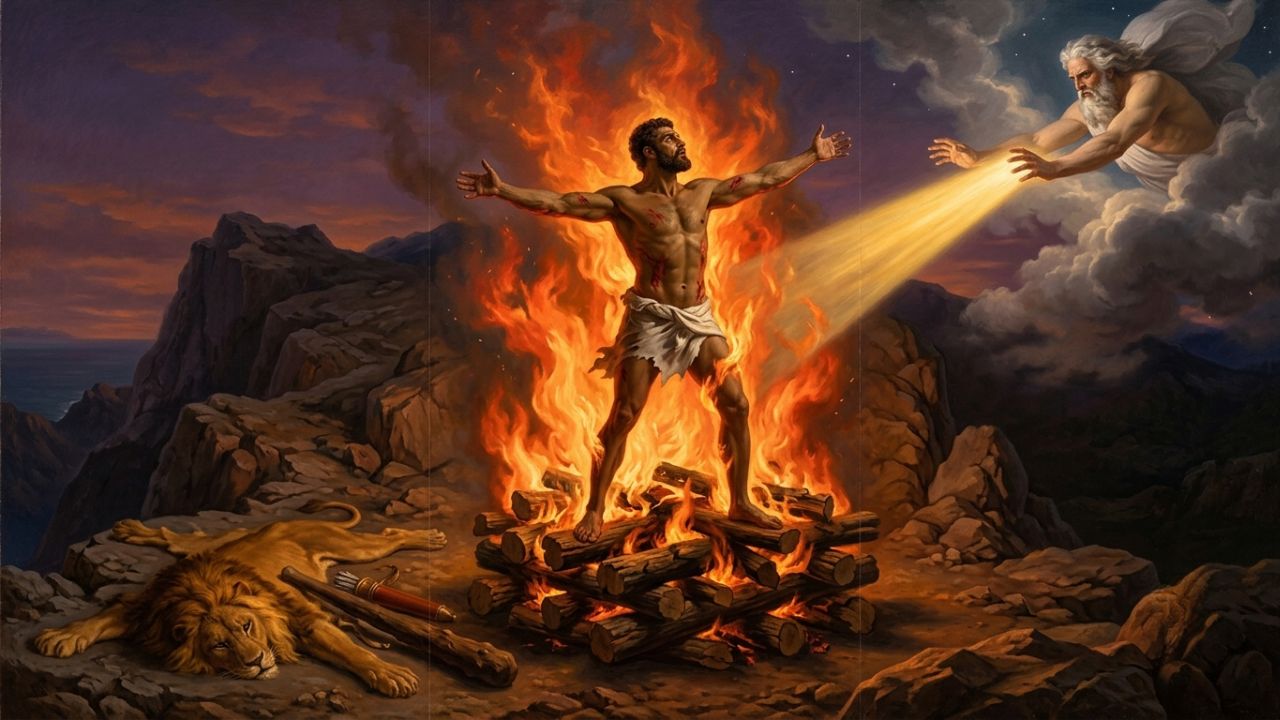
Hercules, already dying, asked to be placed on a funeral pyre of oak wood and set alight himself, choosing to end with dignity rather than go on consumed by a poison that neither swords nor monsters had ever managed. As the flames consumed him, Zeus, his father, finally intervened: he took him to Olympus and received him among the gods, granting him the immortality that none of his twelve labors, nor all his feats together, had managed to buy him in life.
The strongest hero in Greece, the one who tamed impossible monsters with his bare hands, ended up dead from love misunderstood, from a lie planted years before anyone knew it would matter, and by a woman who loved him so much she ended up killing him without knowing it. As with Hippolyta among the Amazons, once again an innocent woman carried the blame for something that was never, in the end, her mistake.
✦ ✦ ✦
What others saw in the same sky
Even the Greeks, for centuries, didn’t know who this kneeling figure in the sky was. Before Hercules there were other readings, and far from Greece, other civilizations had already told a nearly identical story under a different name.
The Arabs, and the man nobody could name
The original Greek astronomers, Aratus, Eudoxus, Hipparchus, called this constellation Engonasin, “the one on his knees,” without knowing who it was. Aratus wrote, literally, that nobody knew his name or the task he was busy with. There were rival theories before anyone thought of Hercules: a king pleading for his daughter turned into a bear, a hero exhausted from an entirely different battle. It was Eratosthenes, a century after Aratus, who first proposed that the figure was Heracles.
Medieval Arab astronomers inherited that same ambiguity, never fully resolving it. Abd al-Rahman Al-Sufi, in his Book of Fixed Stars from the tenth century, documented the figure with extraordinary precision, but the brightest star in the constellation was simply named Ras Algethi, “the head of the kneeling one.” The name describes a posture, not a hero.
That same star still carries that name today. If you look toward that part of the sky tonight, you will be looking, literally, at someone on their knees, without the star’s own name ever telling you who they are or why they’re there. It is the same unanswered question the Greeks had 2,500 years ago, still open every time someone looks up.
Babylon, and the hero who came centuries earlier
There is no solid evidence that the Babylonians placed Gilgamesh in this specific area of the sky. What does exist, documented in the text of his own epic, is a story that feels almost like a carbon copy: a demigod hero of tremendous strength, impossible feats, the devastating loss of his dearest companion, and a final search for immortality that ends in failure.
And here is the detail worth keeping: the Epic of Gilgamesh is, as far as can be verified, the oldest narrative text to survive from any human civilization, written on clay tablets nearly 4,000 years ago. The oldest text in the entire world already had its own Hercules, long before Greece invented theirs.
Gilgamesh never had a star with his name in this corner of the sky. But long before Greece put its kneeling hero among the stars, Mesopotamia had already written nearly the same myth.
Three civilizations, three different answers to the same unresolved question: who is the kneeling man in the sky. The scientific answer, the one that actually matters for finding him tonight, is a little lower down, between his legs, in a cluster of 300,000 stars that does have a proper name.
✦ ✦ ✦
M13: the cluster Carl Sagan used to say hello to the extraterrestrials
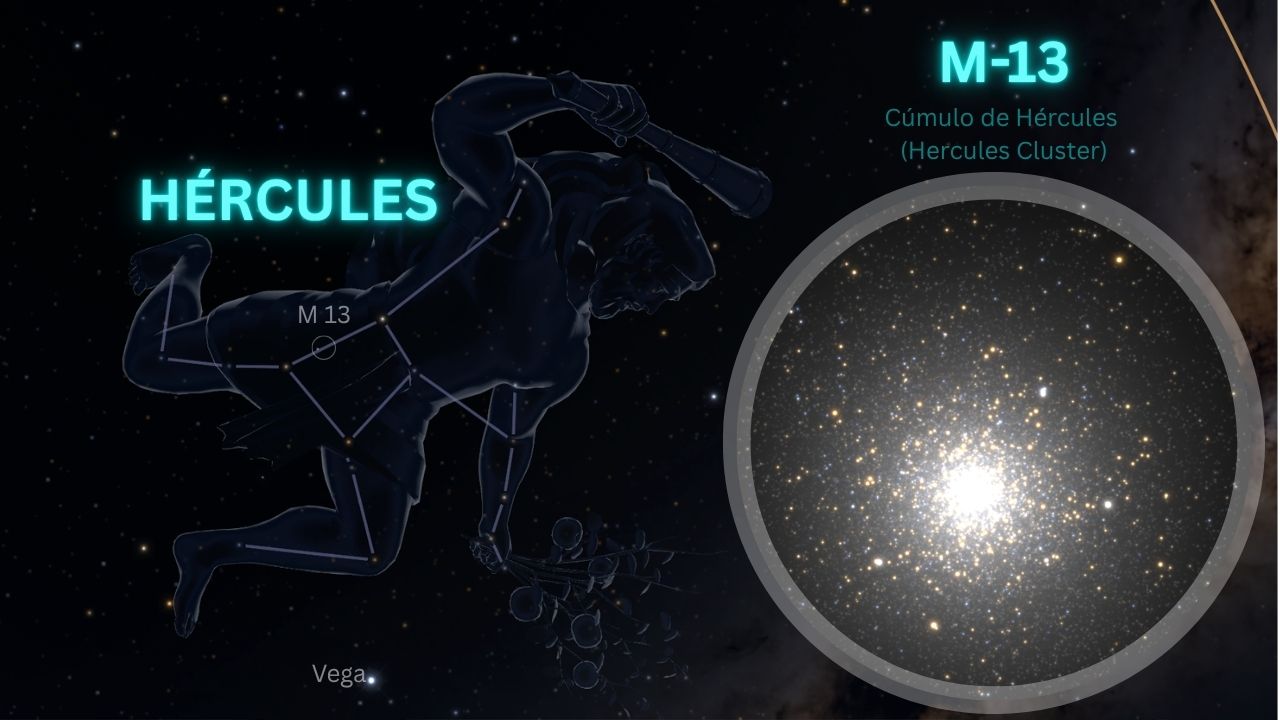
To the naked eye, on a truly dark night, M13 barely shows itself as a fuzzy star, almost a secret. With binoculars it is already unmistakable: a round diffuse patch that doesn’t behave like any star around it. What that patch hides is one of the densest things in our galaxy: 300,000 stars compressed into a sphere just 145 light-years in diameter, about 25,000 light-years away. To give you an idea of how tightly packed things are in there: if your planet orbited a star near the core of M13, you would never know true dark sky. The entire sky would be lit up with thousands of stars as bright as Venus, all at once, every night.
In 1974, Carl Sagan and Frank Drake decided that cluster of stars was the perfect recipient for an introduction from humanity. They pointed the Arecibo radio telescope in Puerto Rico directly at M13 and sent a binary message with basic information about who we are: our DNA, our position in the solar system, the shape of a human body. The detail that truly blows your mind is this: that message will take about 21,000 years to arrive, and by then M13’s own stars will have moved so much in their orbital dance that there probably won’t be anyone left in exactly the direction they aimed. Sagan and Drake knew that perfectly well. They sent it anyway. Not to get a reply, but to leave on record that we tried.
The message itself fit in 1,679 binary digits, about 210 bytes, almost nothing compared to any photo you take today with your phone. But those 1,679 ones and zeros, arranged in a rectangle of 23 by 73 squares (prime numbers, chosen deliberately so any mathematical intelligence would know how to arrange the grid), told practically our entire story in cosmic pixel art. It started with the numbers one through ten, followed by the chemical elements that make up DNA, an illustration of the double helix with the number of base pairs of our genome coded at the center, a human figure with the average height, Earth’s population at the time, a diagram of the entire solar system with our planet highlighted, and finally a drawing of the Arecibo radio telescope itself, like signing a letter with a photo of the pen you used to write it.
It is, without exaggerating, humanity’s first résumé sent to the universe. And like any good résumé, it puts forward our most impressive assets (DNA, mathematics, a radio telescope) and politely omits things like wars, rush-hour traffic, or the fact that in that same 1974 the most listened-to song of the year was by the Bee Gees.
Why M13 specifically? Here is the detail that deflates the mystique a little: it had nothing to do with anything profound or symbolic related to Hercules or his mythology. It was, basically, a matter of logistics. On the exact day and time of the ceremony inaugurating the improvements to the radio telescope, M13 was the large, dense, and relatively nearby cluster that was available in that part of the sky, visible from Puerto Rico, at the moment the scientists had the equipment ready to transmit. Neither Drake nor Sagan chose Hercules for its story. Hercules, without knowing it, did them the favor of being in the right place at the right time.
Neither Drake nor Sagan expected a real reply, nor were they trying to start a conversation. They said so themselves afterward in a scientific publication: the message was symbolic, a demonstration that humanity had the technology to send something that far, more than a serious attempt to contact anyone. It was, at bottom, a proof of concept with an uncertain recipient 25,000 light-years away. The kind of gesture that only makes sense if the attempt matters more to you than the result. Which, to be fair, is basically the entire story of Hercules compressed into a radio telescope: doing something impossible, with no guarantee that anyone will be there to see it.
M92, the forgotten sibling that is actually older than almost everything that exists
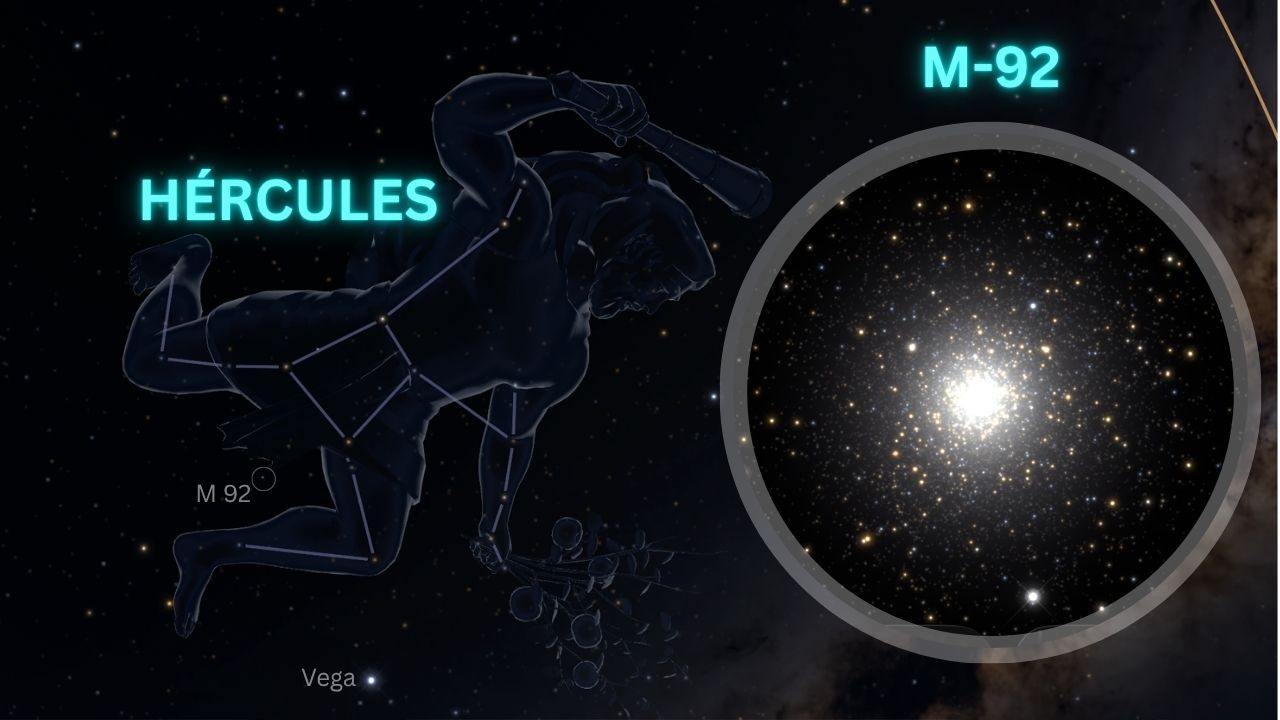
A few degrees away, almost next to M13 in the sky, there is another globular cluster nearly as spectacular, and almost nobody looks for it. M92 suffers the worst PR problem in the universe: being the neighbor of something even more famous. But the detail that should give it all the attention is this: M92 has an estimated age of nearly 14.2 billion years, practically the same age as the entire universe. It is one of the oldest known clusters in the entire Milky Way, a relic that was there almost from the first instant things began to exist, and most people who point their telescope at Hercules never realize they were a hand-turn away from something like that.
NGC 6210, the Turtle Nebula, a preview of our Sun’s future
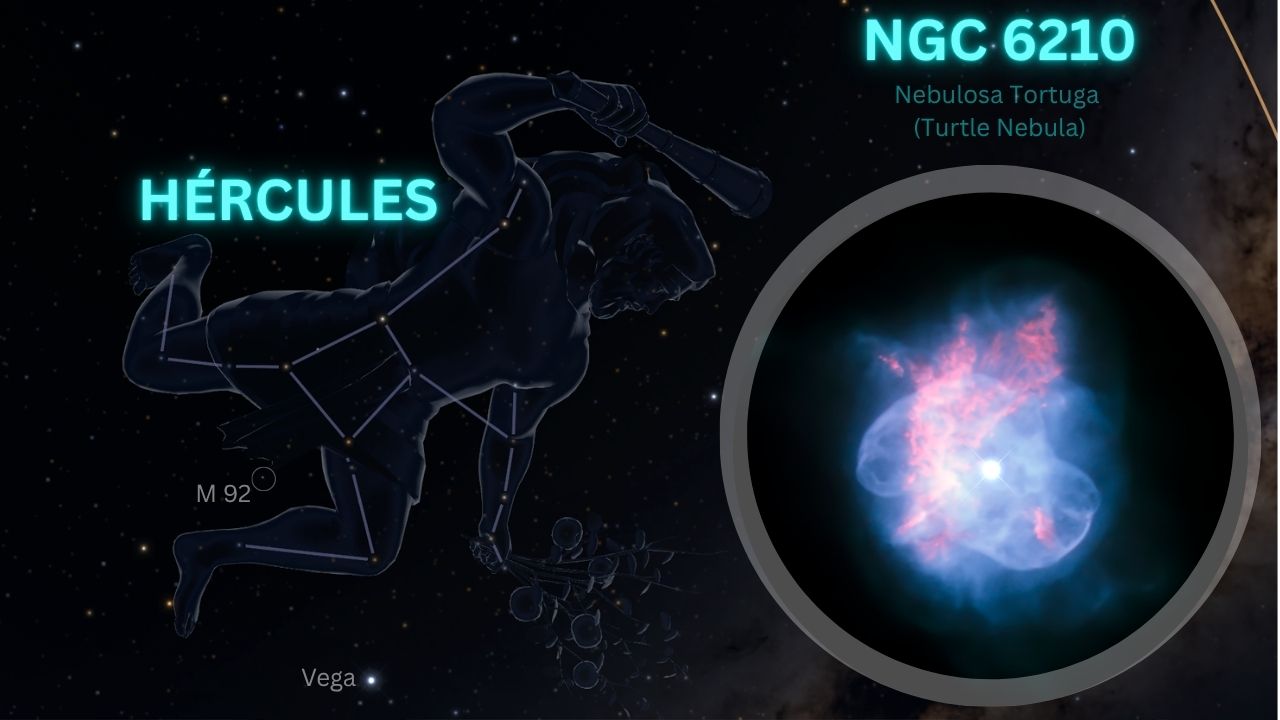
Smaller, but easy to identify by its color: a blue-green disk that stands out immediately against any field of point-like stars. There is one non-negotiable condition though: you need a truly dark sky, away from city lights. Like almost all deep-sky objects, NGC 6210 fades and disappears in any urban sky, no matter how good your equipment is. Under a genuinely dark sky, however, it is one of the most rewarding objects for a beginner: its color is visible even with modest apertures, and improves in definition the larger the mirror.
It is what remains of a Sun-like star when it ends its life and expels its outer layers into space, leaving only a tiny, blazing core at the center. It is, almost exactly, what will happen to our own Sun in about five billion years. It is not an exotic object from another galaxy. It is an advance postcard of our own solar system.
How to find them in the sky
The starting point needs no equipment: find two of the brightest stars in the summer sky, Vega and Arcturus. Hercules lives almost exactly halfway between them. There, forming a slightly lopsided quadrilateral, you will find four moderately bright stars known as the Keystone. That quadrilateral is the torso of Hercules, and it is your anchor for everything else.
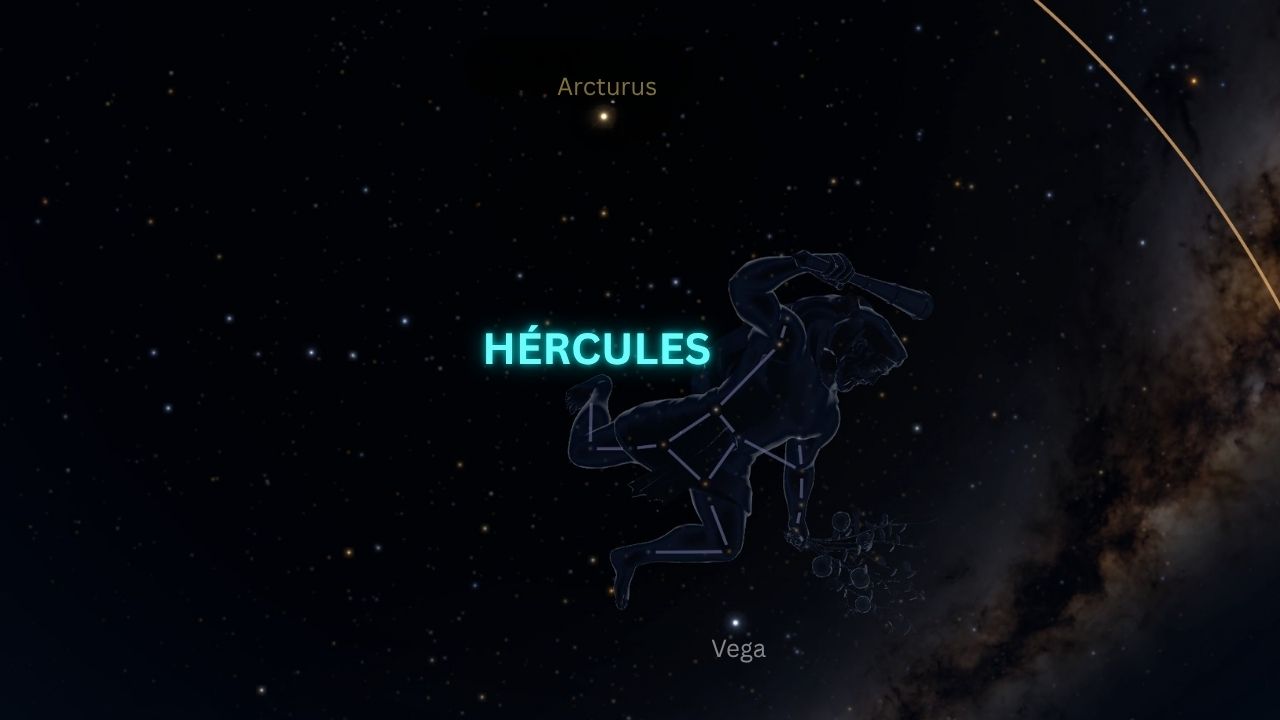
M13 sits on one side of the Keystone, a little more than a third of the way between two of its stars. With binoculars, you will see it as a round patch, similar to an out-of-focus star, impossible to confuse with any point-like star in the field. M92 is a little farther from the Keystone, in the opposite direction, and it is worth looking for right after you find M13, since having them close together is excellent star-hopping practice.
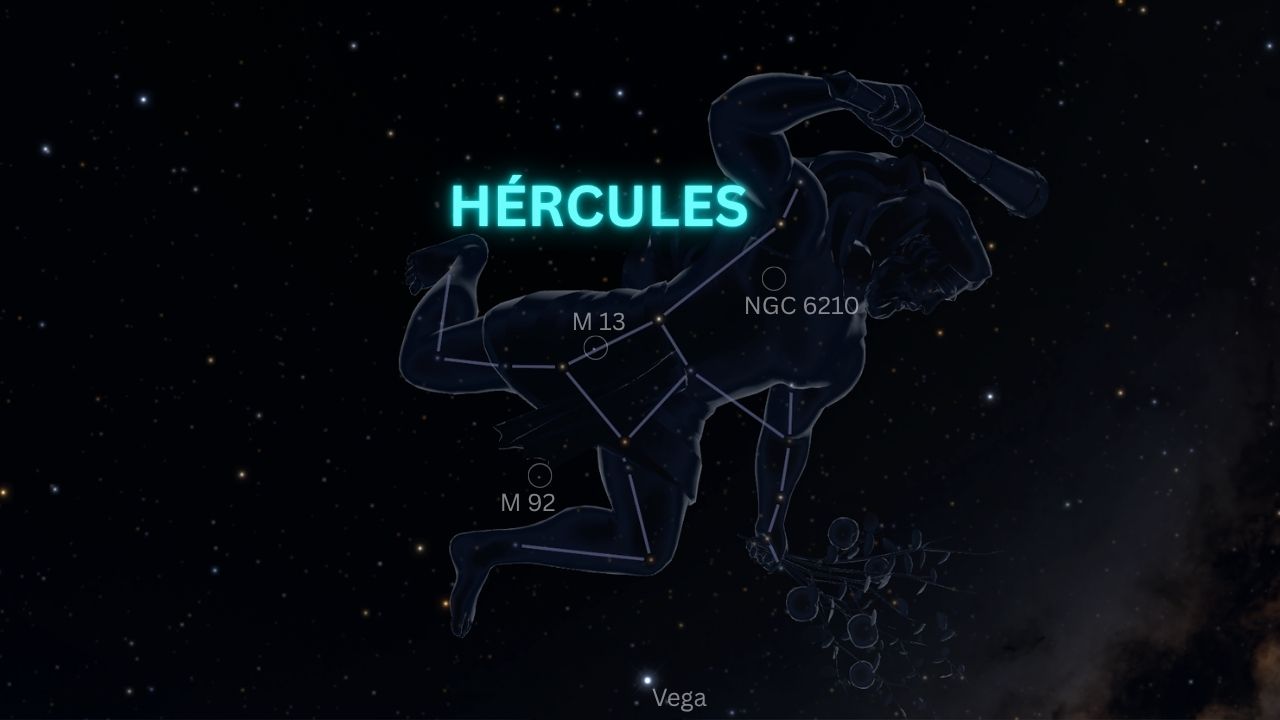
With the CELESTRON SkyMaster 15×70 (Mexico | United States | Spain), M13 shows as a diffuse but clearly identifiable patch, enough to know exactly what you are looking at. With the SKY-WATCHER FlexTube 300P (Mexico | United States | Spain), the story changes completely: M13 stops being a patch and resolves into thousands of individual stars, with visible structure in its core and clear differences in shape compared to M92, which in this same telescope also fully resolves, showing its own bright compact nucleus.
If you prefer something more portable but equally capable of resolving stars, the CELESTRON NexStar 8SE (Mexico | United States | Spain) also resolves M13 into point-like stars all the way to the core at good magnification, in a much more manageable tube for transport, though without the finer structural detail that a 12-inch mirror delivers. For NGC 6210, its blue-green color shows up with either telescope, though the greater aperture of the FlexTube 300P shows it with more definition and brightness.
If what you want is to see M13 resolved into individual stars without carrying a large telescope, the ZWO Seestar S50 (Mexico | United States | Spain) also does it, capturing both M13 and the blue tone of NGC 6210 directly on screen.
✦ ✦ ✦
Hercules spent his entire life solving the impossible by force, and in the end what destroyed him was exactly what he could never control: someone else’s lie, a fear of his own, a woman who loved him. If tonight you look up and find the Keystone between Vega and Arcturus, you will be looking at a man still on his knees, with a cluster of 300,000 stars glowing just between his legs, waiting for someone to find it. If you enjoyed this journey, ASTRONOMIKA TV keeps telling these stories every day on YouTube, Instagram, and TikTok.
✦ ✦ ✦
Frequently asked questions about the Hercules constellation
What does the Hercules constellation represent?
The Hercules constellation represents the Greek hero Heracles, known to the Romans as Hercules, kneeling in the sky in a posture of combat or submission.
Why does Hercules appear kneeling in the sky?
He appears kneeling because the original Greeks did not know who this figure was and called it “Engonasin,” the one on his knees, with no identity attached until Eratosthenes proposed centuries later that it was Heracles.
How many labors did Hercules have to complete?
Hercules had to complete twelve impossible labors, imposed by the oracle at Delphi as penance after killing his wife and children in a fit of madness triggered by the goddess Hera.
How did Hercules really die?
Hercules died poisoned by a tunic soaked in Hydra blood, a gift from his wife Deianira, who had unknowingly been tricked years earlier by the centaur Nessus to take revenge for his own death.
What is M13 in the Hercules constellation?
M13 is the Great Globular Cluster in Hercules, a sphere of approximately 300,000 stars located about 25,000 light-years from Earth, considered the most spectacular globular cluster in the northern hemisphere.
Can you see the Hercules constellation with the naked eye?
Yes, the Keystone of Hercules, the central quadrilateral that forms its torso, is visible to the naked eye under skies with little light pollution, though none of its individual stars is particularly bright.
What is the best time of year to observe Hercules?
The best time is between May and September, with its highest point in the sky during July and August in the northern hemisphere.
What does the name of the star Ras Algethi mean?
Ras Algethi means “the head of the kneeling one” in Arabic, named so by medieval Arab astronomers without committing to any Greek mythological identity.
What is the Arecibo Message and why was it sent to M13?
The Arecibo Message is a binary transmission sent in 1974 by Carl Sagan and Frank Drake toward M13, with basic information about humanity, intended as a demonstration of technological capability rather than a serious attempt at extraterrestrial contact.
What telescope do you need to resolve M13 into individual stars?
A telescope of at least 4 to 6 inches of aperture begins to resolve M13 into individual stars at its outer edges. The CELESTRON NexStar 8SE resolves it to the core at good magnification, and the SKY-WATCHER FlexTube 300P also shows the cluster’s internal structure in detail.
What other deep-sky objects does the Hercules constellation have?
Besides M13, Hercules contains M92, a globular cluster nearly 14.2 billion years old, and NGC 6210, a blue-green planetary nebula known as the Turtle Nebula.
Is Hercules visible from Mexico and Latin America?
Yes, Hercules is visible from virtually all of Mexico and Latin America during the boreal summer months, and is easier to locate the farther north the observer is.
This article contains affiliate links. If you purchase through them, I receive a small commission at no additional cost to you.
Sources and recommended reading
Books
Apollodorus. Bibliotheca (The Library). Loeb Classical Library, Harvard University Press. The most complete and systematic Greek source on the twelve labors of Hercules, essential for verifying the order and details of each task.
Graves, Robert. The Greek Myths. Penguin Books. Classic compilation that cross-references the different versions of each myth, including the lesser-known variants of the catasterism of Hercules and the episode with Omphale.
Digital sources
Constellation Guide. “Hercules Constellation.” Accessed 2026. Reliable technical reference for the deep-sky objects of the constellation, including M13, M92 and NGC 6210. constellation-guide.com
NASA Science. “A Turtle-Shaped Nebula, NGC 6210.” Hubble Space Telescope. Official image and description of the Turtle Nebula, with verified technical details on its structure and distance. science.nasa.gov