
Crotus, Pabilsag, and the Maya mouth of the underworld: three versions of the same patch of sky
There is a teapot in the summer sky. Not a metaphor, not poetry: it is literally the shape formed by the main stars of Sagittarius, and millions of people have seen it without knowing what they were looking at. The steam rising from its spout, that faint diffuse glow visible on very dark nights, points exactly to the center of the Milky Way. Some 26,000 light-years away, a black hole with the mass of 4 million suns is waiting there, and the teapot points straight at it as if it knows something you don’t.
Welcome to the Sagittarius article. There is drama, there are revelations, and a couple of facts that will change the way you look at the summer sky forever.
By Juan Pablo Martín | ASTRONOMIKA TV | May 2026
✦ ✦ ✦
Not Chiron: the mistake everyone makes about Sagittarius
Search “Sagittarius mythology” online and 90% of results will tell you it represents Chiron, the wise centaur, mentor of heroes, physician of Olympus. They are all wrong. Chiron already has his own constellation: Centaurus, down in the Southern Hemisphere. And on top of that, he lends his name to a famous astronomical object, 2060 Chiron, a body astronomers first classified as an asteroid and later turned out to be a comet, just as hard to pin down as the character himself. In astrology he is a major celebrity. But that is another story. Today’s story belongs to Sagittarius, a completely different character, less famous, but with more substance than people give him credit for.
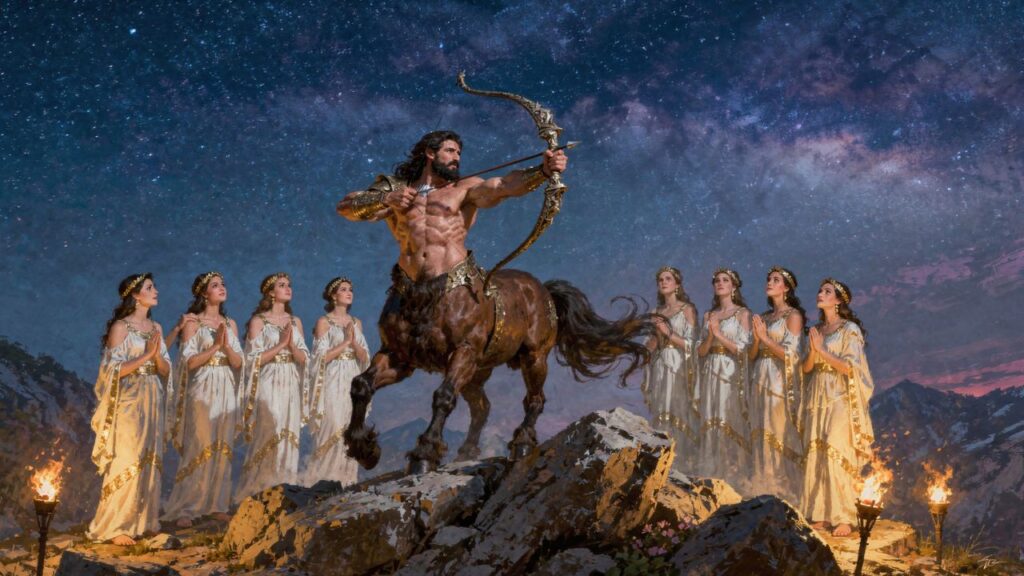
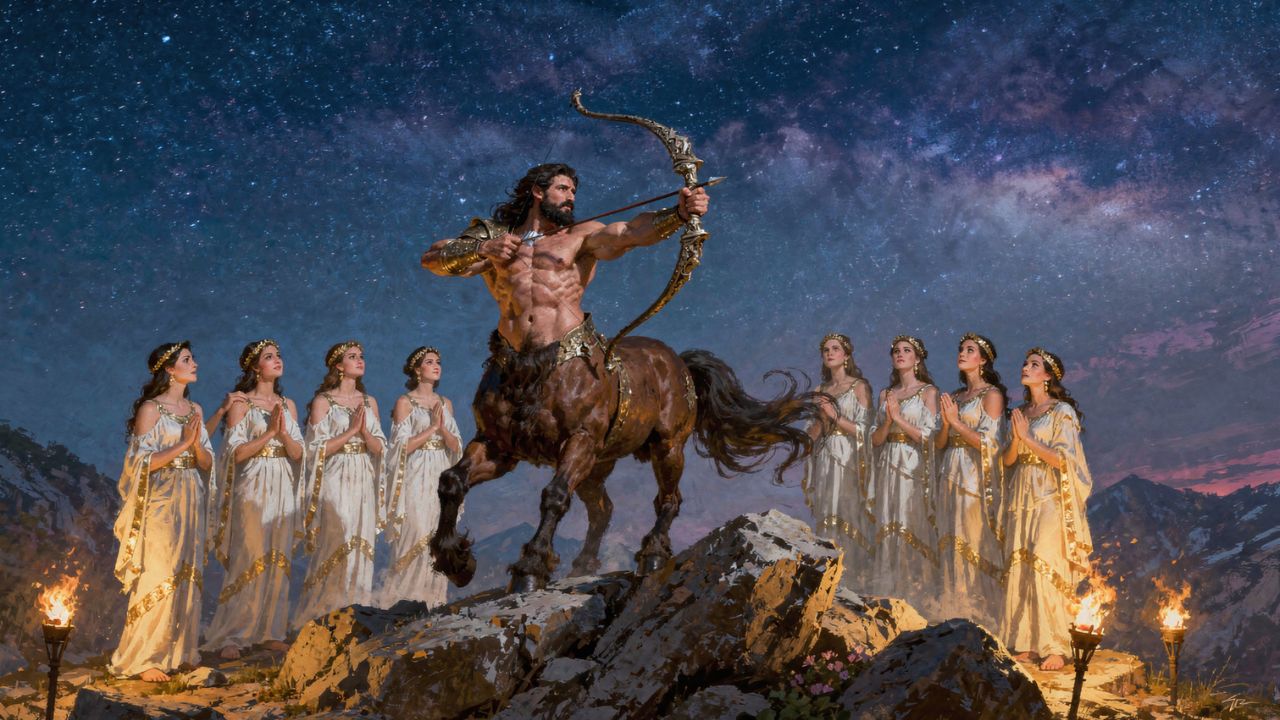
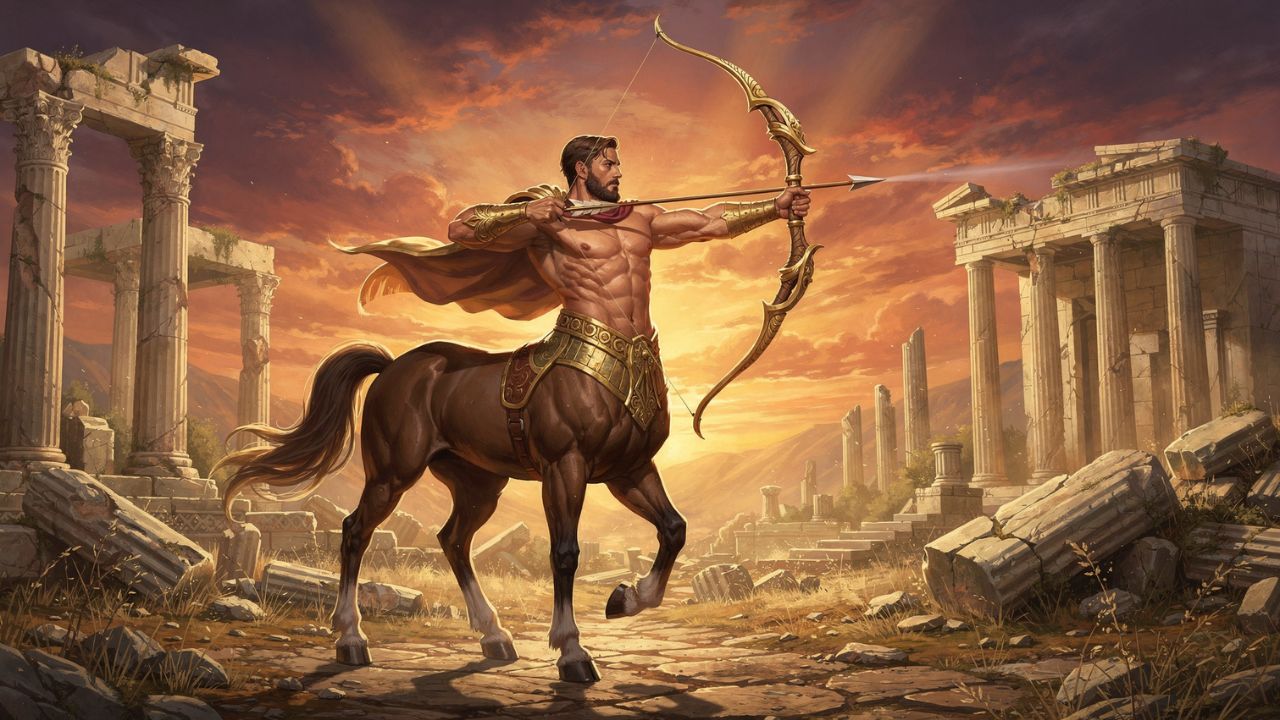
His name is Crotus, son of Pan, the god of shepherds, and of Eupheme, nurse to the nine Muses. Pan, in case you need a reminder, is that god with a human face but goat horns and goat ears, and from the waist down, goat legs and a goat tail. A satyr, in other words. Crotus inherited something of that hybrid nature and grew up on Mount Helicon surrounded by goddesses of the arts. He was a hunter, and according to the Roman writer Hyginus, he was the first to use the bow for hunting, not as a weapon of war but as a tool for survival. That explains the bow in the celestial figure: Sagittarius is not a warrior. He is a hunter who also happened to have excellent taste in music.
Such good taste, in fact, that he was the most enthusiastic audience member whenever the Muses performed. So enthusiastic that, according to tradition, he invented applause. Literally. Before Crotus, no one clapped. The Muses were so grateful that when he died they asked Zeus to place him in the sky.
Zeus, on one of his better days, said yes.
There is a detail most sources ignore: Crotus was not exactly a centaur. Some versions describe him with features closer to his father Pan than to the classic centaurs. That would explain why in the oldest Babylonian representations of this figure, the celestial archer has a scorpion tail and eagle wings, elements that do not fit the Greek centaur image at all. The Greeks simplified. They took a far more complex figure, stripped away the inconvenient parts, and turned it into something more manageable.
Crotus ended up in the sky as Sagittarius: the archer pointing south, toward the center of the Galaxy, though he had no idea. His bow points at the densest, darkest, and most extreme point in the night sky. For the guy who invented applause, he ended up aiming at something quite intimidating.
✦ ✦ ✦
The same archer in other hands: Babylon and the Maya
Sagittarius was not born in Greece. The figure of the celestial archer is far older, and the cultures that saw it before the Greeks gave it meanings that make Crotus look almost tame.
Pabilsag: the god the Greeks clipped the wings from
Before Crotus existed, before the Greeks named this region of the sky, the Babylonians had spent centuries looking at the same point and seeing something completely different. Not a charming hunter who invented applause. A god.
His name was Pabilsag, and he is documented in the MUL.APIN, the most important Babylonian astronomical catalog ever written, composed around 1200 BC. The name translates roughly as “illustrious ancestor” or “lord of the nobles,” which already sounds like someone who means business.
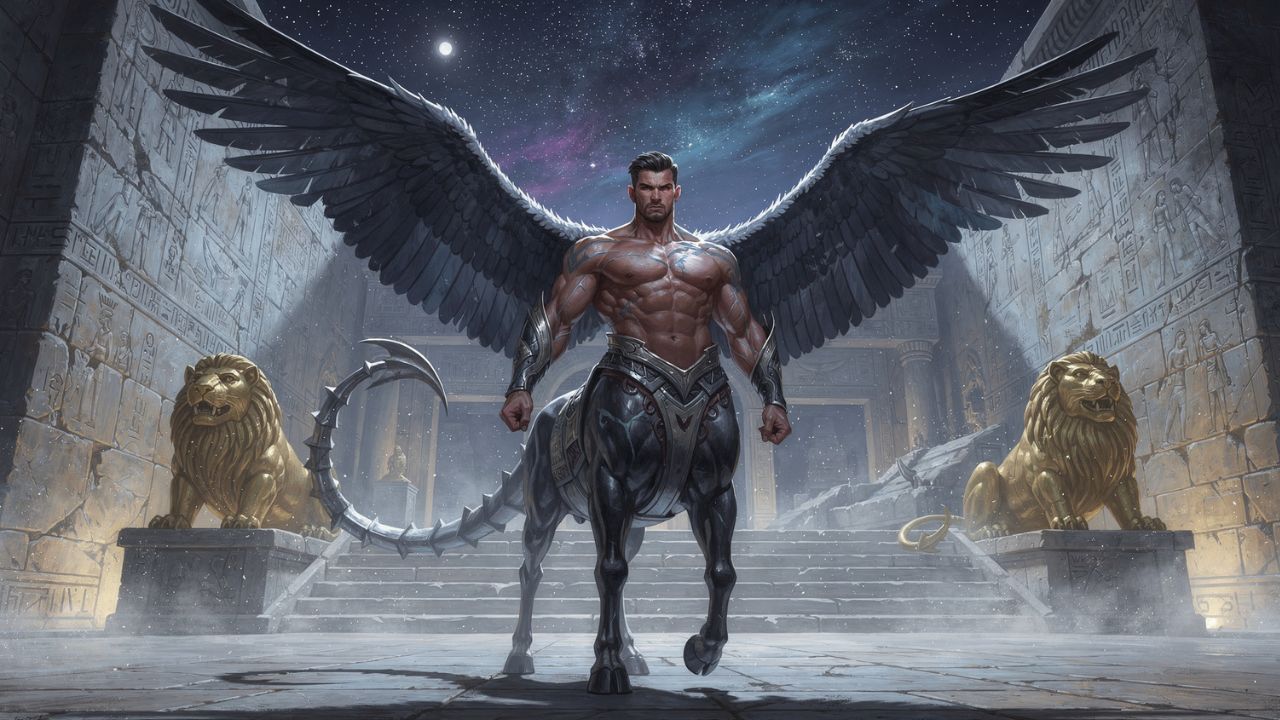
Pabilsag was not a centaur. He was something far more complex: a horse body, a human torso, an imposing male face, eagle wings, and a scorpion tail. A hybrid that combined the most powerful animals the Babylonians knew into a single figure. He was a guardian god, protector of travelers, and husband of Nisaba, goddess of writing and wisdom. Not exactly the profile of someone you strip of wings and turn into the guy who claps at concerts.
But that is exactly what the Greeks did.
They took Pabilsag, removed the wings, removed the scorpion tail, reduced the hybrid figure to a standard centaur, and rebranded him with a far more domestic story. The winged guardian god became Crotus, the Muses’ biggest fan. The Greek story is not bad, it is entertaining and has its charm. But if you ever wondered why Sagittarius feels less epic than other zodiac constellations, now you know: someone stole the epic 3,000 years ago.
Pabilsag came first. Crotus came later. And yet today everyone knows the Greek centaur and almost no one knows there is a winged Babylonian god underneath.
Xibalba: when the same sky is the gate to the underworld
The Greeks saw a charming hunter. The Babylonians saw a winged guardian god. The Maya looked at exactly the same point in the sky and saw something neither of the other cultures dared to imagine: the open mouth of the underworld.
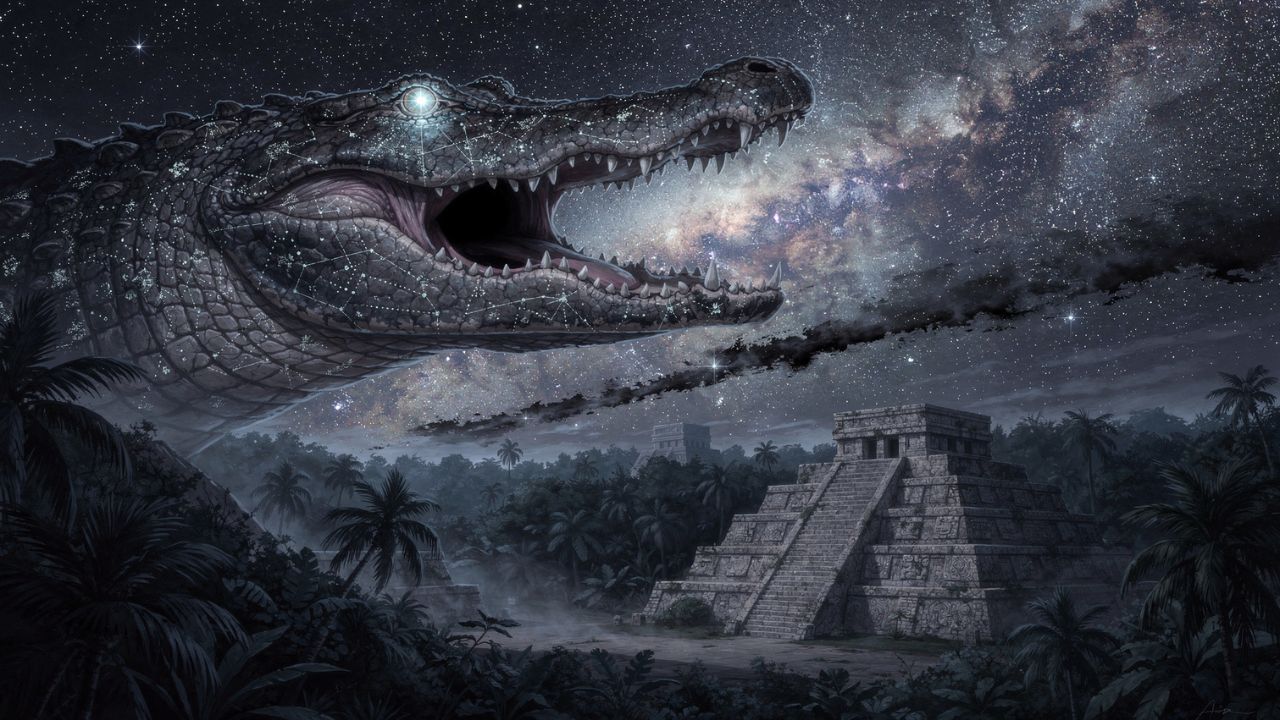
In Maya cosmology, the region of sky where Sagittarius lives has no hero’s name or protective deity. It has a place name. It is called Xibalba Be, which in Yucatec Maya means “the dark road.” And that is not poetic metaphor. It is a literal description of what you can see.
On moonless nights far from city lights, the Milky Way does not look like a uniform band of light. It looks interrupted. A dark rift cuts through it lengthwise, a lane of interstellar dust so dense it blocks the light of stars behind it. The Maya identified that darkness as the open mouth of a cosmic crocodile, or in some versions, a celestial jaguar. And that mouth points exactly toward the galactic center, toward where we now know Sagittarius A* lives.
In the Popol Vuh, the Maya sacred text narrating the creation of the world and the adventures of the Hero Twins, Xibalba is the underworld where the Lords of Death challenge, torture, and are ultimately defeated by Hunahpu and Xbalanque. The entrance to that underworld is in that dark rift in the sky. It was not narrative decoration. For the Maya, the sky was a functional map of the cosmos, and that specific point was the boundary between the world of the living and whatever lay beyond.
Here is the contrast worth sitting with for a moment: the Greeks placed Crotus in that spot, the guy who invented applause and hunted with elegance on Mount Helicon. The Maya placed the door of death. Same patch of sky, civilizations separated by an ocean, and yet both felt that something special was there. Something worth paying attention to. Something that was not ordinary.
Turns out they were right. Neither of them just knew exactly why.
✦ ✦ ✦
The Sagittarius constellation and the most extreme place in the Galaxy
There is an asterism, which is what astronomers call a recognizable star pattern that is not an official constellation, that permanently changed the way many people look at the summer sky. It is called the Teapot, formed by eight stars of Sagittarius arranged exactly as the name suggests: handle, body, lid, and spout. It is one of the easiest patterns to find in the night sky, and once you see it, you cannot unsee it.
But the Teapot is not innocent.
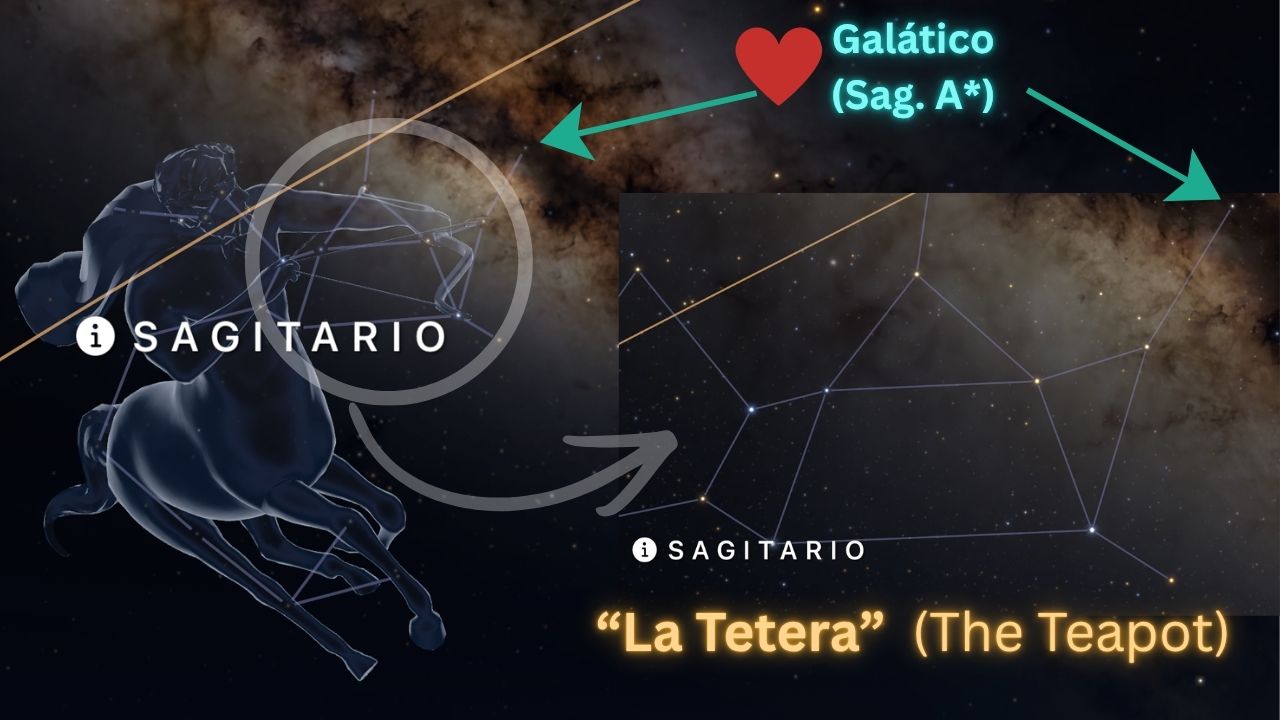
The steam rising from its spout, that diffuse luminous cloud visible on dark nights, is the densest region of the Milky Way. And it points, with the precision of universal geometry rather than astronomical coincidence, exactly toward the center of our Galaxy.
Some 26,000 light-years from Earth, hidden behind dust clouds so thick that no optical telescope can see through them, lives Sagittarius A*: a supermassive black hole with a mass equivalent to 4 million suns. The light leaving that region took 26,000 years to reach your eyes. It set out when modern humans were just learning to farm.
You cannot see it with any visual telescope. Sagittarius A* is invisible in optical light because interstellar dust blocks it completely. It can only be detected at radio and infrared wavelengths. But that does not change what it means to look toward the Teapot on a summer night: you are looking at the heart of the Galaxy. The gravitational center around which everything orbits, including the Sun, including the Earth, including you.
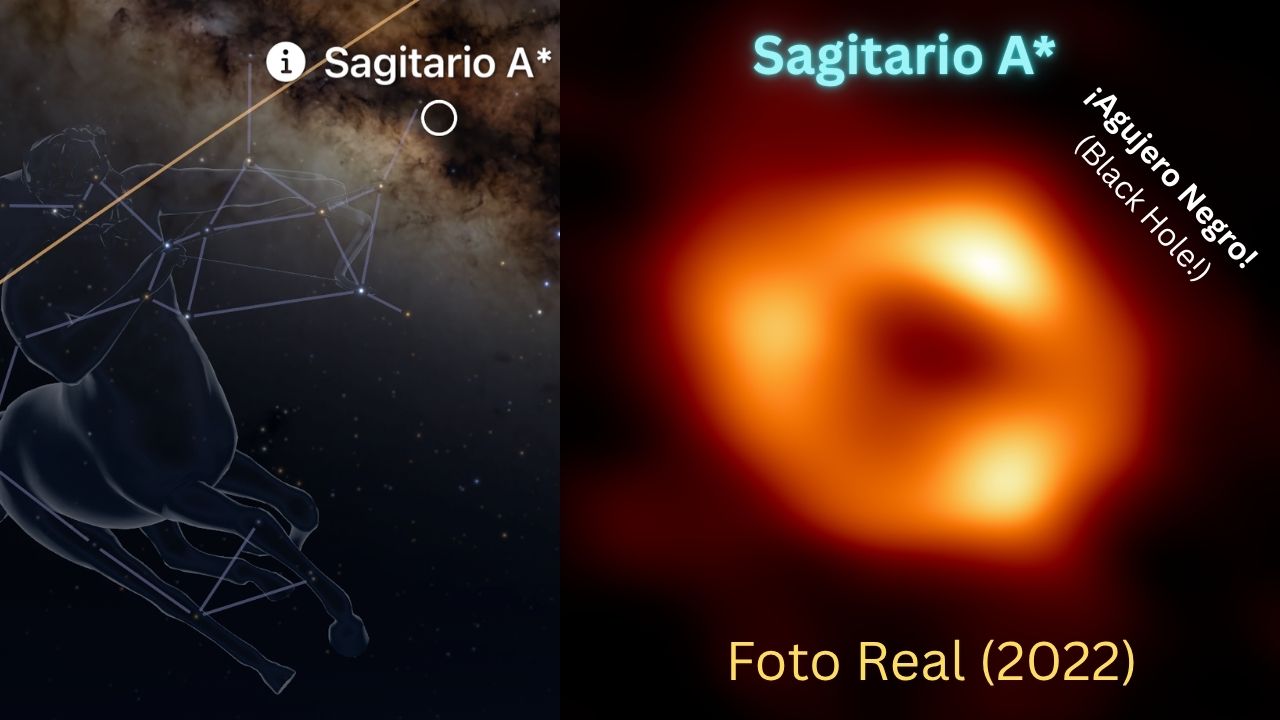
In 2022, the Event Horizon Telescope released the first real image of Sagittarius A*, a photograph that required coordinating radio telescopes across five continents over several years. The image shows a ring of orange light surrounding a circular shadow. That shadow is the event horizon: the point of no return. What goes in does not come out.
But Sagittarius does not end at its black hole.
Before reaching the center, the Teapot’s spout passes through one of the most underrated objects in the night sky: M24, the Sagittarius Star Cloud. It is not a nebula or a cluster. It is a window. A gap in the interstellar dust clouds that normally block the view into the galactic disk. Through that window you can see more stars in a single glance than anywhere else in the sky.
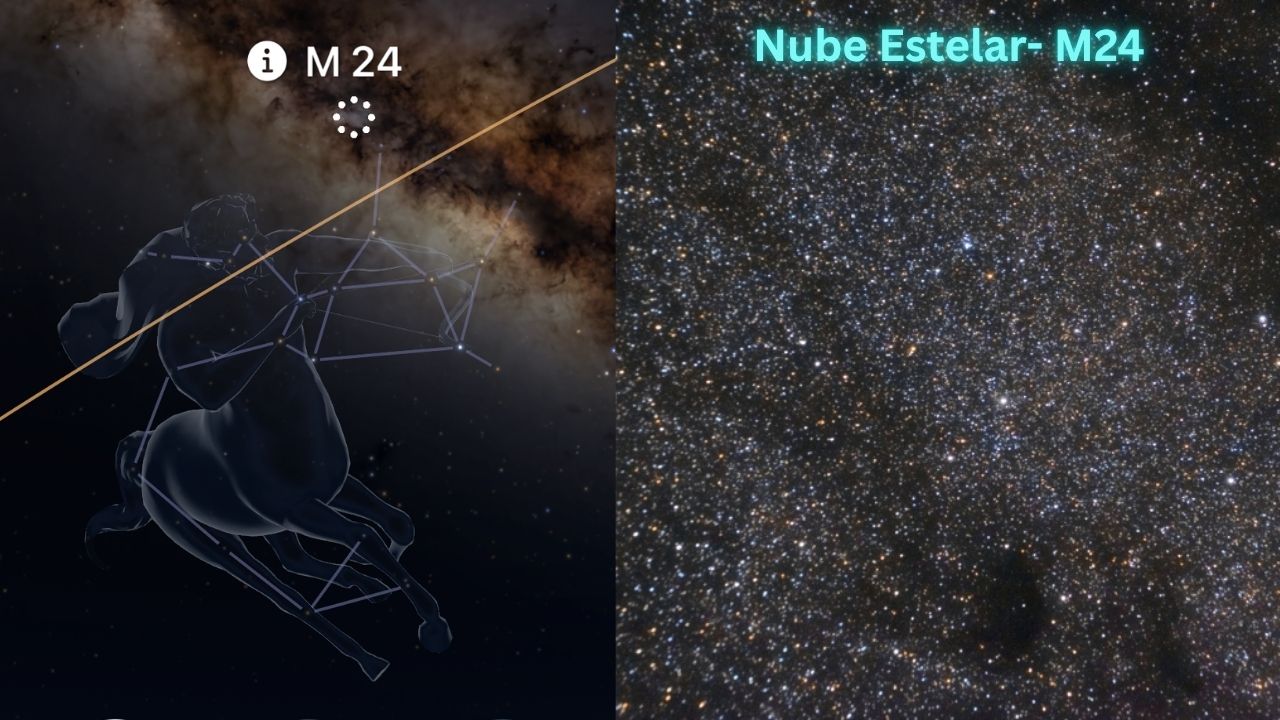
With the CELESTRON SkyMaster 15×70 (Mexico | United States | Spain), M24 overflows the entire field of view: you have to sweep it slowly from side to side to begin processing the stellar density it contains. There is too much to take in at once.
In that same neighborhood sit M8, the Lagoon Nebula, and M20, the Trifid Nebula, two active star-forming regions where stars are being born right now. M8 is visible to the naked eye from a dark sky as a soft patch of light. Through CELESTRON SkyMaster 15×70 binoculars the nebula separates clearly from the star cluster NGC 6530 inside it, though the internal structure and the dark lagoon that give it its name require a telescope to reveal themselves.
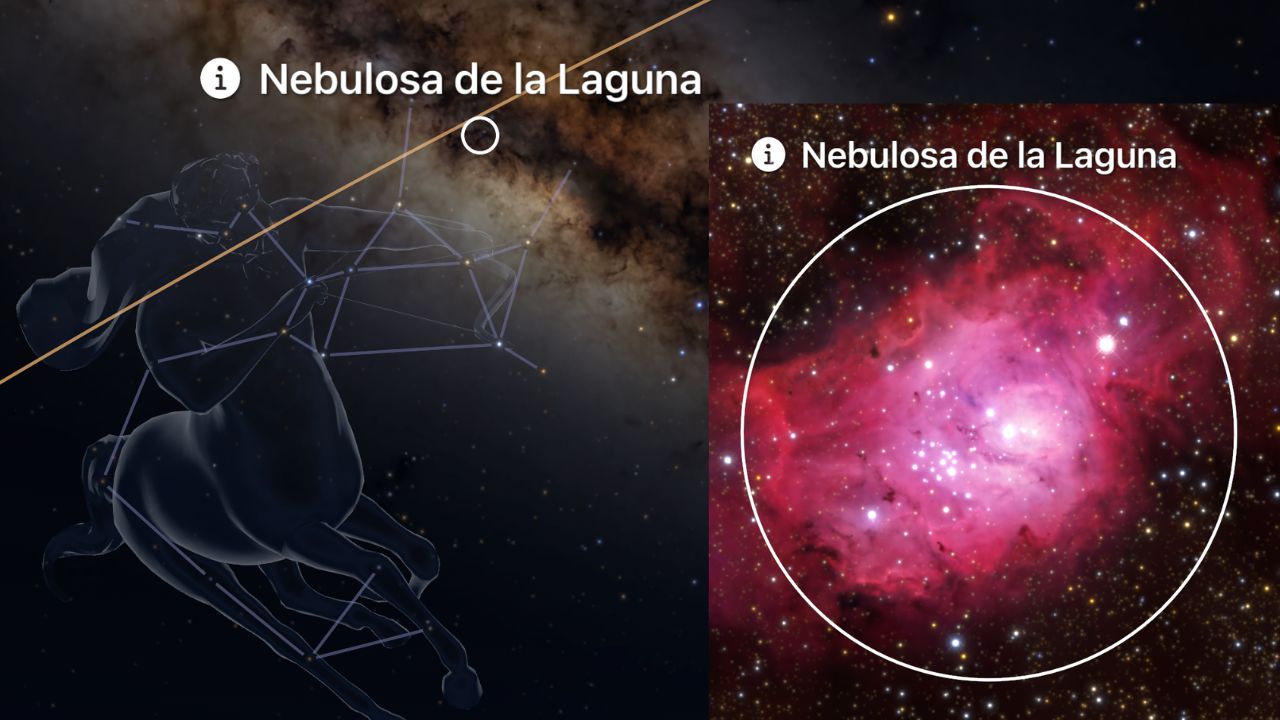
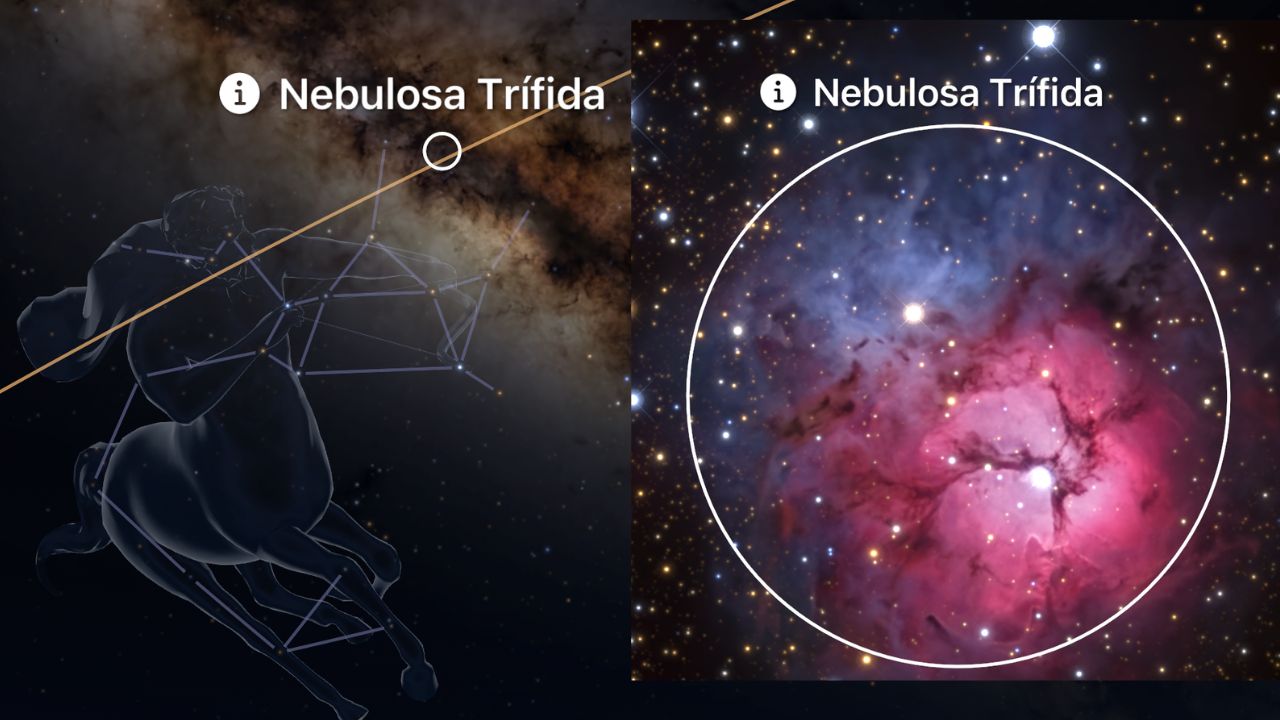
M20 is visually more compact but narratively more interesting: it is one of the few nebulae that simultaneously shows all three types that exist, emission, reflection, and dark, separated by dust lanes that divide it into three lobes. Those lobes are not visible in binoculars, but through the ZWO Seestar S50 (Mexico | United States | Spain) and its automatic image processing they appear with a clarity that makes the trip worthwhile. If you want a detailed comparison of smart telescopes for objects like this, check our Ophiuchus article, where we also explore nebula-rich regions of the sky.
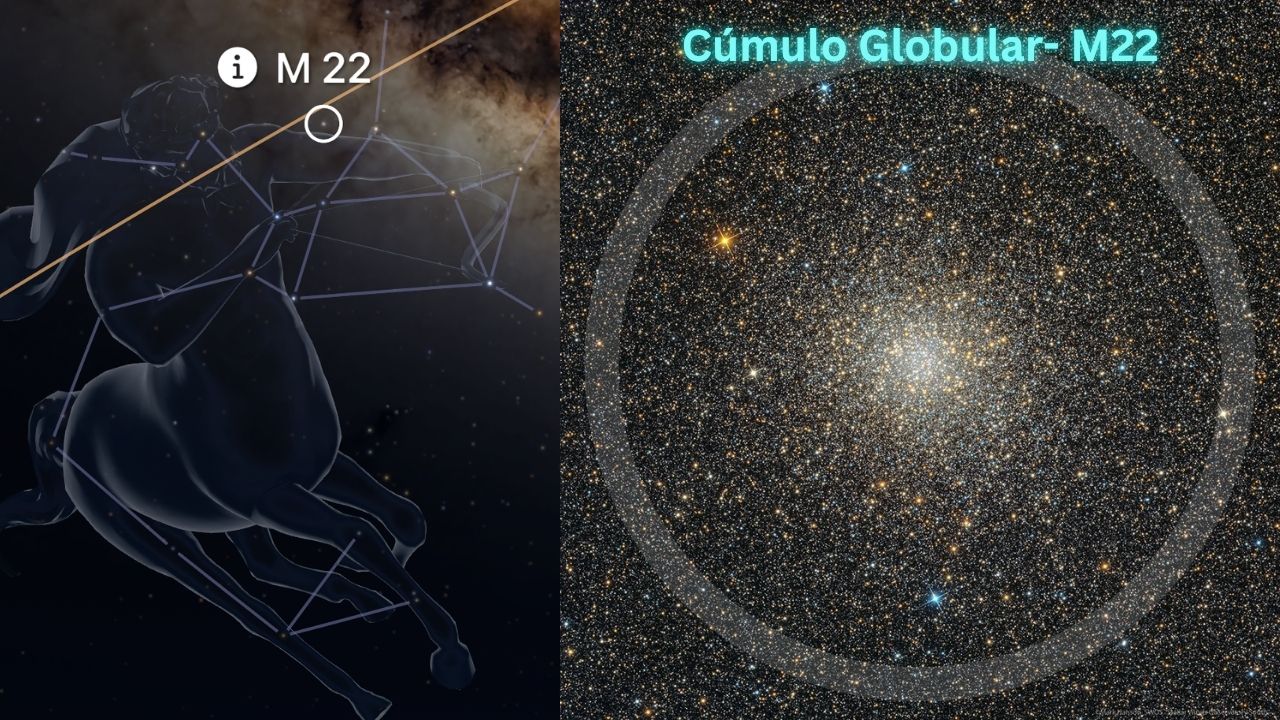
M22 was the first globular cluster ever discovered, in 1665, by German astronomer Abraham Ihle. It contains approximately 100,000 stars gravitationally bound in a sphere roughly 100 light-years across, sitting 10,600 light-years from Earth. Through the ZWO Seestar S50 on a night of good seeing, M22 appears as a bright, compact cluster with the outer halo partially resolved into individual stars.
And then there is M54, where Sagittarius keeps its best-hidden secret.
M54 looks like an ordinary globular cluster. It sits there, compact, looking like any other of the clusters scattered through this constellation. But in 1994 astronomers discovered something that changes its story completely: M54 does not belong to the Milky Way. It is the nucleus of the Sagittarius Dwarf Galaxy, a small satellite galaxy that the Milky Way is currently absorbing. Its stars are being torn away by our galaxy’s gravity in a process that has taken billions of years and will end with the complete disappearance of that dwarf galaxy. Visually it looks like a small, compact globular cluster. Nothing in its appearance gives away what it really is. The drama here is invisible, and that makes it even more interesting.
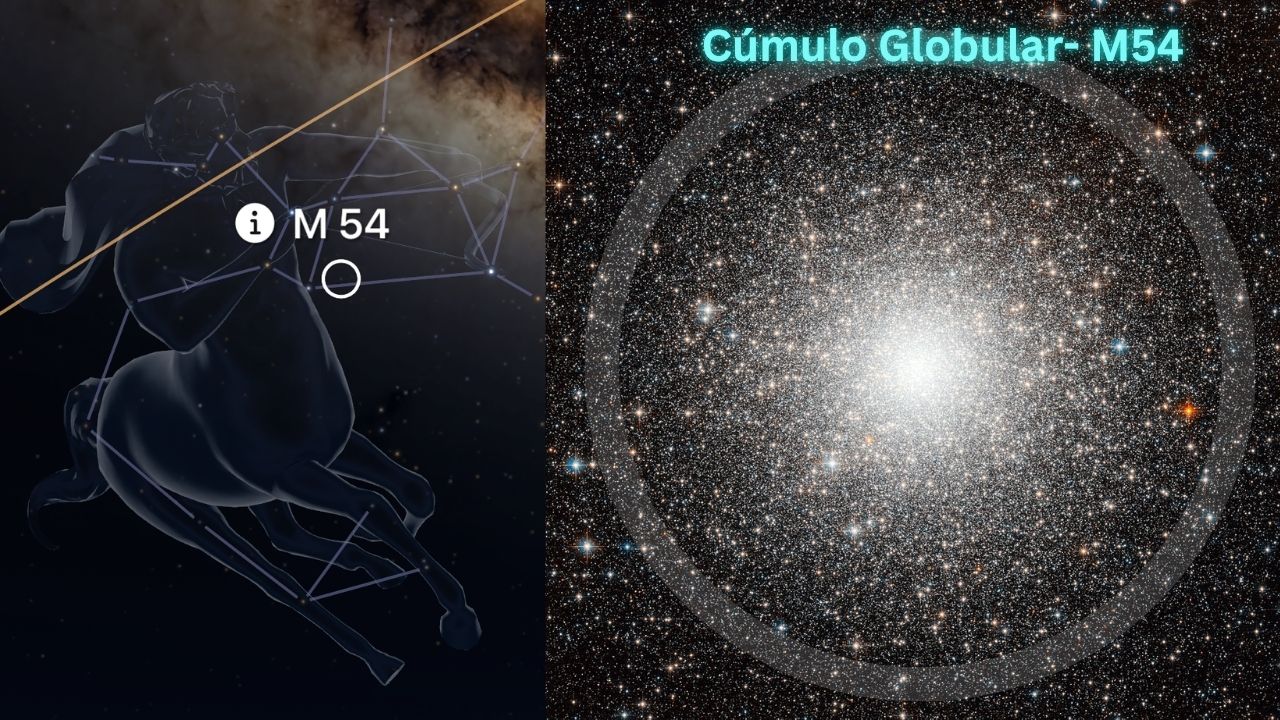
When you point your binoculars at M54, you are not looking at something from our galaxy. You are looking at the remains of another one.
Sagittarius is best seen from the Northern Hemisphere between June and August, when it reaches its highest point in the night sky. From the Southern Hemisphere, where it rises considerably higher, the optimal window runs from November to March. Either way, what you need is not a cutting-edge telescope. What you need is to get away from city lights. Sky darkness matters more than the aperture of any instrument when the goal is to watch the Milky Way rise from the Teapot’s spout.
✦ ✦ ✦
Sagittarius is the constellation that rewards anyone who takes the time to really look at it. It does not have the brightest star in the sky or the most famous myth in the zodiac. What it has is depth, literally and figuratively. Every object it hides is a story inside another story: a devoured galaxy, a window into the Milky Way, a black hole no one can see but that controls everything. The Greeks placed a guy who invented applause there. The Maya placed the door of death. And it turns out that both of them, without knowing it, were pointing at the most extreme place in the Galaxy.
If you want to hear the Sagittarius sky, ASTRONOMIKA BEATS made a track for exactly this: Arrow to the Core (Sagittarius), from the album Path of the Sun: The Infinite Cycle. Play it the next time you point the Teapot toward the heart of the Galaxy.
If you want to keep exploring the sky at this level of detail, ASTRONOMIKA TV has videos, equipment reviews, and observation guides on YouTube, daily content on TikTok, and more on Instagram. The universe has plenty more secrets to give up, and we are just getting started.
And if you want more zodiac: the Taurus constellation hides the Pleiades and the most famous supernova remnant in the sky; Capricorn holds a globular cluster the Greeks never knew existed; and Aquarius hosts the largest planetary nebula visible from Earth.
Frequently asked questions about the Sagittarius constellation
When can you see the Sagittarius constellation?
From the Northern Hemisphere, Sagittarius is best seen between June and August, when it reaches its highest point in the night sky. From the Southern Hemisphere, the optimal viewing window runs from November to March, and the constellation rises much higher in the sky, making it a far more spectacular experience from those latitudes.
Why is Sagittarius depicted as an archer centaur?
The figure comes from Greek mythology, which identified this constellation with Crotus, son of the god Pan. Crotus was a hunter credited with inventing the bow for hunting. However, the original representation is far older: the Babylonians had already drawn a hybrid god named Pabilsag at this point in the sky, with eagle wings and a scorpion tail, centuries before the Greeks gave it the form of a centaur.
Is Sagittarius the same as Chiron?
No. This is one of the most repeated mistakes in astronomy outreach. Chiron has his own constellation: Centaurus, in the Southern Hemisphere. Chiron also lends his name to the astronomical object 2060 Chiron, a comet-asteroid orbiting between Saturn and Uranus. Sagittarius represents Crotus, a completely different character with a completely different story.
What is Sagittarius A*?
Sagittarius A* is the supermassive black hole at the exact center of the Milky Way, located in the direction of the Sagittarius constellation. It has a mass equivalent to 4 million suns and sits approximately 26,000 light-years from Earth. In 2022, the Event Horizon Telescope released the first real image of Sagittarius A*, revealing the ring of light surrounding its event horizon.
Can you see Sagittarius A* with a telescope?
Not with any optical telescope. Interstellar dust completely blocks visible light from the galactic center. Sagittarius A* can only be detected at radio and infrared wavelengths using specialized instruments like radio telescopes. What you can do is point toward the Teapot asterism and know you are looking exactly in its direction.
What is the Sagittarius Teapot?
The Teapot is an asterism, a recognizable star pattern that is not an official constellation, formed by eight stars of Sagittarius arranged exactly like its name suggests: handle, body, lid, and spout. It is one of the easiest patterns to identify in the summer sky. The steam that seems to rise from the spout corresponds to the densest region of the Milky Way, pointing directly toward the galactic center where Sagittarius A* resides.
What deep sky objects can be observed in Sagittarius?
Sagittarius has the highest concentration of Messier objects of any constellation in the sky. The most accessible include M8 (Lagoon Nebula), visible to the naked eye from dark skies; M20 (Trifid Nebula), with its three lobes visible through the ZWO Seestar S50; M22, one of the closest and brightest globular clusters; and M24, the Sagittarius Star Cloud, the densest concentration of stars visible to the naked eye anywhere in the sky.
What is M54 and why is it special?
M54 looks like an ordinary globular cluster, but in 1994 astronomers discovered it is actually the nucleus of the Sagittarius Dwarf Galaxy, a small satellite galaxy that the Milky Way is currently absorbing. It is one of the few Messier objects that does not belong to our galaxy. When you observe it, you are looking at the remains of another galaxy in the process of disappearing.
What equipment do I need to observe Sagittarius?
It depends on the object. M8 and M24 are rewarding even with 15×70 binoculars like the CELESTRON SkyMaster. M22 and M20 show much more detail with a smart telescope like the ZWO Seestar S50. But the most important factor is not the equipment: it is sky darkness. From a location with little light pollution, Sagittarius offers one of the richest naked-eye experiences in the entire night sky.
Why did the Maya associate Sagittarius with the underworld?
The Maya identified the region of sky corresponding to Sagittarius as Xibalba Be, the dark road, which in their cosmology was the entrance to the underworld. This association comes from the dark rift that cuts through the Milky Way in that direction, a band of interstellar dust so dense it blocks the light of stars behind it, creating a black lane visible to the naked eye on dark nights. The Maya interpreted that darkness as the open mouth of a cosmic crocodile: the boundary between the living world and what lay beyond.
This article contains affiliate links. If you purchase through them, I receive a small commission at no additional cost to you.
Sources and recommended reading
Books
Hyginus, C. J. (2nd century AD). Astronomica. Recommended modern translation: Mary Grant (1960), University of Kansas Press.
The Latin classical text where the story of Crotus as the character behind Sagittarius is documented. An essential primary source for correcting the confusion with Chiron.
Aveni, A. (2001). Skywatchers of Ancient Mexico. University of Texas Press.
The most solid academic reference on Mesoamerican astronomy. Documents the Maya interpretation of the galactic center and the dark rift of the Milky Way as Xibalba Be.
Digital sources
Event Horizon Telescope Collaboration (2022). First Sagittarius A* Image.
eventhorizontelescope.org
The primary source for the first real image of Sagittarius A*, with verified technical data on mass and distance to the galactic center.
Hunger, H. & Pingree, D. (1989). MUL.APIN: An Astronomical Compendium in Cuneiform. Archiv für Orientforschung.
jstor.org
The academic source documenting Pabilsag in the original Babylonian astronomical catalog. The foundation for everything written about the Babylonian tradition of Sagittarius.