
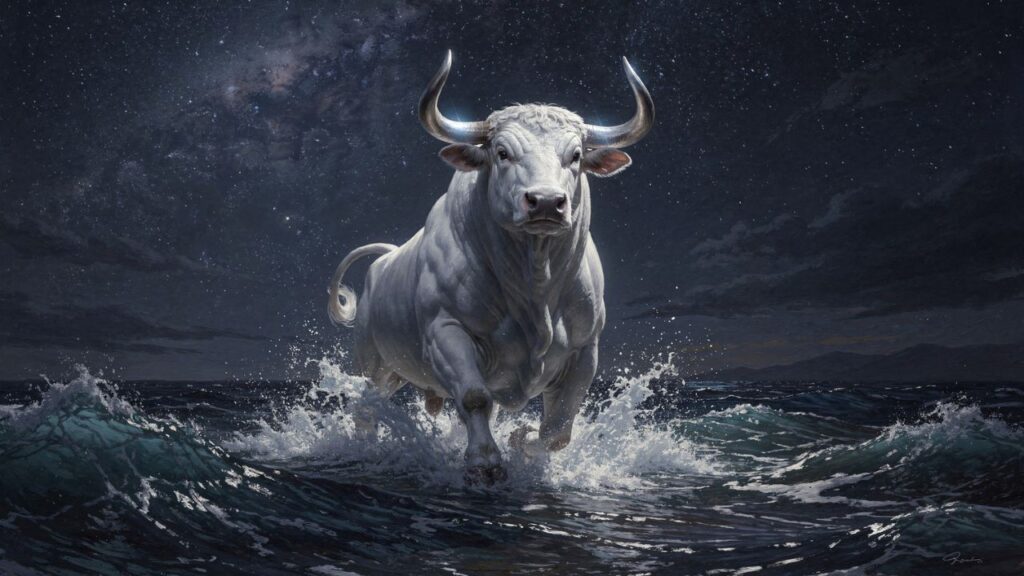
The Taurus constellation is one of the oldest in the sky. It was documented by the Babylonians more than 4,000 years ago, and ever since, it has been telling the same story: a bull that is not what it appears to be.
Greek mythology, the Aztec apocalypse of the Pleiades, and the nebula born from an explosion the Chinese saw in broad daylight
By Juan Pablo Martín | ASTRONOMIKA TV | May 2026
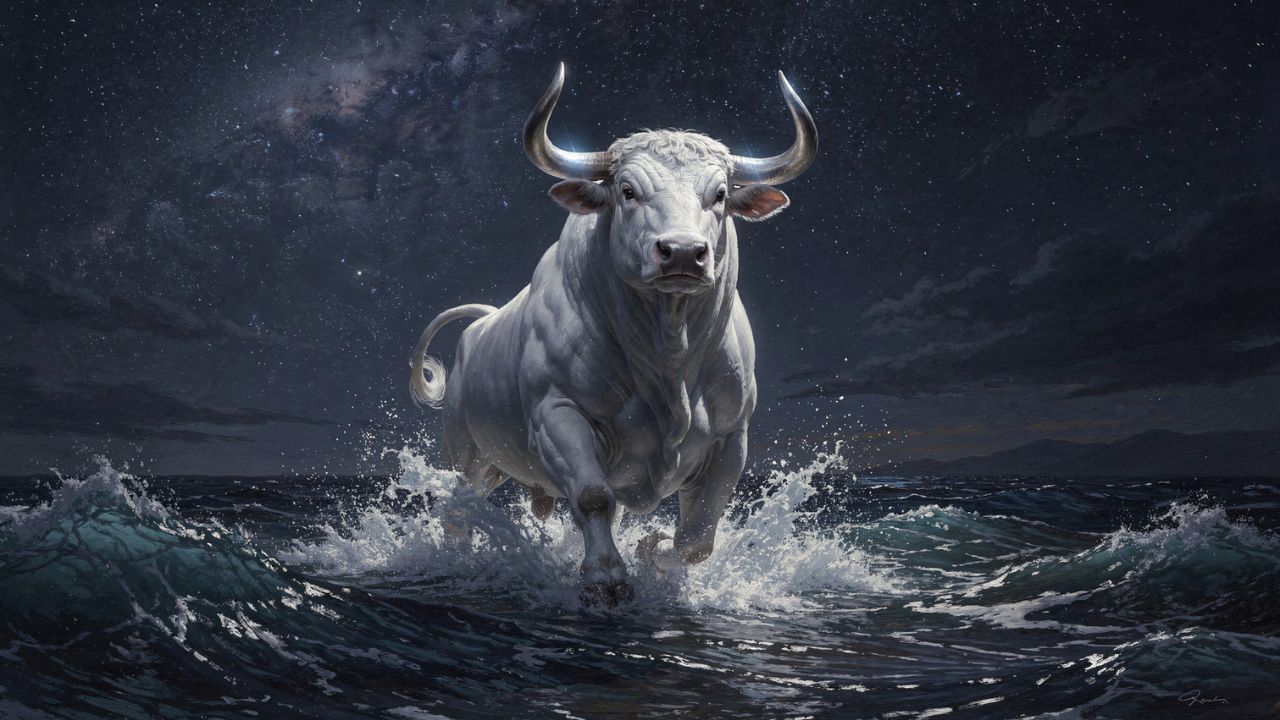
Image: ASTRONOMIKA TV / Flux 2 Pro
The most powerful god in the universe disguised himself as a bull to kidnap a princess. And it worked.
Zeus, king of Olympus and lord of the skies, had a recurring problem: he was married, he was omnipotent, and he could not stop falling for mortal women. His wife Hera knew it. She watched him closely. So Zeus, with all the creativity that comes with being a god, came up with a solution: disguises.
Europa was the daughter of King Agenor of Phoenicia, on the coast of what is now Lebanon. She was young, she was beautiful, and she had a habit of going down to the shore to play with her friends. Zeus spotted her from Olympus and decided he had to meet her. He turned himself into a bull. Not just any bull: one as white as snow, with horns that shimmered like the moon and breath that smelled of saffron. So perfectly beautiful that Europa approached him without hesitation, petted him, sat on his back. And at that exact moment Zeus bolted toward the sea and didn’t stop until he reached Crete, the largest Greek island, still one of the most visited destinations in the Mediterranean today.
Europa could do nothing. She was in the middle of the ocean, riding a bull that swam faster than any ship.

Image: ASTRONOMIKA TV / Flux 2 Pro
On Crete, Zeus revealed his true identity. From that union came three sons: Minos, who would become the most powerful king of the ancient Mediterranean; Rhadamanthus, who would end up as a judge of the dead in the underworld; and Sarpedon, who would die in the Trojan War.
Minos inherited the throne of Crete and built a powerful kingdom centered on Knossos, the city you can still visit today on the north of the island, which was for centuries the heart of Minoan civilization. He was a formidable king. He was also, privately, a man with a very specific and very poorly hidden weakness for women who weren’t his wife.
His affairs were so frequent and so brazen that Pasiphae, his wife, daughter of Helios the sun god and heir to some of his power, finally reached her limit. She cast a curse as twisted as his pride: every time Minos finished with one of his lovers, what came out of his body was not what nature intends, but a swarm of snakes, scorpions, and giant venomous centipedes that the Greeks associated with the darkest corners of the underworld. The creatures killed the woman on the spot. None of his lovers survived the surprise. Pasiphae, being immortal, was the only person the curse couldn’t touch.
Minos, true to his reputation, decided the problem wasn’t reason enough to stop. He kept at it with the same stubbornness as always, as if the curse might make an exception this time. It didn’t. His lovers kept running out of luck.
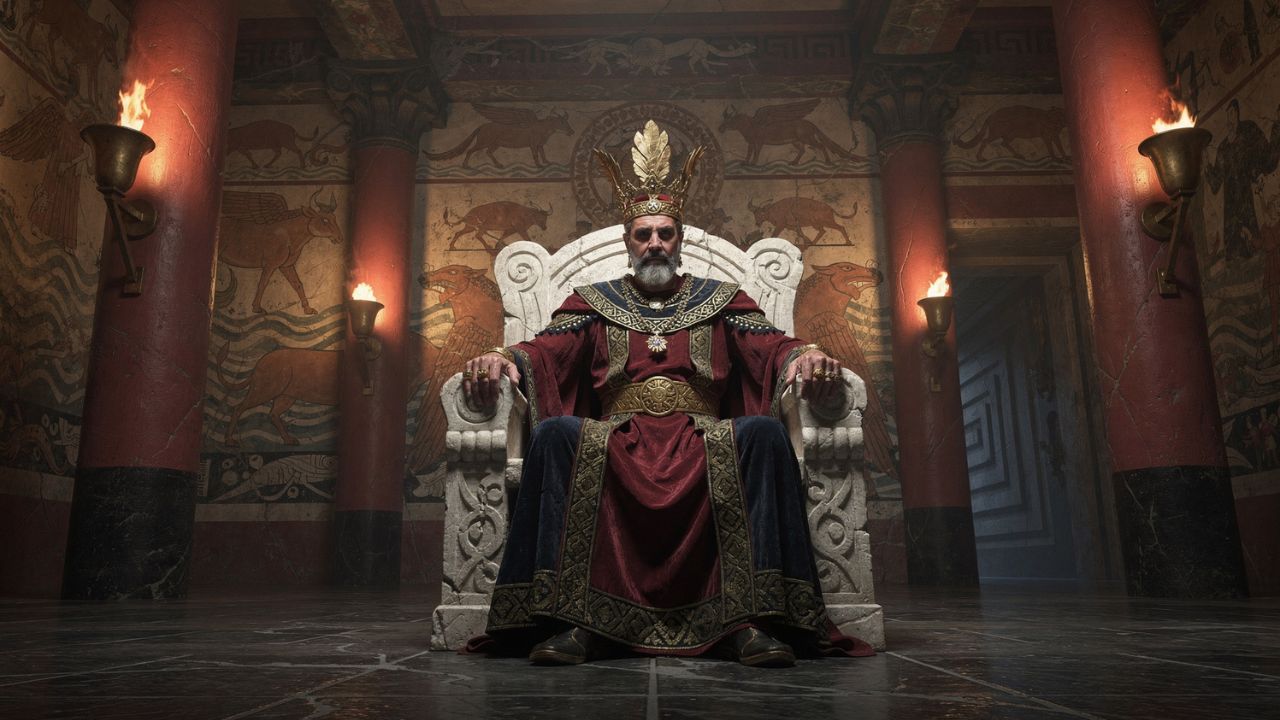
Image: ASTRONOMIKA TV / Flux 2 Pro
Until Procris arrived.
Procris was the daughter of King Erechtheus of Athens, in what is today mainland Greece, and she arrived in Crete fleeing a marital disaster that hadn’t been entirely her fault. She was married to Cephalus, a hunter she loved, but the goddess Eos, the dawn, wanted him too and chased him relentlessly. Cephalus resisted, faithful to Procris, so Eos decided to test whether that loyalty was as solid as he thought: she disguised him as a stranger, loaded him with gifts, and sent him to seduce his own wife. If Procris gave in, Cephalus would no longer have a reason to keep rejecting Eos. Procris, not recognizing him, agreed. When Eos lifted the disguise, Procris was devastated by the shame. She fled to Crete without looking back.
At Minos’s court, Procris understood the king’s problem right away. The solution she came up with was simple enough to sound like a joke: if the problem was what came out of Minos before it reached its target, all it needed was a barrier in the way. She designed a goat-gut sheath, thin but sturdy, that Minos had to wear before every encounter. Pasiphae’s creatures got trapped inside, never touching anyone. The woman walked away unharmed. Minos, satisfied.
Yes, you read that right. Three thousand years before the word “condom” existed, a huntress from Crete had already solved the same problem with the same logic. History never gave her the credit she deserved.
Minos paid well for the idea: he offered her Laelaps, the hound that never failed to catch its prey, and a javelin that never missed its mark, two treasures that for a huntress like her were worth more than any gold. The plan worked exactly as she designed it. Minos delivered the gifts, and Procris, who knew Pasiphae’s temper well, left Crete before the queen learned the details.
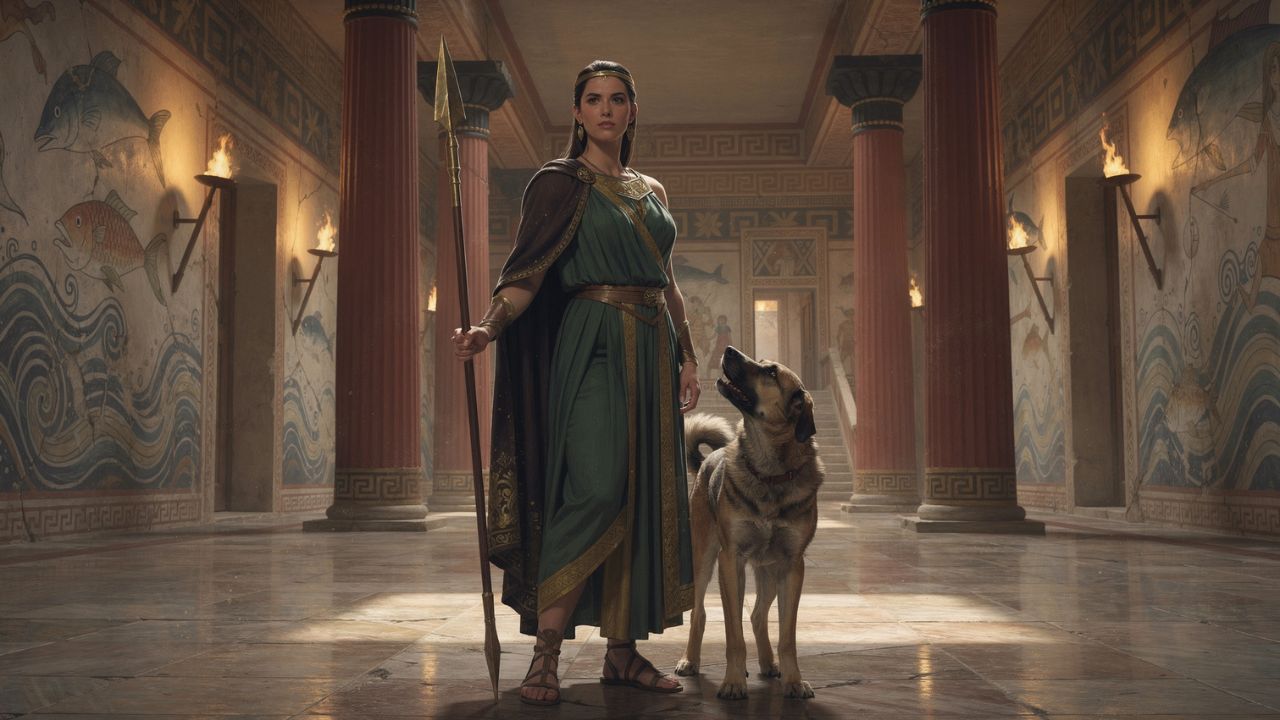
Image: ASTRONOMIKA TV / Flux 2 Pro
Her story didn’t end well regardless. Back in Athens she reconciled with Cephalus, but jealousy never left her. One day she followed him on a hunt, hidden among the bushes, convinced she’d find him with someone else. Cephalus heard the rustling in the brush and threw the javelin without looking. He killed her by accident. The same javelin Minos had given him as a gift.
Zeus’s family, no matter which generation you look at, always ends the same way.
With the matter of his lovers solved, or at least under control, Minos kept ruling. And that’s when the problem with the bull arrived.
Poseidon, god of the sea, sent him a white bull of supernatural beauty to sacrifice in his honor. Minos received it, looked at it, and decided it was too perfect to kill. He tried to be clever: he swapped it for another bull from his herd, similar but without that divine perfection, hoping Poseidon wouldn’t notice the difference. Poseidon noticed. And he was doubly offended: first by the disobedience, then by the attempted deception.
The punishment was calculated to hurt where it would hurt most. Poseidon didn’t destroy the kingdom. He did something worse: he cursed Pasiphae with an irresistible attraction, completely beyond her control, toward that same white bull. A desire that gave her no peace, that consumed her day and night.
Pasiphae, desperate, went to Daedalus, the most brilliant inventor in Crete. She couldn’t explain where this desire came from or why it consumed her with such force, only that she needed to get close to the bull, as close as a human body could possibly get, and that she needed it now. Daedalus, without asking too many questions (some things are better left unasked twice), built a hollow wooden cow, perfectly articulated and covered in real hide, convincing enough for Pasiphae to climb inside and finally satisfy what was consuming her. The plan worked. From that encounter the Minotaur was born: head of a bull, body of a man, the appetite of both.
Minos ordered the construction of the Labyrinth, another work by Daedalus, an inescapable prison where no one could find their way. There he locked up the creature. To feed it, he demanded a periodic tribute from Athens of seven young men and seven young women.
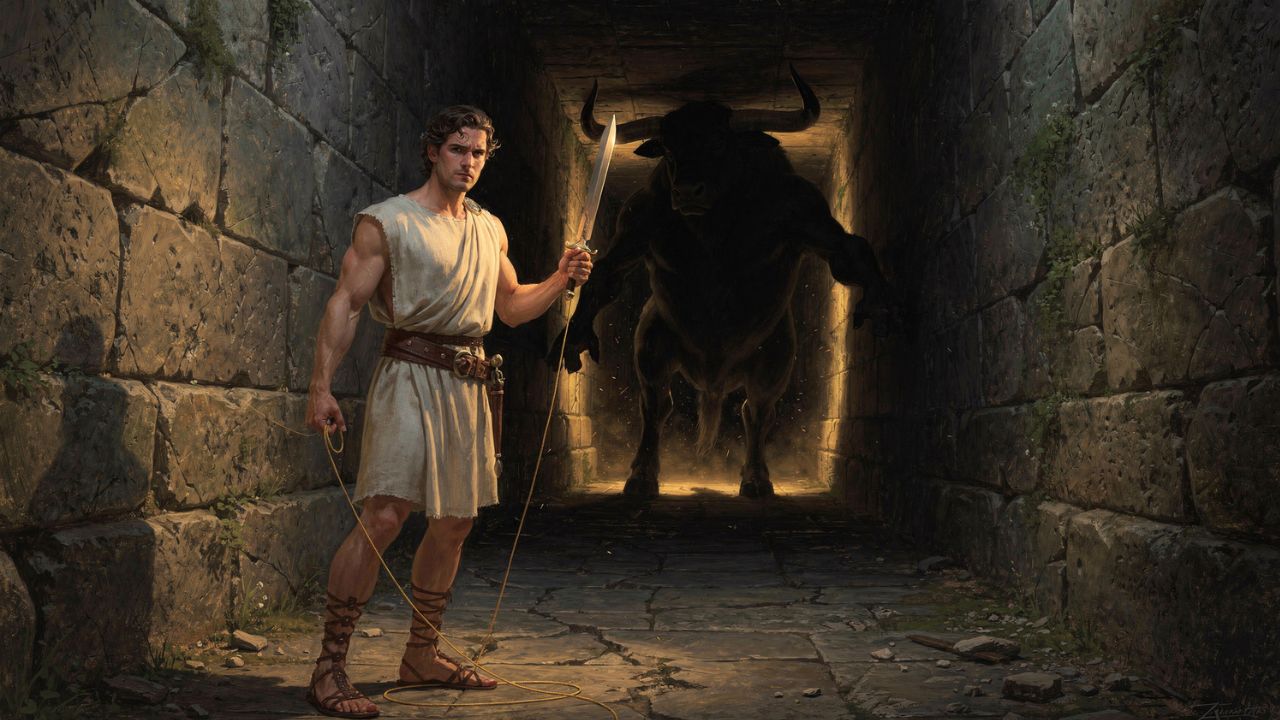
Image: ASTRONOMIKA TV / Flux 2 Pro
That tribute continued until Theseus, prince of Athens, arrived and volunteered among the condemned with a plan. Ariadne, daughter of Minos and Pasiphae, saw him arrive and fell in love on the spot. She gave him a ball of thread so he could find his way out of the Labyrinth after killing the Minotaur. Theseus went in, killed the beast, followed the thread back out, and escaped Crete with Ariadne.
Minos lost the monster, his daughter, and that same night, Daedalus too, who fled along with his son Icarus. Minos chased them across the Mediterranean until he found Daedalus hiding in Camicus, a city on the west coast of Sicily, under the protection of the local king Cocalus. When Minos demanded the inventor be handed over, Cocalus first offered him a hot bath. The king’s daughters poured boiling water over him. Minos died in the tub, chasing the man who had built the wooden cow.
There’s a poetic justice in that the Greeks left uncommented.
But there’s another drama in this same corner of the sky, one with no labyrinths, no wooden contraptions, no hunting accidents. This one has seven sisters, a hunter who couldn’t take no for an answer, and a star that, to this day, still shines dimmer than the rest out of shame.
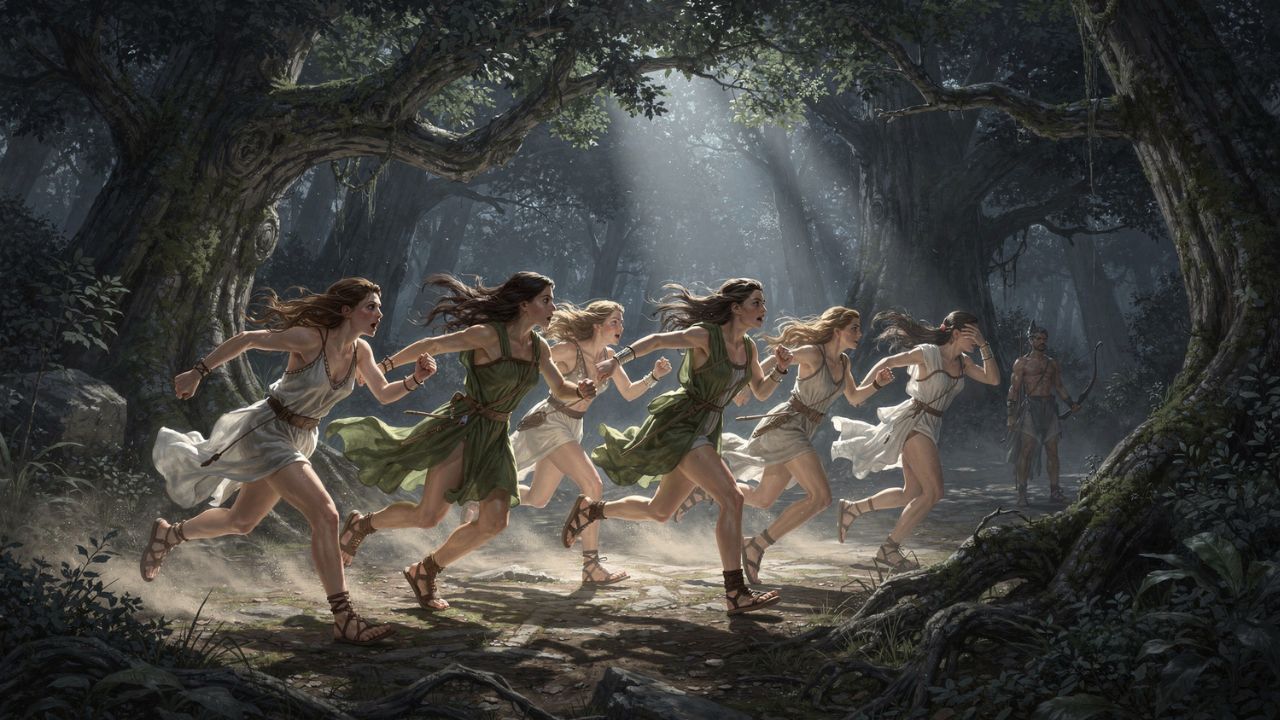
Image: ASTRONOMIKA TV / Flux 2 Pro
The Pleiades were daughters of Atlas, the titan condemned by Zeus to carry the weight of the sky on his shoulders forever, and of Pleione, an oceanid nymph who protected sailors. Seven sisters: Maia, Electra, Alcyone, Taygete, Sterope, Celaeno, and Merope. They lived on Mount Cyllene, in the northern Peloponnese, and were part of Artemis’s retinue, the goddess of the hunt. They ran through the forests, hunted, swam in cold rivers, and celebrated the goddess’s rites with the discretion Artemis demanded. They were free, they were beautiful, and for that exact reason they were in permanent trouble.
They weren’t an anonymous group. Each one had her own story.
Maia, the eldest, was so beautiful that Zeus himself visited her in secret in a cave on Mount Cyllene. From that union came Hermes, messenger of the gods, inventor of the lyre, guide of souls to the underworld. Maia raised her son alone, keeping it from Hera for a reasonable amount of time.
Electra also had Zeus as a lover and became the mother of Dardanus, the mythical founder of Troy. When, centuries later, the city fell and burned, Electra abandoned her place in the sky, unable to watch the destruction of what her son had built. Some say she turned into a comet. That would explain why only six sisters still shine in the sky.
Alcyone, Taygete, Sterope, and Celaeno also had divine lovers, with Poseidon, with Ares, with various minor gods. Their stories cross paths with the founding of cities, royal lineages, and forgotten wars.
And then there was Merope. The only one who fell for a mortal: Sisyphus, the most cunning and most punished king in all of Greek mythology, the same one who spends eternity pushing a boulder uphill only to watch it roll back down. Merope married him knowingly. That’s why, to this day, her star is the faintest in the cluster. She shines dimmer than her sisters because she’s spent millennia ashamed.
Everything changed the day they crossed paths with Orion.
Orion was the greatest hunter the Earth had ever produced. The son of Poseidon according to the most widespread version, of giant stature by every account, with skill with a bow that no mortal nor god could match. He was also, according to the texts, extraordinarily handsome. In short: the perfect definition of “all of them, mine.” The kind of guy who walks into a room, sees seven different women, and decides, with total conviction, that he wants all of them. At the same time. No negotiation possible.
He chased them for seven years.
Seven years of fleeing through forests, hiding in caves, begging the gods to do something. Zeus finally intervened: he turned them into doves so they could escape by flight, and then into stars. But he didn’t place them just anywhere in the sky. He placed them on the bull’s back, so Taurus would protect them.
Orion also ended up in the sky, turned into a constellation. And the chase continues there, night after night, for all eternity. Orion advances toward the Pleiades. The bull stands in his way. The Pleiades always stay ahead, always sheltered behind those horns.
Some read more into that celestial position than simple protection. The bull guarding the Pleiades carries the entire history you already know: the deception of Poseidon, Pasiphae’s ordeal, the Minotaur, the Labyrinth. A bull marked by guilt and consequences. And now there it stands, planted between seven defenseless women and the world’s best hunter, with no chance of winning and no chance of retreating. As if the sky were the place where debts get paid forever.
The Greeks never explained it that way. But they drew it exactly that way.
If you want to keep following the thread of how these stories connect with other zodiac constellations, we already have the full article on Aries, where the golden fleece and the Cretan world connect in a way you won’t expect.
The same sky, completely different stories
The same group of stars the Greeks turned into the setting for a kidnapping, a monster, and an eternal chase was seen by two other cultures as something completely different. Not romance, not family drama. Something much bigger.
For the Mexica, the Pleiades decided whether the Sun would rise again
The Mexica built one of the most powerful empires on the American continent from their capital Tenochtitlan, the lake-bound city that today rests beneath the historic center of Mexico City. Their astronomy wasn’t decorative. It was the mechanism that kept the universe running, and the priests who operated it knew it with a clarity that would give anyone chills.
At the center of that system was a group of stars the Mexica called Tianquiztli: the marketplace. What we know today as the Pleiades. If the word sounds familiar, that’s because it is: “tianguis,” the informal street market that still fills the corners of any Mexican city every weekend, comes directly from Tianquiztli. Four thousand years later, the name still lives in everyday Spanish, even if no one buying vegetables at their neighborhood tianguis knows they’re saying the Mexica name for a star cluster.
The name was no accident. A marketplace is where everything gets exchanged, where cycles renew, where the old leaves and the new arrives. For the Mexica, the Pleiades served exactly that function in the sky, but on a scale no human market could match. Every 52 years, when the ritual calendar and the solar calendar aligned in what they called the Xiuhpohualli, the entire world reached a breaking point. The Mexica believed the universe had already been destroyed and rebuilt four times before this one. And that this fifth era could end too.
The question wasn’t philosophical. It was practical and urgent: would the Sun rise again, or not?

Credit: Mexico City Ministry of Tourism
The answer depended on the Pleiades.
On the night that closed each 52-year cycle, the priests extinguished every fire in the empire. Every single one. Homes, temples, road torches, the eternal flames of the great altars. The most powerful empire in Mesoamerica plunged into total darkness, waiting. People shut themselves inside their homes, covered their windows, covered their mirrors, held their children close. Those who were sick hid with special care: it was believed that if the Sun failed to return, the sick would turn into beasts that would devour the survivors.
The priests climbed Cerro de la Estrella, in what is today the Iztapalapa neighborhood, southeast of Mexico City. From there they watched the sky. If the Pleiades crossed the exact zenith point at midnight, the cycle renewed. The Sun would return. If they didn’t cross that point, the demons of the sky would descend and devour humanity. The darkness would be permanent.
The Pleiades always crossed the zenith. Always. But that didn’t make the waiting any lighter.
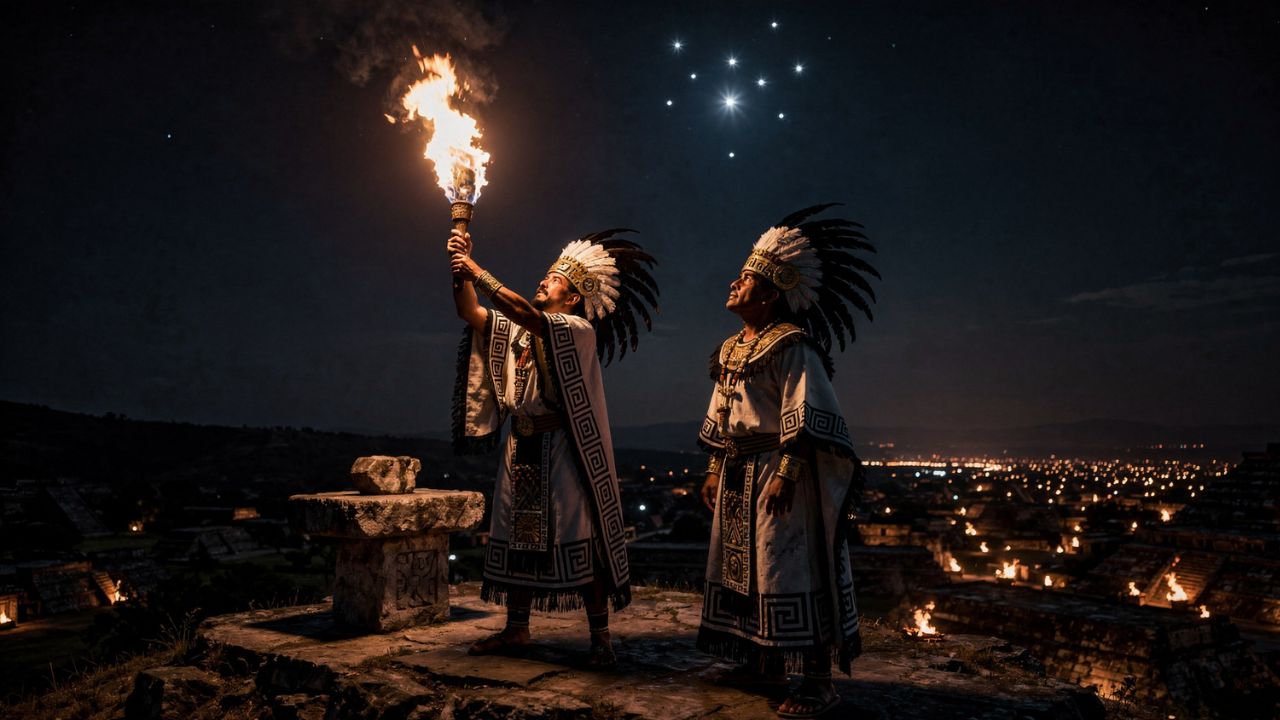
Image: ASTRONOMIKA TV / Flux 2 Pro
When the stars confirmed the cycle would continue, a priest lit the new fire directly on the altar at the top of the hill. That fire was carried by runners to every corner of the empire. Homes received it from the sacred torches. Temples lit up again. The world started over, with another 52 years of credit.
The last documented New Fire Ceremony took place in 1507, just 14 years before the fall of Tenochtitlan. The remains of Cerro de la Estrella are still there, open to visitors, surrounded today by one of the densest urban areas on the planet.
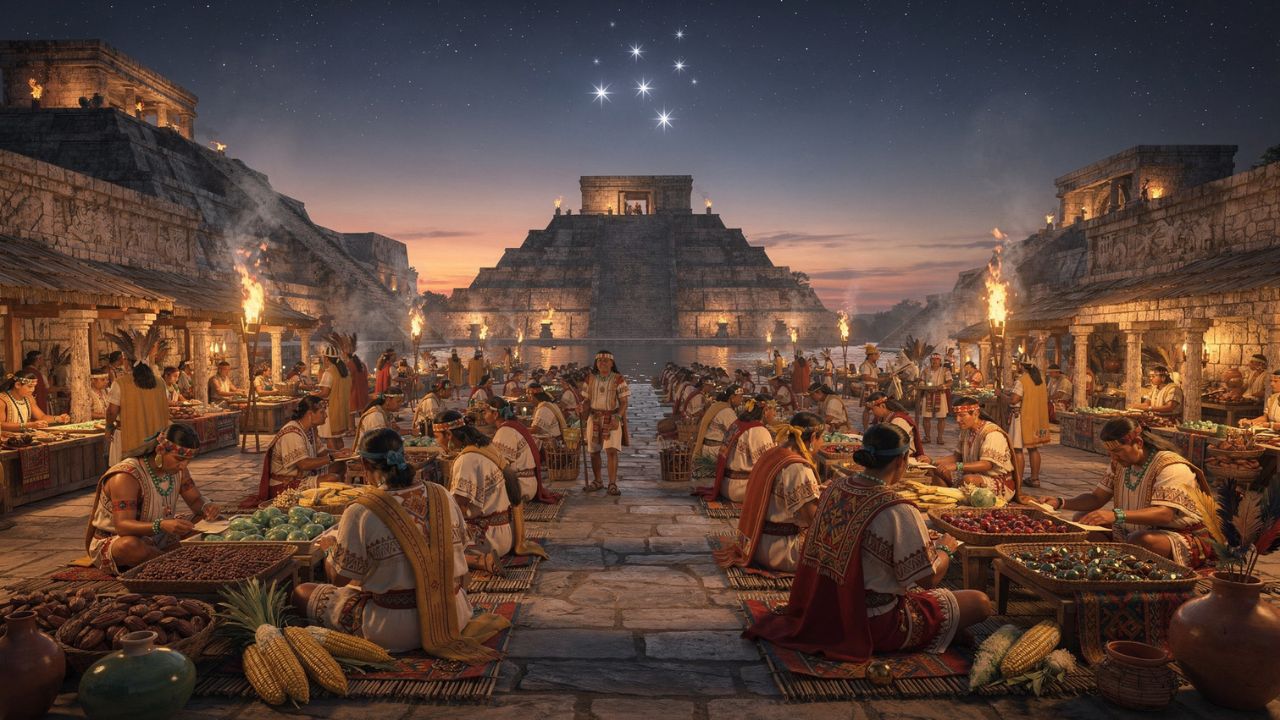
Image: ASTRONOMIKA TV / Flux 2 Pro
What makes this myth so powerful next to the Greek one is exactly that contrast: for the Greeks, the Pleiades were victims. Beautiful nymphs chased by an obsessed hunter, saved by a god who turned them into stars so they’d stop being harassed. For the Mexica, those same stars were judges of the universe. They didn’t ask to be rescued. They decided whether the world continued.
In humanity’s oldest epic, this bull was a weapon of mass destruction
While the Greeks put Zeus on the back of a bull and the Mexica turned the Pleiades into arbiters of the apocalypse, in Mesopotamia, the region now occupied by southern Iraq, someone was writing the oldest story we know. Not on paper. On baked clay tablets, marked with the wedge-shaped script we call cuneiform.
The Epic of Gilgamesh is more than 4,000 years old. It predates the Iliad, predates the Bible, predates almost everything we consider literature. And at its center is a bull.
Gilgamesh was the king of Uruk, the most powerful city-state of his time, located in what is today southern Iraq, about 170 miles southeast of modern-day Baghdad. He was two-thirds god and one-third human, which in practical terms meant he was stronger, faster, and more arrogant than anyone else on Earth.
Ishtar, the goddess of love and war, watched him and decided she wanted to marry him. She made him a direct proposal. Gilgamesh turned her down. But he didn’t stop at no: he listed, one by one, every previous lover of hers she had destroyed once she grew bored of them. It was, diplomatically speaking, a devastating rejection.
Ishtar, furious, went up to the heavens to see her father, the god Anu, and demanded the Bull of Heaven, Gugalanna, as a weapon of revenge. Anu tried to talk her out of it: releasing the bull would bring seven years of famine on humanity. Ishtar said she had grain reserves for those seven years and to just give her the bull already. Anu gave in.
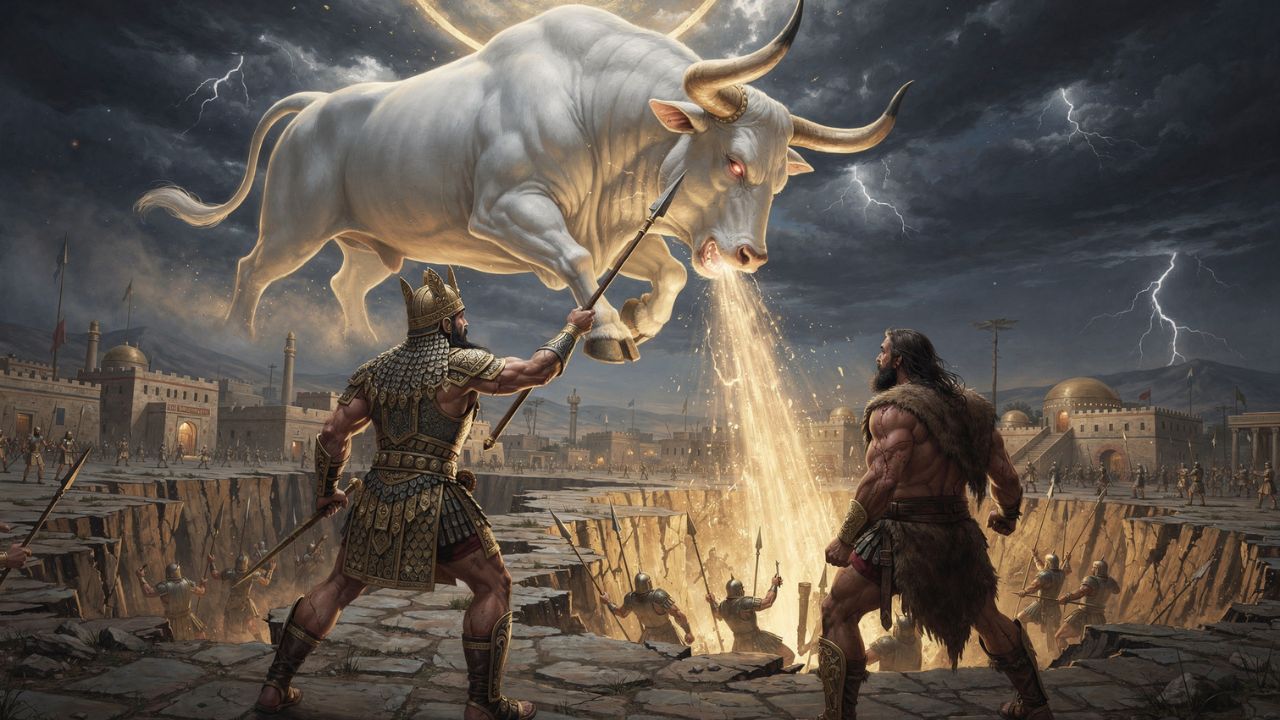
Image: ASTRONOMIKA TV / Flux 2 Pro
Gugalanna descended on Uruk. Every snort tore craters in the ground that swallowed hundreds of warriors. Three snorts, three hundred men dead. The entire city shook.
Gilgamesh and his companion Enkidu, the wild man the gods had created to humble the king’s arrogance and who ended up becoming his best friend, faced the bull together. Enkidu grabbed it by the horns. Gilgamesh finished it off.
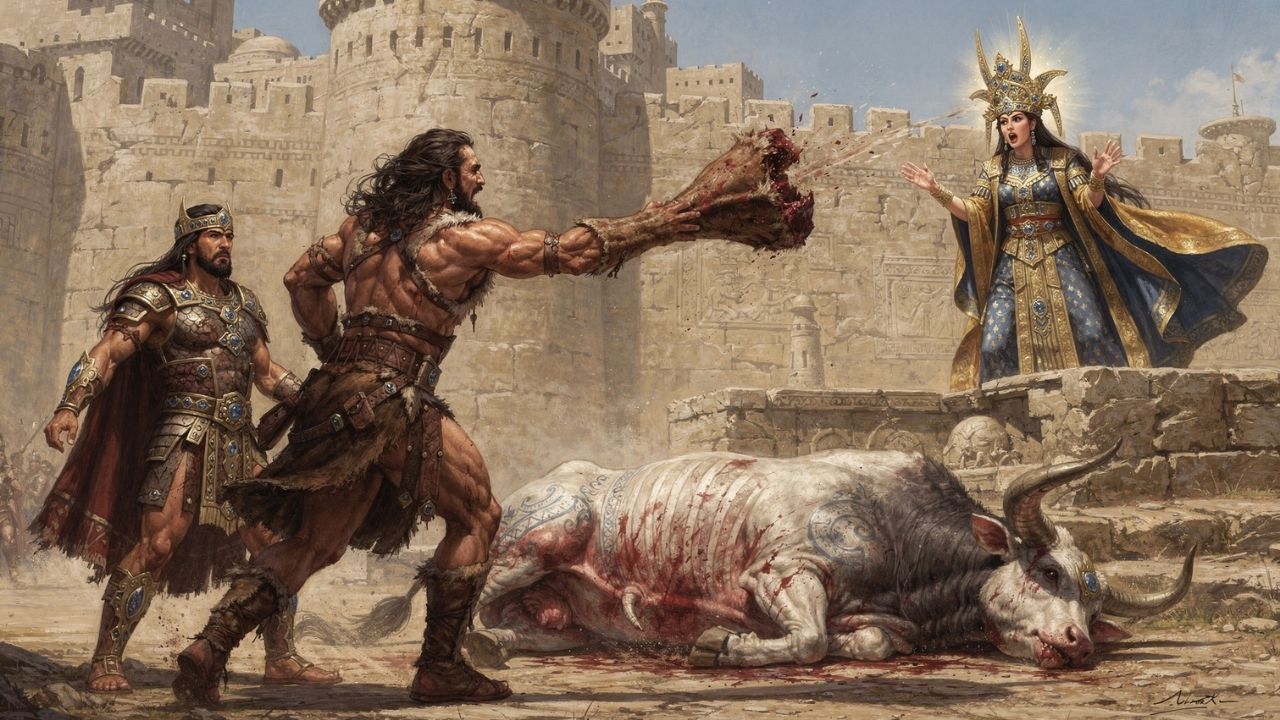
Image: ASTRONOMIKA TV / Flux 2 Pro
Ishtar, from the walls of Uruk, let out a furious wail. Enkidu, never one for diplomacy, ripped a leg off the dead bull and threw it at her.
The gods met that night and made a decision: someone had to die for killing the sacred bull. They chose Enkidu. Not Gilgamesh, the king. The friend.
Enkidu fell ill and died slowly over twelve days, with Gilgamesh never leaving his side. That death is what pushed Gilgamesh to seek immortality in the second half of the epic. Everything that followed, the journey to the end of the world, the search for the plant of eternal life, the snake that steals it at the last moment, was born from that night facing the dead bull in the streets of Uruk.
The contrast with the Greek myth couldn’t be clearer. The Greek bull is Zeus in disguise, seductive, calculating, out to conquer a woman. The Mesopotamian bull is Gugalanna, a weapon of destruction sent by the gods, a bomb with horns that triggers the epic’s greatest tragedy. The same animal in the sky. Stories that have nothing in common.
In the year 1054, a Chinese astronomer watched something be born that you can still find in Taurus today
On the night of July 4, 1054, an astronomer at the Chinese imperial court recorded something he had never seen before: a “guest star” that suddenly appeared in the sky, so bright it could be seen in broad daylight. Not for one night. Twenty-three days straight, visible by day. At night it lasted nearly two years before fading out.
It wasn’t a new star. It was a star dying in the most violent way the universe allows.
What that astronomer saw was a supernova: the final explosion of a massive star that had exhausted its fuel and collapsed in on itself in a fraction of a second before releasing more energy than the Sun will produce in its entire lifetime. The explosion happened 6,500 light-years away, which means the light that astronomer saw in 1054 had left its source back when the great pyramids of Mesoamerica didn’t yet exist. It arrived late, but it arrived spectacular.
What’s left of that explosion is M1, the Crab Nebula.
The “M” comes from Charles Messier, an 18th-century French astronomer obsessed with finding comets. The problem was that the sky is full of fuzzy patches that look like comets but aren’t, and Messier got tired of mixing them up. In 1758 he pointed his telescope at Taurus, found a smudge that wasn’t a comet, got frustrated, and decided to make a list of “annoying objects to ignore” so he’d never waste time on them again. That list ended up with 110 objects and became the most widely used deep-sky observing guide in history. M1 was the first. The Messier catalog was born out of irritation. If you’d like to hear Messier’s story in another format, we dedicated a full song to him on ASTRONOMIKA BEATS: listen here.
M1 by the numbers: an expanding cloud of gas eleven light-years across. To put that in perspective: the distance between the Sun and the nearest star is four light-years. M1 is nearly three times that distance, and all of that material was once a single star before the explosion. It’s still expanding at 1,500 kilometers per second, as if the blast had happened five minutes ago. At its center beats a pulsar: a neutron star roughly the size of Mexico City, spinning 30 times per second.
The difference between what you see with your eyes and what a camera reveals is dramatic. Here’s what that looks like side by side.
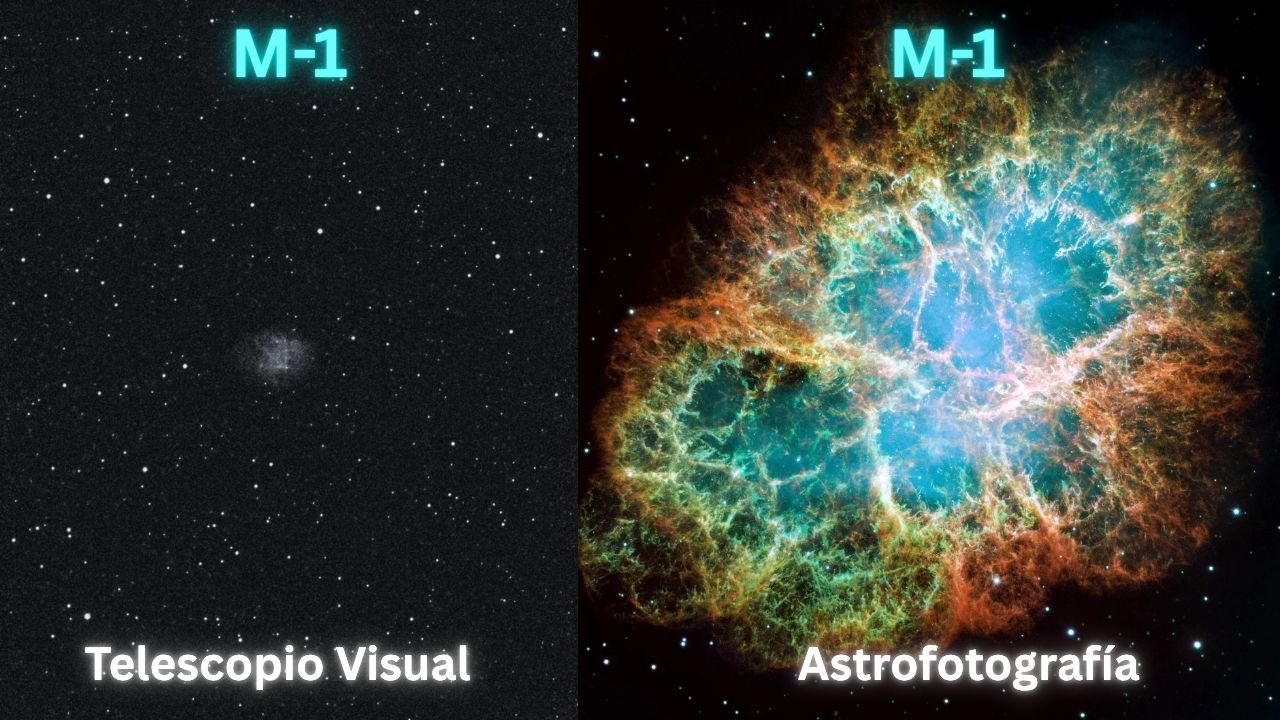
Image: ASTRONOMIKA TV
With the ZWO Seestar S50 (Mexico | United States | Spain) you can capture M1 from your own terrace on a night with good transparency. After a few minutes of live stacking it appears as a clearly visible oval smudge, ghostly, with no internal structure, but unmistakably there where nothing should be. The DWARFLAB Dwarf 3 (Mexico | United States | Spain) offers a similar experience, also with automatic live stacking, but in an even more compact body for anyone observing away from home or who doesn’t want to carry much gear. If you have a visual telescope like the CELESTRON NexStar 8SE (Mexico | United States | Spain) and an eyepiece between 15 and 25mm, M1 reveals its oval shape clearly and starts to show an irregular internal texture that’s impossible to make out with binoculars. Either way, you won’t see the colorful filaments from the Hubble photos: that requires hours of exposure with specialized equipment.
Capture: Sky Guide App
Taurus doesn’t just hide an explosion. It also holds two of the most beautiful star clusters in the sky.
The Pleiades, M45 in the Messier catalog, are a real family: they all formed from the same cloud of gas about 100 million years ago and travel together through space like a school bus. They’re so young in cosmic terms that when they were born, dinosaurs had already been walking the Earth for 65 million years.
With the naked eye, under a dark sky, you can make out between six and seven stars. With CELESTRON SkyMaster 15×70 binoculars (Mexico | United States | Spain) the show changes completely: more than a hundred stars fill the field of view, surrounded by a faint nebulosity that isn’t gas from star formation but interstellar dust the cluster happens to be passing through. The cluster didn’t make that cloud. It just found it along the way and is lighting it up as it passes.
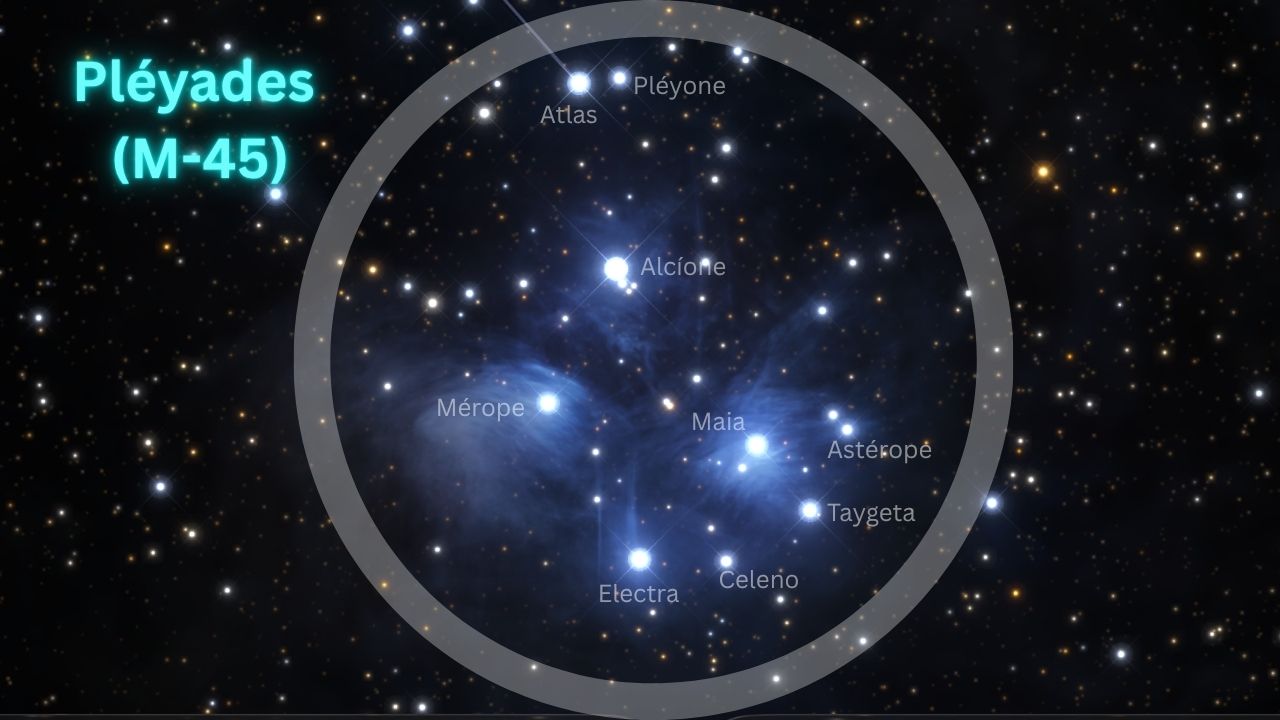
Image: ASTRONOMIKA TV
A few degrees from the Pleiades, forming the V-shaped face of the bull, are the Hyades, the closest open cluster to Earth. Only 153 light-years separate us from them, close enough in astronomical terms that astronomers use them as a calibration ruler to measure farther distances. They’re also a family, born together about 625 million years ago, far older than the Pleiades and noticeably more spread out, as if time had slowly pulled them apart.
At the visual center of the Hyades, marking the bull’s eye with that unmistakable deep orange, sits Aldebaran. But Aldebaran doesn’t belong to the cluster. It’s only 65 light-years from us, less than half the distance to the Hyades, and it simply happens to line up in the same direction by pure geometry.
Aldebaran in scale: it has 44 times the Sun’s diameter. If it took the Sun’s place, its surface would extend out to about halfway to Mercury’s orbit. The bull’s brightest eye is also one of the closest giant stars in the night sky.
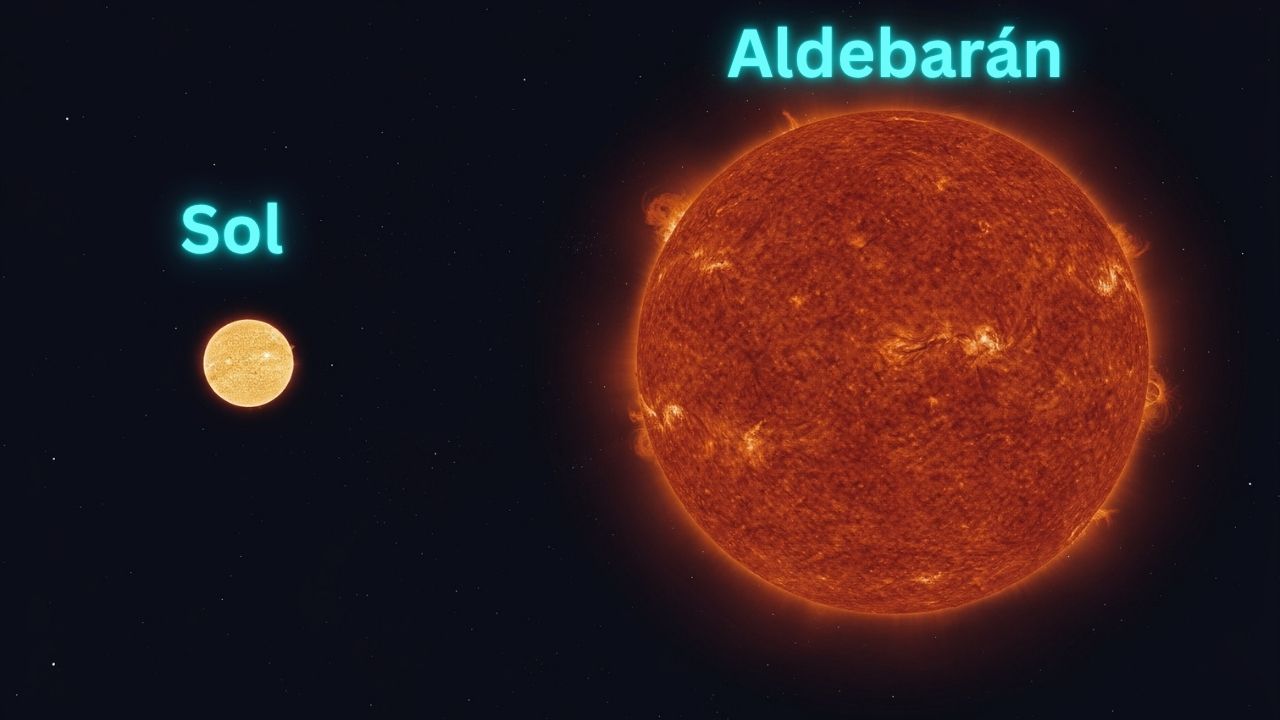
Image: ASTRONOMIKA TV / Flux 2 Pro
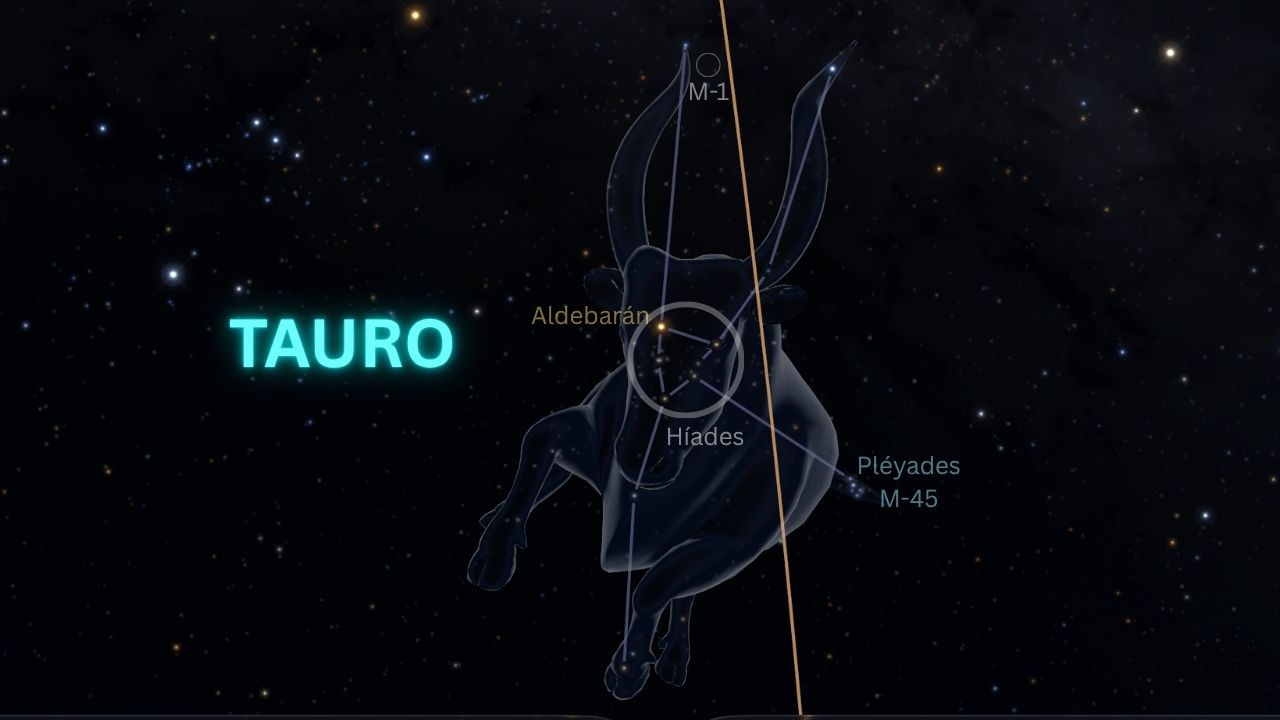
To find all of this from your own backyard or terrace, you don’t need coordinates or complicated apps. Look for Orion’s belt, those three stars in a perfect line that everyone recognizes in the winter sky. Follow them toward where the Sun rises each morning. The first bright, deep-orange star you find is Aldebaran, the bull’s eye. Around it you’ll see the V of the Hyades. Keep going in that same direction and you’ll spot that small, tight group that looks like a glowing little cloud: the Pleiades. M1 is a bit further along, between Aldebaran and the bull’s northern horn, invisible to the naked eye but perfectly reachable with a smart telescope or with the CELESTRON NexStar 8SE under a reasonably dark sky.
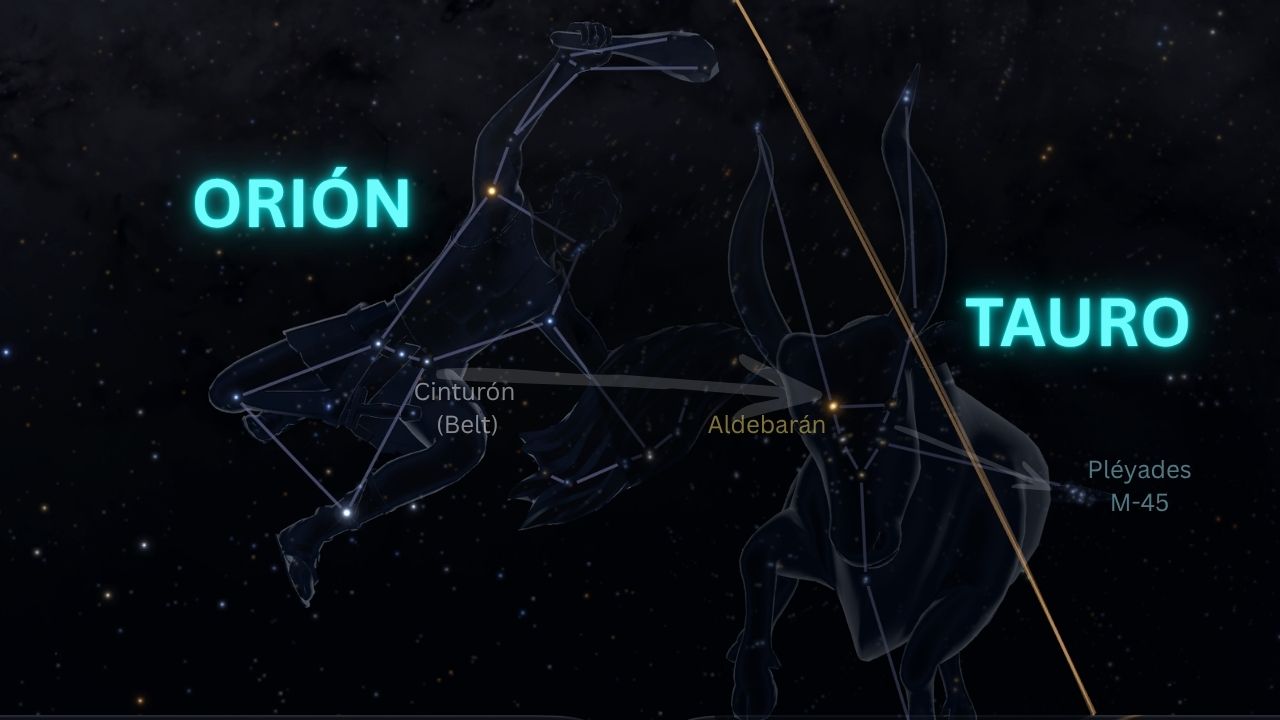
Created by: ASTRONOMIKA TV from a Sky Guide App capture
Taurus is visible in the northern hemisphere between November and March, with December as the best month: it culminates at midnight and dominates the sky all night long. In the southern hemisphere it’s visible between June and August, lower on the northern horizon but completely accessible.
The same point in the sky that a Chinese astronomer watched explode nearly a thousand years ago, that the Mexica used to decide whether the world would continue, that Gilgamesh defended with his own life, and that Zeus used as a disguise to cross the Mediterranean. Taurus is no quiet constellation. It never was. Find it this winter, look for that deep orange of Aldebaran, and remember that behind those horns are seven sisters who’ve been running for millennia.
And if you want to take something from tonight’s sky beyond the data, ASTRONOMIKA BEATS wrote a song for every zodiac constellation. Taurus’s song is called Taurus Field, part of the Path of the Sun album, made to play in the background while you search for Aldebaran in the sky. Listen here. And if you’d also like to keep exploring the sky with us, you can find us on YouTube, Instagram, and TikTok as ASTRONOMIKA TV.
Frequently asked questions about the Taurus constellation
What is the Taurus constellation and where is it located?
Taurus is a zodiac constellation located between Aries to the west and Gemini to the east. It represents a bull and is one of the oldest constellations in the sky, documented by the Babylonians more than 4,000 years ago. Its brightest star is Aldebaran, an orange giant that marks the bull’s eye.
What is the brightest star in Taurus?
Aldebaran is the brightest star in Taurus and one of the brightest in the entire night sky. It’s an orange giant 44 times larger than the Sun, located 65 light-years from Earth. Despite appearing at the visual center of the Hyades, Aldebaran doesn’t actually belong to that cluster: it’s much closer and only lines up in the same direction by geometry.
What are the Pleiades and how many stars do they have?
The Pleiades, also known as M45, are an open star cluster located on the bull’s back. They contain hundreds of stars, although only six or seven can be distinguished with the naked eye. With binoculars like the CELESTRON SkyMaster 15×70 you can see more than a hundred in a single view. In Greek mythology they were the seven daughters of the titan Atlas, turned into stars by Zeus to protect them from the hunter Orion.
What is M1, the Crab Nebula?
M1 is the remnant of a supernova observed by Chinese astronomers on July 4, 1054, so bright it was visible in daylight for 23 days. It’s the first object in the Messier catalog and one of the most studied deep-sky objects in history. Today it’s an expanding gas cloud eleven light-years across, with a pulsar at its center spinning 30 times per second.
When is the best time to see the Taurus constellation?
In the northern hemisphere, Taurus is visible between November and March, with December as the optimal month, when it culminates at midnight and dominates the sky all night. In the southern hemisphere it can be observed between June and August, lower on the northern horizon but perfectly accessible from temperate latitudes.
Can you see Taurus with the naked eye?
Yes. Taurus is one of the easiest constellations to identify with the naked eye. Aldebaran, its main star, stands out for its intense orange color. The Hyades form a clearly visible V with no instrument needed, and the Pleiades appear as a small glowing cloud that anyone can spot in a moderately dark sky.
What Greek myth is behind the Taurus constellation?
Taurus represents the white bull that Zeus transformed into to kidnap Europa, princess of Phoenicia, carrying her by swimming to Crete. From that union came Minos, the most powerful king of the ancient Mediterranean. The bull also carries the Pleiades on its back, the seven daughters of Atlas, placed there by Zeus to protect them from the hunter Orion.
Who were the Pleiades in Greek mythology?
The Pleiades were seven nymphs, daughters of the titan Atlas and the nymph Pleione: Maia, Electra, Alcyone, Taygete, Sterope, Celaeno, and Merope. They were part of Artemis’s retinue, and each one had her own story. Maia was the mother of Hermes, Electra was the mother of Dardanus, the founder of Troy, and Merope was the only one who married a mortal, which is why her star is the faintest in the cluster.
What did the Aztecs call the Pleiades?
The Mexica called the Pleiades Tianquiztli, meaning “the marketplace.” That same word is the origin of “tianguis,” the informal street market still found across Mexico and Latin America today. For the Mexica, the Pleiades decided every 52 years whether the Sun would rise again or whether the world would come to an end.
What was the Mexica New Fire Ceremony?
It was the most important ritual of the Mexica calendar, celebrated every 52 years. On that night, every fire in the empire was extinguished, and priests watched to see whether the Pleiades crossed the exact zenith at midnight from Cerro de la Estrella, in what is today Iztapalapa, southeast of Mexico City. If they crossed, the world continued and the new fire was lit. The last documented ceremony took place in 1507.
What are the Hyades and how do they relate to Taurus?
The Hyades are an open star cluster that forms the V-shaped face of the bull, only 153 light-years from Earth, the closest cluster to us. Astronomers use them as a reference to calibrate farther distances. In Greek mythology they were sisters of the Pleiades, also daughters of Atlas.
What telescope or binoculars do I need to see the Crab Nebula?
With binoculars like the CELESTRON SkyMaster 15×70 you can detect M1 as a faint smudge under a dark sky, with no visible detail. With a visual telescope like the CELESTRON NexStar 8SE and an eyepiece between 15 and 25mm, the nebula shows its oval shape and a clearly visible irregular internal texture. With a smart telescope like the ZWO Seestar S50 or the DWARFLAB Dwarf 3, you get a recognizable nebulous image after just a few minutes of live stacking from your own terrace.
This article contains affiliate links. If you purchase through them, I receive a small commission at no additional cost to you.
Sources and recommended reading
Books
Allen, R. H. (1963). Star Names: Their Lore and Meaning. Dover Publications.
A classic and essential reference on the origin of star and constellation names across cultures. The chapter on Taurus covers the Greek, Arabic, and Mesopotamian traditions in detail.
Sahagún, B. de (1577/1979). Historia general de las cosas de la Nueva España. Editorial Porrúa.
The most complete primary source on Mexica cosmology and rituals, including the New Fire Ceremony and the meaning of the Pleiades in the Aztec ritual calendar.
Sandars, N. K. (1972). The Epic of Gilgamesh. Penguin Classics.
An accessible, well-documented translation of humanity’s oldest epic. Includes the complete episode of the Bull of Heaven, Gugalanna, and its role in the story of Gilgamesh and Enkidu.
Graves, R. (1955). The Greek Myths. Penguin Books.
The most complete single-volume collection of Greek myths, with source analysis for each variant. Covers in detail the stories of Zeus and Europa, Minos and Pasiphae, the Minotaur, Theseus, and the Pleiades.
Digital sources
NASA/ESA. (2023). Crab Nebula (M1) — James Webb Space Telescope imagery.
Updated images and data on M1 captured by the James Webb Space Telescope.
www.nasa.gov — Webb images Crab Nebula
Chandra X-ray Center, Harvard University. Crab Nebula: A star’s spectacular death in 1054.
Updated data on the Crab pulsar, its rotation speed, and its X-ray emissions.
chandra.harvard.edu — Crab Nebula
Instituto Nacional de Antropología e Historia (INAH). La Ceremonia del Fuego Nuevo.
Official INAH documentation on the Mexica New Fire ritual and Cerro de la Estrella.
www.inah.gob.mx
The Electronic Text Corpus of Sumerian Literature, University of Oxford. The Epic of Gilgamesh.
Access to the original cuneiform tablets in transcription and translation, including the Bull of Heaven episode.
etcsl.orinst.ox.ac.uk