
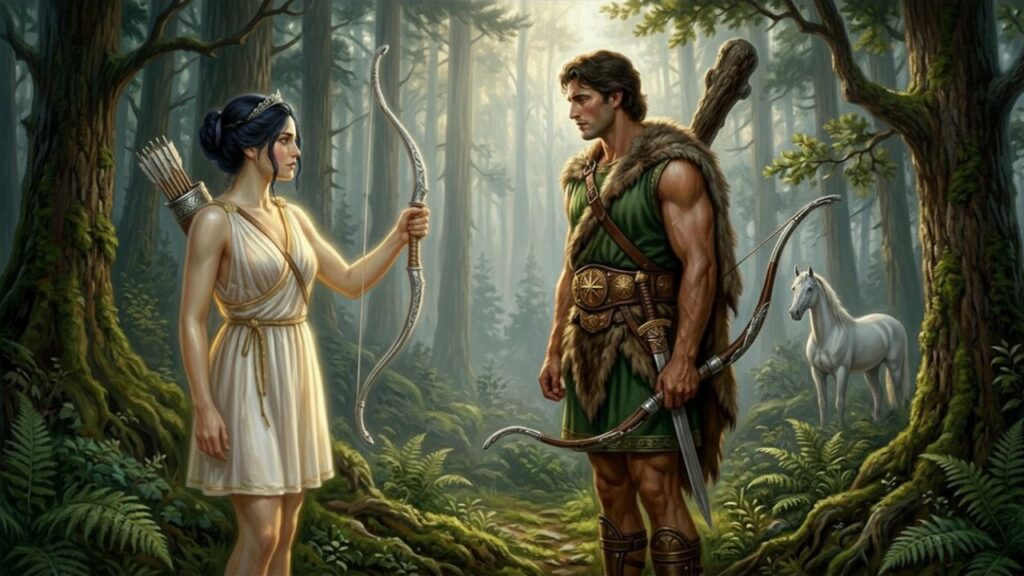
The hunter born of three gods, who chased seven eternal nymphs, fell for the only goddess who never loved anyone, and died twice. This is the complete story.
By Juan Pablo Martín | ASTRONOMIKA TV | June 2026
Act I
The Impossible Birth
Some heroes are born from forbidden love, dark prophecies, or goddesses who came down from Olympus for a single night. Orion was not. Orion was born from a buried oxhide, and his fathers were three gods who granted a favor to an old man without giving him too many explanations.
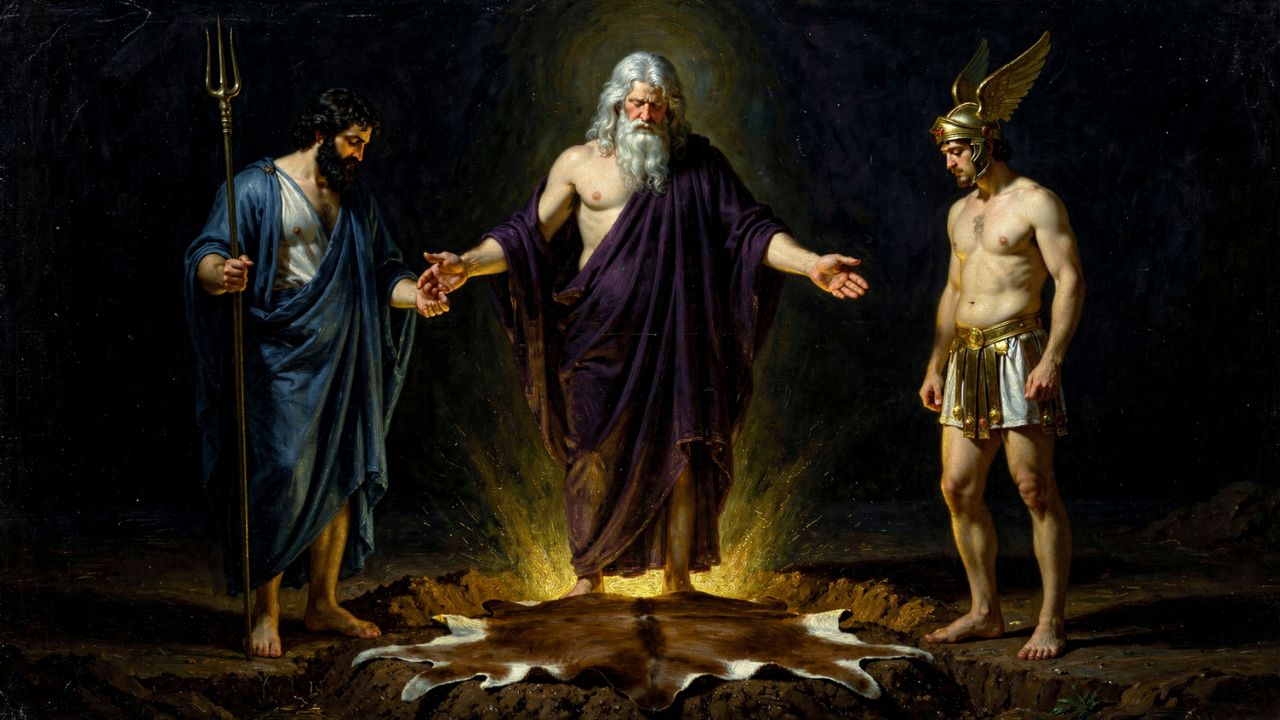
The story begins in Boeotia, a region in central mainland Greece, northwest of Athens, which still carries the same name today. There lived Hyrieus, a common man, a widowed farmer with no children and no great ambitions. One day he received three visitors who were not what they appeared: Zeus, lord of Olympus and god of the skies; Poseidon, god of the sea and earthquakes; and Hermes, messenger of the gods and the shrewdest of the three. None of them revealed their identity. They simply arrived, and Hyrieus received them as strangers were received in the ancient world: with total hospitality, sacrificing the best he had.
The best he had was a bull. The only one he had left.
The three gods ate, drank, and when the time came to leave, decided to reward the old man. They offered to grant him a wish. Any wish.
Hyrieus thought for a moment and asked for the one thing he lacked: a son.
The three gods granted the wish in the only way that occurred to them. They urinated on the sacrificed bull’s hide, buried it, and told Hyrieus to wait nine months.
Hyrieus waited.
Nine months later, Orion emerged from the earth. Without a mother, or with the Earth herself as his mother, according to the poet Nonnus of Panopolis, who calls him “the one with three fathers.”
Hyrieus raised him as best he could. But raising Orion must have been like trying to tame a storm. There was no awkward phase, no teacher, no years of practice. He arrived in the world already knowing. He brought down animals that no adult hunter could reach. Poseidon had given him the strangest gift: the ability to walk on water. Not swim. Walk, as if the sea were solid ground beneath his feet. And he knew it, with that calm and slightly unsettling certainty of someone who has never had to try to be the best in the room.
The problem with that kind of certainty is that it never comes alone. It always brings something else with it: the conviction that the rules applying to everyone else do not apply to you.
That is what Orion carried from day one. And that is what was going to destroy him.
Act II
The Wildest Hunter in the Cosmos
The problem with being the best hunter in the known world is that no one tells you so to your face. Everyone applauds, everyone steps aside, everyone lets you go first. And if no one ever says no to you your whole life, at some point you stop hearing the inner voice that should.
Orion never developed that voice.
He hunted everything that moved. Boars, lions, bears, river serpents longer than three men laid end to end. The forests of Boeotia fell silent within years because the animals learned not to cross his path. People admired him. Kings hired him. Nymphs sought him out. He had, according to some sources, fifty children by as many nymphs. He loved them in his way, which was not exactly the way they would have chosen. Orion received all of this as something perfectly natural, because for him it was.
But then he saw the Pleiades, and here we need to pause a moment so you understand who Orion was getting himself into.
The seven daughters of Atlas and Pleione were not women in the sense that Orion was a man. They were mountain nymphs who had existed since before the Olympian gods took power, and they looked exactly the same as they did on the first day. They did not age. The face they had when the world was young was the same face they had when Orion saw them. If one of them told you she had seen a kingdom fall, she was not saying it the way someone remembers history. She was saying it the way someone remembers last Tuesday.
They were not all-powerful like the Olympian gods, but they lived in that intermediate territory between the mortal and the divine: more than human, untouched by time, companions of Artemis and intimately acquainted with forests and mountains in ways no mortal hunter could match.
Orion had been in the world perhaps two decades. The Pleiades had been in it since before the world was recognizable.
He saw all seven, wanted all seven, and started pursuing them with no further protocol than that.
To understand why that was such an extraordinarily bad idea, you need to know them one by one. Their names and complete stories deserve their own article, which is already on its way at ASTRONOMIKA TV. For now, what matters is that they were named Maia, Electra, Taygete, Alcyone, Celaeno, Sterope and Merope. Seven eternal beings, seven stories connecting to the greatest myths of the Greek world, and one irony that only reveals itself later: Alcyone was technically Orion’s grandmother. For seven years Orion pursued his own grandmother without knowing it. Greek mythology was that twisted, and made no apologies for it.
Orion saw all seven, wanted all seven, and started pursuing them with no further protocol than that. The Pleiades fled. And here begins one of the most absurd episodes in all of Greek mythology: a seven-year chase in which the most fearsome hunter in the world could not catch seven women who simply did not want to be caught. Not because he was slow. But because they were infinitely smarter.
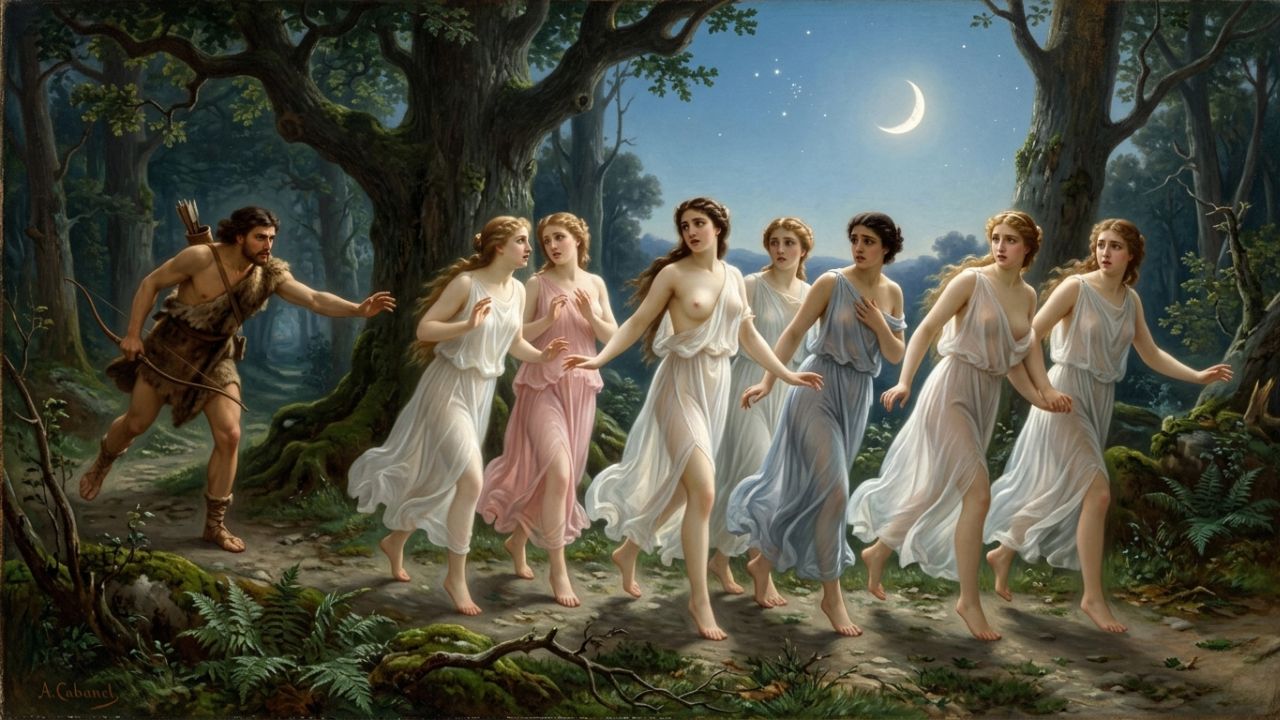
Zeus observed the situation with his characteristic mix of amusement and irritation, and made a decision: he turned them into doves so they could fly away from Orion, then placed them in the sky as stars, where they would shine forever on the shoulder of Taurus the bull. If you have already read the Taurus article at ASTRONOMIKA TV, you know exactly where to find them. You can read it here.
Orion stood looking at the sky.
And kept hunting. Because Orion without an obsession was simply a man with too much energy and nowhere to put it.
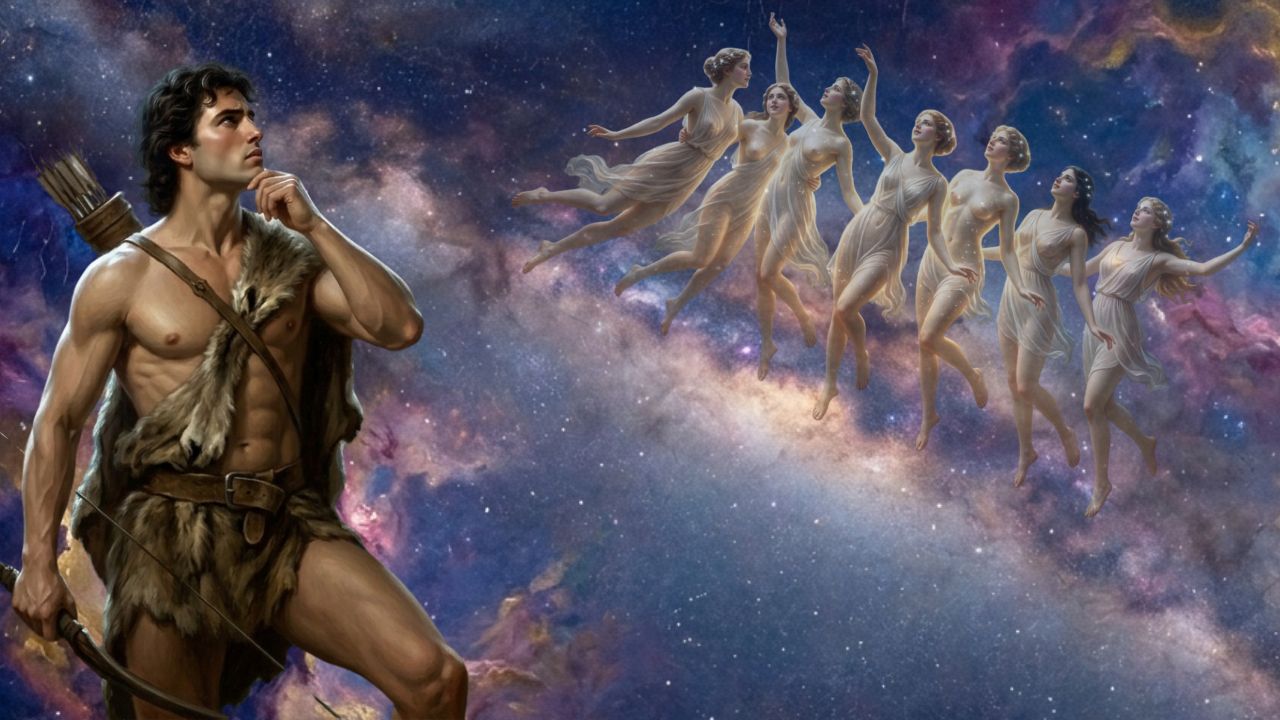
The problem with the seven years of pursuit was not the wasted time. It was what Orion had learned from them, which was nothing. He was still the same: convinced that what he wanted was reason enough to pursue it, that refusal was a temporary obstacle and not a final answer.
And then he opened his mouth further.
At some banquet, around some fire, Orion made the declaration that would seal his fate: he could kill every animal that lived on the Earth. Every single one. Without exception. Not as a threat. As a description of a plan.
Gaia, the primordial goddess of the Earth, mother of every creature that walked, swam or flew on her surface, heard him.
She filed that information away.
For now she did nothing. But she filed it away.
Act III
The Two Meropes and the Fall
Orion arrived at the island of Chios walking on the sea, because as a son of Poseidon he could. He did not arrive humble. He arrived as what he was: the most fearsome hunter in the known world, with the reputation of having chased seven eternal nymphs for years and having threatened to exterminate every living creature on Earth.
Oenopion received him well. Too well.
Oenopion was king of Chios, son of Dionysus, the god of wine, which explained several things about how he managed his affairs. He threw Orion a banquet, offered him hospitality, and promised him something Orion had not expected: the hand of his daughter Merope.
Here the article has to pause a moment so the reader can connect the name. Merope. The same Merope Orion had just left behind in the sky, the dimmest of the Pleiades, the only one who felt ashamed and hid. Two women with the same name, no relation between them, and both were going to end badly for him. If Orion had been the least bit superstitious, he would have turned around at that moment.
But Orion was not superstitious. Orion was arrogant.
The problem was that Oenopion had no real intention of keeping his promise. It was a tactic. He asked Orion to first hunt all the dangerous beasts on the island. Orion did it. He came back. Oenopion invented another condition. Orion fulfilled it. Months passed, perhaps years according to some versions, and the wedding was always exactly one favor away.
Think about it: the man who could not catch seven nymphs during seven years because they fled, now could not marry a woman whose father simply kept moving the finish line. Orion did not learn. Or rather, he learned to hunt anything with four legs but could not read people.
At some point Orion grew tired of waiting. Or he got drunk, which was easy in Chios because Oenopion produced the finest wine in the region, being the son of the god of wine a considerable competitive advantage. The most documented version says that Orion was inflamed by wine and that night forced himself on Merope.
Oenopion found him at dawn. He did not kill him. Something worse: he gouged out his eyes while he slept and threw him on the beach.
Think about it. The man who walked on the sea, who had chased seven eternal beings for years, who had promised to exterminate every living creature, wakes up lying on a beach in Chios unable to see anything at all. The most fearsome hunter in the world, reduced to listening to the waves without being able to stand up.
And here comes the most unexpected part of his entire story: Orion listened.
Someone told him that if he crossed the sea to Lemnos, the island where Hephaestus had his forge, he could find help. And Orion, who had never listened to anyone in his life, decided to believe it.
Hephaestus, the divine blacksmith, the ugliest god on Olympus, the one thrown from the sky by his own mother as a baby because she did not find him beautiful enough, took pity on Orion and lent him Cedalion to guide him.
Cedalion was no ordinary servant: he was a minor demigod associated with the Cabiri, those small figures of unusual proportions who inhabited the underground forges and guarded the secrets of fire and metals. Some sources say he had been the very teacher who taught Hephaestus the art of smithing when he was young. The image that remained engraved in ancient art is this: the most imposing man in the known world, walking blind toward the east, with a compact figure full of ancient wisdom sitting on his shoulders, pointing the way. The one who never knew how to listen to anyone, carrying on himself someone smaller than his arm to tell him where to go.
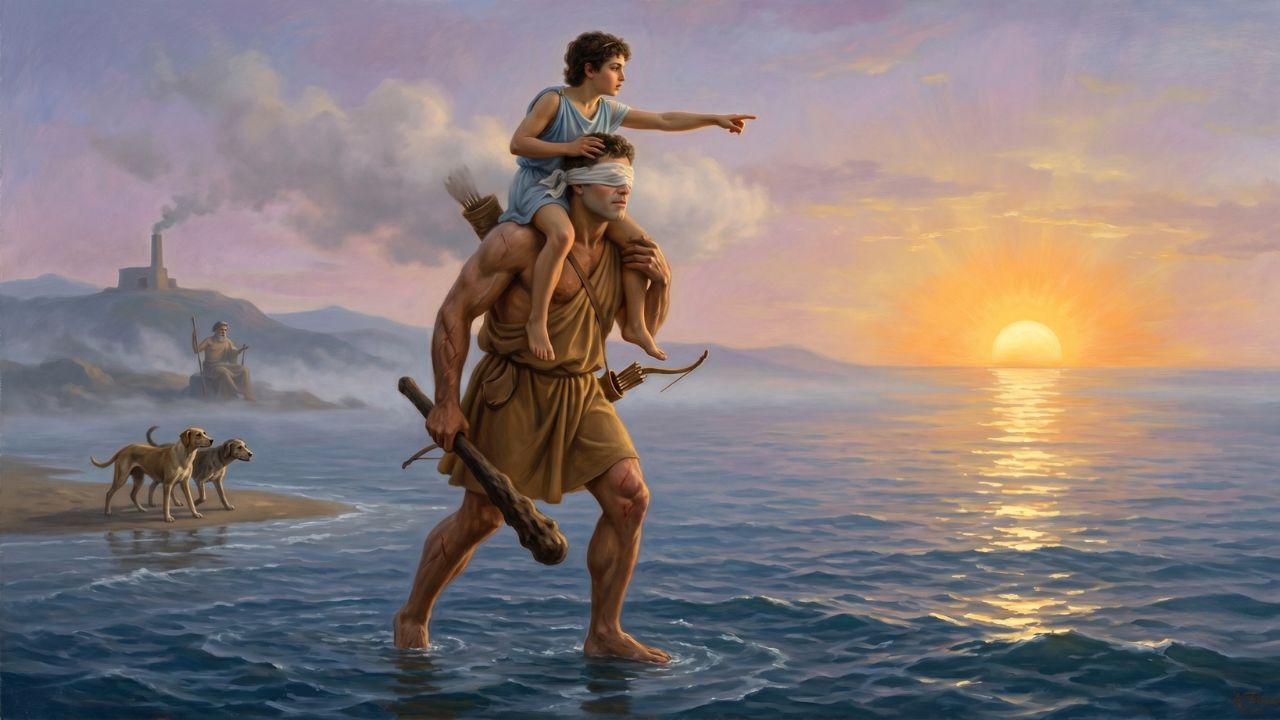
At dawn, when the first rays of the Sun touched his closed eyes, his sight returned.
He went back to look for Oenopion afterward. Of course he did. But Dionysus, his grandfather, had already hidden him underground in a chamber built specifically for that moment. Orion searched the whole island and found nothing. He could not take his revenge. Oenopion, the man who had blinded and humiliated him, got away with it.
Orion had to move on. For the first time in his life, he had to leave something unresolved and continue. The world was the same. He was not.
Act IV
The Only One Who Matched Him
To understand what happened between Orion and Artemis in Crete, you first need to understand who Artemis was. Not as a goddess, but as a person.
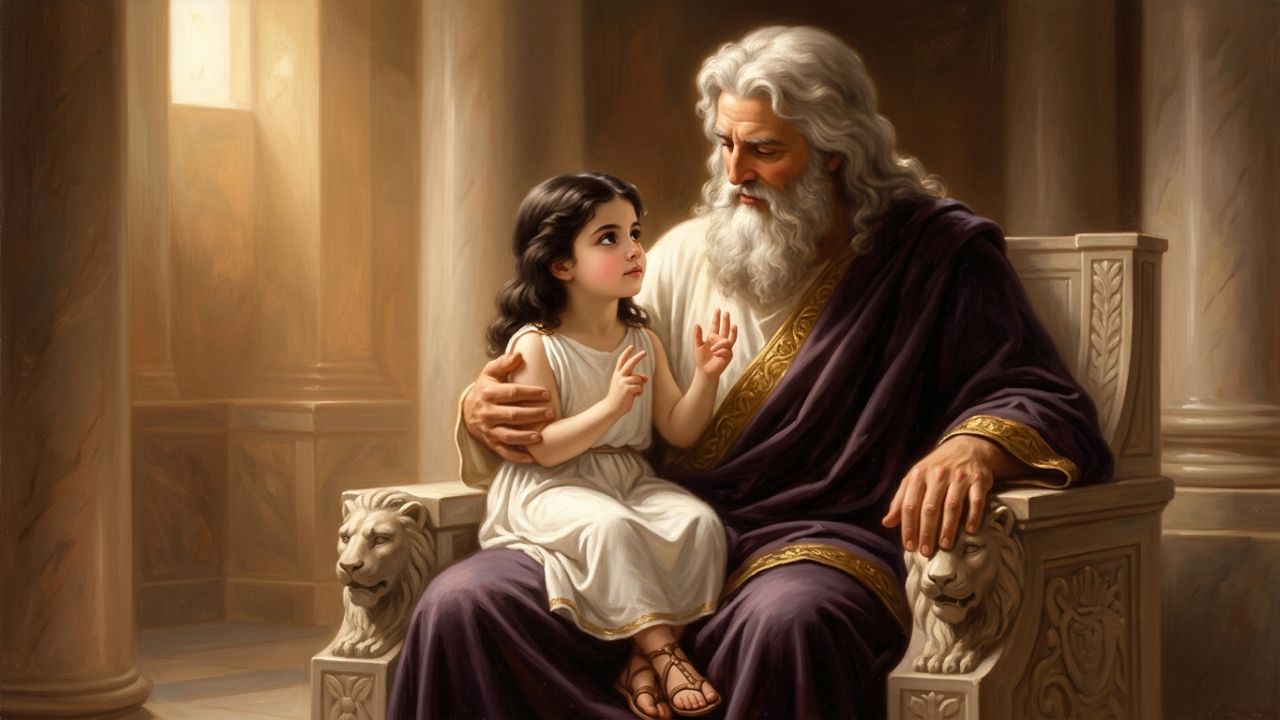
When Artemis was three years old, according to the poet Callimachus, the only ancient source that describes her childhood, she was sitting on Zeus’s lap on Olympus. Not standing, not in a formal position. Sitting with that confidence only children have who know they are loved unconditionally. And from there, in the tone of a girl who already knows what she wants, she told her father what she needed to live her life as she imagined it.
She asked for nine things. The first, and most important: eternal virginity. Not imposed chastity, not purity as a religious obligation. A choice. The decision of a three-year-old girl who already understood that love as Olympus practiced it, with its deceits, its traps and its consequences always paid by the women, was not what she wanted for herself. She had seen her mother Leto flee pregnant across the entire Mediterranean chased by Hera’s jealousy, unable to find a place to give birth in peace. She was three years old and already knew enough.
She also asked for a silver bow and arrows, a short tunic for running through the mountains without obstruction, sixty nymphs as hunting companions, and all the mountains of the world. Not a city, not a palace, not a throne. The mountains.
Zeus granted everything without hesitation. Without negotiating, without conditions. Everything. Immediately.
She grew up in forests, in mountains, in cold rivers at dawn. She became the best archer in the known world. Her nymphs swore chastity under her example and under severe penalty if they broke that oath. The last man who crossed her path without permission was Actaeon, a Theban hunter who had the misfortune of stumbling upon her while she bathed in a forest river. It was not his intention. It did not matter. Artemis turned him into a stag on the spot, and his own dogs tore him apart without knowing they were hunting their master.
That was the territory Orion arrived in.
What the ancient sources did say about what happened in Crete is enough to sense what they did not dare write.
Orion arrived with his sight restored and something harder to name. A humility he had not had before. Not declared, not announced, simply present in the way he moved, in the silence that now inhabited where before there had been noise. He was still the same man in size and strength. But something in him had settled, like dust settles after a long storm.
Artemis observed him before approaching. And what she saw was not the reckless man who had chased Pleiades for seven years. She saw someone who hunted with an attention that only comes from having lost something important. Who read the forest in silence. Who did not need anyone watching him to do it well.
She approached.
The first moment the sources do not recount but that can be sensed in everything they do tell was probably small. Not an epic encounter but something everyday. Perhaps a morning when Orion missed a shot and instead of covering it up let out a brief laugh at himself. Without an audience, without performance. And Artemis, who had spent centuries surrounded by nymphs who revered her and gods who feared her, looked at him differently.
They started hunting together.
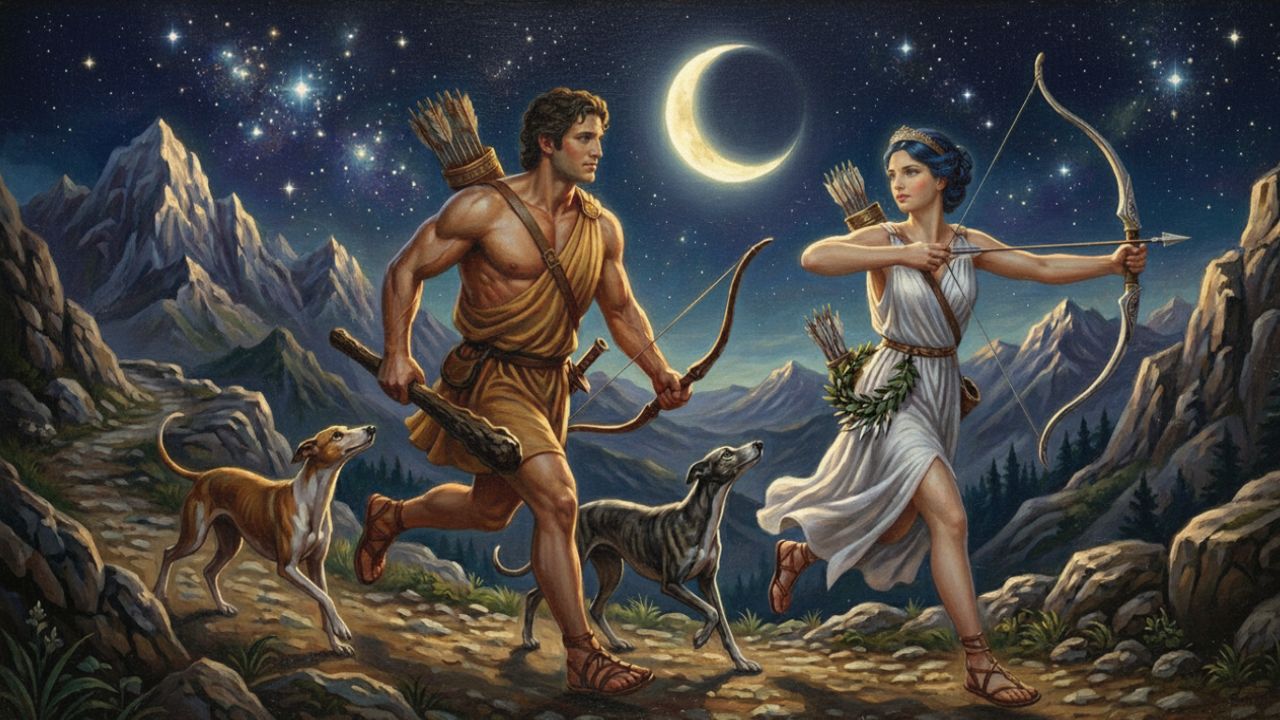
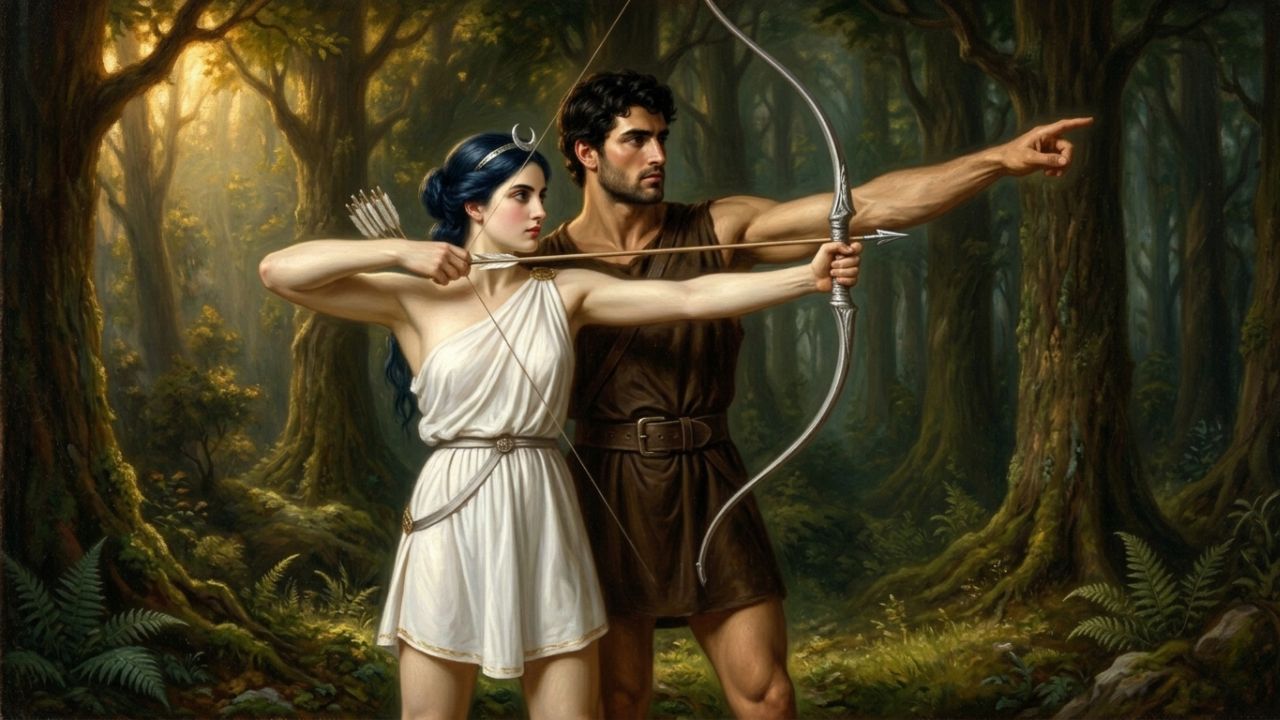
There was no hierarchy between them. Neither was teaching the other, neither was impressing the other. There were two intelligences moving at the same rhythm. He followed tracks she pointed out. She shot arrows he had calculated first. They made decisions in silence, with minimal gestures, with that communication that needs no words because it has already moved to the level of instinct.
At night they talked. The sources do not say about what. But Artemis, who had lived centuries in the mountains surrounded by companions who followed her and gods who courted her from a distance, began spending the hours she used to fill with silence accompanied by a mortal who neither followed her nor courted her. Who was simply there, just like her, watching the same sky with the same familiarity of someone who has looked at it all their life.
There is an enormous difference between admiring someone and recognizing yourself in someone. With everyone else, Artemis had been admired. With Orion, for the first time, she was recognized.
The second moment the sources do not recount but that lives between their lines was Orion realizing that what he felt was unlike anything he had felt before. With the Pleiades he had wanted to possess them. With Merope of Chios he had wanted to marry her. With everyone else he had wanted to obtain something.
With Artemis he wanted something else. He wanted to keep being there. Not to conquer, not to impress. Just to keep waking before dawn in the mountains of Crete knowing she would also be there, with her bow on her shoulder and that way she had of moving through the trees as if the forest belonged to her, which was exactly because it did.
That distinction, so simple and so brutal, was the closest Orion ever came to understanding what real love was.
Always with him were his two hunting dogs, whose memory the sky preserved as the constellations Canis Major and Canis Minor. The larger one, whose principal star is Sirius, the brightest star in all the night sky, faithful and tireless, the one who never strayed further than necessary. The smaller one, whose principal star is Procyon, smaller and faster, the one who always ran ahead sniffing out the path before Orion arrived. Some sources identify the larger dog with Laelaps, the fastest hound in the ancient world. Greek mythology was never very consistent with the names of secondary animals, but it did preserve with precision their place in the sky.
Those two stars, along with Betelgeuse, the reddish shoulder of Orion, form what we today call the Winter Triangle: an asterism that is not an official constellation but something more intimate, a pattern the three form together in the sky that no one asked them to form. Its three vertices sit near the celestial equator and are visible from almost anywhere in the world: in the northern hemisphere they dominate the night sky from December through March, and in the southern hemisphere they shine during those same months in the southern summer.
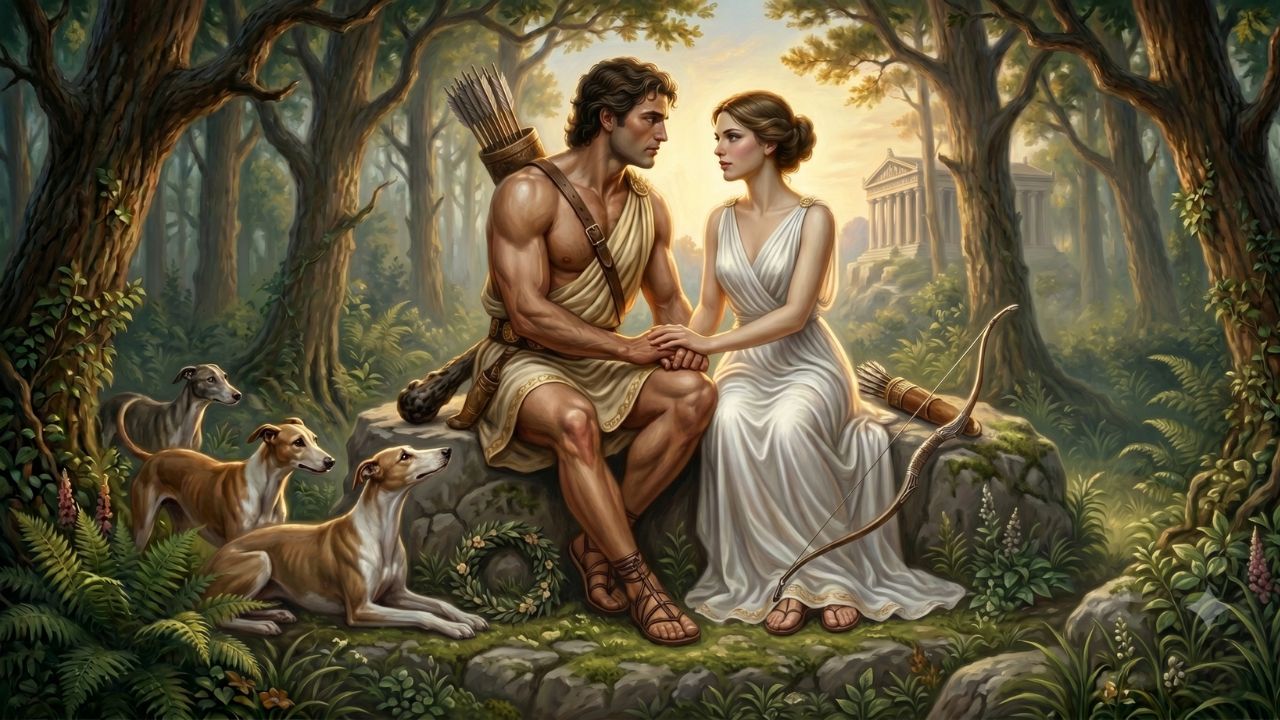
The third moment the sources do not recount but that the entire story pushes toward was a night when the two were too close to the edge.
And it was Artemis who stepped back. Not coldly. Not with the brusque rejection she had given everyone who had come too close before. But with the clear and slightly painful awareness that crossing that line would break something neither of them wanted to break. That what they had, fragile and unnamed and without precedent in all of Olympus’s history, only existed exactly like this. That naming it would change it. That consummating it would end it.
Orion understood. He did not protest, did not insist. He stayed where he was, let the moment pass, and the next dawn they both went out to hunt as always.
That was also love. Perhaps the rarest and most difficult kind.
But the silent pain of that gentle rejection accumulated in Orion like water building behind a dam. He converted it into the only thing he had ever known how to do: hunt harder, move faster, talk louder. And at some point, at some banquet or around some fire in the mountains of Crete, he opened his mouth again and said what he should not have: that he could kill every animal that lived on Earth. The sources do not connect that outburst with the pain of what happened between him and Artemis. But the character’s arc says it on its own.
Gaia heard him.
This time she did not file it away.
If you want to stay with this story a little longer, I composed a piece for Orion and Artemis. It is called Flechas y Estrellas (Arrows and Stars).♫ Coming soon on Spotify — ASTRONOMIKA BEATS
Act V
The Two Endings
Apollo heard everything. And smiled.
Greek mythology does not have a single version of what happened next. It has two. And both are true in the sense that myths are true: not as historical record but as a radiograph of the human soul.
The Scorpion
This is the oldest version and the most cosmological of the two.
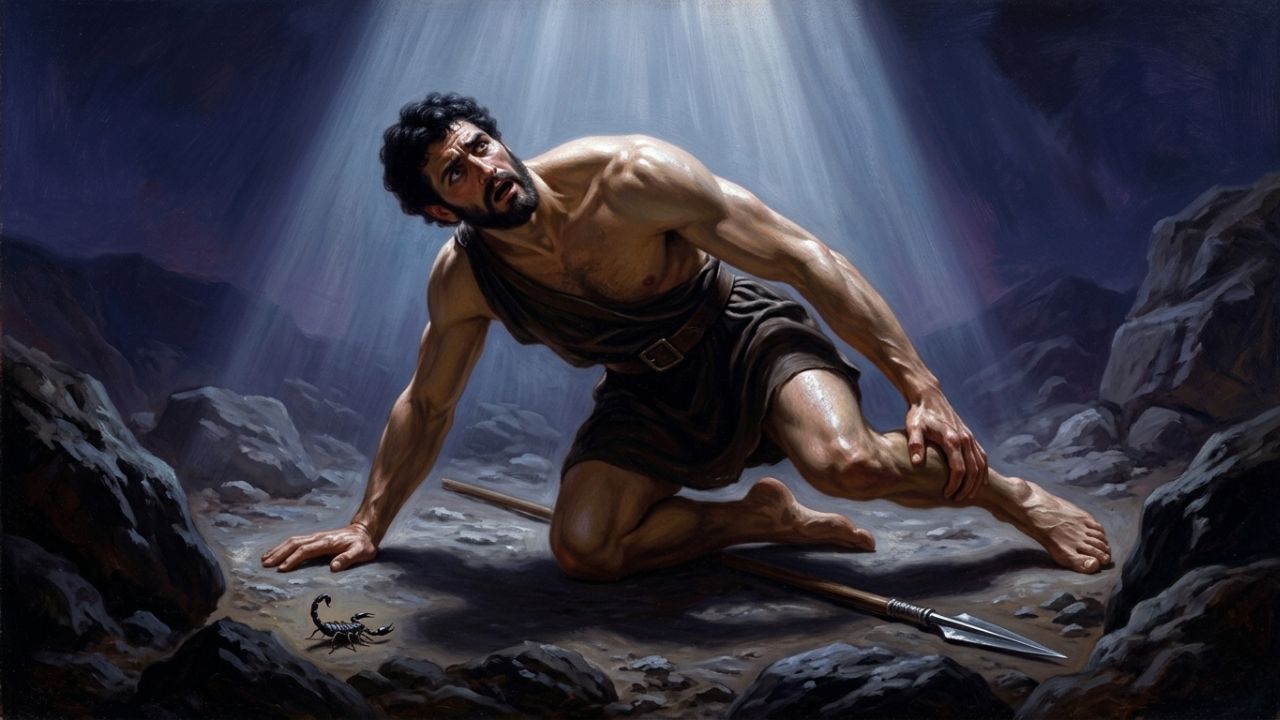
Gaia, tired of Orion’s threats, sent a scorpion to finish him off.
Not a monster. Not a supernatural creature of epic proportions forged in the depths of the earth. A scorpion. The kind of animal that could appear under a rock in any garden in Boeotia, that children learned to avoid from an early age, that farmers killed without a second thought with their sandal.
The best hunter the world had ever known, the son of three gods, the man who walked on the sea and who had promised to exterminate every living creature on Earth, died from the sting of an animal that any ordinary mortal could accidentally step on in their backyard.
Gaia did not need to create a monster to defeat Orion. She only needed to remind him that nature does not operate on a scale of size but on a scale of consequences. That the universe has no sense of humor, but it does have a sense of irony.
The scorpion won.
Zeus placed them both in the sky. The scorpion as Scorpius. Orion as Orion. But on opposite sides of the celestial vault, so they would never meet again. That is why today, when Scorpius rises in the east, Orion sinks in the west. When Orion dominates the winter sky, Scorpius is hidden below the horizon. They have been circling each other for thousands of years, eternally at war and eternally separated. If you have already read the Scorpius article at ASTRONOMIKA TV, this will sound familiar. You can read it here.
The second version has no scorpions and no cosmic battles. It has something much worse: a brother who knew his sister too well.
Artemis’s Arrow
This is the cruelest version. Not because it has more violence, but because it has more love.
Apollo had been waiting for the exact moment for days. Not just any moment. The right one.
He chose it in the last hours of the night, when the sky had not yet decided to become dawn and the sea was a dark surface with barely the reflection of the stars. It was the hour when Orion usually swam alone, far from shore, before there was enough light to hunt. His private ritual, the only moment of the day when he was completely alone, without dogs, without bow, without the invisible armor he put on in front of any witness.
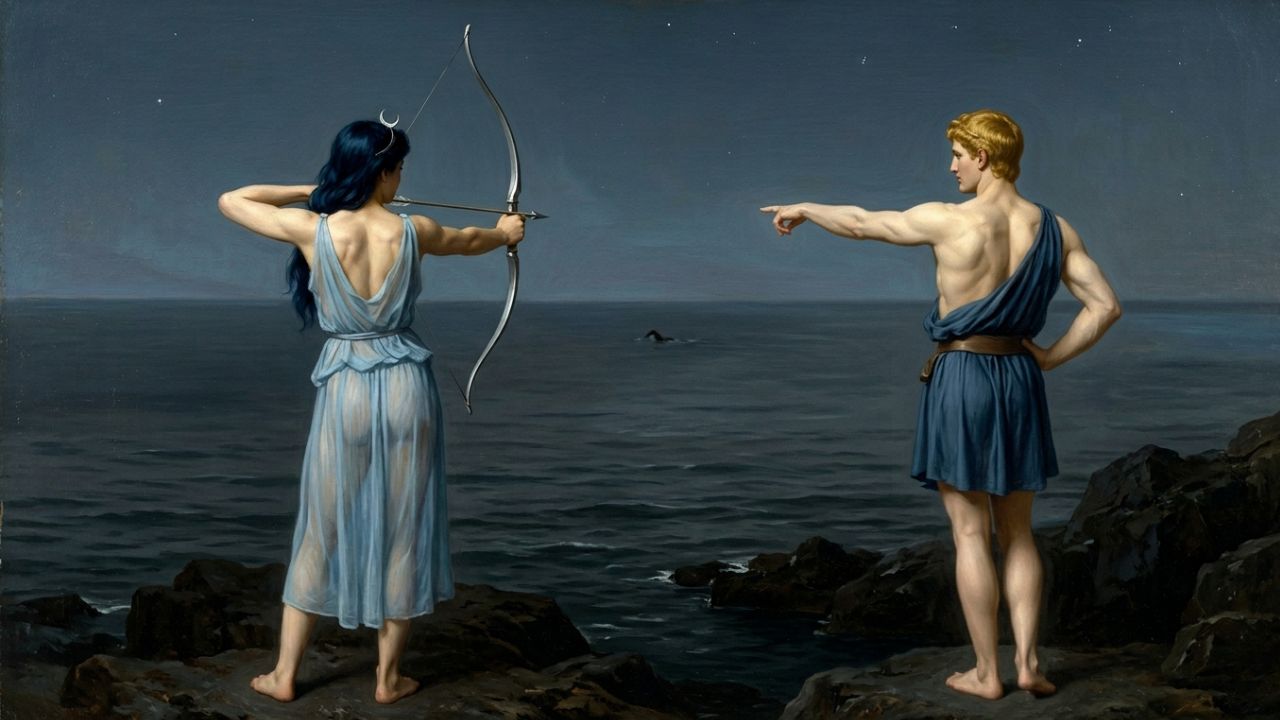
Artemis was on the shore preparing the pack for the dawn hunt, with that scarce light that distorts distances and turns outlines into anonymous shadows. Apollo approached her with the calculated casualness of someone who has been rehearsing the moment for days. He pointed to a dark spot on the water, barely visible in the pre-dawn darkness, moving slowly against the current.
“See that?” he said. “That thing floating out there. I bet you can’t hit it from here.”
He had chosen that moment because he knew that in that darkness before dawn any silhouette becomes an anonymous target. Because he knew Artemis would be awake with her bow in hand. Because he knew that in that treacherous light, between night and dawn, his sister would not be able to recognize what she was looking at before she shot.
Artemis drew the bow. She calculated the distance with the precision that never failed.
She released the arrow.
Artemis’s arrow never missed.
When the waves brought the body to shore and Artemis saw who it was, the silence that followed was the longest in all of Greek mythology. The sources do not describe what she felt at that moment because there were probably no words for it in any language the Greeks knew. They only say she wept. Artemis, who never wept, who had turned Actaeon into a stag without blinking, wept.
And then she did something no god had ever done before for any mortal: she went to find Asclepius, the god of medicine, the only being in the cosmos capable of restoring life to the dead, and begged him to resurrect Orion.
It was not the gesture of a goddess who had lost a hunting companion. It was the gesture of someone who had just understood, too late and in the worst possible way, what she had lost.
Asclepius tried. But Zeus stopped everything with a thunderbolt. Asclepius fell struck before he could finish. The line between mortals and gods could not be erased, not even by a goddess’s grief, not even by the most unjust mistake in the world.
Orion did not return.
Zeus placed him in the sky as a constellation. One of the largest. One of the brightest. One of the most recognizable from any point on Earth.
And Artemis, who ruled the Moon, kept traveling across the sky every night.
The ecliptic, that invisible line along which the Moon, the Sun and the planets travel, passes just grazing Orion. Close enough for the Moon to enter the limits of the constellation from time to time, cross through its stars, get as close as it can.
But it never stops there. It always passes by.
Every month, for thousands of years, Artemis approaches Orion in the sky. Every month she gets as close as she can get. And every month she passes by without touching him, because that was always the nature of what existed between them: as close as possible without crossing the line.
The oldest platonic love in the universe, written in the sky for anyone who knows how to read it.
That is everything Orion was and everything he left behind. A man born from soil and three gods, raised by an old man who sacrificed the only thing he had, feared by everything that lived on Earth, unable to learn from his mistakes until those mistakes left him without eyes, a blind walker toward a light someone promised him existed, companion of the only person who matched him, and a star forever in the winter sky.
Not a bad ending for someone born from a debt three gods owed an old man in Boeotia.
And if you want to hear what his loyalty sounded like, I also composed something for his dogs. It is called Lealtad Inmortal (Immortal Loyalty).♫ Coming soon on Spotify — ASTRONOMIKA BEATS
What Other Eyes Saw
The Greeks were not the only ones to look at that pattern of stars and feel there was something there deserving a name, a story and a place at the center of the cosmos. Thousands of kilometers away, with no contact between them, two civilizations looked at the same sky and saw completely different things. Neither knew about the other. Both reached the same conclusion: that group of stars matters.
The Maya: the Turtle and the Three Stones of Creation
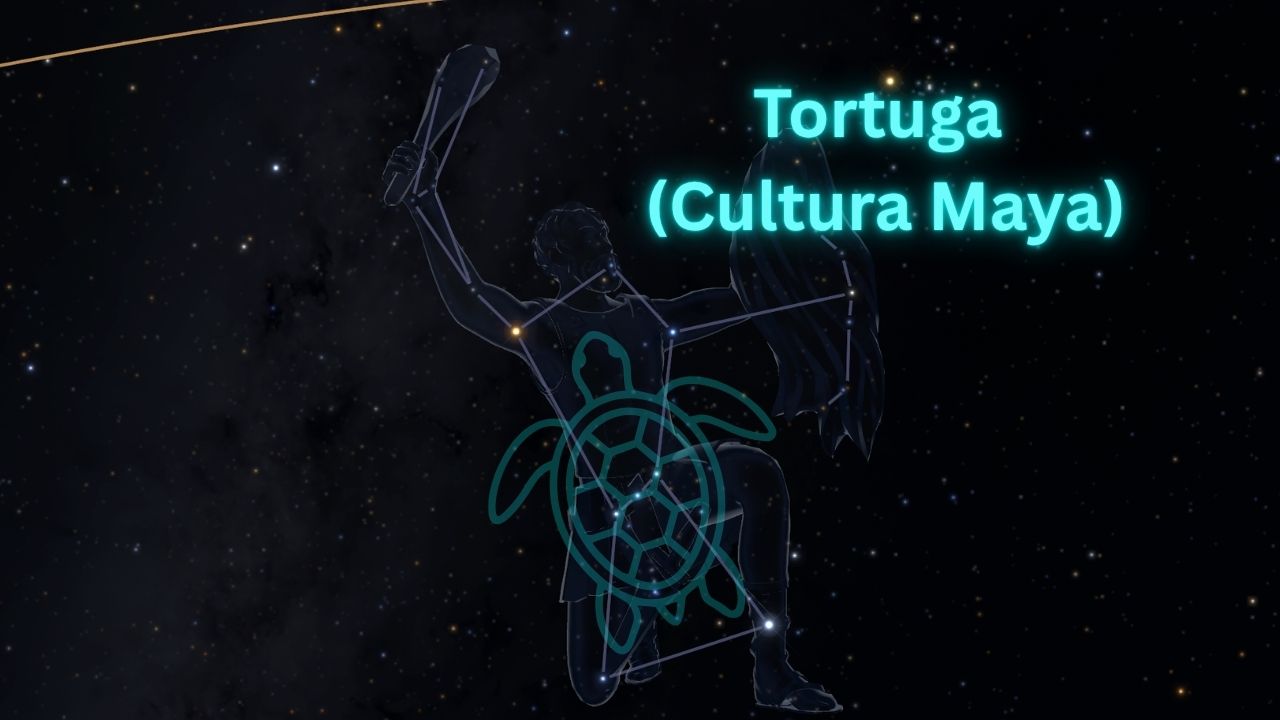
For the Maya, Orion’s Belt, those three perfectly aligned stars the Greeks placed on the hunter’s waist, was something entirely different: the shell of a cosmic turtle. In the Madrid Codex, one of the few Maya books that survived colonial destruction, it appears represented as ak’ ek, the turtle stars, with three glyphs carved on its shell.
But the turtle was only the surface. What was inside was more important.
The K’iche’ still refer to the triad of three stars in Orion as the “Sky Stones,” and to the nebula observed below the Belt, the one we call M42 today, as “The Smoke of the Heart.” In Maya cosmology, those three stones are the stones of the primordial hearth, the cosmic fireplace where the gods lit the fire of creation at the beginning of the world. M42, the nebula that anyone can see with the naked eye as a fuzzy smudge in Orion’s sword, was for them the smoke of that original fire, still burning after thousands of years.
Researcher Linda Schele identified the Orion region as the heart of Creation in Maya cosmology, the place where the Maize God Hun Hunahpu was resurrected and where the sky of the new age would rise. The Greeks placed an arrogant hunter there. The Maya placed the origin of everything there.
The Egyptians: Osiris and the Stars of the Afterlife
For the Egyptians of the Old Kingdom, the stars of Orion were Osiris, god of death and resurrection. Not a representation of Osiris. Osiris himself, in the form of starlight, ruling the night sky for thousands of years.
The connection between Orion and Osiris is documented in the Pyramid Texts, the oldest religious writings in the world, carved on the walls of the pyramids of Saqqara around 2400 BC. For the pharaohs, dying and becoming Osiris meant literally ascending to the stars of Orion. The southern shaft of the Great Pyramid was designed to point toward where the Belt culminated in the sky during the era of its construction, an architectural detail the Pyramid Texts themselves confirm as intentional.
In 1989, Belgian engineer Robert Bauval proposed something more ambitious: that the three Giza pyramids were physically designed to align with the three stars of the Belt. The idea got a lot of popular attention and it is easy to understand why. The problem is that modern archaeology and astronomy do not support it: the angles and distances between the pyramids do not precisely match those of the stars at any point during the Fourth Dynasty, and Egyptian texts never mention that intention. It is a romantic theory that science has rejected.
What history did preserve without dispute is that the Egyptians believed the gods descended from Orion’s Belt, and that Sirius, the brightest star in the sky, was the representation of Isis, wife and sister of Osiris. Together, Orion and Sirius were the divine couple that had created all of human civilization. The Greeks placed a hunter and his dog there. The Egyptians placed the parents of the world there.
Three civilizations. The same point in the sky. None knew about the others. All felt that place mattered.
What none of them could know is that science would prove them right, though for reasons completely different from what they imagined.
The Facts That Will Blow Your Mind
Betelgeuse: The Star Dying Right in Front of You
Find Orion in the winter sky and look for its right shoulder. There is Betelgeuse, a reddish and slightly orange smudge that stands out to the naked eye against the cold blue of Rigel on the opposite foot. That color difference is not a trick of the atmosphere. It is the difference between a star in the fullness of its life and a star that is going out.
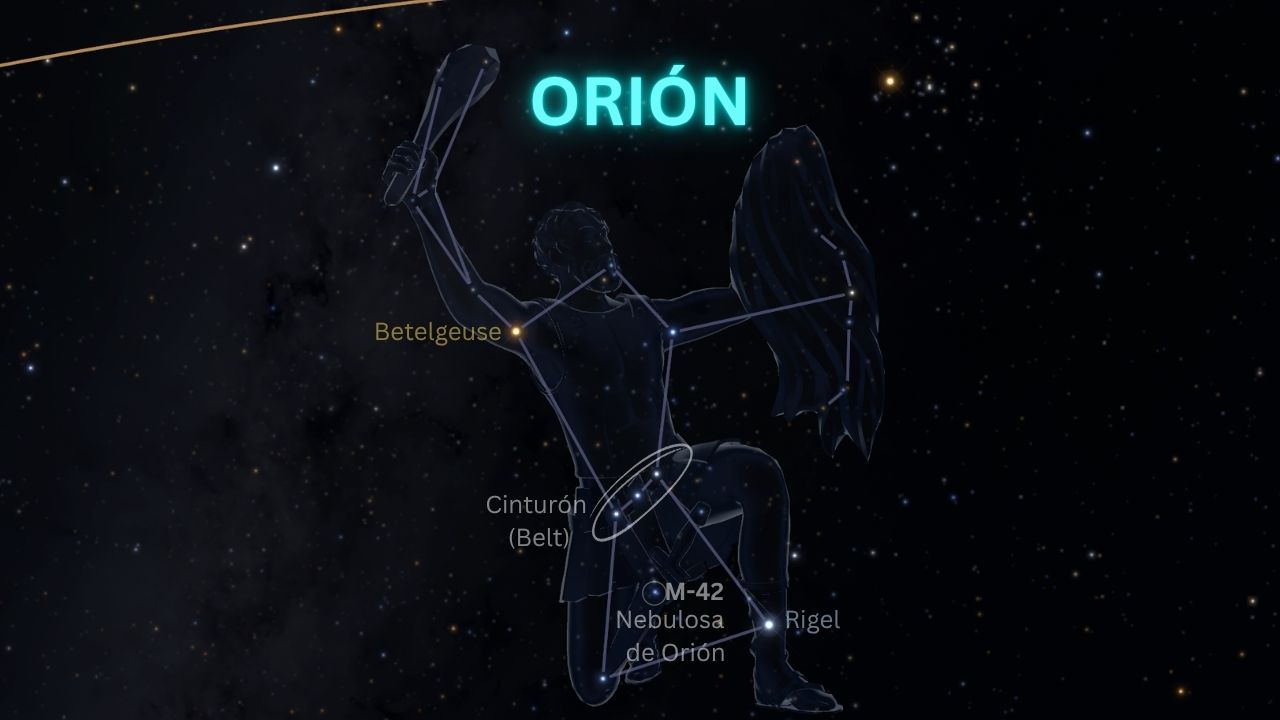
Betelgeuse is a red supergiant. If you placed it at the center of our solar system instead of the Sun, its surface would reach the orbit of Jupiter. Not Mars, not Earth. Jupiter. The Sun would fit inside it approximately one million times.
And it is dying.
In 2019 Betelgeuse lost almost a third of its usual brightness within weeks and visibly changed shape. Astronomers called it the Great Dimming. They had never seen anything like it.

When it explodes as a supernova it will be visible during the day for weeks. As bright as the full Moon, visible in broad daylight, without needing a telescope or waiting for night. The problem is that it is 700 light-years away. That means the light you see when you look at it tonight left it 700 years ago. If Betelgeuse has already exploded, we do not know yet. The news travels at the speed of light and has not arrived.
It may no longer exist. It is possible that somewhere in the universe, centuries ago, Orion’s right shoulder already became the brightest object in the night sky. And we keep looking at the same spot without knowing.
M42 and the Most Active Neighborhood in the Winter Sky
Lower your gaze from Orion’s Belt toward its sword, that line of three dimmer points hanging vertically. The middle point is not a star. It is M42, the Orion Nebula, a cloud of gas and dust 24 light-years in diameter where, right now, while you read this, new stars are being born.
To the naked eye, on a dark night, it looks like a slightly bright fuzzy patch. With a pair of CELESTRON SkyMaster 15×70 (Mexico | United States | Spain) it transforms into a luminous cloud that overflows the entire field of view. With a ZWO Seestar S50 or S30 Pro (Mexico | United States | Spain) the Trapezium appears, a group of four young stars at the heart of the nebula, born less than a million years ago, whose ultraviolet radiation illuminates all the surrounding gas and creates that glow the Maya called the Smoke of the Heart.
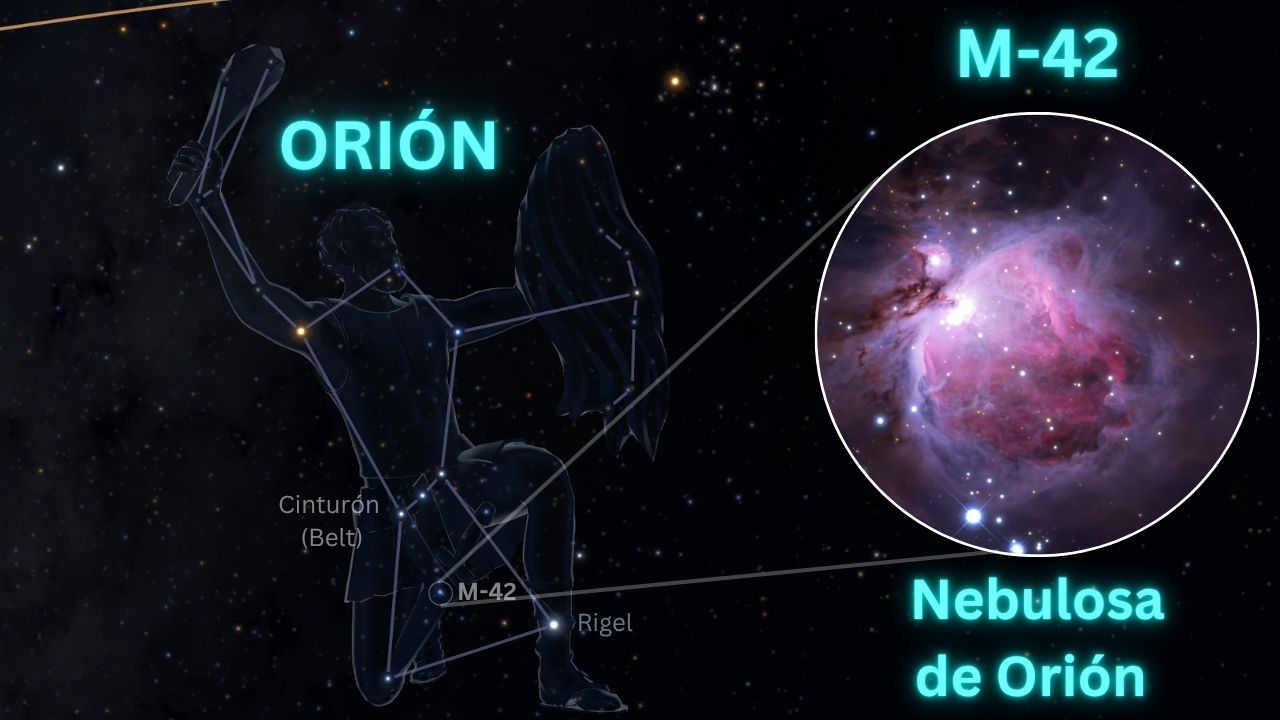
M42 is 1,344 light-years away. The light you see tonight left the nebula when the Maya were still building their last cities and Europe did not know America existed. And yet there it is, accessible to any human eye that knows where to look, the most photographed and most studied stellar nursery in the known universe.
Just above M42, separated by a thin dark strip of dust, is M43, the De Mairan Nebula. With binoculars it looks like a rounded extension of M42. With the ZWO Seestar S50 they are clearly distinguishable as two separate objects divided by that strip of darkness. And to the northeast of the Belt is M78, the brightest reflection nebula in the northern hemisphere, where light from two internal stars bounces off dust clouds and creates a diffuse bluish glow.
The Dark Side of Orion: What Only the Camera Can Reveal
There is another version of Orion that the human eye never sees directly but that exists out there, superimposed on the one we know, waiting for a camera and a dark night.
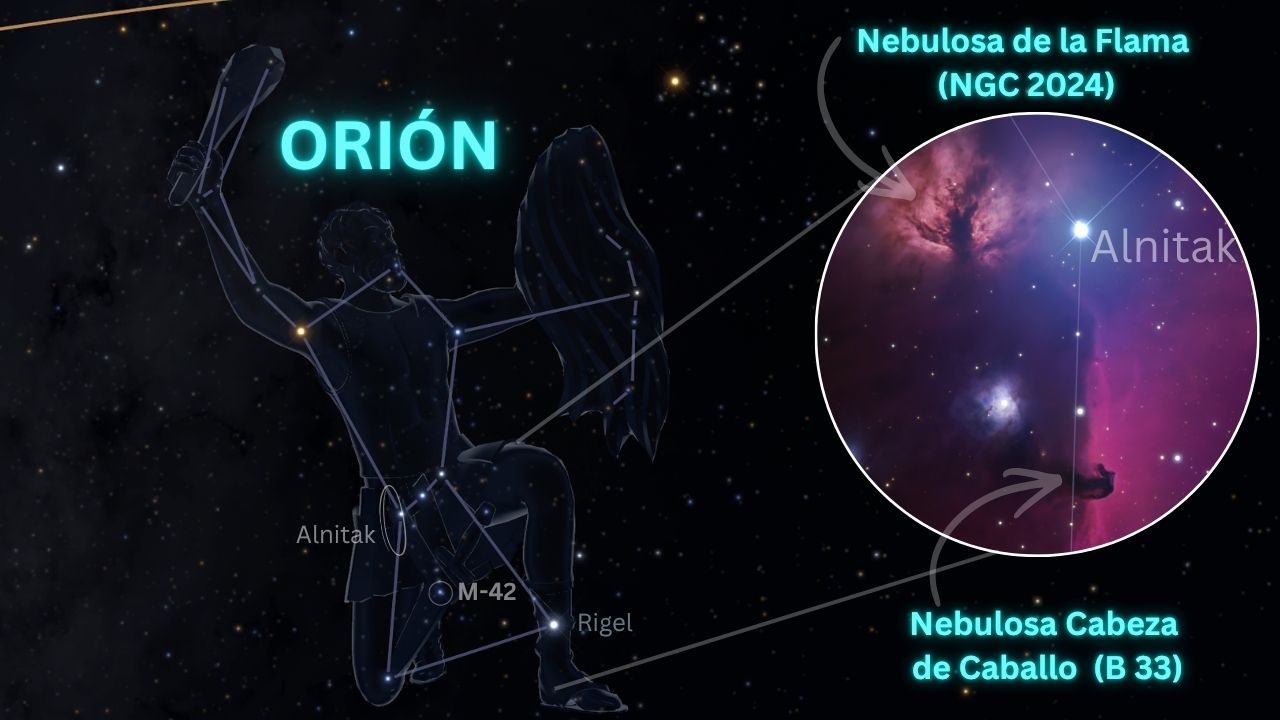
The first is the Horsehead Nebula, also known as Barnard 33. It sits just south of Alnitak, the left star of the Belt, silhouetted against the reddish glow of an emission nebula behind it. Its shape is exactly what its name describes: a dark outline in the profile of a chess knight emerging from a cloud of bright gas. It is one of the most recognized images in modern astronomy and one of the most difficult to capture. It cannot be seen visually even with the best telescopes on the market. With a ZWO Seestar S50 in photography mode, on a moonless night with good sky, it starts appearing after several stacked exposures.
Right next to it is the Flame Nebula, NGC 2024. An emission nebula with dark filaments of dust that give it exactly the appearance of a flame with separate tongues of fire. In wide-angle photographs, the Horsehead and the Flame appear together in the same frame, with Alnitak blazing above them both as if it had set them on fire.
And then there is Barnard’s Loop, a nebula in the shape of a giant arc that surrounds almost half the entire constellation. It only appears in wide-angle photographs with long exposure. When you see it for the first time, Orion suddenly looks different: no longer a set of bright stars on a black background, but a bubble of gas that contains all of the constellation’s drama inside it. Barnard’s Loop is the scar left by ancient supernova explosions that shaped the region millions of years ago.
Rigel, the Belt and How to Find Orion From Anywhere in the World
Rigel, Orion’s left foot, is a blue-white supergiant 120,000 times more luminous than the Sun. It is the seventh brightest star in the night sky and one of the youngest of the great visible stars, at barely ten million years old, an infancy in stellar terms.
But the key to finding Orion is not Rigel or Betelgeuse. It is the three Belt stars.
Alnitak, Alnilam and Mintaka form the most recognizable alignment in the night sky. Three stars almost perfectly in a line, separated by nearly equal distances, shining with similar intensity. There is nothing like it anywhere else in the sky. In Mexico and throughout Latin America they are popularly known as the Three Marys or the Three Wise Men. Once you find them, everything else falls into place: Betelgeuse upper left, Rigel lower right, the sword hanging vertically from the Belt’s center toward the south.
From almost anywhere in the world, including Mexico, Spain and Latin America, Orion dominates the night sky from November through March, rising in the east around nine in the evening in December and reaching its highest point, almost directly south, around midnight. From the southern hemisphere, the same constellation appears inverted, with Rigel above and Betelgeuse below, but equally recognizable.
The two dog stars, Sirius in Canis Major and Procyon in Canis Minor, along with Betelgeuse form the Winter Triangle, visible from almost any inhabited point on Earth during those same months. It is not an official constellation but something more personal: a pattern the three form together in the sky without anyone asking them to, just as they did in the forests of Crete.
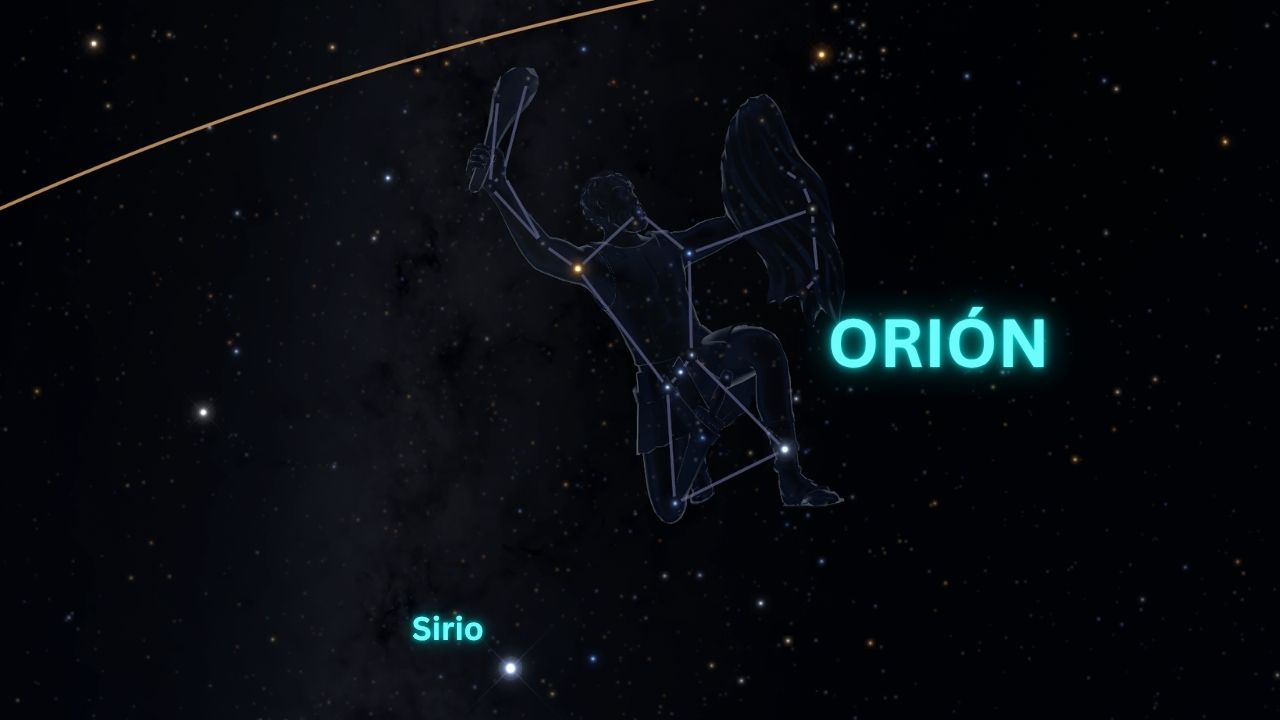
And about the ecliptic: that golden line you see in the image above is the Moon’s monthly path. It grazes Orion, close enough for the Moon to enter the constellation’s limits from time to time, cross through its stars and get as close as it can. With CELESTRON SkyMaster 15×70 binoculars on a night when the Moon transits near Betelgeuse or the Belt, you can see them in the same field of view: the bright cold Moon on one side, the stars of Orion on the other.
The Greeks knew nothing about ecliptics. But they watched the same sky we watch, and saw the same thing we see: that the Moon and Orion approach each other, again and again, every month, for thousands of years.
And they never touch.
Equipment for Tonight
Orion is generous with every level. It has objects for the naked eye, for binoculars, for visual telescopes and for long-exposure photography. No instrument is wasted pointing at it.
CELESTRON SkyMaster 15×70
Mexico | United States | Spain
The natural first step for anyone who wants to go beyond the naked eye. With 70mm aperture and 15x magnification, M42 becomes a luminous cloud that overflows the entire field of view. In dark skies some internal structure starts to emerge. In moderately light-polluted skies, like most Latin American cities, the nebula is still spectacular even without the filaments that only appear with greater aperture. The Belt shines with a clarity that makes you understand for the first time why three civilizations looked at that same point and felt it was special. A tripod is recommended to get the most out of them, but the result is worth it from the very first night.
ZWO Seestar S50 or S30 Pro
Mexico | United States | Spain
The leap that changes the entire experience. It has no eyepiece: it is an automated astronomical camera controlled from your phone that in less than a minute starts building an image of M42 that surpasses what you can see visually through much larger telescopes. Its built-in dual-band filter blocks light pollution, meaning from the middle of a city you can capture details that used to require a field observatory. The S50 has higher resolution for small objects like the Trapezium. The S30 Pro has a wider field of view and can frame M42 and the Horsehead together. Both are extraordinary for Orion.
SKY-WATCHER FlexTube 300P
Mexico | United States | Spain
This is where Orion stops being an object and becomes an experience. With 12 inches of aperture, M42 shows real internal structure, the Trapezium cleanly resolves into four individual stars, and on nights of good seeing a greenish tint appears in the ionized gas, an effect caused by doubly ionized oxygen that almost no other instrument allows you to see visually. From the city, with moderately polluted sky, M42 is still impressive. The Horsehead Nebula remains difficult even with this instrument and requires special filters, but the Flame Nebula starts to hint itself on transparent nights. Its collapsible FlexTube design makes it surprisingly portable for its size.
Orion and Its Connected Worlds
- Scorpius: his eternal enemy. That is why they never share the sky.
- Taurus and the Pleiades: the seven sisters who fled from him. He is still chasing them.
- Canis Major: Sirius, his most faithful dog. The brightest star in the night sky. (Coming soon at ASTRONOMIKA TV)
- Canis Minor: Procyon, the small one who always ran ahead. (Coming soon at ASTRONOMIKA TV)
- Lepus: the hare at his feet, forever fleeing. (Coming soon at ASTRONOMIKA TV)
Frequently Asked Questions About the Orion Constellation
Who are Orion’s parents in Greek mythology?
Orion has three divine fathers: Zeus, lord of Olympus; Poseidon, god of the sea; and Hermes, messenger of the gods. The three visited Hyrieus, a farmer from Boeotia who received them with total hospitality and sacrificed his only bull in their honor. In return, they offered to grant him any wish. Hyrieus asked for a son. The three gods urinated on the sacrificed bull’s hide, buried it, and nine months later Orion emerged from the earth. He was born without a mother, or with the Earth herself as his mother according to the poet Nonnus of Panopolis, who calls him “the one with three fathers.”
Why did Orion chase the Pleiades?
Orion saw the seven daughters of Atlas and Pleione and decided he wanted them all, without asking. The Pleiades fled. Orion chased them for seven years crossing mountains, forests and islands, unable to catch them because they were infinitely smarter. Zeus finally turned them into doves so they could escape and then placed them in the sky as stars on the shoulder of Taurus the bull, where they shine to this day. Orion keeps chasing them across the eternal sky, always at the same distance, never quite reaching them.
What happened to Orion on the island of Chios?
Orion arrived on Chios and king Oenopion promised him the hand of his daughter Merope in exchange for hunting all the dangerous beasts on the island. Orion fulfilled every condition but Oenopion always invented a new one. At some point Orion forced himself on Merope. Oenopion blinded him while he slept and threw him on the beach. Orion crossed the sea to Lemnos, where Hephaestus took pity on him and lent him his assistant Cedalion to guide him. Carrying Cedalion on his shoulders, Orion walked east until the rays of the Sun restored his sight.
What is the relationship between Orion and Artemis?
After recovering his sight, Orion arrived in Crete where he met Artemis, goddess of the hunt. They hunted together and developed the deepest bond in all of Orion’s life. Artemis, a virgin by her own choice since age three, had never admitted a man into her circle. With Orion she made an exception because she found for the first time someone who matched her. The relationship was platonic but emotionally intense. When Artemis accidentally killed him through her brother Apollo’s trap, she went to find Asclepius to resurrect him. She could not. Zeus placed him in the sky, and Artemis, who governs the Moon, approaches him every month following the ecliptic without ever being able to stop at his side.
How did Orion die according to Greek mythology?
There are two versions. In the first, Gaia sent a scorpion to kill him as punishment for having promised to exterminate every living creature on Earth. The scorpion defeated him and Zeus placed them both on opposite sides of the sky. In the second version, Apollo tricked Artemis into shooting an arrow at a dark shape in the sea in the pre-dawn darkness, without telling her it was Orion. Artemis killed him without knowing it. Neither version is the official one. Both coexist.
What are the names of Orion’s dogs and what stars represent them?
Orion’s dogs do not have consistent proper names in the ancient Greek sources. What mythology did preserve was their place in the sky: the constellations Canis Major, the big dog, and Canis Minor, the small dog. Some sources identify the larger one with Laelaps, the fastest hound in the ancient world. The principal star of Canis Major is Sirius, the brightest star in the entire night sky. The one of Canis Minor is Procyon, whose name in Greek means “before the dog,” because in ancient Greece it rose before Sirius. Together with Betelgeuse they form the Winter Triangle, visible from almost anywhere in the world from December through March.
What is the Orion Nebula and how can it be observed?
M42, the Orion Nebula, is a cloud of gas and dust 24 light-years in diameter where new stars are being born right now. It is 1,344 light-years away and is the closest active star-forming region to the Sun. To the naked eye it appears as a fuzzy smudge in Orion’s sword. With binoculars it becomes an extensive luminous cloud. With a smart telescope like the ZWO Seestar S50 the Trapezium appears, the four young stars at the heart of the nebula whose radiation illuminates all the surrounding gas.
What is Betelgeuse and when will it explode as a supernova?
Betelgeuse is the red supergiant on Orion’s right shoulder, 700 times larger than the Sun. It is in its final stages of life and will eventually explode as a supernova, being visible during the day for weeks. We do not know when: it could be today or it could be in a hundred thousand years. It is 700 light-years away, which means if it has already exploded, the news has not yet reached Earth.
When and from where can the Orion constellation be seen?
Orion is one of the most visible constellations in the world. From the northern hemisphere it dominates the night sky from November through March, rising in the east around nine in the evening in December and reaching its highest point in the south around midnight. It is perfectly visible from Mexico, Spain and all of Latin America. From the southern hemisphere it appears during those same months but inverted, with Rigel above and Betelgeuse below. The easiest way to find it is to look for the three perfectly aligned Belt stars, known in Mexico and Latin America as the Three Marys or the Three Wise Men.
How did the Maya and Egyptians see Orion?
The Maya saw in Orion’s Belt the shell of a cosmic turtle, called ak’ ek in the Madrid Codex. The three Belt stars were the Sky Stones, the primordial hearth where the gods lit the fire of creation. M42 was the Smoke of the Heart, the smoke of that original fire still burning. For the Egyptians of the Old Kingdom, Orion’s stars were the god Osiris, lord of death and resurrection. The connection is documented in the Pyramid Texts, the oldest religious writings in the world. The Greeks placed a hunter and his dog there. The Maya placed the origin of everything there. The Egyptians placed the parents of the world there.
Sources and Recommended Reading
Books
Graves, Robert. The Greek Myths. Penguin Books, 2012. The most comprehensive reference on classical Greek mythology, with all variants of each myth documented and compared.
Callimachus. Hymns and Epigrams. Harvard University Press (Loeb Classical Library), 1921. Primary source for Artemis’s childhood and her petition to Zeus. The Hymn to Artemis is one of the few ancient texts that describes the goddess as a child.
Digital Sources
NASA Science: verified data on Betelgeuse, the Great Dimming of 2019, M42 and the Orion Molecular Complex. science.nasa.gov
Messier Objects: complete database of deep sky objects in Orion with verified technical data. messier-objects.com
This article contains affiliate links. If you purchase through them, I receive a small commission at no additional cost to you.