
The myth of the princess who paid for her mother’s mistakes, the hero who negotiated before rescuing her, and the closest galaxy you can see tonight with your own eyes. With medieval Arab astronomy, Vedic tradition, and the most fascinating deep sky objects of autumn.
By Juan Pablo Martin | ASTRONOMIKA TV | August 2026
A mother with an overinflated ego nearly destroyed a kingdom. Her daughter paid the debt. And the galaxy that carries that princess’s name has been heading toward us for 4,500 million years. Tonight you can step outside, find four bright stars in the autumn sky, and see with your own eyes the farthest light the human eye can reach.
But first, the story.
The day a mother sacrificed her daughter to save her own ego
Andromeda did nothing wrong. That’s the first thing to make clear. She didn’t defy any god, didn’t break any oath, didn’t make any political miscalculation. She was an Ethiopian princess who lived in her parents’ palace on the coast of what today would be Lebanon or Israel, and the only thing she had was a beauty her mother found too good to keep quiet about.
And a life that, up to that point, looked pretty good.
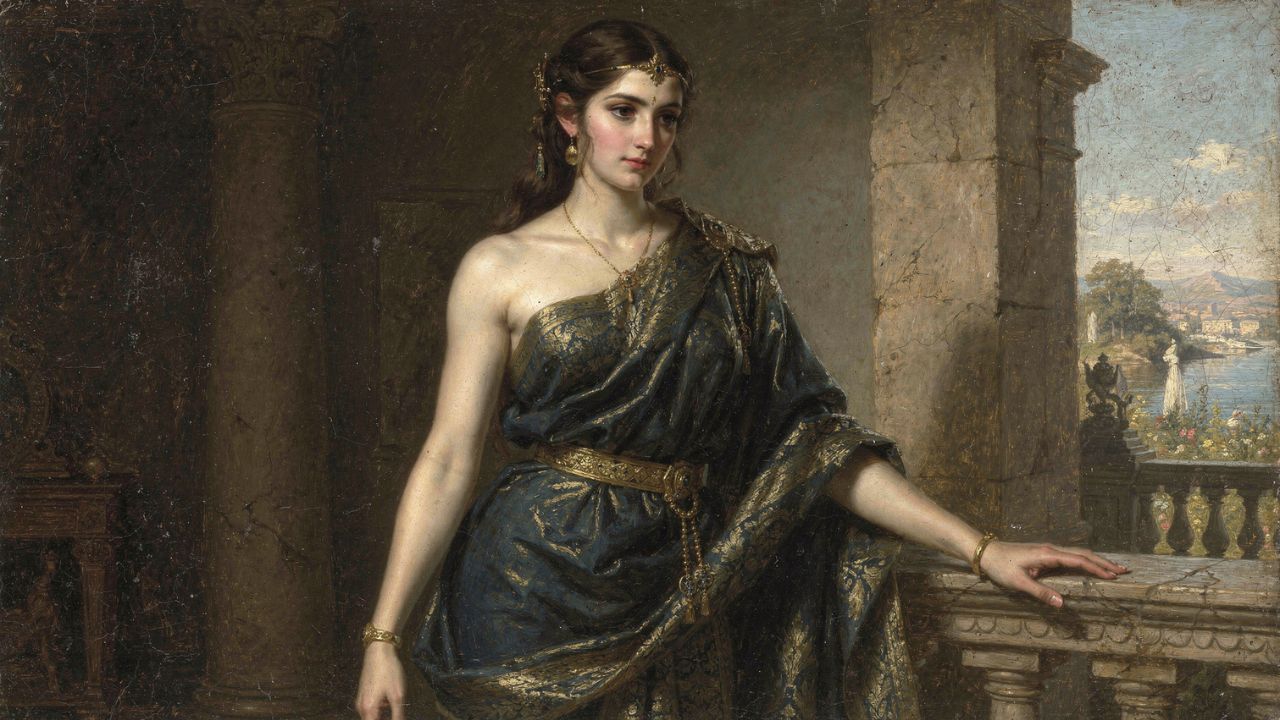
Andromeda was the daughter of Cepheus, king of Ethiopia, and Cassiopeia, his queen. Cassiopeia was, without question, the most beautiful woman at court, and she had known it forever, with the calm of someone who has never had a reason to doubt it. That certainty was exactly the problem. Not the beauty itself, which was real and undeniable, but what Cassiopeia did with it: she used it, she flaunted it, she turned it into an argument.
Cassiopeia’s problem wasn’t that she was beautiful. It was that she knew it, and had always known it, with the calm of someone who has never had a reason to doubt it.
It wasn’t the young, defenseless beauty of her daughter. It was something more calculated and more dangerous than that: the beauty of a woman who has had decades to perfect the effect she produces on others, and who has used it as a tool ever since she learned it worked.
Andromeda was betrothed to Phineus, a man of noble blood and lineage enough to aspire to a princess’s hand. Phineus was, in fact, her own father’s brother. Her uncle. Marriages between close relatives were common practice among the dynasties of the ancient world, a way to keep power within the family and seal alliances without giving up territory. No one at the Ethiopian court saw it as strange.
We do, but that’s a different conversation.
What the classical texts don’t tell us is what Andromeda saw in Phineus beyond the contract. But Phineus was heir to Belus, a powerful figure in the kingdom, with command over men and resources. In the world Andromeda lived in, that was no small thing. She had probably known him her whole life. She had probably learned to see him as her future.
What Andromeda didn’t know was that this future had an expiration date.
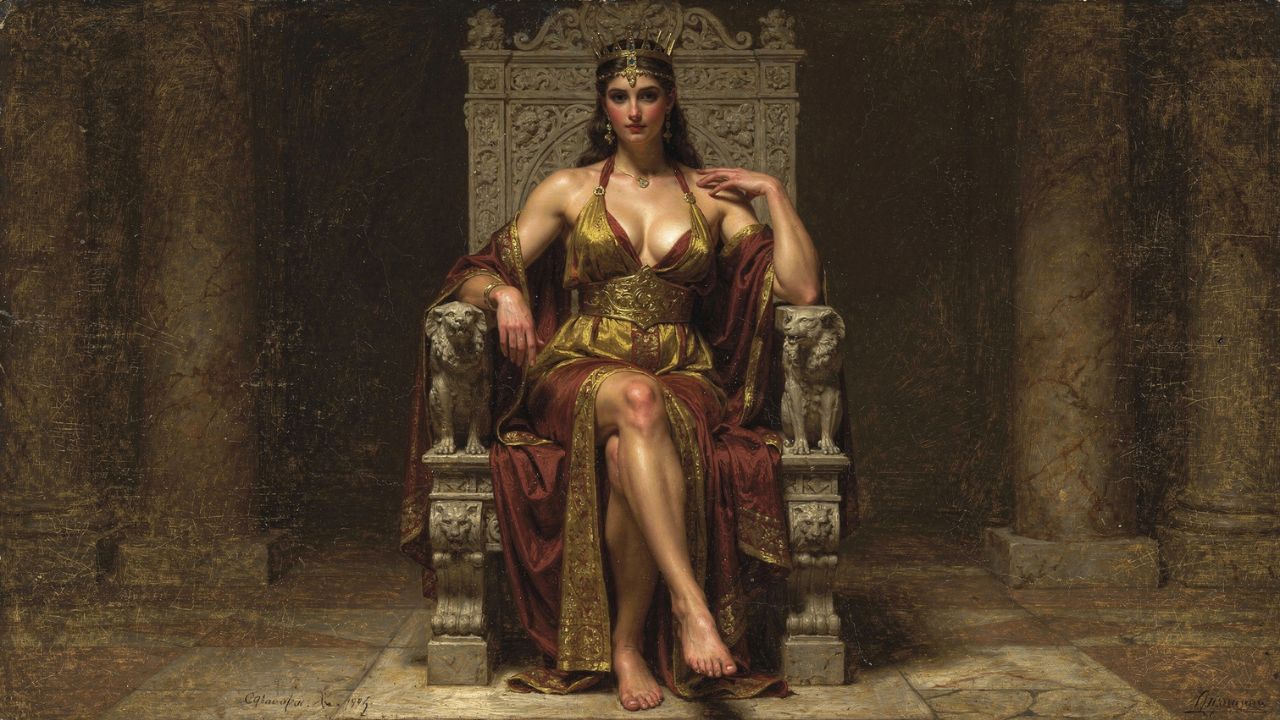
Cassiopeia, queen of Ethiopia, was a woman who confused privilege with merit. One day, in public, as a state declaration, she opened her mouth and said what she should never have said.
According to the oldest version of the myth, the one left to us by the Roman mythographer Hyginus in his Fabulae, Cassiopeia proclaimed that her daughter Andromeda’s beauty surpassed that of the Nereids, the fifty sea nymphs, daughters of the god Nereus. In another equally documented version, what she proclaimed was that her own beauty was superior to theirs. Both versions say the same thing about Cassiopeia: she was the kind of person who needed everyone to know her worth. The only difference is whether she used her daughter as a trophy or was satisfied with her own ego.
Either way, the result was identical.
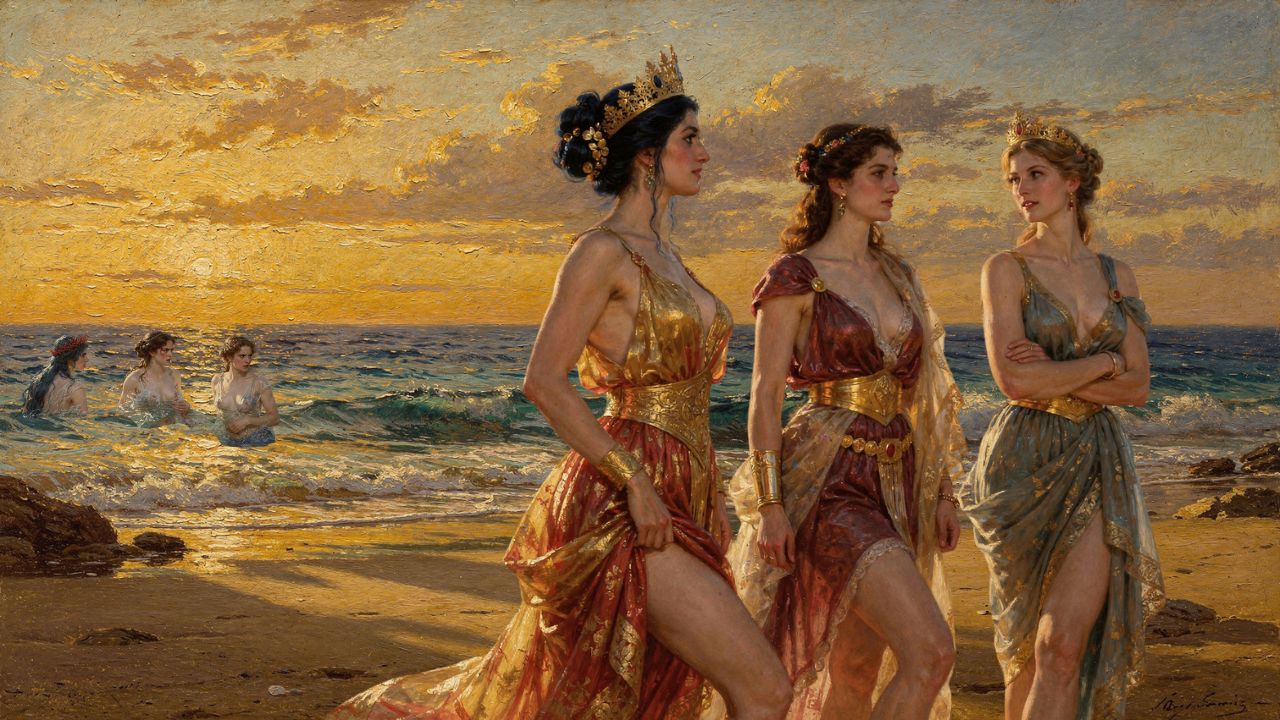
The Nereids heard. Poseidon, god of the sea and protector of the nymphs, heard too. And Poseidon was not the type to let insults slide, especially ones coming from mortals.
He sent Cetus, the most feared sea beast of the ancient Mediterranean, to devastate the coasts of Ethiopia, in what today would be the coastal strip of modern Lebanon and Israel. Fields destroyed, fishermen dead, ports wrecked, ships sunk before reaching land. An entire kingdom paying for its queen’s vanity.
Andromeda learned all this from her palace. Picture her there: a young woman watching her world collapse because of her mother’s words. Hearing the screams of people on the coast. Watching her father pace the halls with the face of someone who has no idea how to fix what wasn’t his fault. Waiting for someone to do something. Looking at Phineus, her betrothed, the man with an army and the lineage to try anything, and seeing in his eyes something she hadn’t expected to see.
Not resolve. Not courage. Waiting.
Phineus waited. Calculated. Watched how the situation unfolded before committing to anything.
Cepheus, desperate, consulted the oracle of Amun. The answer arrived without delay and without mercy: the only way to stop Cetus was to sacrifice Andromeda. Hand her over to the monster. His own daughter.
And here is where the story gets truly dark, because what happened next wasn’t the unilateral decision of a heartless father. It was something more complicated and more disturbing than that.
Cepheus came before Andromeda. He explained what the oracle had said. He told her the entire kingdom depended on what was decided in the following hours. And in that moment, Andromeda looked her father in the eyes, looked toward the window where the sea could be heard destroying her kingdom’s coast, and made the one decision that no one else in this story was able to make.
She said yes.
Not because her parents demanded it. Not because Phineus asked her to. But because Andromeda was the kind of person who acts when no one else does. Because she looked around, saw that the men who were supposed to love and protect her were paralyzed, and decided that if someone had to pay that debt, she would rather choose it herself than have it forced on her.
There’s a difference between being sacrificed and choosing to sacrifice yourself. Greek texts rarely acknowledge that difference. But it was there.
The darkest decision in this saga wasn’t made by the monster or the god. It was made by a man who loved his daughter and chained her anyway. The story of the king who carried that weight has its own chapter.
And while Andromeda was making that decision, Cassiopeia, the one who caused all of it with an ego comment at the worst possible moment, doesn’t appear in any version of the myth. She’s simply not there. She let her daughter pay the bill alone.
What came next was brutal in its simplicity.
In ancient Greek culture, sacrifice required that the offering be presented without artifice, without protection, without anything mediating between her and the will of the gods. So what followed wasn’t an accident or an excess. It was protocol.
They stripped her of her clothes. In front of her father’s soldiers. In front of the very citizens she had decided to save. With her parents’ palace visible on the horizon and the torches lit as if nothing extraordinary were happening on the shore.
And Phineus, her betrothed, the man with an army and the lineage to try anything, was there too. The texts don’t say so explicitly. But they don’t say he wasn’t, either. And if he was there, if he saw that moment and stayed exactly where he was without moving, without protesting, without doing absolutely anything, then there’s only one word for what Phineus really was.
He wasn’t Andromeda’s betrothed. He was a spectator.
There are silences that define a person forever. This was Phineus’s.
They left her only her princess’s jewels: a golden diadem across her forehead, bracelets on her forearms, earrings the sea wind would later move. The only ornament they let her keep was the one that reminded her she was someone, that she had a name and a rank, even though in that moment neither one did her any good.
Andromeda didn’t lower her head. The texts don’t say that either. But everything about this character points in one direction: she was the kind of person who didn’t lower her head. So we imagine her that way, because it’s the only version consistent with who she was.
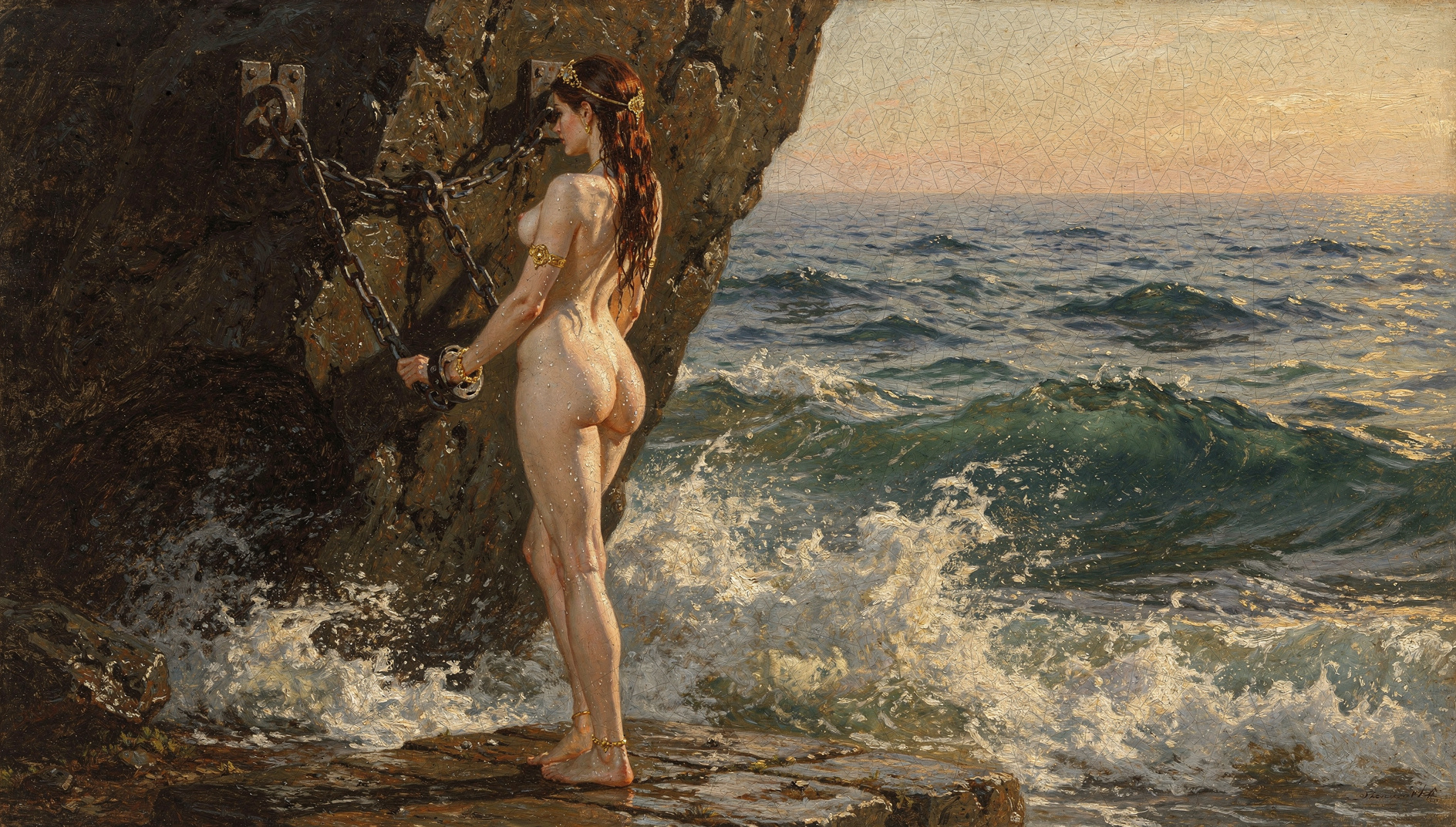
They chained her naked to a rock on the shore. And the entire kingdom she had decided to save left her there and walked away.
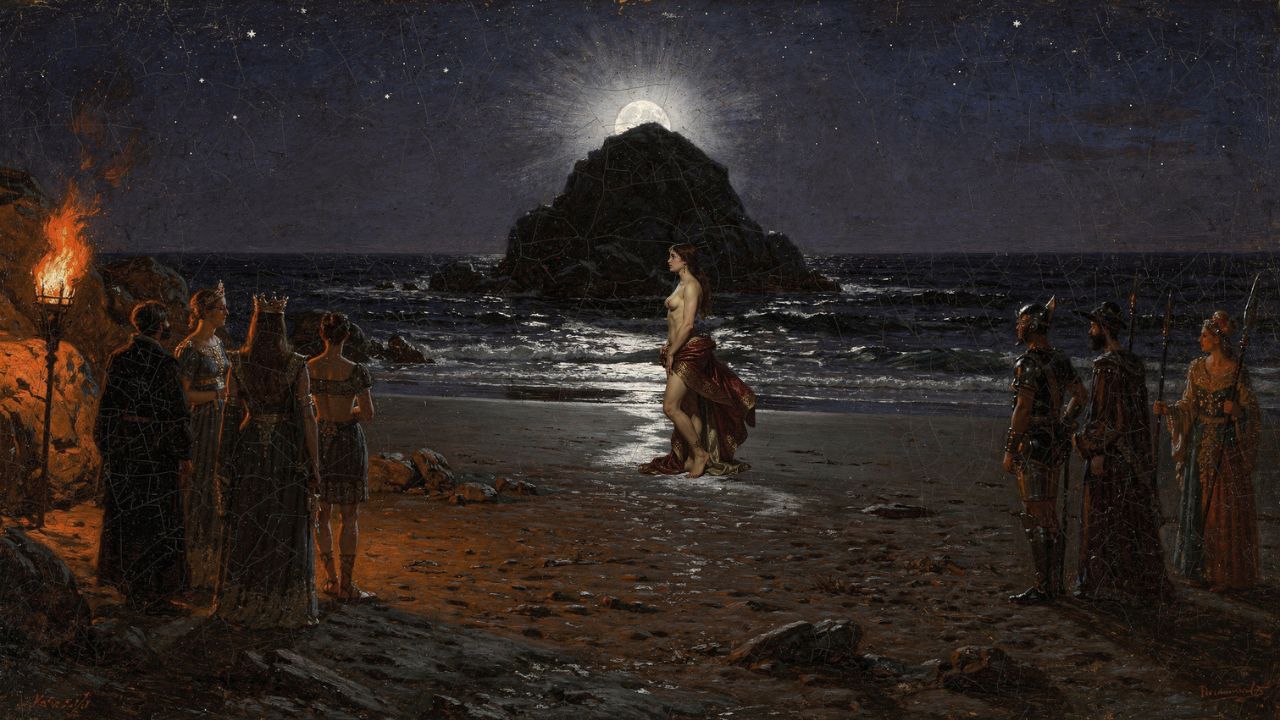
Think about what was going through her mind in that moment. The cold of the metal on her wrists. The salt wind hitting her skin. The waves breaking against the rock at her feet, colder each time, higher each time. Her own kingdom’s coast visible from there, her parents’ palace on the horizon, the lights on, life continuing. Phineus’s silence. Her mother’s absence. And the certainty, growing with every wave, that no one was coming.
She waited.
Then he arrived.
But before talking about what Andromeda saw from that rock, you need to understand who the man who appeared in the sky was.
Perseus was the son of Zeus and Danae, a mortal princess of Argos, in the south of present-day Greece. His story began long before this moment and would continue long after, but what matters for understanding what was about to happen on that rock is this: he had just beheaded Medusa, the only mortal Gorgon, a creature whose gaze turned to stone anyone who looked at her directly. To pull it off, the gods had equipped him with a polished bronze shield he used as a mirror, a harpe, a curved blade forged from adamantine, the hardest metal in the cosmos, winged sandals, and a leather bag to carry what he cut. He was flying back over the Mediterranean when he looked down.
Where exactly he was coming from, what else he had done before this moment, and what would happen afterward, that has its own chapter. The full story of Perseus begins long before this rock.
Now then. Let’s be honest with the story and with ourselves.
Perseus had faced Medusa without blinking, had crossed the edge of the known world without hesitation, had carried a Gorgon’s head in a bag like someone carrying the groceries. He was, by any reasonable measure, the bravest man of his generation.
But he had also spent weeks completely alone at the edges of the world. No city, no palace, not a single conversation that wasn’t with monsters or gods.
Greek heroes had a very strict code of honor. But they also had eyes. And Perseus, demigod or not, was still a man in his twenties with all the consequences that implies. Calling what he felt in that moment “extra courage” would be technically accurate. The Greeks simply called it Eros, the god who doesn’t ask permission from anyone, not even the sons of Zeus.
“Boys will be boys.” Even when the boy is the son of Zeus.
What he saw from the sky was this: Andromeda chained to the rock, completely naked except for her jewels, her skin golden and damp from the sea breeze under the low light of the Ethiopian afternoon. Slender, with a defined waist and long legs, barely parted under the weight of standing for so many hours. Her arms raised above her head stretched every line of her body, from the wrists marked by the shackles to the curve of her hips. Her chestnut hair, loose, damp against her shoulders with sweat and salt. And her eyes: brown, wide, fixed on the horizon with a determination that didn’t match the naked, vulnerable body holding it. Her chest rose and fell with a breath that was no longer one of fear. Perseus, who hadn’t seen anyone who wasn’t a monster or a god in weeks, felt the impact in his body before his mind had time to process it.
That was what finally decided Perseus. Not just the beauty, though the beauty was there and impossible to ignore. It was that: the gaze.
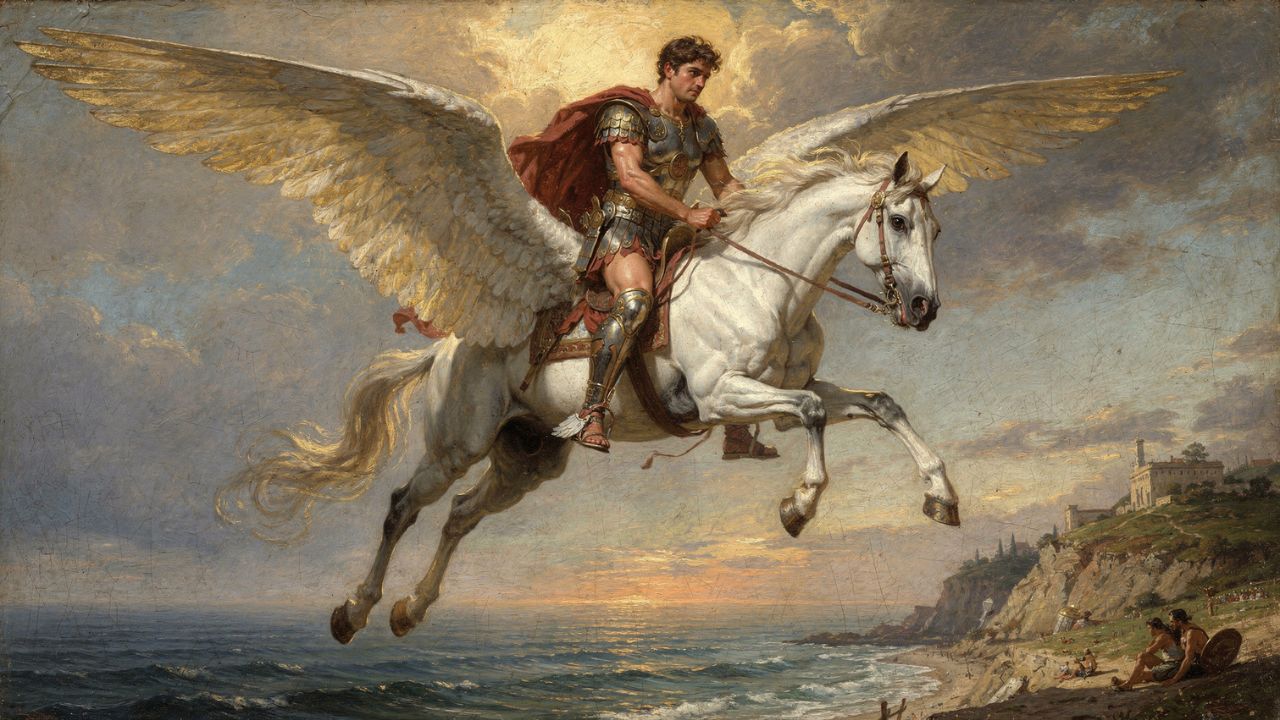
Perseus descended on Pegasus. The white horse with enormous wings spread at its sides cut through the air with the silent precision of something that doesn’t fully belong to any one world. Andromeda raised her eyes and saw a figure descending from the sky, a man in armor, riding something that shouldn’t exist but existed anyway. The wind stirred up by Pegasus’s wings reached her first, before he did, and raised goosebumps on her skin in a way the sea wind hadn’t managed in hours. When he landed beside her, she had to lift her chin to look at him straight on. Tall, taller than she had imagined from the sky. Broad shoulders under the bronze breastplate still darkened with salt, arms marked with real muscle, not statue muscle, the muscle of someone who had used that body to survive. His dark hair damp against his forehead from the flight. And his eyes, clear, direct, without that uncomfortable glance-away that men have when they don’t know what to do with what they’re looking at. He looked at her completely, without apologizing for looking, and she didn’t lower her arms to cover herself. In her defense, she didn’t have many options with her wrists still chained above her head, but that’s a detail the story prefers to overlook. Something stirred in her that had nothing to do with fear. She wanted him close. She wanted him there, with her, in the simplest and oldest way a body can want another.
Perseus landed on the rock beside her. The first thing he did was talk to her. With genuine curiosity. Who are you, why are you here, what did they do to you. And Andromeda told him everything: her mother’s vanity, the oracle, her father’s decision, Phineus’s silence. Perseus listened. Which was something no one else had done that day.
Then he did something Andromeda didn’t expect: before rescuing her, he flew to the shore where Cepheus and Cassiopeia were and negotiated the marriage. He closed the deal first.
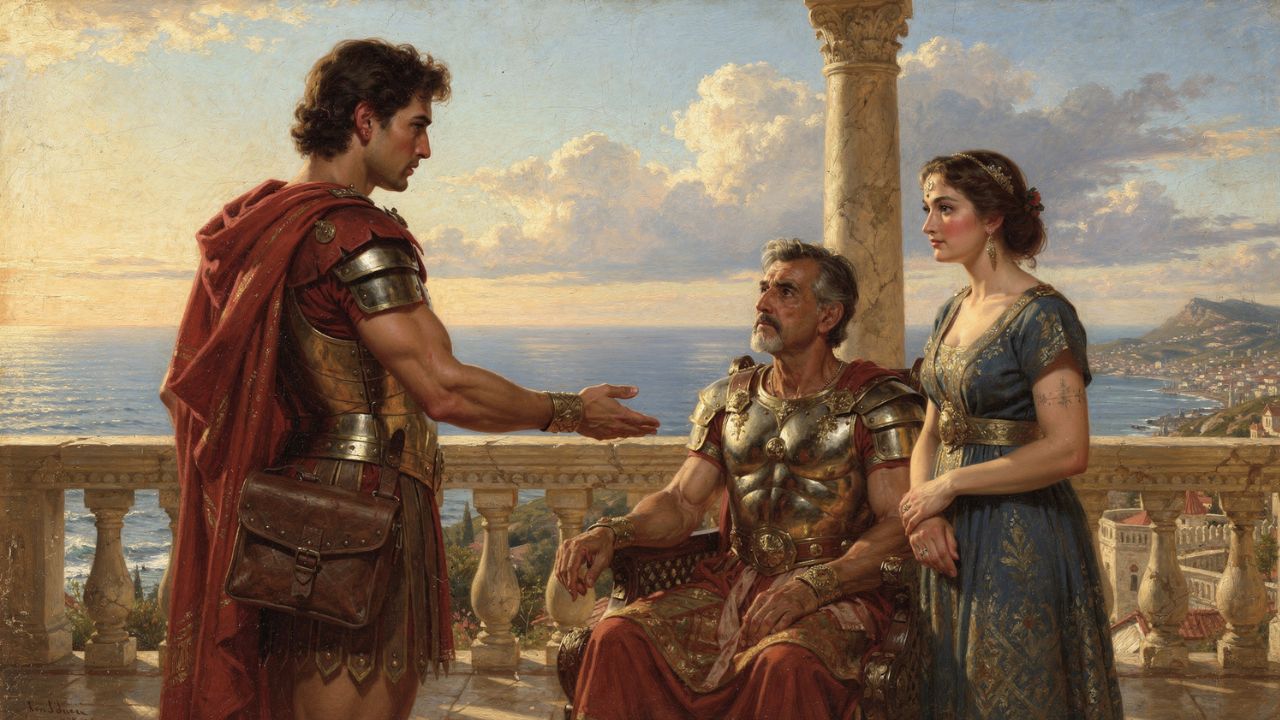
Yes, that’s true too. Perseus was a hero, not a saint. And Greek heroes did nothing without calculating the outcome.
Andromeda remained chained to the rock while the adults closed the deal on the shore. The sea at her feet sounded different now, deeper, as if something large were moving beneath the surface. The time it took Perseus to return from the shore must have been the longest of that entire endless day. The fear that her parents would say no. That the deal wouldn’t close. That this extraordinary moment would evaporate and leave her alone again with whatever was coming up from the depths.
But her parents agreed. Of course they agreed.
Perseus returned.
And then the sea opened.
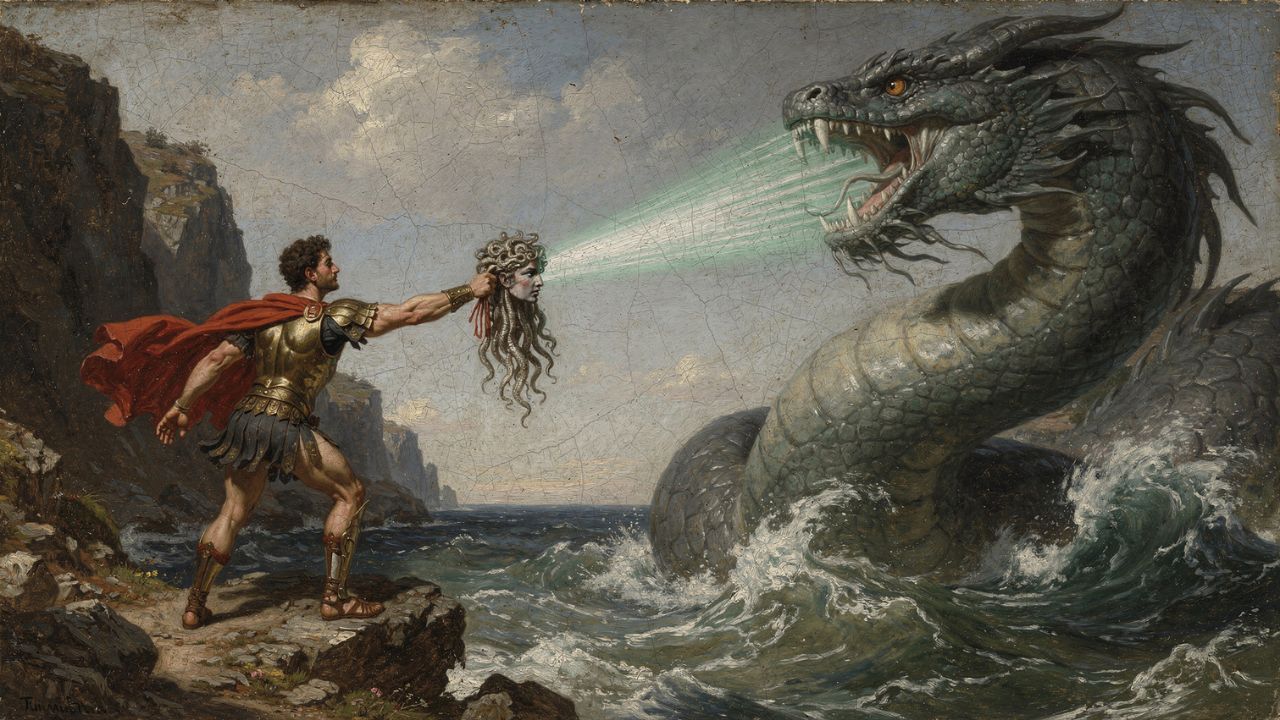
Cetus emerged from the depths with the slowness of something in no hurry, because nothing in the ocean dares challenge it. An enormous darkness advancing the way things that live where no light reaches advance, where water pressure crushes anything not specifically built to withstand it.
Andromeda saw it coming from the rock. The water at her feet changed color first, from blue to dark green, as if something very large were pushing the seafloor upward. Then the sound, a dull movement that wasn’t a wave because it came from too far below. Then the shadow, enormous, beneath the surface, advancing straight toward where she stood.
Classical texts don’t describe what Andromeda felt in that moment. But there’s one thing we do know: she didn’t look away.
And while Cetus advanced and Perseus dove to intercept it, Andromeda did the only thing she could do: stay on that rock and want, with everything she had left, for the man who had come down from the sky for her to win.
Perseus acted before Cetus reached the rock. The versions of the myth don’t agree on the exact method. Some say he used Medusa’s head to petrify the monster. Others that he faced it directly with the harpe, using the shield’s reflection. Ovid has him fighting on top of the monster, in the water, for several minutes of real combat.
He probably used everything he had. That was Perseus’s style.
When the water calmed and Cetus stopped moving, there was a moment of absolute silence over the Ethiopian sea. The kind of silence that only exists after something very large finally ends.
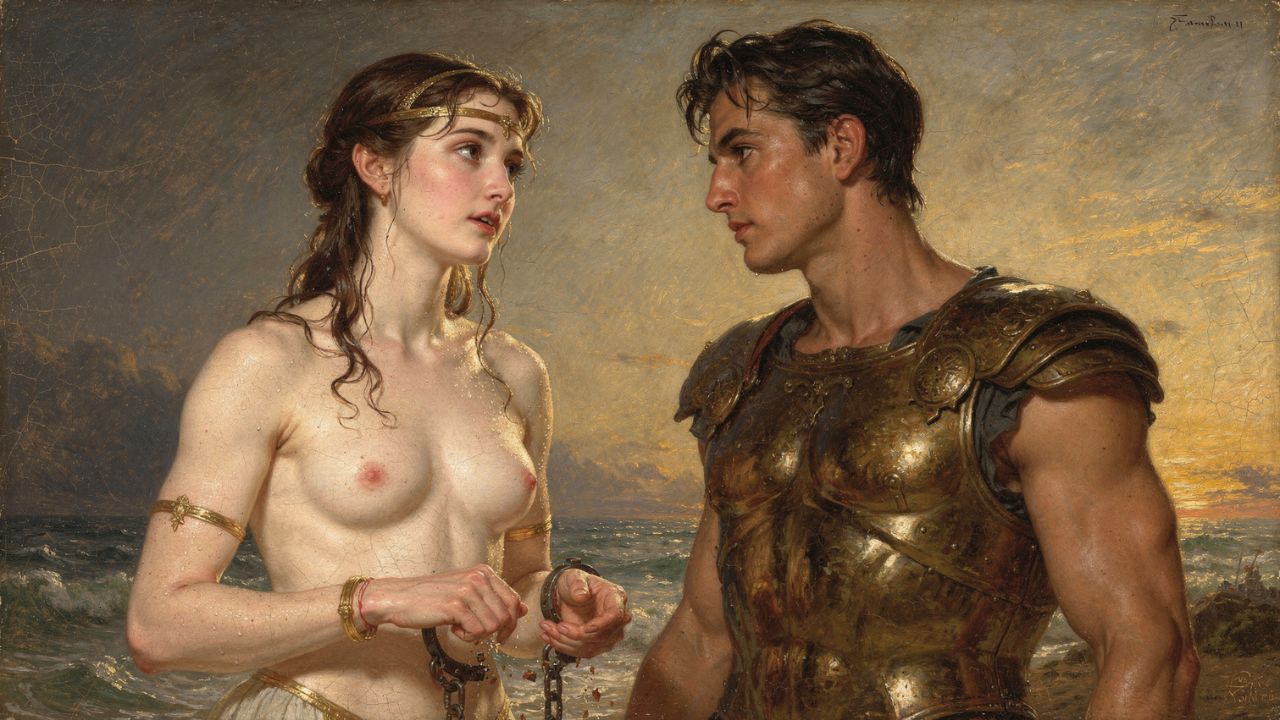
Perseus returned to the rock. Soaked, his bronze breastplate darkened by seawater, the harpe still in his hand. He stood in front of her.
He, covered in bronze and leather and sea. She, with nothing but her jewels and that gaze. The two of them at the same height for the first time, face to face on that rock, with the still water below and the afternoon sky catching fire behind them.
With the same hand that had just killed Cetus, he broke the chains.
The metal fell into the sea.
That first second of freedom has a very specific physicality: the sudden weight of her arms coming down, muscles burning after hours of tension, the strange and wonderful sensation of a body remembering it has gravity. The wrists marked by the shackles. The air filling her lungs differently.
Andromeda lowered her arms. She looked at him. With the same open gaze she had faced the horizon with all day. Except now the horizon had a different face.
Sometimes opposites don’t cancel each other out. They complete each other.
And as for what happened between them in that moment, let’s just say there was more than words. An embrace that started as gratitude and that neither of them rushed to end. His hands, still cold from the sea, finding her skin, still warm from the afternoon sun. Their bodies close, closer than a simple rescue requires, their breathing syncing without either one directing it. If they had been alone, if the whole village hadn’t been watching from the shore waiting to see them return, that embrace wouldn’t have been the only thing that happened on that rock. They both knew it. You could tell by how neither one let go a second before they had to. But there was an entire kingdom watching, so they settled for the embrace, and for the silent promise that that same night, far from prying eyes, nothing would stand in their way.
What we do know is that when they flew back to the shore, they flew together.
Whatever had started on that rock wasn’t over yet. It had just been put on hold.
The wedding was held in Ethiopia that same night. And it was, to put it delicately, memorable.
Because in the middle of the banquet, when the food had been served and the wine had gone around enough times, the doors of the hall opened and in walked Phineus.
The betrothed who hadn’t lifted a finger when Andromeda was chained to the rock. The man who had waited to see how the situation unfolded before committing to anything. The uncle now claiming what he considered his, now that the danger had passed and someone else had done the work.
He arrived with an armed force, claiming Andromeda as his original bride.
It was Cepheus himself who confronted him first. And the words he said were recorded in Ovid’s Metamorphoses with a precision that still stings: “Why didn’t you take her yourself from the rocks she was chained to? Does the prize now go to the man who stood watching while an old father nearly lost his daughter?”
Phineus didn’t answer with words. He threw a spear.
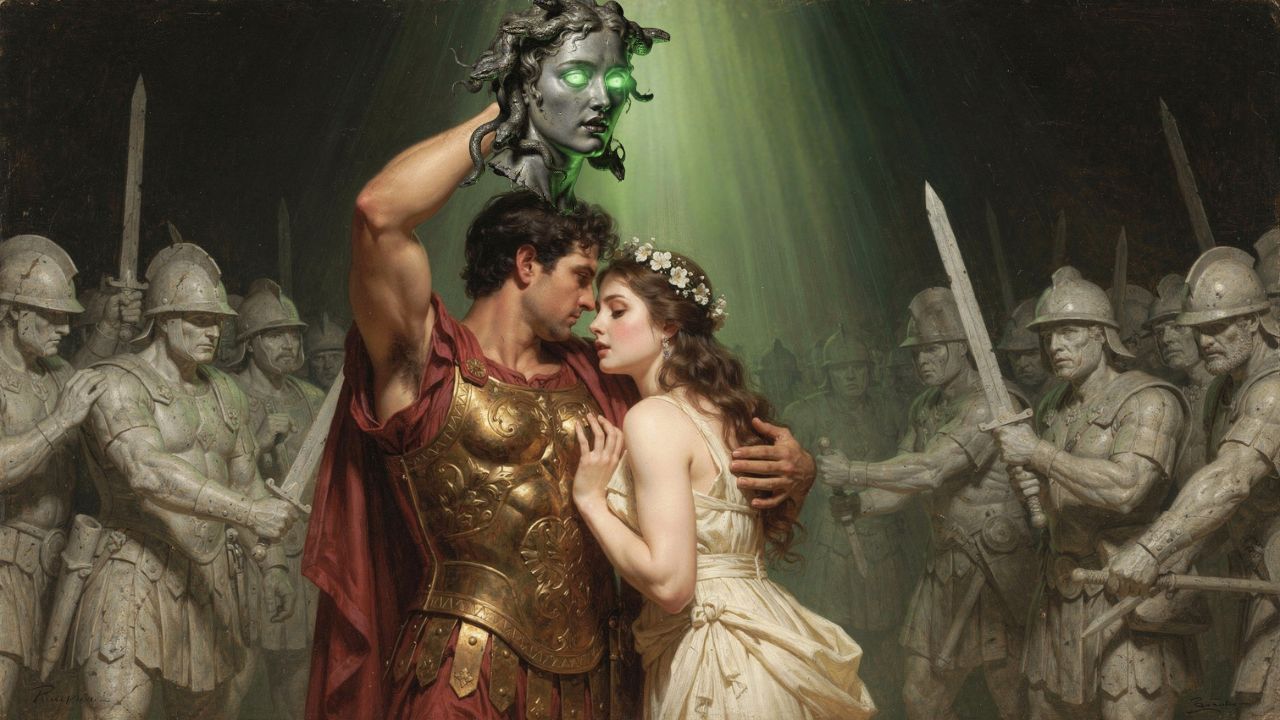
Chaos broke out in the wedding hall. Torches toppled, tables flew, cups rolled across the floor mixing wine with blood. Phineus’s men were many. Perseus was one. But Perseus had killed Medusa with a mirror and a harpe while flying above her, so the concept of “being outnumbered” produced more curiosity in him than fear.
Perseus, outnumbered but not out of resources, did the one thing only he in all of Greek mythology could do at that moment: he reached for the bag.
He warned the ones on his side first to look away. And then he raised Medusa’s head.
Phineus and all his men turned to stone in the middle of the wedding hall. Some with their cups still in hand. Some with swords raised. Some with their mouths open mid-sentence, a sentence they never finished.
The bride’s uncle, turned into a statue at his own wedding feast, surrounded by his petrified army. Forever.
Andromeda had started that day naked and chained to a rock, waiting for a sea monster to end everything. She ended it also naked, but on her wedding night, beside the one man who had bothered to come down from the sky for her that day. If that’s not a character arc, nothing is.
And here comes the detail that makes this story different from almost everything else in Greek mythology, because happy endings there are a statistical rarity. The Greeks believed life had a natural tendency toward tragedy. Oedipus discovered he had killed his father and married his mother. Achilles chose short glory over a long life and died young. Heracles, the most powerful of all, ended his days burning in a poisoned tunic.
Andromeda and Perseus went to Argos, in the Peloponnese, in the south of present-day Greece, and ruled together. They had seven children. They built something. They grew old.
When they died, the goddess Athena placed them together among the stars, so they would remain eternally close to one another in the northern sky. Not as punishment, not as a warning, not as a reminder of some excess of pride. Just so they would stay together.
If this story sounds like something that should have music, at ASTRONOMIKA BEATS we turned it into exactly that. “La princesa encadenada,” from the album “Historias en las Estrellas,” is the sound version of what you just read. You can find it on Spotify.
The woman no one defended, who made the one decision no one else was able to make, who endured chained and naked on a rock facing the sea while waiting for something she had no objective reason to expect, ended up being the only person in this entire story who truly chose her own fate.
In Greek mythology, that’s as close to justice as you’re going to get.
Cassiopeia also ended up in the sky. But she circles eternally around the north pole, sometimes upside down, never able to rest. And the most unsettling part isn’t the punishment. It’s that in no version of the myth, in no surviving Greek text, does she ask for forgiveness. Not once.
That one has its own chapter too.
But the Greeks weren’t the only ones who looked at this corner of the sky and found something extraordinary. Thousands of kilometers away and centuries apart, other civilizations raised their eyes to the same stars and saw completely different worlds.
That’s what the Greeks left in this corner of the sky: a broken family, a rescue, a happy ending rare for their mythology. But the stars don’t belong to a single culture, and other eyes, in other centuries, looked up and saw something completely different.
The same sky, three completely different stories
The astronomer who saw M31 first and didn’t know what it was
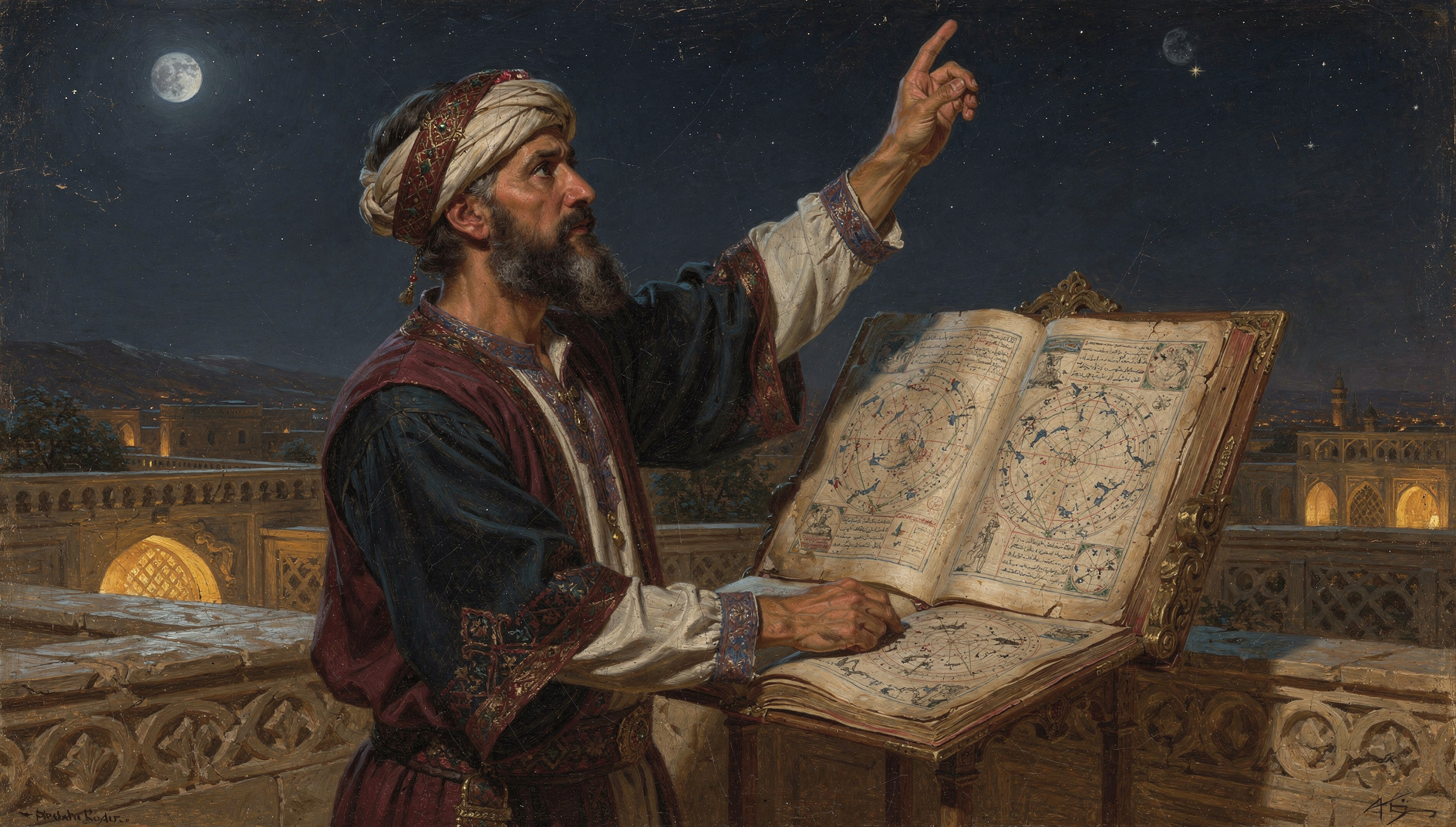
In the year 964 AD, in the city of Shiraz, in present-day Iran, a Persian astronomer named Abd al-Rahman al-Sufi finished writing one of the most important books in the history of astronomy: the Kitab suwar al-kawakib, the Book of Fixed Stars.
Al-Sufi was the kind of scientist the centuries produce very rarely. Meticulous, obsessive, with the patience of someone who can spend years staring at the same patch of sky without getting bored. He took Ptolemy’s star catalog, reviewed it entirely, corrected what was wrong, and added what was missing. Every star had its position, its brightness, its name in classical Arabic. Decades of work condensed into a single volume.
And at some point in that work, while tracking the region of the sky the Greeks called Andromeda, Al-Sufi noted something he didn’t know how to classify.
He called it sahabet al-leil. The little cloud of night.
It was M31. The Andromeda Galaxy.
He didn’t know what it was. No one in the world knew yet. He didn’t have the vocabulary to describe it because the concept of a galaxy wouldn’t exist for almost a thousand more years. But he saw it, drew it with enough precision that modern astronomers could identify it without any doubt, and recorded it in his book as a real object worth documenting even though it couldn’t be explained.
That’s what a good scientist does: document what he sees even when he can’t explain it yet.
The Arabic names Al-Sufi and his predecessors gave to the stars of Andromeda are the same ones we use today. Alpheratz comes from the Arabic surrat al-faras, the horse’s navel, a star the Arabs shared between Andromeda and Pegasus because geographically it belongs to both. Mirach comes from al-maraqq, the flank. Almach comes from al-anaq al-ard, the badger of the earth.
Each name is a coordinate in a celestial navigation system that worked for centuries, long before telescopes or satellites or astronomy apps on a phone existed.
Where the Greeks saw the drama of a dysfunctional family, Arab astronomers saw a precision map and a mysterious cloud that didn’t fit anything they knew. Two completely different ways of looking at the same sky. Both equally valid. Both equally fascinating.
And while Al-Sufi documented with a scientist’s precision, on the other side of the world a completely different system of knowledge looked at the same stars and found something that had nothing to do with clouds or maps.
The serpent that sleeps where the stars end
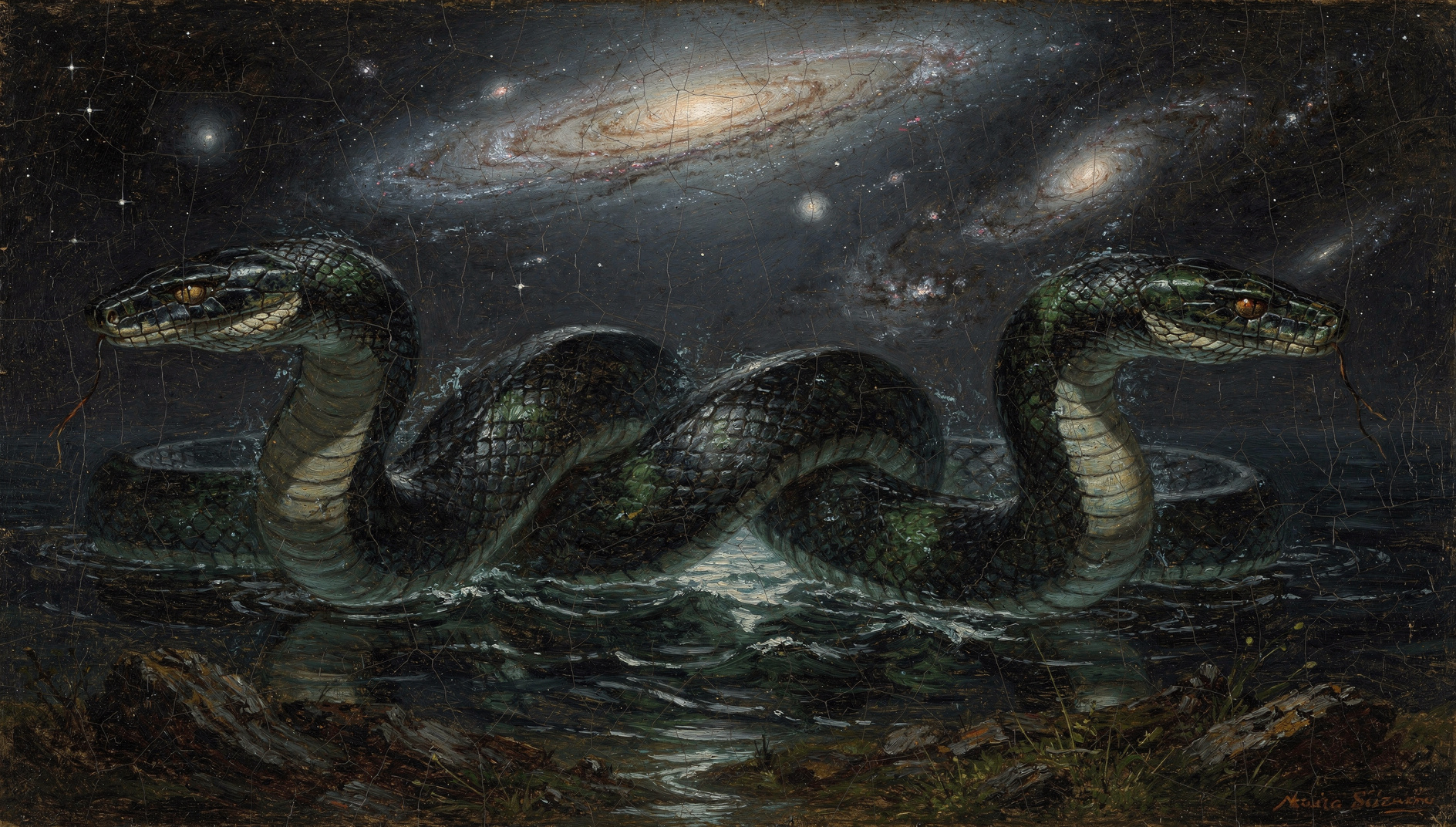
In ancient India, Vedic astronomers divided the sky in a completely different way than the Greeks and the Arabs. Instead of constellations, they used lunar mansions: 27 regions of the sky the Moon travels through over the course of its monthly cycle. They called them nakshatras.
Mansion number 26 was called Uttarabhadrapada, which in Sanskrit means something close to “the auspicious feet.” Its two main stars are Gamma Pegasi and Alpha Andromedae, exactly the ones that today mark the corner of the Great Square of Pegasus and the head of the Andromeda constellation.
Vedic seers looked at those two stars and didn’t see a princess. They saw the hind legs of a funeral bed, a symbol of transformation and passage between worlds. The threshold between what exists and what comes after.
And the deity governing that nakshatra was Ahirbudhnya, pronounced roughly “a-ir-bud-nia,” and who, it has to be said, the Vedic texts themselves never bothered to make famous.
The Sanskrit name says it all: ahi means serpent, budhnya means bottom or depth. Ahirbudhnya is the serpent that lies beneath the surface of the earth, in the primordial depths where no light reaches and where Vedic texts suggest the oldest mysteries of the cosmos sleep.
Now then. Here’s where it gets interesting, or rather, where the lack of information becomes fascinating in itself.
Ahirbudhnya appears exactly twelve times in the entire Rigveda, one of the longest and most detailed texts of antiquity. Twelve. In a book with more than ten thousand verses. And in none of those twelve mentions does it appear as the protagonist of anything. Always in lists, always in passing, always alongside other gods who do have epic stories, battles, romances, and betrayals.
Scholars who have spent centuries studying Vedic texts basically shrug when someone asks about Ahirbudhnya. What little the texts say is that it was born in the waters, that it lives at the bottom of cosmic rivers, and that the faithful invoked it asking it not to harm them. That last part is particularly telling: they didn’t ask for favors, they didn’t ask for prosperity or love or victory in battle. They just asked to be left alone.
It’s the most mysterious god in the Vedic pantheon, not because its stories are complicated but because it apparently doesn’t have any. Or if it does, someone decided three thousand years ago it was better not to write them down.
And that, paradoxically, makes it more unsettling than any story they could have invented for it.
The Greeks placed a chained princess in this corner of the sky and built her a five-character family drama complete with a sea monster. The Vedic seers looked at the same stars and placed there an entity so ancient and so dark they didn’t even bother giving it a story. They just asked it, very respectfully, not to do anything bad.
What none of them anticipated, not the Greeks, not Al-Sufi, not the Vedic seers, is what the Andromeda constellation holds inside it. Something that makes Cassiopeia’s family drama look, with all due respect, like a minor matter.
The neighboring galaxy already on its way, visible tonight
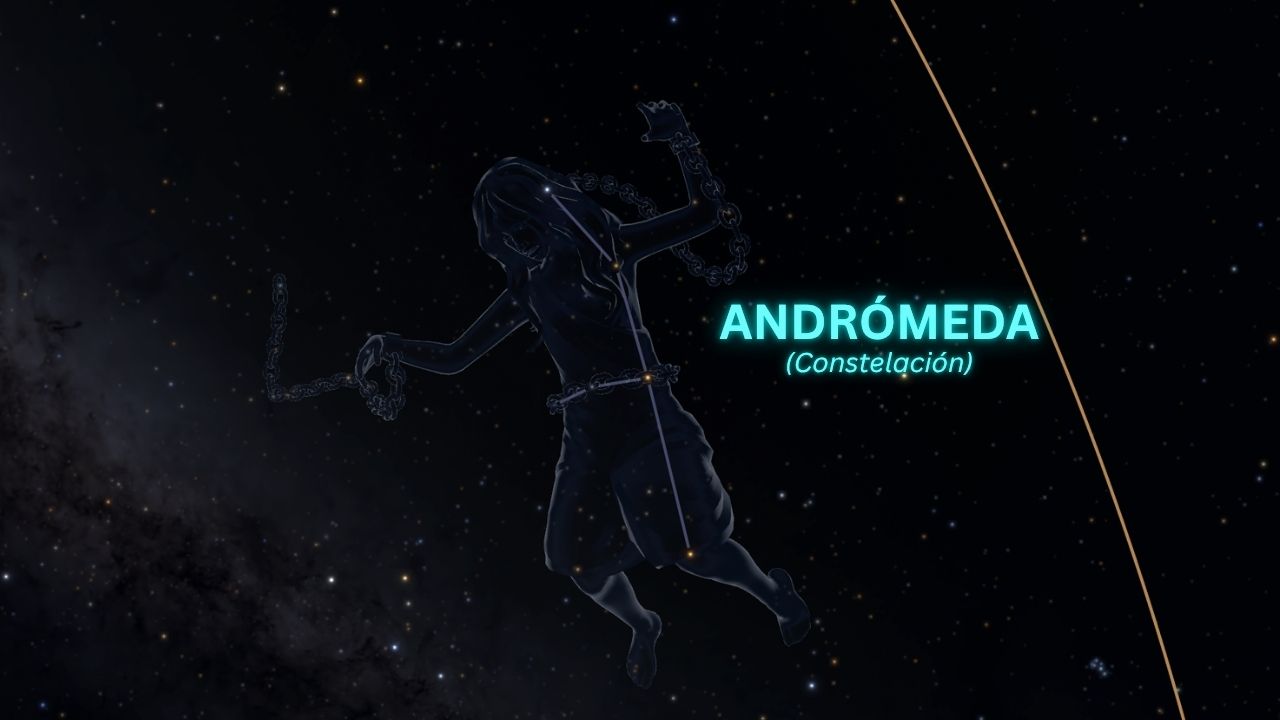
M31, the Andromeda Galaxy. The neighbor that won’t stop getting closer.
M31, the Andromeda Galaxy, has approximately one trillion stars. To put that in perspective: the Milky Way, our galaxy, has between 200,000 and 400,000 million. M31 doubles it. It’s the largest spiral galaxy in the Local Group, the cosmic neighborhood we live in, and it’s already traveling toward us at 110 kilometers per second. To calibrate that speed: it’s like covering the distance between Madrid and Paris in under two seconds, nonstop, for billions of years.
In approximately 4,500 million years, M31 and the Milky Way are going to merge.
It’s not a violent collision like the word “merger” suggests. The space between stars is so vast that the odds of two stars colliding directly are nearly zero. It’s more like mixing two clouds of smoke than a train wreck. But the result will be a completely new galaxy, elliptical in shape, that astronomers already have a provisional name for: Milkomeda. And Earth’s night sky, billions of years from now, will be completely unrecognizable.
Our descendants, if there are any, will see something from Earth that no human has ever seen.
The most unsettling fact: when you look at the Andromeda Galaxy tonight, you’re not seeing M31 as it is now. You’re seeing light that left there 2.54 million years ago. At that moment on Earth, the first members of genus Homo, our direct ancestors, were already walking around. Agriculture was still 2.53 million years away. That light left the Andromeda Galaxy when the first humans were just beginning to form on our planet, traveled that entire time through intergalactic emptiness, entered Earth’s atmosphere, passed through your pupils, and landed on your retina. You are the end of that light’s journey.
When and from where to see it:
In the northern hemisphere the Andromeda Galaxy is prominent from August through January, peaking in autumn. In October it nearly reaches the zenith at midnight from Mexico and Central America. By November it’s already visible well from dusk without having to wait until midnight.
From the southern hemisphere the situation changes. The Andromeda constellation is visible only north of 40 degrees south latitude. From Mexico City, Bogota, Lima, Caracas, or San Jose, Costa Rica, it’s visible with no problem. From Buenos Aires or Santiago it’s also visible, but lower on the northern horizon and for fewer hours each night.
How to find it:
Look for the Great Square of Pegasus: four bright stars forming a large square toward where the Sun sets in autumn. From the square’s upper left corner, follow a chain of stars toward the northeast. The second bright star in that chain is Mirach, a red giant with a characteristic orange tone. From Mirach, go straight up toward the north two star-hops. One hop is roughly the width of your closed fist at arm’s length, which covers about 10 degrees of sky. It’s the same tool navigators have used for centuries and requires no equipment at all. There’s M31, the Andromeda Galaxy: an elongated blurry patch, like a faint smudge of light, best seen if you don’t look at it directly but slightly to the side. That trick is called averted vision, and it works because the receptors most sensitive to low light are on the edges of the retina, not the center.
With the naked eye under a dark, moonless sky, the Andromeda Galaxy appears as a faint but unmistakable oval smudge. It’s the farthest object the human eye can reach without optical aid.
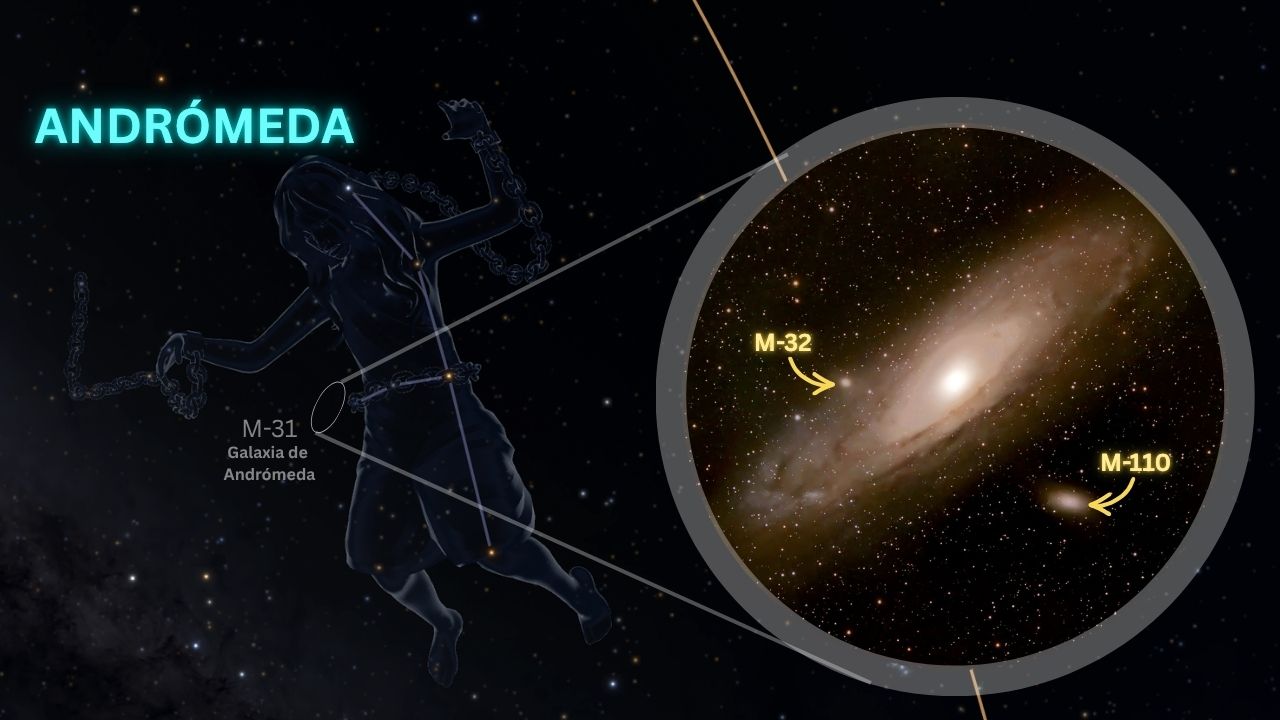
The next level reveals what the naked eye can’t. With the ZWO Seestar S50 (Mexico | United States | Spain), the experience changes completely: in a single night of image stacking it reveals M31’s spiral structure, the dark dust lane crossing its disk, the brightness differences between the compact core and the outer arms, and the satellite galaxies M32 and M110 as objects with their own shape and structure.
For those who want to go further, the jump in aperture completely changes the experience. With the SKY-WATCHER FlexTube 300P (Mexico | United States | Spain), M31’s outer halo starts to become visible on nights of excellent transparency, along with regions of higher star density in the spiral arms. It’s one of those objects that grows with every millimeter of aperture you give it.
M32 and M110. The companions nobody mentions.
The Andromeda Galaxy doesn’t travel alone. It brings at least 14 satellite galaxies along with it. The two most accessible are M32 and M110, which flank M31’s central core.
M32 is the most compact and brightest. A dwarf elliptical galaxy orbiting so close to M31 that astronomers have evidence they collided directly in the past. Not a gentle merger: a real impact that tore away its stellar disk and left visible scars in the structure of both. M32 survived. But it’s not what it used to be.
M110 is bigger and more diffuse, with an oval shape extending toward the northwest of M31’s core. With the ZWO Seestar S50 after several hours of stacking, M110 starts to reveal its own internal structure. Even galaxies have scars, and with the right equipment you can see them.
NGC 404, the Ghost of Mirach. The galaxy hiding behind a star.
While hunting for the Andromeda Galaxy by star-hopping from the Great Square of Pegasus, you pass through Mirach, the orange-red giant serving as a reference point. If you have a telescope, it’s worth stopping there before moving on.
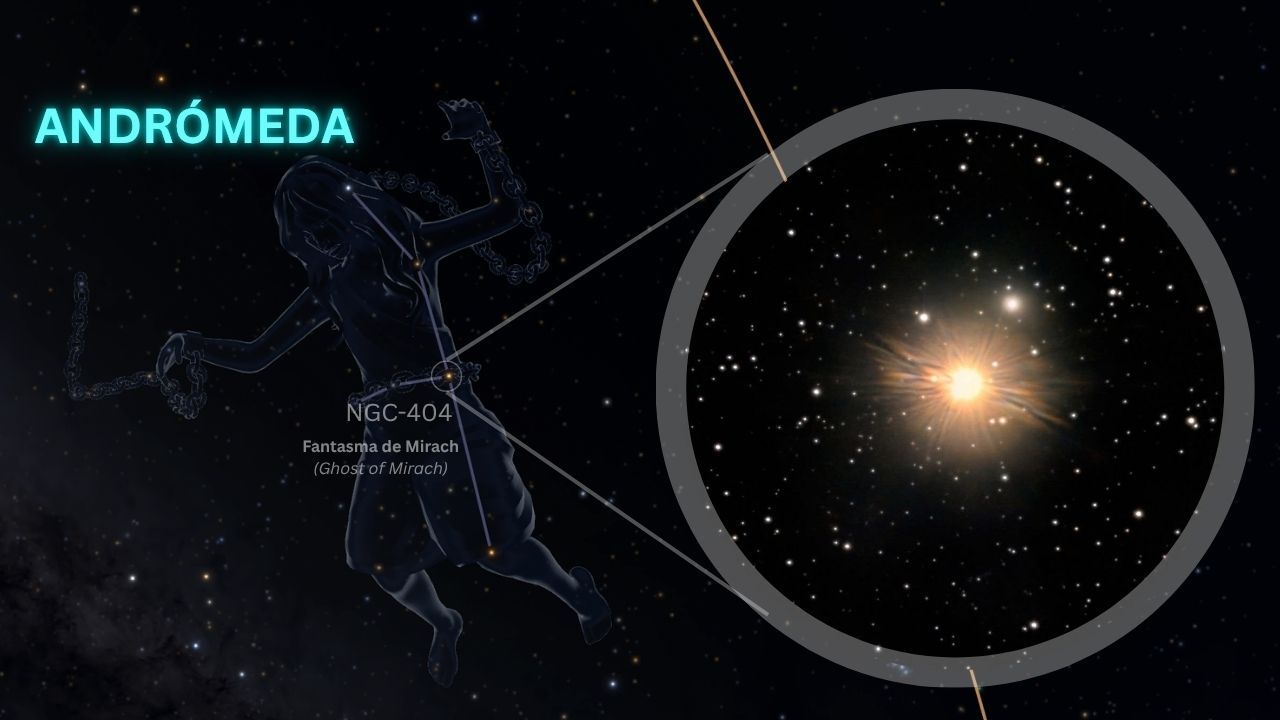
Just 7 arcminutes northwest of Mirach, hidden behind its glow, there’s a dwarf galaxy called NGC 404. Astronomers call it the Ghost of Mirach, and the name couldn’t be more fitting. Mirach shines with enough intensity to produce glare and reflections in the eyepiece that are constantly mistaken for the galaxy. For years, NGC 404 didn’t even appear on some star charts because the star’s symbol would have covered it completely.
It’s a challenging but achievable object with a visual telescope. The trick is to position Mirach just outside the edge of the field of view and use high magnification to boost the contrast between the galaxy and the star’s glow. When NGC 404 appears, it shows up as a faint, round disk with a slightly brighter core. It looks like a ghost peeking out right as the flashlight stops pointing directly at it.
The ZWO Seestar S50 handles this object well because its stacking software compensates for Mirach’s brightness more effectively than the human eye at the eyepiece.
NGC 891, the Silver Sliver Galaxy. What our own galaxy would look like from outside.
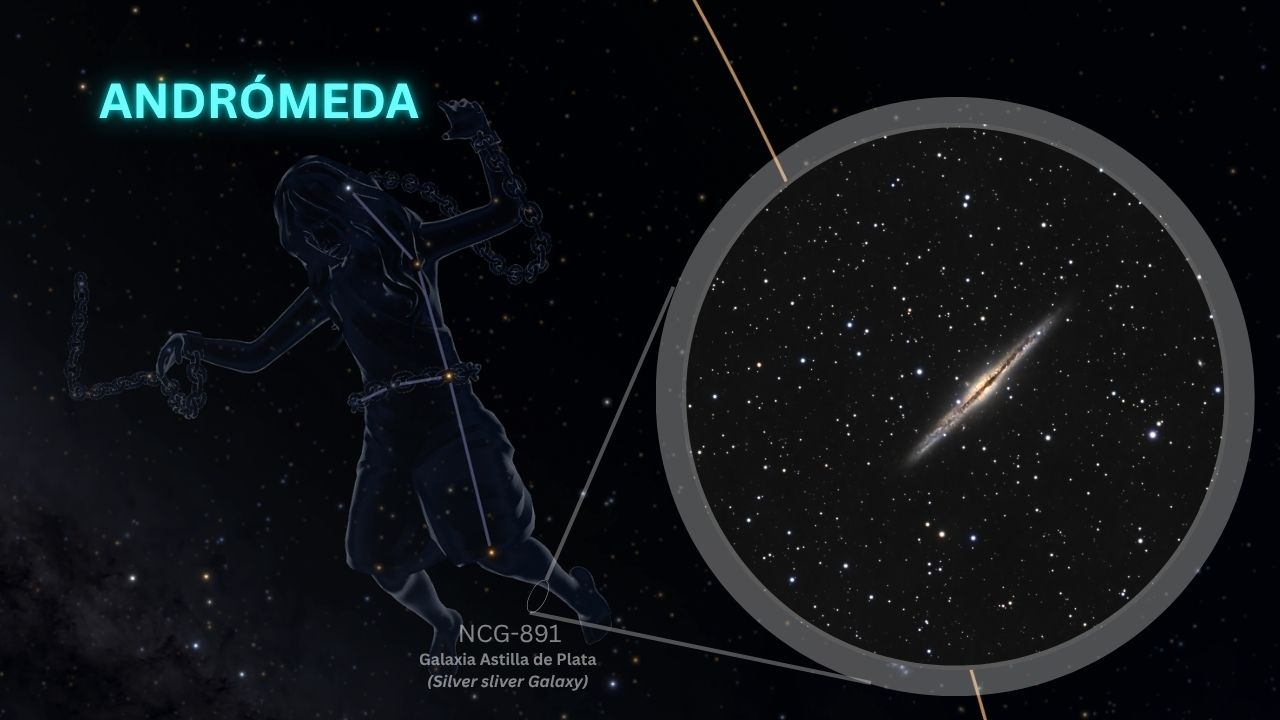
3.5 degrees east of Almach, Andromeda’s third brightest star, there’s a galaxy amateur astronomers know as the Silver Sliver Galaxy: NGC 891.
NGC 891 is oriented almost perfectly edge-on to us, which means that instead of seeing its spiral shape from above, we see it as a thin line of light with a dark dust lane cutting through its center with exact, symmetrical precision. It’s one of the most perfect edge-on galaxies in the entire sky.
And there’s a detail that makes it especially fascinating: NGC 891 is remarkably similar to the Milky Way in size and luminosity. What you’re seeing when you observe NGC 891 is, with fairly good approximation, what our own galaxy would look like if you could step outside it and look at it from 27 million light-years away. You can’t see the Milky Way edge-on from inside it. But you can see NGC 891 and get a very precise idea of what kind of galaxy you actually live in.
It was so visually important that when the Large Binocular Telescope at Mount Graham Observatory, in Arizona, took its first test image in 2005, it chose NGC 891 as its target. When you want to prove your telescope works, you aim it at the best thing you’ve got.
With the ZWO Seestar S50 on a night of good sky, NGC 891 appears as a thin needle of light with the dark dust lane already visible after several hours of stacking. With the SKY-WATCHER FlexTube 300P under dark skies, the dust lane bisecting the galaxy is evident, and on nights of excellent transparency, variations in the density of that lane start to become visible.
A princess, a galaxy, and an ending worth the wait
Andromeda has been chained in the sky for more than two thousand years, depending on who’s telling the story. A mother with an overinflated ego, a father who made the darkest decision of his life, a betrothed who chose silence, and a princess who decided for herself when no one else was able to. All of it is up there, turned into stars, every autumn night.
Tonight you can step outside, find the Great Square of Pegasus, follow the chain of stars toward the northeast, and see with your own eyes the farthest light the human eye can reach. You don’t need a telescope. You don’t need experience. You just need a dark sky and to know where to look.
Follow ASTRONOMIKA TV on YouTube, TikTok, and Instagram for more stories like this one. And if music is your thing, find us as ASTRONOMIKA BEATS on Spotify.
This article contains affiliate links. If you purchase through them, I receive a small commission at no extra cost to you.
What is the Andromeda Constellation?
The Andromeda Constellation is a northern hemisphere constellation named after Princess Andromeda of Greek mythology. It’s the 19th largest constellation in the sky and is famous for hosting the Andromeda Galaxy (M31), the farthest object visible to the naked eye from Earth, located 2.54 million light-years away.
Where is the Andromeda Galaxy in the sky?
To find the Andromeda Galaxy (M31), look for the Great Square of Pegasus, four bright stars forming a large square in the autumn sky. From the square’s upper left corner, follow a chain of stars toward the northeast until you reach Mirach, a bright orange star. From Mirach, go straight up toward the north two star-hops. One hop equals the width of your closed fist at arm’s length, covering about 10 degrees of sky. There M31 appears as an elongated blurry patch of light.
Can you see the Andromeda Galaxy without a telescope?
Yes. The Andromeda Galaxy (M31) is the farthest object visible to the naked eye from Earth. Under a dark, moonless sky far from light pollution, it appears as a faint but unmistakable oval smudge. The trick is to use averted vision: look slightly to the side of it rather than straight at it, because the receptors most sensitive to low light are on the edges of the retina.
How far away is the Andromeda Galaxy?
The Andromeda Galaxy (M31) is approximately 2.54 million light-years from Earth. That means the light you see tonight left there 2.54 million years ago, when the first members of genus Homo, our direct ancestors, were already walking the Earth.
Is it true Andromeda is going to collide with our galaxy?
Yes. The Andromeda Galaxy (M31) is traveling toward us at 110 kilometers per second and will merge with the Milky Way in approximately 4,500 million years. It won’t be a violent collision: the space between stars is so vast that few will collide directly. The result will be a new elliptical galaxy astronomers already call Milkomeda.
What months is Andromeda best seen in the sky?
The best time to observe the Andromeda Constellation and the Andromeda Galaxy (M31) is from August to January, peaking in October and November. In October, M31 reaches its highest point in the sky at midnight from the northern hemisphere. By November it’s already visible well from dusk without waiting until midnight.
From which countries and cities can you see the Andromeda Galaxy?
The Andromeda Galaxy (M31) is visible from any point north of 40 degrees south latitude. That includes all of Mexico, Central America, the Caribbean, Colombia, Venezuela, Ecuador, Peru, and northern Brazil. From Buenos Aires and Santiago it’s also visible, though lower on the northern horizon. From latitudes beyond 40 degrees south it becomes very difficult or impossible to see.
What equipment do I need to observe M31?
The Andromeda Galaxy (M31) doesn’t need any equipment to be seen: it’s visible to the naked eye under a dark sky. With the ZWO Seestar S50 on a night of stacking, M31 reveals its spiral structure, the dark dust lane, and its satellite galaxies M32 and M110 as independent objects. With the SKY-WATCHER FlexTube 300P, the outer halo and luminosity variations in the spiral arms start to become visible on nights of excellent transparency.
What are M32 and M110?
M32 and M110 are the two brightest satellite galaxies of the Andromeda Galaxy (M31). M32 is a compact, bright dwarf elliptical galaxy orbiting very close to M31, with evidence of having collided with it in the past. M110 is larger and more diffuse, with an oval shape visible northwest of M31’s core. Both are visible with the ZWO Seestar S50 on a night of stacking.
Who discovered M31?
Persian astronomer Abd al-Rahman al-Sufi was the first to document the Andromeda Galaxy (M31) in the year 964 AD, describing it as “the little cloud of night” in his Book of Fixed Stars. He didn’t know what it was, but he saw it, drew it, and recorded it with enough precision that modern astronomers could identify it without doubt. It’s the first documented description of a galaxy in human history.
Is Andromeda part of the zodiac?
No. The Andromeda Constellation is not part of the zodiac. Zodiacal constellations are those located along the ecliptic, the Sun’s apparent path across the year. Andromeda sits well north of that band, which is why Maya and Aztec cultures, very focused on the ecliptic, didn’t include it in their main astronomical systems.
What will the sky look like when M31 and the Milky Way merge?
When the Andromeda Galaxy (M31) and the Milky Way merge in approximately 4,500 million years, they’ll form a new elliptical galaxy called Milkomeda. The process won’t be violent: the space between stars is so vast that few will collide directly. But Earth’s night sky will become completely unrecognizable, with the new galaxy dominating the horizon in every direction.
Sources and further reading
Burnham, R. (1978). Burnham’s Celestial Handbook: An Observer’s Guide to the Universe Beyond the Solar System. Dover Publications.
Al-Sufi, A. (964 AD). Kitab suwar al-kawakib (Book of Fixed Stars). Available in facsimile at the Library of Congress of the United States.
NASA/ESA Hubble Space Telescope. Images and data on M31, M32, M110, NGC 891, and NGC 404. hubblesite.org
Wilkins, J. & Dunn, R. (2006). 300 Astronomical Objects: A Visual Reference to the Universe. Firefly Books.