
The myth of the hero who killed the Gorgon using a mirror, rescued a naked princess chained to a rock, and unknowingly fulfilled the prophecy he had spent his whole life trying to avoid. With medieval Arab astronomy, imperial Chinese astronomy, and the most spectacular deep sky objects of the winter sky.
By Juan Pablo Martin | ASTRONOMIKA TV | August 2026
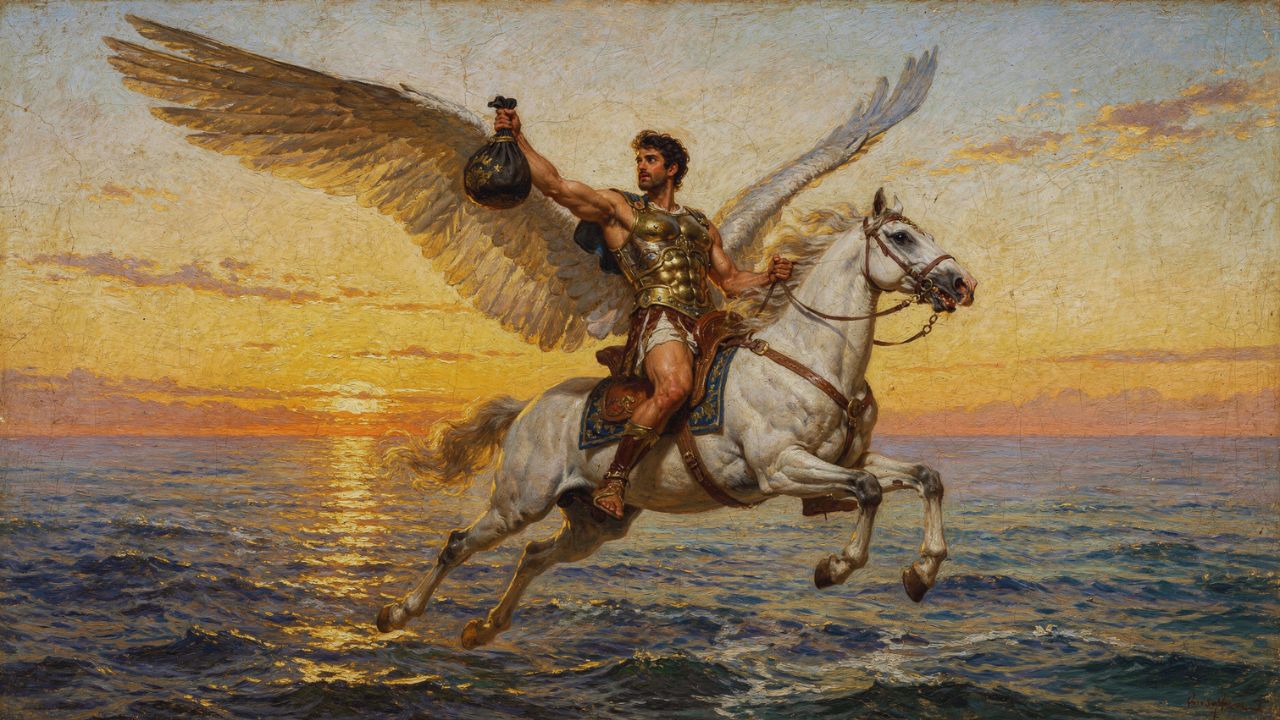
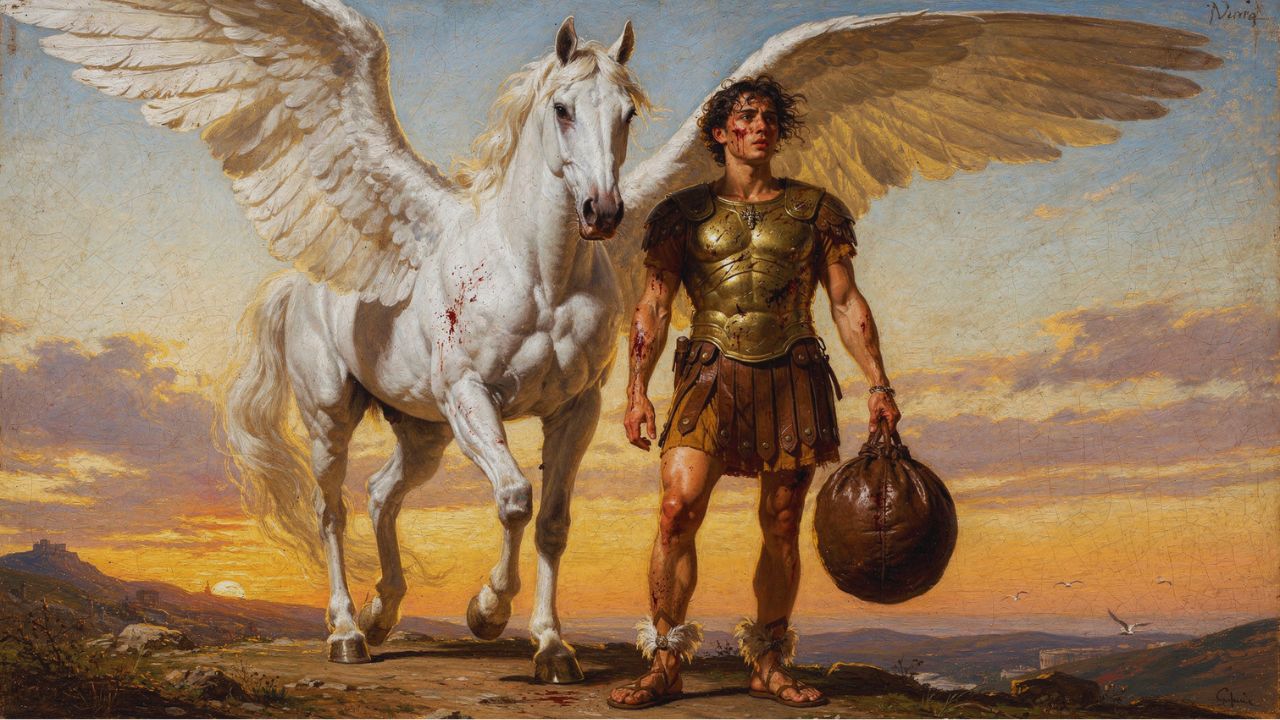
A young man flies over the Mediterranean sea riding a white winged horse, carrying something in a bag he cannot look at directly. He has just left the cave of the Gorgons. Something that still kills. Something that seconds earlier was the head of the most feared creature in the ancient world, a Gorgon whose gaze turned any living being to stone.
The sun has just risen. The sea below reflects that first orange of dawn and Perseus flies over it not yet knowing his story is just beginning. That what he has just done, killing Medusa and coming out alive, is only the prologue.
The young man is not a god. He is the son of one, but he himself is mortal. He bleeds. He doubts. He is afraid. And he has just done something no human being had ever managed before.
His name is Perseus. And his story isn’t just that of a hero completing impossible missions. It’s the story of a boy who grew up without a father, who watched his mother humiliated by a king, who received weapons he didn’t know how to use, and who, without meaning to, ended up fulfilling the cruelest prophecy in the Greek world: killing his own grandfather.
Without knowing it. Without wanting it. In the happiest moment of his life.
That’s what makes Perseus different. Not his strength. Not his divine blood. But that fate caught up with him anyway, even though he did everything right.
He still had no idea the most interesting part of his life was about to begin.
But to understand how a boy with no horse ended up flying over the Mediterranean with a monster’s head in a bag, we have to go back. To before he was born. To the fear of a king.
Danae, the Golden Rain, and the Chest Cast Into the Sea
Acrisius, king of Argos, had a daughter named Danae. And Danae was no ordinary princess. Pindar describes her as the most beautiful woman in Argos, golden hair, fair skin, the kind of beauty that in the ancient world made men make stupid decisions. Even Zeus, from Olympus, had noticed her.
The problem was that the Oracle of Delphi had just given Acrisius news no father wants to hear: his daughter’s son would kill him.
Acrisius didn’t wait around. He did what the powerful do when they’re afraid: he locked Danae in a bronze tower, no real windows, no doors to the outside, with permanent guards. The logic was simple. No men, no son. No son, no prophecy. No prophecy, Acrisius sleeps soundly.
What Acrisius hadn’t accounted for was Zeus.
The king of the gods had been watching her from Olympus long enough to decide a bronze tower wasn’t an obstacle. And Zeus, when he wanted something, found a way.
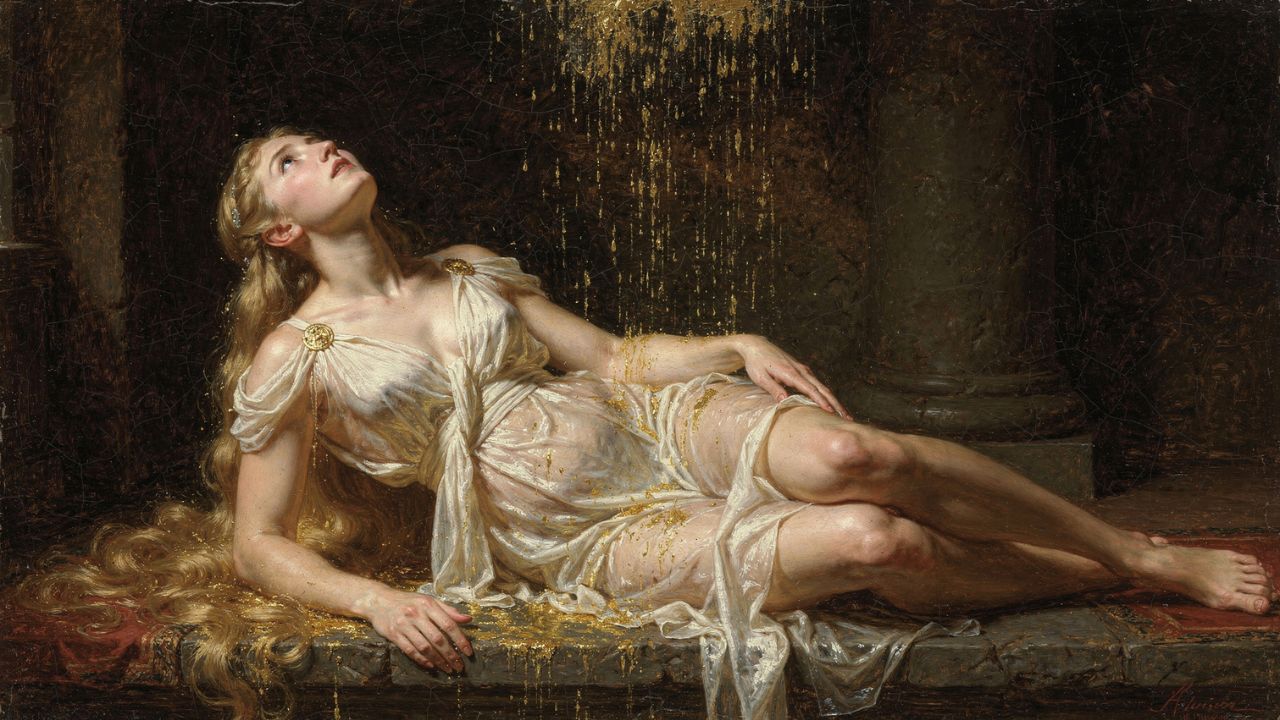
He turned into golden rain.
Danae was alone in her bronze cell when she began to notice something strange. A crack in the ceiling, or maybe between the stones, no one knows for sure, through which a light began to seep in that wasn’t sunlight. It was warmer. Denser. It had weight. The golden rain fell over her slowly, almost with intention, and with it came a voice.
The ancient texts don’t record what Zeus said to her. Pindar speaks only of a stream of gold that flowed into her lap. What is clear is that Danae understood, at some point in that experience, that the rain wasn’t rain. That the voice wasn’t wind.
The Greeks took it for granted without saying so directly: it was Zeus, the lord of Olympus, and he had gone to the trouble of turning into something completely different just for her. It was an honor that arrived without asking permission.
When Acrisius found out his daughter was pregnant, he panicked. Killing Danae with his own hands was a sacrilege the gods would punish without mercy. So he did something that in his mind sounded cleaner.
Acrisius called it divine justice. The sea simply received them without an opinion.
He had a wooden chest built. Just big enough for a woman and a newborn, with little room to move and less to breathe comfortably. He sealed it from the outside. And he threw it into the sea.
Picture that for a moment. The inside of the chest completely dark. The sound of water hitting the wood on every side. The constant motion of the waves. Danae, who days earlier was a princess of Argos, holding a newborn in that darkness with no idea whether the chest would hold, no idea where the current was taking them, no idea whether anyone would find them before the water got in.
The chest floated for days.
And someone found them.
A fisherman named Dictys, on the island of Seriphos, pulled the chest up in his nets one morning. He opened it expecting lost cargo or the remains of some shipwreck. He found a young woman, exhausted, hair stuck to her face and eyes squinting against the first light in days. And in her arms, a baby looking at him with a calm that made no sense after what they’d just been through.
Dictys took them home. He fed them. He cared for them. He wasn’t rich or powerful, just a fisherman, but he was a good person, and that, in Greek mythology, is rarer than it sounds.
Danae and Perseus lived with him for years. A simple but safe life.
Perseus grew up on that island, from baby to teenager to young man with his father’s shoulders and his mother’s character, still not knowing who he really was.
The trouble arrived with Dictys’s brother.
Polydectes was the king of Seriphos, and from the moment he saw Danae he wanted her for himself. While Perseus was growing up on the island, the king kept his distance out of calculation, not respect. The young man was deterrent enough.
When Perseus was old enough to be a real problem, Polydectes found the perfect solution. He organized a banquet where every guest had to bring a horse as a gift. Perseus had no horse, he was the son of a refugee living with a fisherman, and Polydectes knew that perfectly well when he invited him.
Perseus, young and with his pride intact, said what any young man his age would have said: that he could get anything the king asked for.
Polydectes smiled and said what Perseus wasn’t expecting: “Then bring me Medusa’s head.”
It was a death sentence disguised as a request. No one had ever returned alive from an encounter with a Gorgon. The plan was simple: Perseus leaves, Perseus dies, Danae is left alone.
Perseus didn’t know that yet. But he was about to find out.
The Weapons of the Gods
Perseus left Polydectes’s banquet with his mouth dry.
Not from the wine. From what he’d just said.
Medusa’s head. He had spoken those words in front of everyone as if it were something you could pick up at a market, as if there were some version of the world where a boy with no horse, no armor, and no real combat experience could walk back from that mission. Now he was alone in the Seriphos night and the silence was crushing him.
Medusa was a Gorgon. That wasn’t some children’s legend. It was as established a fact as the sun: looking at her directly turned you to stone. No one had ever come back from where the Gorgons lived. No one. And he had just promised to bring back her head like it was a birthday present.
That’s when they appeared.
There was no thunder, no blinding light. Simply, suddenly, he wasn’t alone anymore. Two figures in front of him in the dark.
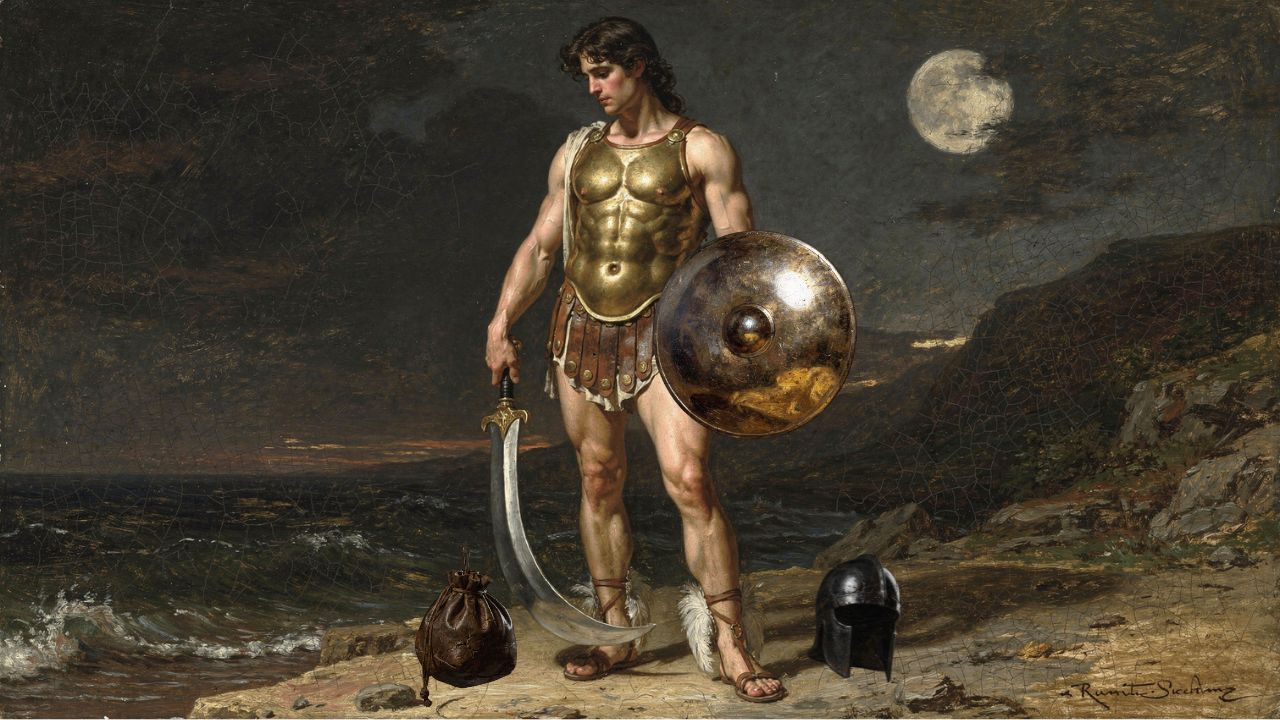
Perseus was about twenty years old, give or take. Tall, broad-shouldered, with the kind of body that forms when you grow up working with a fisherman and then spend weeks on a mission that demands moving, climbing, and surviving. His light armor left his arms exposed, tanned by the Mediterranean sun. Dark hair tousled by the wind. Nothing about his appearance suggested he was about to receive gifts from three Olympian gods and the underworld. That, perhaps, was the most dangerous thing about him.
A woman with gray eyes, the coldness of someone who’s always right and knows it, straight posture, a gaze that didn’t blink. A young man with a smile that suggested he knew something you didn’t and was enjoying it. Athena, goddess of wisdom and battle strategy, daughter of Zeus. And Hermes, messenger of the gods, the fastest being on Olympus, the only one who could move freely between the world of the living and the world of the dead.
Perseus recognized them instantly. Any Greek would have. And he felt two things at once: relief and terror, because when gods show up in person in front of you, it’s usually because what comes next is too big to handle alone.
Athena spoke first. No preamble. She told him the mission was possible, but going in unprepared was suicide. That he needed three things before approaching where the Gorgons lived: to know where to find them, to know how to move without being seen, and never, under any circumstances, to look at Medusa directly.
Then the gifts began.
Athena’s bronze shield. It was no ordinary combat shield. It was a piece of polished bronze so fine, so worked, that its surface reflected like a perfect mirror. Perseus picked it up and saw his own face in it, slightly distorted by the curve of the metal, but perfectly clear. If you can’t look at Medusa head-on, you look at her in the reflection. You work with your back to her. You use the shield as your eyes.
Hermes’s Harpe. It wasn’t an ordinary sword or a field sickle. It was something in between, and more lethal than either: a curved blade like the moon in its waning quarter, designed to hook and pull rather than push, like a knife that cuts better when dragged than when stabbed. A single well-placed strike was enough to end anything. But what made it truly unique wasn’t its shape. It was the material. Adamantine. The same metal Cronus had used to castrate Uranus in the time before time. A metal that exists in no mine, that melts in no human forge, forged somewhere between the divine and the physical. With an edge that doesn’t dull. That doesn’t give. That cuts what no ordinary metal can cut.
Hermes’s winged sandals. Two small white wings on each ankle, soft to the touch like real feathers, but with a strange density, as if they carried more substance than they showed. Hermes told him to think about rising, nothing more, and Perseus did it almost by reflex, and his feet left the ground. It wasn’t dramatic. There was no gust of wind, no sound. He simply stopped being on the earth and was in the air, level with Hermes’s eyes, floating with the same ease with which you stay afloat in water once you’ve learned to swim. He stayed there a few seconds without saying anything. Looking down. Looking at his own feet over the void. Hermes smiled. “You can come down now.”
The helm of Hades. The nymphs of the north, the Hesperides, kept something in their custody that belonged to the god of the underworld: the helm of Hades, a helmet that made its wearer invisible. It was dark leather, no ornaments, no decoration. Nothing that made it look special from the outside. But when Perseus put it on his head, Athena and Hermes stopped looking at him. Not because they lowered their eyes. Because they could no longer see him. Completely. No trace, no shadow, no sound of footsteps. Perseus took it off and existed for them again.
The kibisis. Athena handed him one more thing before leaving. A leather bag, completely ordinary in appearance. But its interior was made to hold what no normal container could: Medusa’s head, which even separated from her body kept watching and kept killing. The mechanics were these: after the strike, extend the open bag behind him without turning around, guided only by the shield’s reflection, put the head inside without seeing it at any point, like someone picking something up off the ground completely blind, relying only on what they see in a mirror. Close the bag first. Turn around after. In that order.
Before disappearing, Athena and Hermes gave him one last instruction: first he had to find the Graeae, three elderly sisters of the Gorgons who shared a single eye and a single tooth between them. They knew where the Gorgons were. And they weren’t going to say so willingly.
Perseus spent the rest of that night with the weapons in front of him, unable to sleep, going over every move. The shield in his left hand, the Harpe in his right, the sandals on his feet, the helm ready to put on at the exact moment. It smelled of sea and cold night air. The shield’s bronze was cool to the touch. The sandals’ feathers, absurdly soft for something with so much power.
He left before dawn. For the first time in his life, fear and preparation weighed exactly the same.
The Night of Medusa
The Graeae weren’t hard to find. They were impossible to ignore.
Three figures in the half-light of a place that wasn’t exactly on any map, a point between the known world and the one that begins where sailors stop going. Old since before Perseus was born, old since before his mother was born, old perhaps since forever. They shared one eye between the three of them and one tooth between the three of them, passing them hand to hand depending on who needed to see or eat at that moment.
Perseus watched from the shadows with the helm of Hades on, invisible, and felt something he didn’t expect to feel: not fear yet, but a mild nausea. The sight of the three figures passing the wet eye hand to hand in the dark was the kind of image that sticks behind your eyes forever.
He waited for the exact moment. When the eye was in the air, in transit between two hands, Perseus took it.
The Graeae exploded into screams. Perseus let the silence do the work. Then he spoke, without revealing exactly where he was, only his voice floating from some point in the dark. The eye in exchange for the Gorgons’ location. The Graeae resisted. They cursed. They threatened with whatever three blind, toothless old women could threaten with. But without the eye they couldn’t see anything. Eventually they talked.
Perseus kept his word, gave the eye back, and left before they could use it to see him. He rose on the sandals and followed the course they’d given him.
Flying toward where the Gorgons lived, he felt something that wasn’t exactly courage. It was more the temporary absence of fear, that strange state where the brain disconnects from the consequences because if it thinks them through in detail, it stops moving. Perseus had chosen not to think. Just follow the procedure.
The air changed before he could see them, several degrees of difference within seconds, and with it came a smell he couldn’t name: damp stone, something ancient, something mineral mixed with something that had no reference in any previous experience. The kind of smell the body recognizes as danger before the brain can process why.
Hollywood has told this story many times with an epic face-to-face battle and Medusa as a grotesque, repulsive creature. The original sources say otherwise on both counts. Perseus found her asleep, because facing her awake was suicide. And her face, according to Ovid, Pindar, and Apollodorus, had nothing monstrous about it. Athena’s curse changed her hair, not her face. What Perseus was about to face in that cave wasn’t something disgusting to look at. It was something beautiful that kills. And there’s something in that combination considerably more terrifying than any monster Hollywood has ever designed.
The real epic that night wasn’t the strike. It was everything before it.
The full story of Medusa, who she was before becoming what she became, what was done to her, and why she ended up as the most feared creature in the ancient world, deserves its own article. And it’s going to get one. [Article on Medusa, coming soon]
He found them asleep.
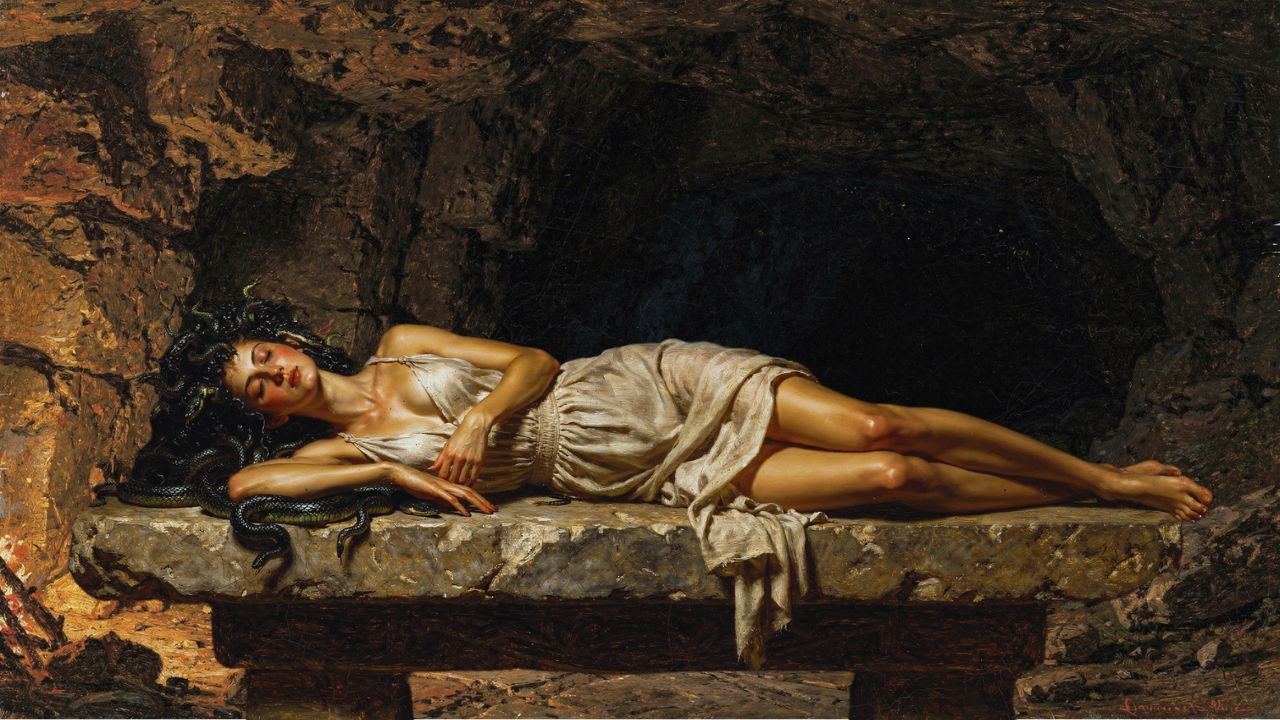
And he saw her. In the polished metal. Asleep.
It wasn’t what he expected. Perseus had spent weeks mentally building the image of a monster, something grotesque and repulsive, something disgust would make easier to face. What the reflection showed him was a woman. Beautiful. With the strangest hair he’d ever seen, a dense crown of small snakes moving slightly even in sleep, but with a face that had nothing monstrous about it.
No ancient text says Athena disfigured her face when she cursed her. She only changed her hair. And gave her that gaze. But now her eyes were closed, and what Perseus saw in the reflection was simply a sleeping woman, beautiful and dangerous at once, with no idea anyone was watching from the dark.
That made everything harder. But Danae was still waiting in Seriphos.
He went down slowly. The sandals made no sound. The helm kept him invisible. He raised the shield in front of him and searched the reflection, moving backward, inch by inch, toward where the polished metal showed him Medusa was.
And then one of the other Gorgons moved.
Not waking up. Just shifting position in her sleep, an abrupt movement that made her arm fall onto the stone with a dull thud that in that absolute silence sounded like thunder.
Perseus froze.
He stopped breathing. Literally. The air got trapped in his chest and didn’t come out. Three seconds. Five. Ten. Shield raised, Harpe in his right hand, invisible but completely paralyzed, listening for whether the movement would continue. Whether something would wake up. Whether that sound had been enough to end everything right there.
Nothing happened.
The silence returned. The figure stopped moving. And Perseus exhaled slowly, so slowly that the sound of his own breath felt deafening to him.
He kept moving forward.
When the shield’s reflection showed him he was in position, that he had the right angle, that the distance was what he needed, he paused. Just a second. The last second before.
He thought of his mother. It wasn’t a conscious decision, she was simply there, Danae, in that final second, and that was enough.
He raised the Harpe.
The strike was precise. The adamantine blade did in a single motion what no ordinary metal could have done. And Perseus, without turning around, extended the open kibisis behind him, guided only by the shield’s reflection, caught what had fallen, closed the bag, and only then, only once the bag was closed and secured, did he allow himself to turn around.
Then something happened that wasn’t in any instruction Athena or Hermes had given him.
From Medusa’s blood, from the place where her neck had been, two figures emerged. One was Chrysaor, a warrior born adult and armed. The other was a white horse with enormous, perfect wings, which unfurled in the darkness of that cave with a sound like sails unfolding in the wind.
Pegasus.
Perseus watched it being born. Watched the horse spread its wings for the first time, shake its head, take a step on stone with hooves that in that silence rang out like bells. And there was a moment, brief as anything, where the two of them looked at each other, the young man with the closed bag in his hand and the newborn horse with its wings still wet, and something passed between them that no ancient text describes precisely.
That’s when the other Gorgons woke up.
There was no time. Perseus mounted Pegasus, who responded as if he’d been waiting for him, as if he knew exactly what he’d been born for, and together they shot out of that place into the open night. The Gorgons hunted for them with a fury that made the air shake. But the helm of Hades did its job. They found nothing.
There are versions of this story where Perseus rode Pegasus from that very moment, and it has to be said, they make the story considerably more interesting and visual. If the winged horse was just born from the greatest feat of your life, there’s something poetically perfect about flying out of there together. We take that creative liberty gladly.
He was alive.
And beneath him, the Mediterranean sea was beginning to turn orange.
Andromeda: What Perseus Saw From the Air
Perseus had no plans to stop.
He’d been flying for hours over the Mediterranean with the kibisis in hand, Pegasus beneath him responding to his every thought as if the two of them had been flying together for years, and in his mind a single destination: Seriphos. His mother. Ending this.
He had accomplished the impossible. He had Medusa’s head. Polydectes was about to become a very elegant statue and Danae was about to be free. That was the plan. That was everything.
And then he looked down.
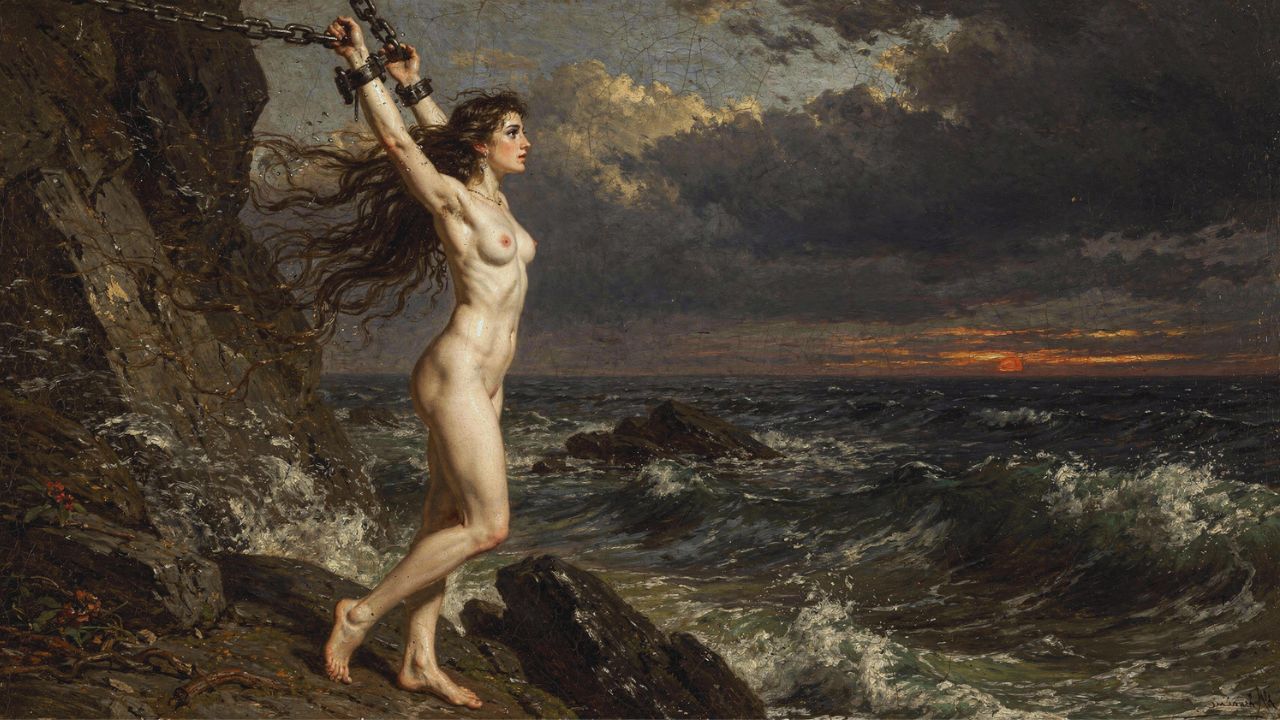
There was something on the coast of Ethiopia that shouldn’t be there. A lone human figure on a rock the sea was pounding from every side. Perseus dropped altitude a little without thinking, on pure instinct, because something about that image didn’t add up.
He dropped a little more.
From the air, it had already been hard to ignore. Up close, ignoring it was flatly impossible.
It was a young woman. Chained to the rock by the wrists, arms extended upward, completely exposed to the wind and the sun and the gaze of anyone who happened to pass by. Completely exposed, period, because she wasn’t wearing anything. Not a stitch of cloth. Not a single ornament. Nothing.
Perseus stopped thinking about Seriphos.
She was slender, the kind of slenderness that isn’t fragility but perfect proportion, skin white as Parian marble contrasting with dark chestnut hair the sea wind was tossing in every direction, sticking to her neck, her shoulders, her face. With no line of clothing dividing her anywhere, which meant that contrast between fair skin and dark hair was completely visible from top to bottom, without interruption.
Perseus dropped a little more.
The sea splashed against her long, well-toned legs, water running down them as the waves climbed the rock. Her waist was narrow, almost unbelievably narrow, opening into hips that had that curve Greek sculptors had spent centuries trying to capture in marble without ever quite managing it. Her stomach was flat and taut, with that smooth line running down from the navel. Her chest was generous for such a slender figure, firm, defying with total indifference both gravity and the sanity of any male observer within a reasonable radius. That position left absolutely nothing visually unresolved, and Perseus was a young man with active adrenaline who had gone, to put it conservatively, far too long without seeing something like this up close.
She smelled like sea and salt and warm skin under the sun. And beneath all of that, something softer and more her own, something warm and feminine the water hadn’t washed away but concentrated, that reached him from very close, and that Perseus registered without meaning to and couldn’t unregister.
He thought about four things at once, approximately.
The first was that he had to get down there.
He landed on the rock. Got off Pegasus and walked toward her. He wore his light armor stained with whatever remained from the cave of the Gorgons, which he preferred not to identify in more detail, dark hair stuck to his forehead by sweat and sea wind, and exposed arms with that direct, unpretentious muscle of someone who actually uses them. He wasn’t the kind of hero painters would later put in a fresco, perfect and immaculate. He was a young man who had just done something impossible and still had the adrenaline in his eyes.
She looked at him with big dark eyes, with a mix of relief and distrust that made perfect sense given he was a stranger who had just appeared flying in from the sea on a winged horse.
“Who are you?” she asked. Her voice was steady for someone in her situation, which Perseus found, if anything, even more attractive.
He introduced himself. Son of Zeus, slayer of Medusa, occasional traveler by winged horse. The complete résumé. And then he asked what any reasonable person would have asked: what a woman like her was doing in a place like this, in conditions like these.
She told him. Her mother Casiopea’s pride, the Nereids’ curse, the sea monster coming to claim her as an offering. The full story from Andromeda’s perspective has its own article, and it’s worth reading. What we’ll tell here is what Perseus lived through in those hours.
Andromeda was still on the rock. Chained. Waiting. Every minute Perseus spent convincing a pair of parents was one more minute she stayed there, exposed to whatever came from the sea.
He went to speak with her parents.
The Negotiation on the Terrace
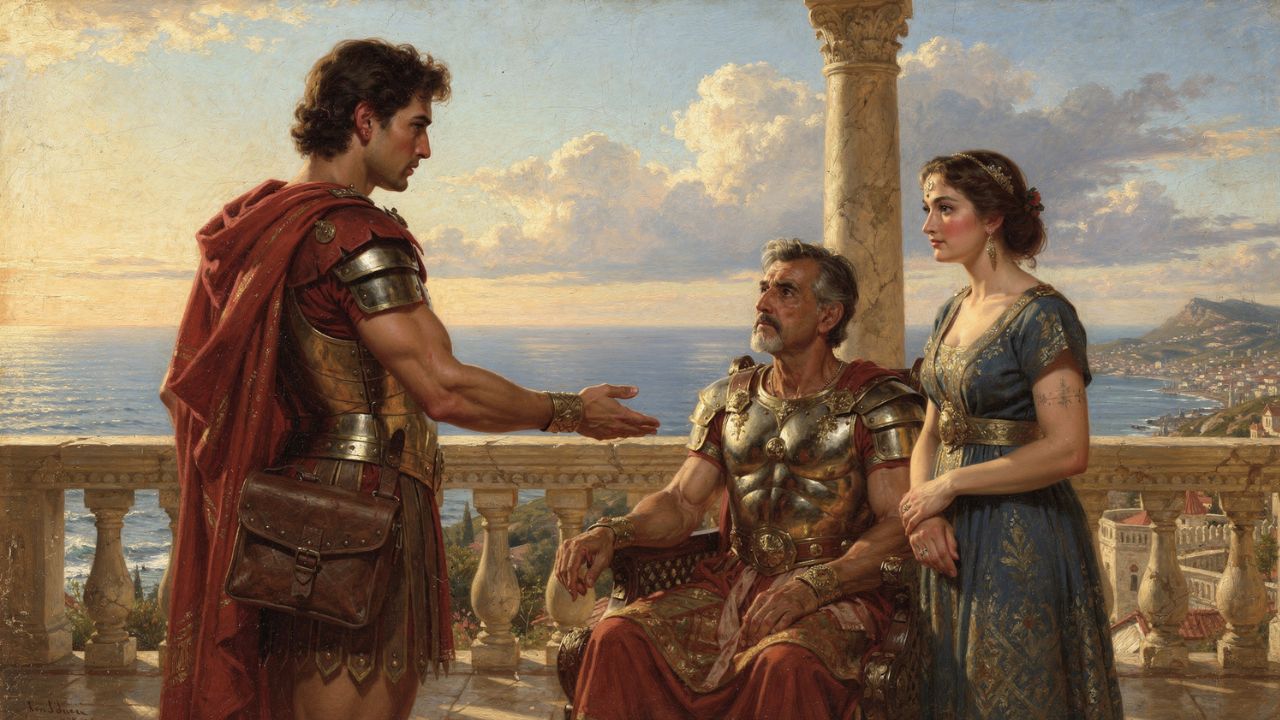
Cepheus and Cassiopeia saw him arrive from the palace terrace, that lookout over the cliff from which they’d spent hours staring at their daughter chained on the rock across the way, unable to do anything. Against that backdrop, the entire conversation carries an extra emotional weight: Andromeda was visible from there through the whole negotiation.
First they heard the sound, something between wind and flapping wings, a rhythm that matched no bird they knew. Then they saw it: a human figure on a white horse that wasn’t flying like a bird, descending in a spiral toward the palace with a calm that clashed with the fact that it was a man on a horse in the air.
Cassiopeia grabbed her husband’s arm.
Cepheus said nothing. The two of them just stared until Perseus landed on the terrace. The guards recognized him and had no idea what to do with that information, because it clearly wasn’t in the protocol for a warrior to come flying in on a winged horse. Well, he hadn’t left with a horse. He’d come back with one. With wings. But that was a protocol problem, not his.
“I am Perseus, son of Zeus and Danae of Argos.”
Cepheus blinked. Cassiopeia blinked. The two of them looked at the winged horse standing there on their terrace with total indifference, as if that were the most normal thing in the world.
Perseus got straight to the point. He had no time for small talk, because the sea monster could show up at any moment and Andromeda was still chained to that rock. He told them he’d seen their daughter. That he knew what was coming. That he could face it.
Cepheus looked at him with the expression of a man who hasn’t slept in days and has just heard something he desperately wants to believe but that his brain hasn’t quite processed yet.
“Alone?”
Perseus opened the kibisis slightly. Just an inch. Enough for Cepheus and Cassiopeia to glimpse something inside without really seeing what it was. Both took an involuntary half-step back.
“Just me,” Perseus confirmed, and closed the bag.
“If I kill the monster and save Andromeda,” he said, with a calm that even surprised himself given what he was about to propose, “I want her hand.”
Silence.
The alternative to saying yes was his daughter dying, devoured by Cetus, in the next few hours. “Deal,” said Cepheus.
What Perseus didn’t know at that moment, because no one mentioned it in that conversation, was that Andromeda was already promised to someone. What Cepheus had left out would come back that night with the full force of things left unsaid at the wrong moment. His name was Phineus.
Perseus left the palace, mounted Pegasus, and flew back to the coast before Cepheus had even finished processing what he’d just agreed to. There was no time to lose. Cetus could show up at any moment, and Andromeda had already been chained to that rock for far too many hours.
The Battle With Cetus
He reached the rock with the sun still high. No solid plan beyond the fact that Andromeda couldn’t die devoured by a sea monster that day, a noble goal even if the operational details were still considerably vague.
He positioned himself in the air above the rock, Pegasus still beneath him as if the horse understood this wasn’t a moment for sudden movements. Andromeda watched him from below with those big dark eyes. He gave her a reassuring gesture with his hand.
Then the sea changed.
It wasn’t gradual. It was a before and after separated by three seconds. The water that a moment earlier had been blue and relatively calm began moving from below, a deep, slow motion that had nothing to do with normal waves. The kind of movement that happens when something enormous shifts in the depths and the entire ocean has to make way.
Perseus felt the change before he saw anything. A vibration in his chest, in his bones, somewhere deeper than his ears. The kind of frequency the body registers as danger before the eyes confirm why.
Then Cetus appeared.
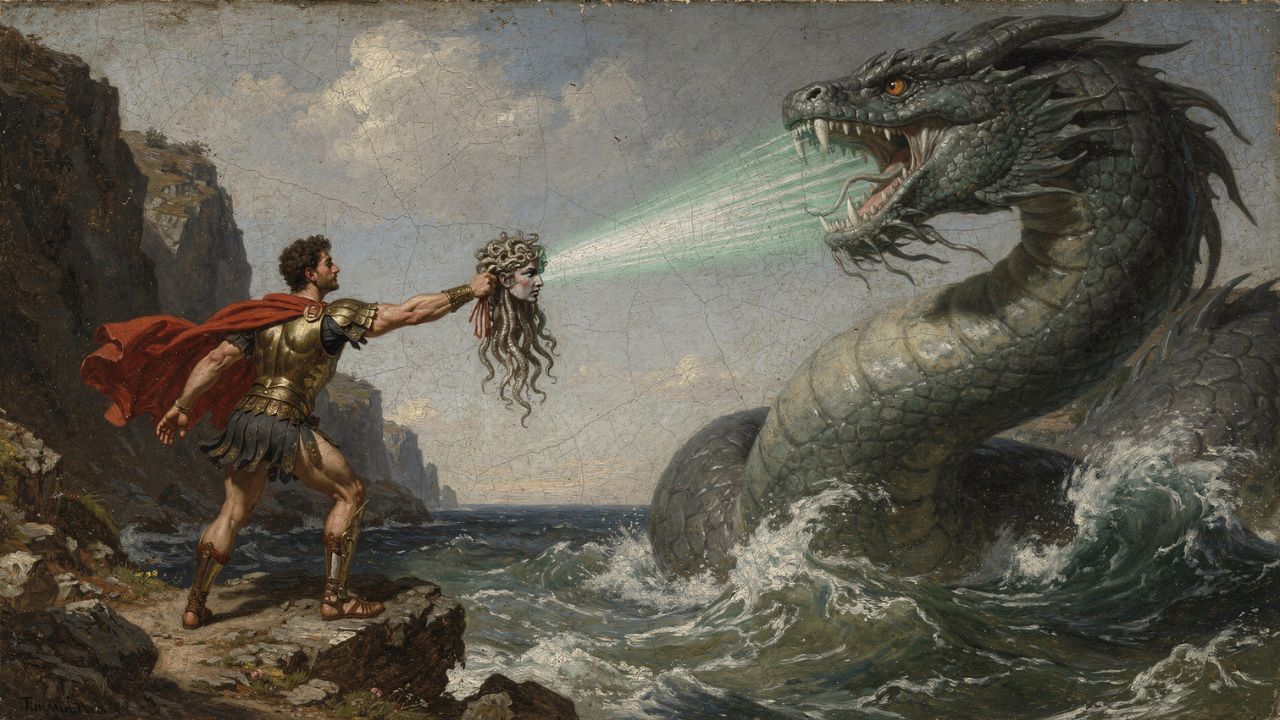
It emerged slowly, with the unhurried confidence of something that has never had predators in its entire existence and therefore feels no need to rush. First the head, dark green, the size of a mid-sized ship, with scales that reflected the sun like wet armor. The fangs were long and curved, the color of old bone, jutting out even with its mouth closed. And the eyes, two yellow points with vertical pupils, carrying the gaze of something that has been doing this for millennia and has never once failed.
The neck emerged next. Then the body, endless, snaking beneath the surface with ripples that churned the water in every direction. Perseus tried to calculate the total size and at some point stopped trying, because the number wasn’t helping him emotionally.
Cetus saw Andromeda on the rock. And accelerated.
Perseus had about four seconds of pure paralysis. A sea monster the size of several ships bearing down on a chained woman who couldn’t move, and there he was, up in the air, with a leather bag, a Harpe, and no concrete plan.
The Harpe wasn’t going to work. He understood that immediately, with the brutal clarity that well-focused panic provides. Getting close enough to use the Harpe meant being within range of those fangs. He thought. The monster was about thirty meters from the rock. Then twenty.
And then he saw it. The bag.
It wasn’t exactly a plan. It was more a question that answered itself in a fraction of a second: if Medusa’s head turned any living creature to stone, what would it do to a sea monster the size of a floating island?
There was only one way to find out.
Perseus put his hand into the kibisis without looking inside, grabbed what he found, and drew himself up on Pegasus to his full height. He turned toward Cetus, holding Medusa’s head pointed directly at the monster, arm extended firmly upward, his own gaze turned to one side, toward the horizon, because even though there was no direct danger to him, no one in their right mind experimented with the edges of that kind of power any more than strictly necessary.
Cetus had its mouth open when it saw her.
The effect wasn’t instant. It was worse than that. It was progressive, visible, relentless. It started at the monster’s head, that dark green turning gray first, then stone, then rock, the open jaw freezing mid-motion with its fangs exposed. Then the neck. Then the enormous body snaking beneath the surface, section by section, petrifying from front to back like a wave traveling in reverse.
The process took nearly a minute.
A minute during which Perseus stayed in the air, arm raised, eyes fixed on the horizon, praying to his father Zeus and to Athena and to Hermes and basically to any available deity that no stray reflection in the water would play a cruel trick on him.
When the sea went still again, he looked.
Cetus was stone. A new rock formation on the coast of Ethiopia, shaped like a gigantic sea serpent with an expression of absolute surprise. Mouth still open, fangs bared, yellow eyes frozen at the exact moment it realized something had gone very wrong.
Perseus put the head back in the bag. Closed it. Exhaled for about five straight seconds.
Then he looked at Andromeda.
The Rescue
He mounted Pegasus and flew to the rock. Got off Pegasus and walked toward her over the wet stone. Drew the Harpe. Cut the chains with one clean strike at each wrist. The metal fell into the sea with two brief sounds, and Andromeda lowered her arms slowly, with the visible relief of someone who’s held them raised too long.
And she fell forward.
Her hands found Perseus’s shoulders by instinct, her slender fingers gripping the metal of his armor, and his hands found her waist before she finished falling. Damp, warm skin beneath his palms, the curve of her hips between his fingers, her weight light and real against him.
She smelled even better up close.
Perseus felt his heart, which had just started slowing down after Cetus, decide to speed up again for entirely different reasons. And he noticed, with that particular clarity adrenaline has when it mixes with other things, that she wasn’t pulling away. That her hands were still on his shoulders. That she was looking at him from very close with those dark eyes that didn’t drop.
“Are you okay?” he asked. It was objectively the most unnecessary question asked on the coast of Ethiopia that day. But it was what there was.
She looked at him a second before answering. “Now I am.” And in those two words there was something that wasn’t just gratitude.
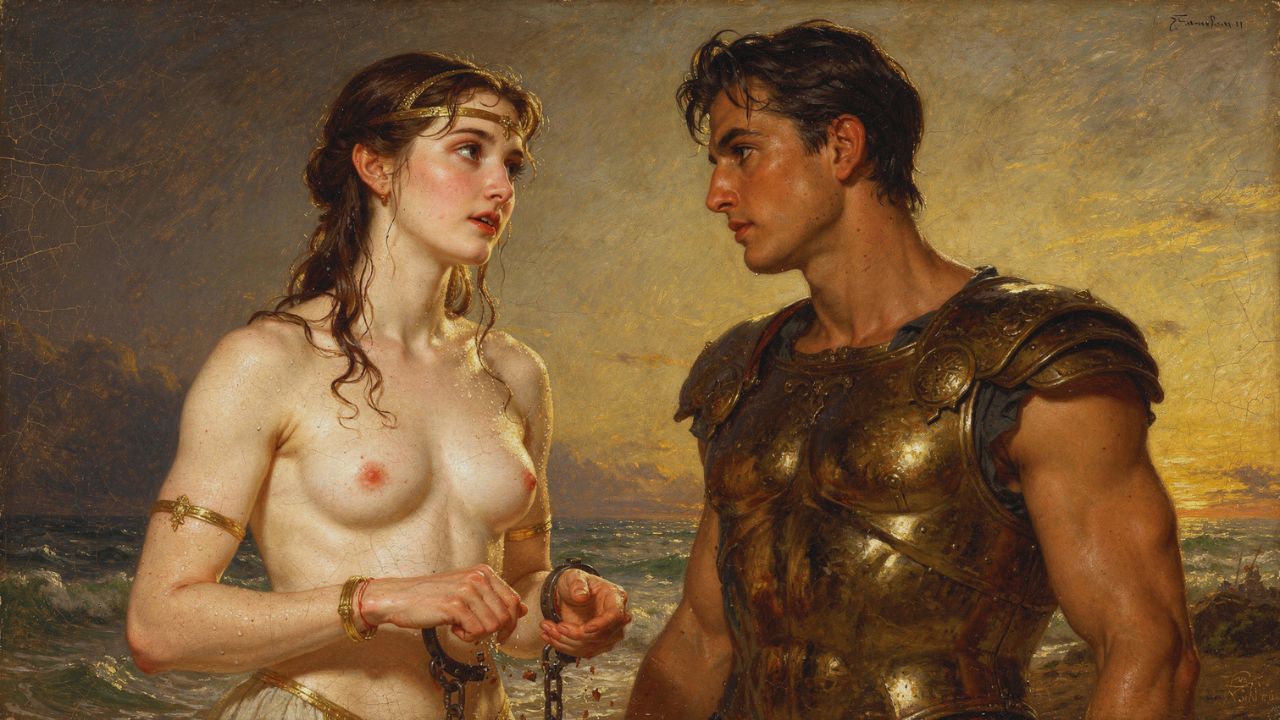
He lifted her onto Pegasus. She ended up seated facing him, her back against his chest, her hips between his legs, her chestnut hair, tossed by the wind, whipping across Perseus’s face with every gust. He put his hands on her waist to hold her steady. His thumbs brushing, without meaning to, that curve where the waist opens into the hips. And he noticed she wasn’t pulling away. Quite the opposite. With every movement of Pegasus in the air, with every current that pushed them slightly, she settled back a little more, toward him, as if the physics of flight were a convenient excuse for both of them.
She asked him if he’d been afraid before going into the cave. Perseus opened his mouth to answer and right at that moment Pegasus caught a current of air and she settled back against him. The answer took several seconds longer than necessary.
When they landed on the terrace over the cliff where Cepheus and Cassiopeia were waiting, Perseus got down first and helped her descend. His hands on her waist again, her weight leaning into him for a second before finding solid ground. She held his gaze a moment longer than necessary before turning toward her parents.
Cepheus and Cassiopeia swept them up in hugs and tears and tumbling words. Perseus let them have that moment and stayed a step back, watching Andromeda reunited with her family. He thought of his own mother. Of Danae waiting in Seriphos. Then he thought about the fact that he’d just gotten engaged to the most beautiful woman he’d ever seen, who was clearly not indifferent to him, and that wasn’t bad either for someone who three days earlier hadn’t even had a horse, and now had one with wings.
The Wedding, Phineus, and the Stone Groom
The wedding was held that same night. Torches, wine, music, and the collective relief of a city that had expected a funeral and threw a party instead. Andromeda was seated beside him, dressed in fine ivory fabric, with those dark eyes still watching him with the same heat as on the rock, only now from a distance of half a forearm instead of separated by the sea.
Perseus thought that marrying her was an excellent idea.
It was a good moment. It lasted exactly until Phineus showed up.
He entered the hall with the walk of someone who had rehearsed his entrance, surrounded by a group of armed men who clearly hadn’t come to dance. Phineus was Cepheus’s brother and Andromeda’s official fiancé, a detail Cepheus had considered unnecessary to mention during the terrace negotiation.
He was taller than Perseus. Bulkier. With the look of someone who is right to be furious and knows it, which made him considerably more dangerous than someone who was simply furious.
The hall went silent.
Phineus pointed at Perseus with a finger that didn’t shake. “That woman is mine. The engagement existed before you came flying in from wherever it is you come from.”
Perseus looked at him. Then looked at Cepheus. Then looked back at Phineus.
“Where were you when Cetus was coming for her?” he asked. Without raising his voice. Without moving from his seat.
Phineus didn’t answer that directly, which was basically an answer.
At some point in that exchange, once the words ran out and Phineus’s men started to move, Perseus stood up, raised a hand toward his own people so no one would look, reached into the kibisis, and pulled out Medusa’s head for the third time in two days.
Phineus had exactly enough time to understand what he was looking at.
He was left standing in the middle of the hall, in gray stone, arm still extended in the accusatory gesture he’d been making, mouth slightly open, eyes carrying an expression later historians would politely describe as surprise but which was actually something considerably more specific.
It was a perfectly detailed statue of a furious man who arrived too late to his own wedding.
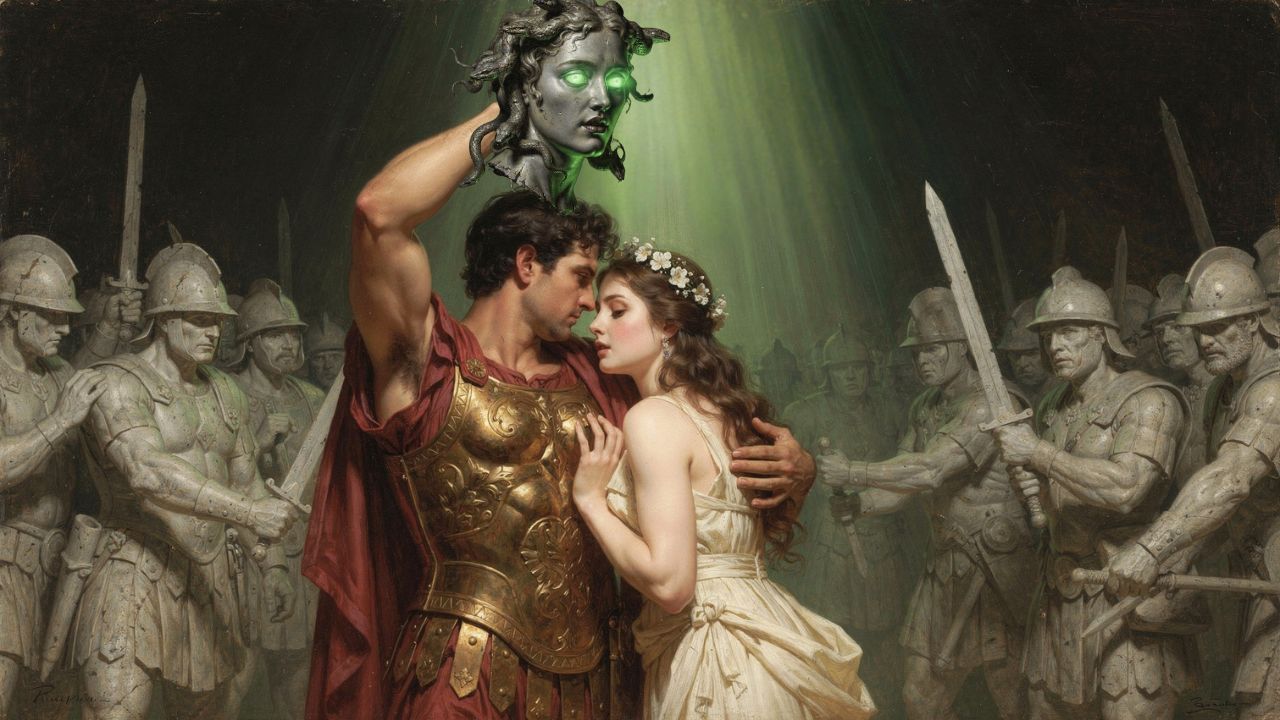
Perseus put the head back in the bag, looked around the hall where the guests who’d had the good sense not to look in the wrong direction remained fully flesh and blood, and sat back down next to Andromeda.
She watched him with those dark eyes. With something between admiration and amusement she was working hard to control.
“Does this happen often?” she asked quietly.
“First time I’ve gotten married,” Perseus replied.
She laughed. Soft, warm, completely real. And Perseus thought that sound was considerably better than anything he’d heard in months, including the silence after Cetus died.
The banquet went on. So did the wedding night. He’d found her naked, alone, and chained to a rock. The night ended with her naked, married, and between palace sheets. Perseus decided it had been a reasonably productive day.
The Return, the Revenge, and the Prophecy No One Could Escape
Perseus left Ethiopia married, with a winged horse, a bag containing Medusa’s head, and a wife who, even dressed and in daylight, remained a considerable distraction.
The flight back to Seriphos was different from the flight out. On the way there had been silence, fear, and an impossible mission ahead. On the way back there was Andromeda seated facing him on Pegasus, her back against his chest, her chestnut hair moving in the wind. They talked through the entire flight with the strange ease two people share after living through something extreme together.
Perseus thought about his mother during that flight. About Danae waiting in Seriphos with no idea what was happening, no idea whether her son was still alive, no idea that the king cornering her was about to have a very specific problem shaped like a head in a leather bag.
They landed in Seriphos at dusk.
The first thing Perseus did was look for Dictys. What he told him in those first few minutes made his blood run cold. Polydectes hadn’t waited. The moment Perseus left the island on his suicide mission, the king had escalated his harassment of Danae. With her son out of the way, no one standing in between, he’d stopped pretending to be patient. Danae had had to take refuge in the nearest temple to stay safe.
Perseus took all of that in with a calm that Dictys found mildly unsettling, the kind of calm that isn’t peace but the low temperature of something about to boil.
“Where’s Polydectes now?” he asked.
At the palace, with his men, celebrating something. Probably Perseus’s definitive absence.
Perseus nodded. He asked Andromeda to wait with Dictys. She looked at him with that expression he already recognized, half question, half absolute trust, and nodded without a word.
He walked to the palace alone.
He didn’t fly. He didn’t use the helm. He walked in through the front door like anyone returning home from a trip. The guards recognized him and had no idea what to do with that information, because it clearly wasn’t in the protocol for the boy they’d sent off to die to come back from killing Medusa with his own free winged horse to boot. They let him pass.
The palace hall was packed. Polydectes on his throne, surrounded by his men, wine and music and the atmosphere of someone who’d spent days celebrating something he considered settled. When he saw Perseus walk in, he froze. Then the surprise turned into something more complex, a mix of disbelief and the stupid pride of someone who doesn’t know when they’ve lost.
“You’re back,” said Polydectes. As if it were an accusation.
“I’m back,” Perseus confirmed. “And I brought what you asked for.”
The hall went silent.
Perseus looked around the hall. There were innocent people there. He told them clearly to look away. To close their eyes. Not to look toward him under any circumstances until he said they could.
Polydectes didn’t close his eyes. Of course he didn’t.
Perseus reached into the kibisis.
“You asked for Medusa’s head,” he said. “Here it is.”
What followed was fast and permanent.
Polydectes was left in stone on his own throne, with the expression of someone who, in that last second, understood exactly what he’d done wrong, and that understanding arrived about three seconds too late.
Perseus put the head back in the bag and went to find his mother.
He found her in the temple where she’d been taking refuge for days. Danae, with that golden hair Perseus remembered his whole life, saw him walk in and took a second to process that he was real. Then she rushed toward him with the intensity of someone who’d spent weeks not knowing whether her son was still alive.
Perseus hugged her. And in that moment, with his mother in his arms, on the island where he’d grown up, with Polydectes now permanent palace decor and Andromeda waiting outside, he felt something he hadn’t felt in a long time.
That everything was okay.
Then he introduced Andromeda to his mother. Danae looked her up and down with that particular speed mothers have for processing critical information, nodded once, and told her son quietly something Perseus wasn’t expecting: “Well done.” It wasn’t clear whether she meant the rescue of Andromeda, the choice of wife, or both at once. Perseus decided not to ask. Some victories you accept without pressing for details.
Andromeda, for her part, looked at Danae with those dark eyes Perseus already knew well, smiled, and said: “He told me about the chest.” Danae blinked. Then looked at her son with an expression that mixed tenderness and a mild threat. “You told her about the chest?”
“Just the highlights,” said Perseus.
Danae sighed. Andromeda smiled a bit more. And in that moment Perseus understood that the two most important women in his life were going to get along perfectly, which was extraordinary news, and that they were probably going to team up against him in every future household disagreement, which was news he preferred not to process just yet.
He made Dictys the new king of Seriphos, the kind of happy ending the fisherman hadn’t expected and completely deserved.
Then came the part no one wanted.
Perseus wanted to find his grandfather. Not for revenge, but exactly the opposite. He wanted to look him in the eye. He wanted Acrisius to see what the baby he’d tried to kill had become.
Acrisius knew before Perseus arrived. When he heard Perseus was heading toward Argos, he fled. He went to Larissa, in Thessaly.
Perseus arrived in Argos and found his grandfather wasn’t there. He stayed in the region. He took part in some athletic games in Larissa, because Greek heroes did that, competing, proving their worth in peacetime with the same intensity they fought with in war.
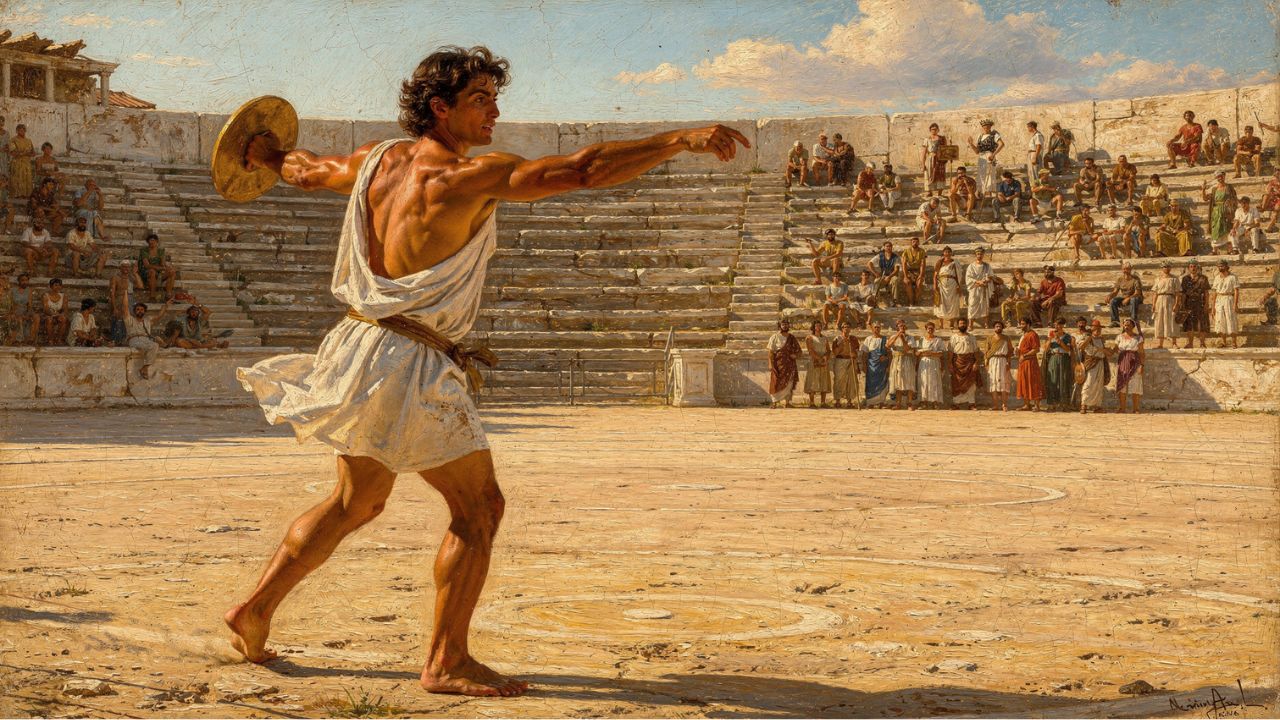
He threw a discus.
There was nothing extraordinary about that throw. It was an ordinary athletic exercise on an ordinary day of games. The discus left his hand with the force and direction Perseus had calculated, heading toward the competition area, right where it was supposed to go.
But the wind knocked it off course.
The discus flew off its intended path, crossed the competition area, and landed among the spectators. Right where an old man was sitting, an old man who had traveled from Argos to Larissa thinking the distance was enough to escape what had been written.
Acrisius died there, in Larissa, struck by a discus his grandson had thrown with no idea he was in the crowd. No intent. No violence. None of the dramatic circumstances you’d expect from the fulfillment of a prophecy that had spent decades terrorizing everyone involved.
Just the wind. Just a discus. Just fate doing what fate does, with a calm efficiency completely indifferent to human plans.
Perseus stood frozen for a long moment, looking at the old man among the crowd.
He had done everything right. He’d been generous when he didn’t have to be. He’d let his grandfather go when he could have hunted him down. He’d taken part in games like any athlete on any normal day.
And still.
The universe doesn’t negotiate. It doesn’t accept good intentions as currency. It doesn’t reward generosity with exceptions. What had been written had been written since before Perseus was born, since before Danae was locked in her bronze tower, since before Acrisius asked the oracle something he’d have preferred not to know.
Perseus understood it there, standing in Larissa with a discus in his hand, in the most mundane moment possible.
Some stories don’t have a happy ending or a tragic one. They just have an ending.
Perseus buried Acrisius with honors in Larissa. It was the least he could do, and it was also the right thing to do.
That night he told Andromeda what had happened. She listened without interrupting, one of the things Perseus had already learned to value about her. When he finished, she didn’t say she was sorry or that it wasn’t his fault. She just placed her hand over his and they sat together in silence for a while.
Sometimes you don’t need to say anything. Perseus learned that that night.
The years that followed didn’t carry the intensity of those first days, and that, for Perseus, was the real gift. They ruled Mycenae, had children, and for the first time in his life Perseus slept without fate waiting for him the next day.
In the end, Zeus turned them both into constellations. Perseus and Andromeda, together forever in the northern sky, separated by only a handful of stars, visible during the same months of the year, as if the universe had decided that a story that began on a rock at the edge of the sea deserved to last forever.
And in the autumn sky, when Perseus rises on the eastern horizon, he carries with him something the Greeks placed there on purpose: the star Algol, blinking on his leg, at the exact point where he would be holding Medusa’s head. But that’s another story. And it deserves its own article. [Article on Medusa and Algol, coming soon]
The Same Sky, Two Completely Different Stories
The Arabs: The Demon Star
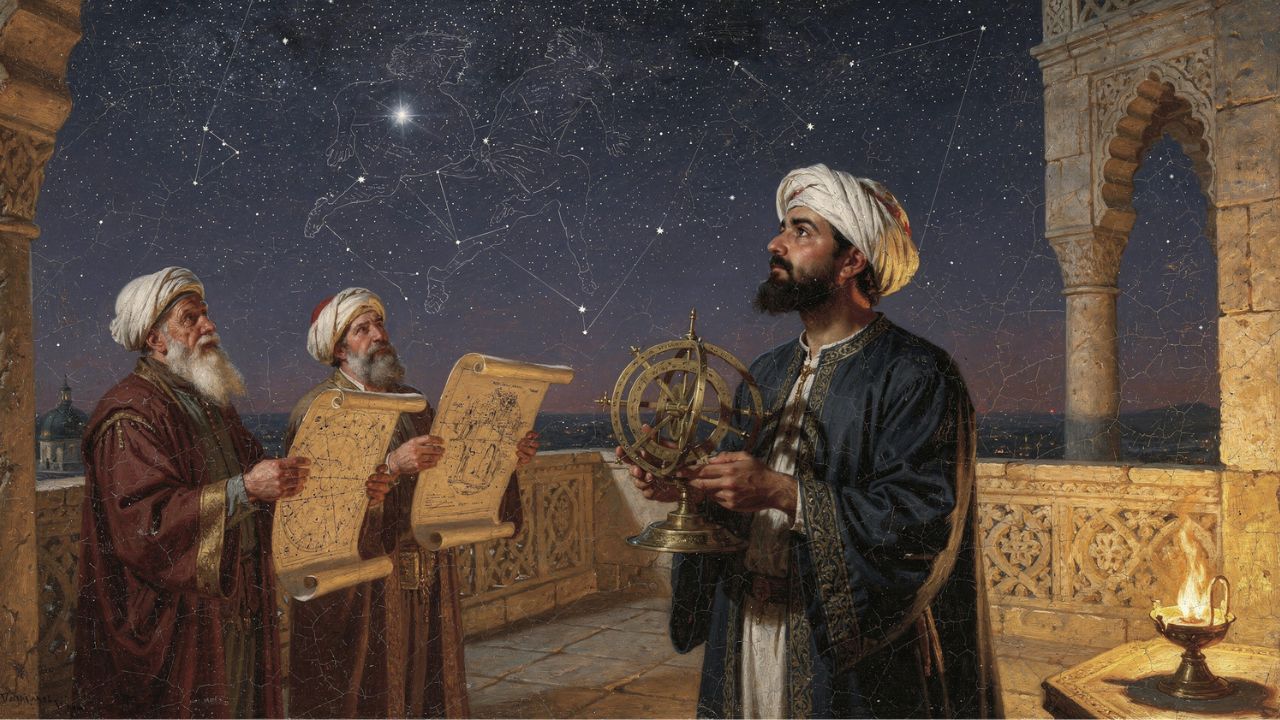
Medieval Arab astronomers, who between the 8th and 12th centuries mapped the sky with a rigor no other civilization of the era matched, noticed something about Perseus that no other ancient astronomer had documented with such attention: that one of its stars blinked.
Not the way all stars flicker because of the atmosphere. Really blinked. With rhythm. With regularity. Roughly every two days and twenty hours, that star’s brightness dropped to a third of normal for about ten hours, then returned to its usual intensity as if nothing had happened.
They called it Ra’s al-Ghul. The demon’s head. Today we know it as Algol.
Not because they knew the Greek myth of Medusa, though some later versions may have blended the two. But because that star behaved in a way no other nearby star did, and that behavior struck them as deeply unsettling. A star blinking with its own rhythm, in the exact spot where the Greeks placed the head of a monster that killed with a glance, isn’t a coincidence easily brushed aside.
They called it a demon without knowing why it blinked. Two thousand years later, modern astronomers discovered the truth: Algol isn’t one star but two, orbiting each other so closely that every 2.87 days one eclipses the other, blocking its light from our perspective. The demon blinked because it had a partner, one that crossed in front of it periodically with almost irritating punctuality.
Different cultures. The same unsettling star. The same intuition that something there was different.
The Chinese: The Great Trench and the Ship of the Dead
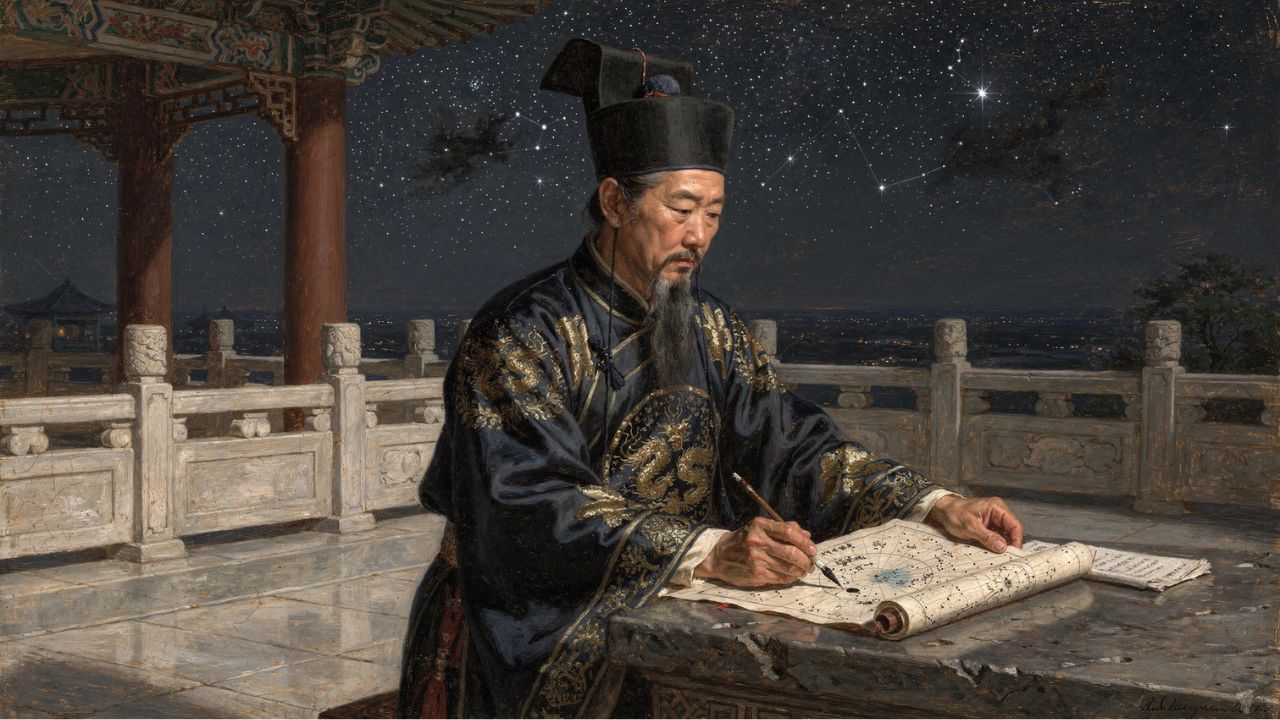
Classical Chinese astronomy didn’t divide the sky the way the Greeks did. There were no heroes or monsters. There were celestial palaces, military generals, rivers of stars, and a system as organized and hierarchical as the empire itself.
And in Perseus’s territory, what the Chinese saw was a story of war, imperial justice, and death on a large scale.
The main asterism covering Perseus’s brightest stars was called Tianchuan, the Celestial Ship. Not a fishing or trading vessel. A military ship sailing the Milky Way, commanded by the Great General of the Sky. A figure of absolute power crossing the river of stars with a purpose no one questioned.
But beneath the ship was what remained after its battles.
Perseus’s darker stars formed Daling, the Great Trench. Not just any trench. The specific pits where, every August, once the season of imperial executions ended, condemned criminals were buried en masse. The bodies of people who had crossed the Chinese state and paid the price, piled into those trenches before the earth covered them for good.
And at the center of that trench, in the star the Greeks used to represent Medusa’s head and the Arabs called the demon’s head, the Chinese placed Jishi: the pile of corpses not yet buried. It wasn’t a decorative figure on the celestial map. Imperial astronomers used it to set the calendar of executions, and its position in the night sky marked when the season of capital sentences was meant to begin and end.
Three cultures looked at the same blinking star. The Greeks saw a dead monster. The Arabs saw a demon. The Chinese saw a cemetery of criminals waiting to be covered by the earth.
Algol blinked the same for everyone. What each culture projected onto that blink says more about them than it does about the star.
Perseus in the Sky
Perseus isn’t a hard constellation to find. It’s one of those that, once you’ve seen it, you can’t stop seeing.
It’s in the northern sky, visible from Mexico, the United States, Canada, Spain, and all of Europe. Also from most of Latin America, including Colombia, Venezuela, Ecuador, Peru, Bolivia, Brazil, and most of Argentina and Chile. Its southern limit sits around 35 degrees south latitude, roughly the line through Buenos Aires or Santiago. South of those cities, Perseus starts sitting too low on the horizon to see well.
In the northern hemisphere it’s visible from August to March, with November and December as its best months. On those winter nights it climbs high, nearly to the zenith, and stays there for hours. In the southern hemisphere the window is narrower: November, December, and January, and always close to the northern horizon, which requires a clear view and some patience.
The easiest trick for finding it is to use Cassiopeia as a starting point. Cassiopeia is that bright constellation forming a zigzag of five stars, easy to recognize because, depending on the time and season, it can look like a W or an M. Both are the same constellation, just in different positions in the sky. If you see a W, look for Perseus below and to the left. If you see an M, look below and to the right. Either way, about two to three fist-widths at arm’s length from the center of Cassiopeia.
The Double Cluster of Perseus, which we’ll get into in detail shortly, sits exactly halfway between Cassiopeia and the main body of Perseus. If you find it, you’re already inside the constellation.
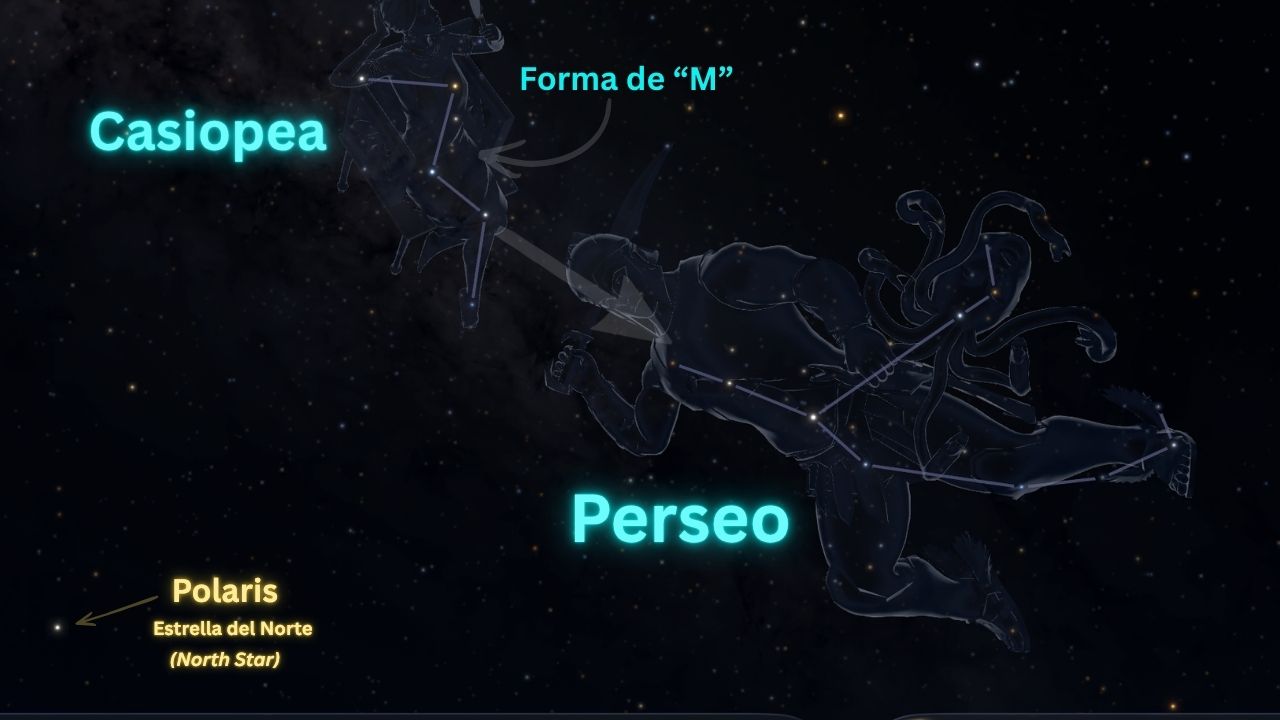
Astronomy apps like Stellarium draw Perseus as a complete human figure: head up top, torso in the center, and two legs spread downward. It’s not a man with arms outstretched, but a hero in motion, mid-stride. Mirfak, its brightest star, marks Perseus’s chest, the central point of the figure from which the head branches north and the legs branch south.
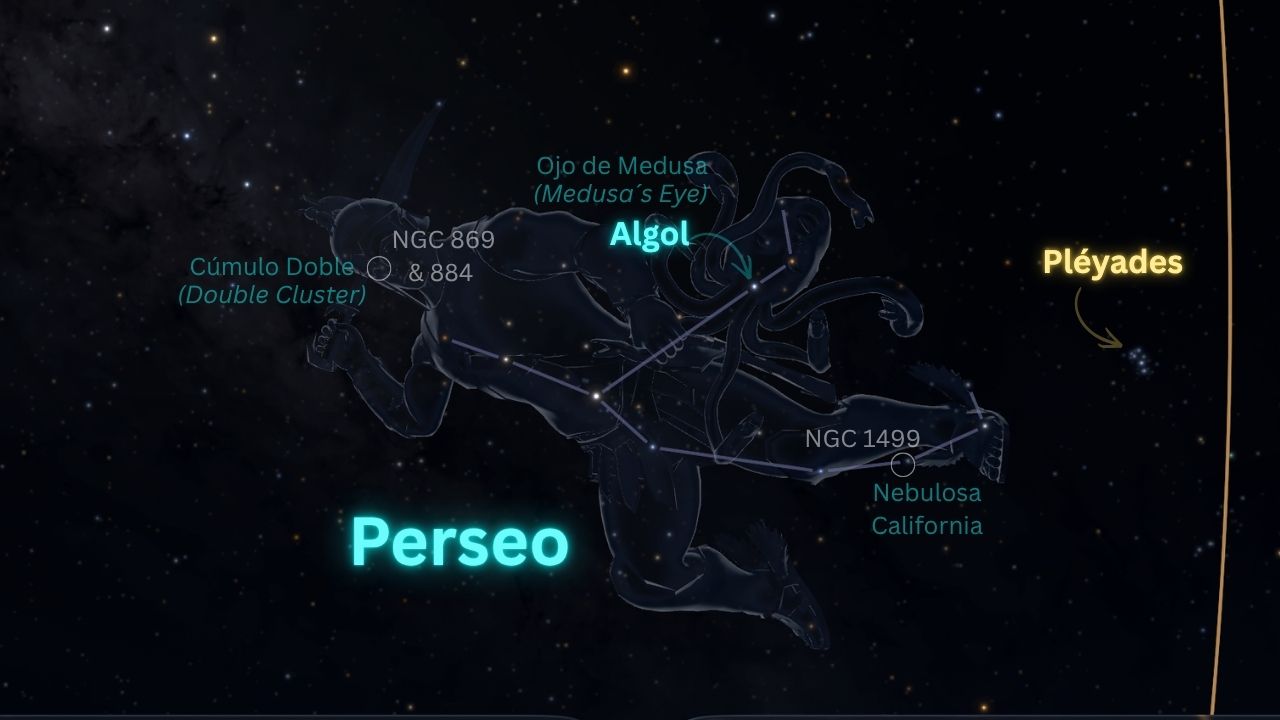
Perseus’s brightest star is called Mirfak, from the Arabic Mirphak, meaning “the elbow.” It’s a yellow supergiant about 5,000 times more luminous than the Sun, roughly 510 light-years away. The light you see tonight when you look at Mirfak left that star around the year 1515, when Hernan Cortes had just arrived on the shores of Mexico and Michelangelo was still painting the Sistine Chapel in Rome.
Mirfak isn’t alone. It’s the central star of the Alpha Persei Cluster, a group of young, hot stars moving together through space that, to the naked eye, look like a soft cloud of light around it. Through binoculars the effect is spectacular.
On Perseus’s right leg, at the point where he’d be holding Medusa’s head, sits a star the Greeks already singled out as special, one the Arabs called Ra’s al-Ghul: the demon’s head.
Algol blinks. Not the way all stars flicker because of the atmosphere, but for real, with rhythm, with regularity. Every 2.87 days its brightness drops to a third of normal for about ten hours, then returns as if nothing happened.
The full story of Algol, why it blinks, what it has to do with Medusa, and what modern astronomers discovered when they pointed their instruments at it, deserves its own article. And it’s going to get one. [Article on Medusa and Algol, coming soon] For now, just this: it’s the most famous variable star in the sky, it has spent centuries unsettling anyone who watches it closely, and it sits exactly where you’d want it if someone had designed the sky with a sense of drama.
The Double Cluster: NGC 869 and NGC 884
There are objects in the sky that are pretty. And there are objects that make you let go of the telescope and just stare into space for a few seconds, processing what you just saw.
The Double Cluster of Perseus is one of the second kind.
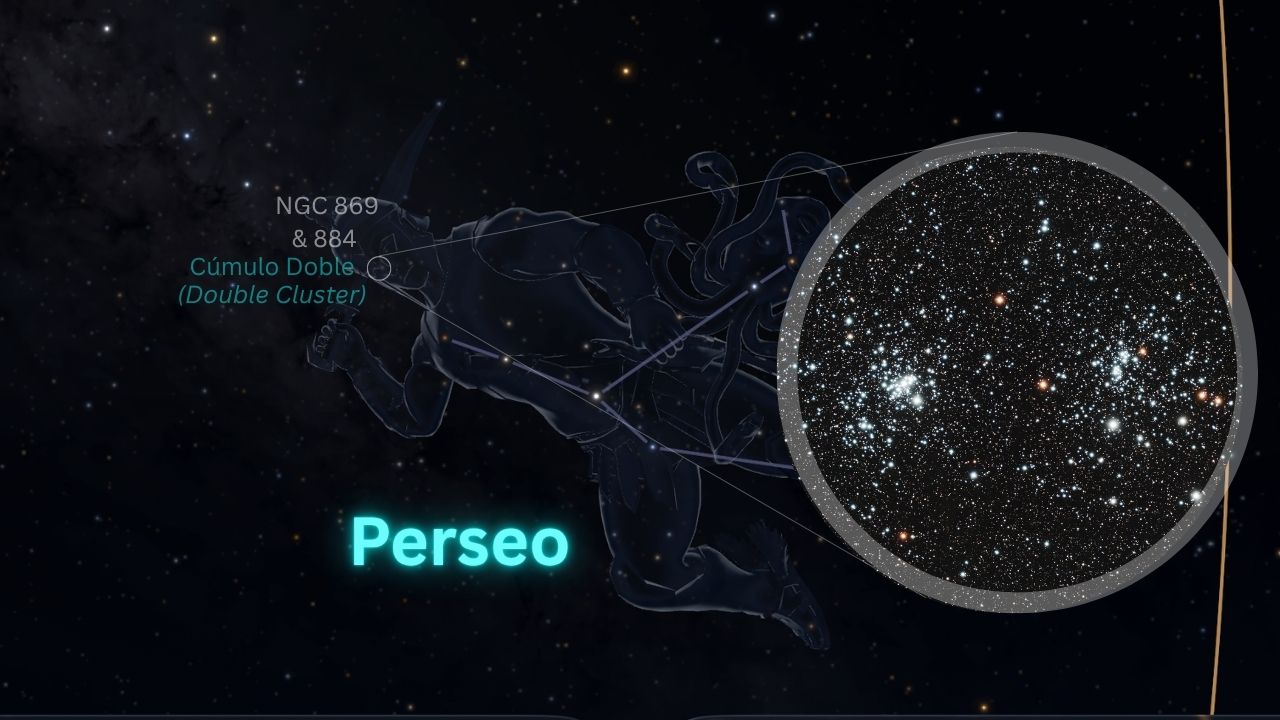
It isn’t one but two completely distinct star clusters, NGC 869 and NGC 884, which from Earth appear so close together that for centuries observers mistook them for a single smudge of light. The Greek astronomer Hipparchus catalogued them around the year 130 BC as a nebula, a diffuse smudge, unable to resolve what was inside. Humans probably saw them long before that, perhaps since prehistory, with no idea what they were.
Today we know they’re two physically separate clusters, hundreds of light-years apart from each other, traveling together through the Perseus arm of the Milky Way, about 7,500 light-years from us. And both are heading our way. NGC 869 is approaching Earth at 39 kilometers per second, and NGC 884 at 38 kilometers per second. Two cities of stars traveling toward us at a speed that makes any human rocket look like a bicycle. At that rate, they’d take more than 100,000 years just to close one light-year of distance. And there’s nothing we can do about it except enjoy the view while they arrive.
The detail nobody mentions: Charles Messier, the 18th century French astronomer who catalogued more than a hundred deep sky objects, included the Pleiades and the Beehive Cluster in his famous list, two clusters considerably less spectacular than the Double Cluster. And he left the Double Cluster out. No one knows why. It’s one of the minor but genuinely irritating mysteries in the history of astronomy.
They aren’t twins. They’re siblings who grew up together but took different paths. NGC 869 is the brighter and more compact of the two, with a denser, more concentrated core of blue-white stars. NGC 884, on the right, is more spread out and has something its sibling doesn’t: red supergiants. While NGC 869 is predominantly blue and white, NGC 884 has stars glowing in shades of orange and red that stand out dramatically against the background. Think of Betelgeuse, that reddish star marking the shoulder of Orion that everyone has seen without knowing its name. The red supergiants of NGC 884 are exactly that kind of star, giants near the end of their lives burning through their last reserves of fuel before going supernova. Five of them have proper names: RS Persei, AD Persei, FZ Persei, V403 Persei, and V439 Persei. Individual named stars inside a cluster 7,500 light-years away. That says something about its scale.
Both clusters are roughly 14 million years old. For perspective: the Pleiades, which look young and bright to us, are between 75 and 150 million years old. The Double Cluster is ten times younger than the Pleiades. Fourteen million years, on a cosmic scale, is essentially yesterday. When these stars were born, the first hominids of the genus Homo hadn’t even appeared on Earth yet.
To the naked eye in a dark sky, the Double Cluster looks like a patch slightly brighter than the background of the Milky Way. Through binoculars, the two clusters fill the field of view almost touching, surrounded by a haze of background stars, like two cities of light separated by a dark corridor. It’s the kind of view that makes people stop talking.
With the ZWO Seestar S50 (Mexico | United States | Spain), the Double Cluster becomes an entirely different object. The individual stars resolve with clarity, the contrast between the blue-whites of NGC 869 and the reds of NGC 884 becomes visible and striking, and the Milky Way’s background star field adds a depth that, in long-exposure photography, turns out to be simply stunning.
Here’s the detail that generates the most silence when you have someone at the telescope with you: the light you’re seeing right now left those stars 7,500 years ago. When that light began its journey toward us, writing didn’t yet exist on Earth.
NGC 1499: The California Nebula
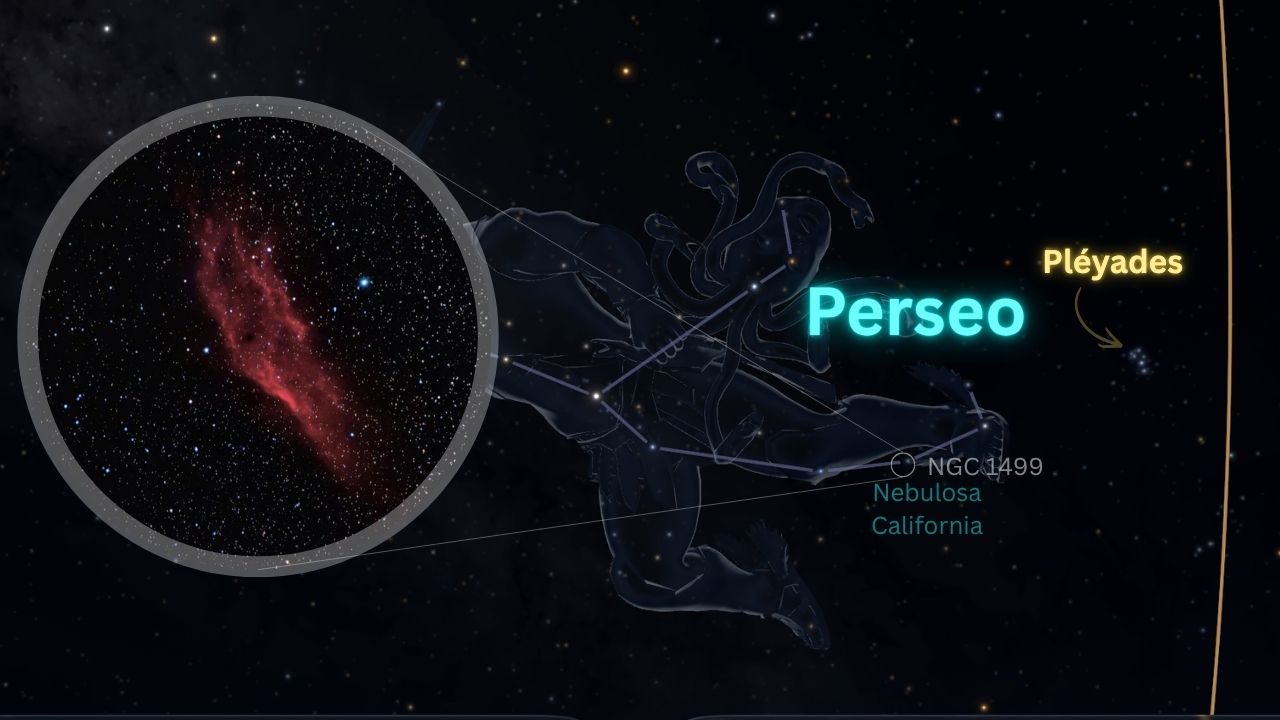
If the Double Cluster is Perseus’s star object for visual observers, the California Nebula is its best-kept secret for astrophotographers.
NGC 1499 was discovered on November 3, 1885 by American astronomer Edward Emerson Barnard. And it got its name for the most literal reason possible: in long-exposure photographs, its shape strikingly resembles the outline of the state of California on a map. It’s not a small coincidence. It’s an absurdly precise one. The Bay of San Francisco is there, the Gulf of California is there, the state’s elongated shape is there.
NGC 1499 has a real size of roughly 100 light-years in length. In apparent size in the sky it spans 2.5 degrees, five times the diameter of the full Moon. It’s enormous.
The California Nebula doesn’t glow on its own. It needs help. And that help comes from a single star: Xi Persei, also known as Menkib, an O7-type star, one of the hottest and most energetic that exist, which ionizes the hydrogen throughout the nebula and makes it glow. It’s as if a single candle were lighting up an entire stadium.
Here’s the honest part: the California Nebula is one of the most frustrating objects in the sky for visual observers. Its surface brightness is so low, so spread out over such a huge area, that most people see absolutely nothing looking through a conventional telescope. It’s a nebula that doesn’t exist visually. It only exists in photography.
And that’s where the ZWO Seestar S50 changes the rules completely. With accumulated long exposure, the Seestar pulls out the nebula’s hydrogen-alpha with a clarity no human eye can reach. For this particular object, a sky away from downtown light matters, you don’t need the desert, but you do need to get a bit away from urban lights so the nebula’s hydrogen has room to appear.
Watching the shape of California gradually appear on your smartphone screen as the Seestar stacks exposures is exactly the kind of moment that turns someone into an astronomer for life.
The Perseids: When Perseus Rains Down on Earth
Every summer, between mid-July and late August, Earth crosses the path left behind by comet 109P/Swift-Tuttle on its last visit to the inner solar system. What’s left of that pass, frozen dust, rock fragments, particles the size of a grape that have spent billions of years traveling through space, enters our atmosphere at about 60 kilometers per second. Friction heats them to 5,000 degrees and vaporizes them within seconds, leaving those bright streaks we all know as shooting stars.
We call them the Perseids because they appear to burst out of the Perseus constellation. That point in the sky where they seem to originate is called the radiant, and in August it points directly at the hero who killed Medusa. It’s not that they actually come from there, it’s just perspective. Like when you’re driving and the trees on either side seem to come from a single point on the horizon even though they’re actually all around you. But the name stuck. And if anyone deserves to have a meteor shower named after him, it’s the guy who killed Medusa without looking her in the eye.
Its peak activity happens around August 12 and 13, coinciding with the feast of Saint Lawrence, which is how it earned its popular name: the Tears of Saint Lawrence. According to Christian tradition, Lawrence died on August 10 in the year 258, and the burning streaks that cross the sky those nights recall the fire of his martyrdom.
Under optimal conditions, at the peak, you can see up to 100 meteors an hour, and in exceptional years that figure has climbed to 400 meteors an hour. The most important variable isn’t the year, it’s the Moon: when the peak coincides with a new moon, the sky stays completely dark and the fainter meteors, the ones that normally get lost in the moonlight, become visible. Those are the nights amateur astronomers remember for the rest of their lives. On truly rare occasions, the peak of the Perseids has coincided with solar eclipses on the same day, turning that stretch into one of the richest on the astronomical calendar all year.
The best part about the Perseids is that you don’t need anything to see them. No telescope, no binoculars. Just a dark sky, getting away from city lights, lying flat on your back looking at the whole sky without fixing on one point, and giving your eyes about 20 minutes to adjust to the dark. If you want to get oriented, open Sky Guide, Star Walk, SkySafari, or Stellarium on your phone, find Perseus in the sky, and keep looking in that general direction. After that, the Perseids do the work on their own.
If you want a soundtrack for the wait, ASTRONOMIKA BEATS has a song made exactly for this hero: “Perseo no falla”, from the album “Historias en las Estrellas.” Play it while you wait for the first one to show up.
Meteors can appear anywhere in the sky, not just near Perseus. Bring a blanket, because it gets cold before dawn even in August. Bring something to eat.
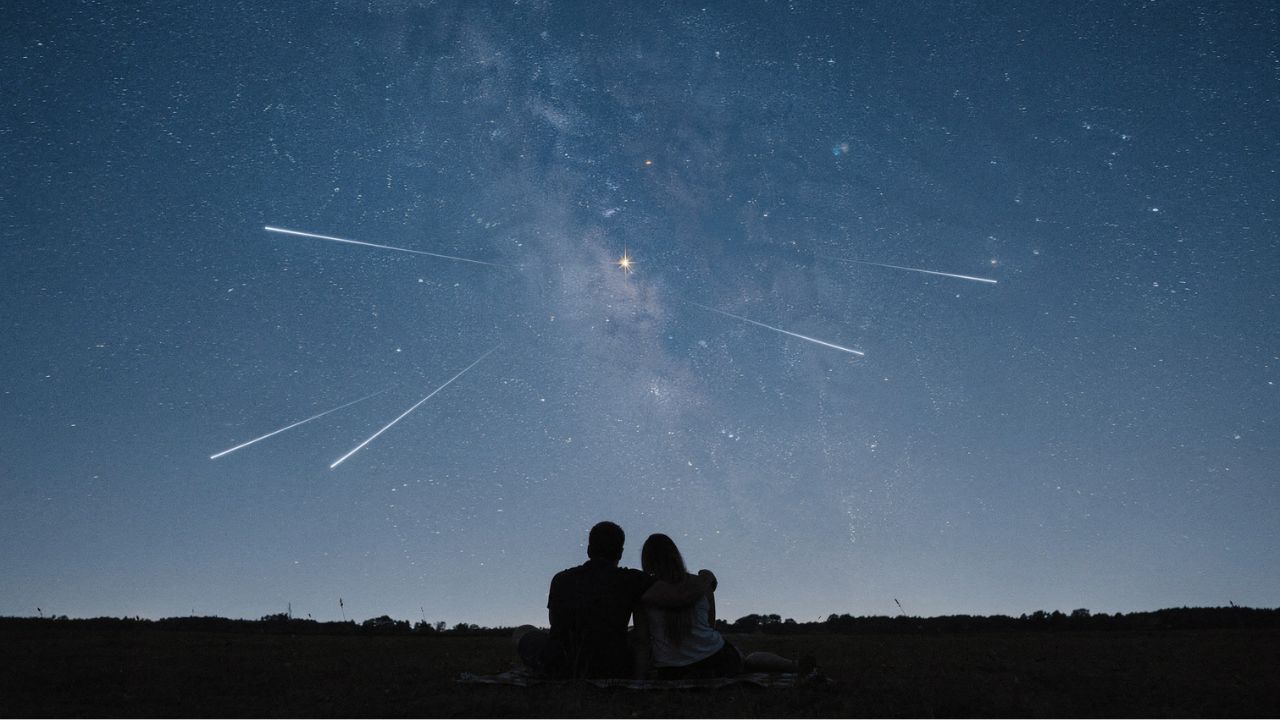
One last thing worth knowing: what you’re seeing isn’t a star. It isn’t even a large rock. It’s a particle the size of a marble, sometimes smaller, burning up at thousands of degrees in the atmosphere 60 kilometers up. That streak of light crossing the sky in two seconds is the final flash of something that has been traveling through space since before Earth even existed.
And yes, you can make wishes. The universe has spent 4,500 million years setting up that moment for you. At the very least, make the most of it.
Frequently Asked Questions About the Perseus Constellation
What does the Perseus constellation represent?
Perseus represents the Greek hero of the same name, son of Zeus and Danae, famous for beheading the Gorgon Medusa and rescuing Princess Andromeda from the sea monster Cetus. It’s one of the 48 original constellations catalogued by the Greek astronomer Ptolemy in the 2nd century.
Where is the Perseus constellation in the sky?
Perseus sits in the northern sky, between Cassiopeia and Taurus. The easiest way to find it is to use Cassiopeia as a reference: if you see it as a W, look for Perseus below and to the left; if you see it as an M, look below and to the right, about two to three fist-widths at arm’s length from the center of Cassiopeia.
Which months can you see the Perseus constellation?
In the northern hemisphere it’s visible from August to March, with November and December as its best months. From latitudes above 40 degrees north, like much of Europe and Canada, Perseus is circumpolar and never dips below the horizon. In the southern hemisphere it’s only visible from latitudes above 35 degrees south, like Buenos Aires or Santiago, and always close to the northern horizon.
What is the brightest star in Perseus?
The brightest star in Perseus is Mirfak, also known as Alpha Persei. It’s a yellow supergiant about 5,000 times more luminous than the Sun, located roughly 510 light-years away. Its name comes from Arabic and means “the elbow.”
Why does Algol blink?
Algol blinks because it’s actually two stars orbiting each other so closely that every 2.87 days one eclipses the other, blocking part of its light from our perspective. That’s why astronomers call it an eclipsing variable star. Medieval Arabs called it Ra’s al-Ghul, the demon’s head, centuries before knowing the scientific reason behind its behavior.
What is the Double Cluster of Perseus?
The Double Cluster of Perseus is two open star clusters, NGC 869 and NGC 884, which from Earth appear very close to one another. They’re roughly 14 million years old, about 7,500 light-years away, and together add up to at least 20,000 solar masses. They’re visible to the naked eye in dark skies and are one of the most spectacular objects in the winter sky through binoculars or a telescope.
What’s the difference between NGC 869 and NGC 884?
NGC 869 is slightly brighter, more compact, and has a higher concentration of blue-white stars at its core. NGC 884 is more spread out and has something its sibling doesn’t: visible red supergiants that contrast dramatically with the cluster’s blue background. That color difference between the two is visible even with binoculars under good conditions.
Did Perseus kill Medusa in direct combat?
No, at least not according to the original sources. Pindar and Apollodorus, the oldest texts that narrate the myth, say Perseus found Medusa asleep. Facing her awake was impossible because her gaze turned any living being to stone. Perseus used Athena’s polished bronze shield as a mirror to approach her from behind without looking at her directly. The epic face-to-face battle is an invention of modern cinema, not of the original myth.
Was Pegasus Perseus’s horse?
In the original myth, Pegasus was born from Medusa’s blood when Perseus beheaded her, and there’s no record of Perseus riding him in the oldest sources. However, later versions, and a good chunk of art and film, do show them together, and it has to be said, it makes the story considerably more interesting. At ASTRONOMIKA TV, we happily take that creative liberty.
What is the California Nebula and why is it called that?
NGC 1499 is an emission nebula in the Perseus constellation that, in long-exposure photographs, has a shape strikingly similar to the outline of the state of California on a map. It was discovered on November 3, 1885 by Edward Emerson Barnard. It measures roughly 100 light-years in length and sits about 1,000 light-years away. It’s practically invisible to the naked eye but extraordinary in long-exposure photography.
Did the prophecy about Perseus come true?
Yes, and in the most unexpected way possible. The Oracle of Delphi had predicted that Danae’s son would kill his grandfather Acrisius. Perseus did everything he could to avoid it: he let his grandfather go when he returned to Argos and didn’t pursue him. But during some athletic games in Larissa, a discus he threw was blown off course by the wind and killed Acrisius, who was in the crowd without Perseus knowing he was there. What was written came to pass.
Did Perseus and Andromeda live happily ever after?
More or less, which in Greek mythology is pretty much a fairy tale ending. They ruled Mycenae, had several children, and according to ancient sources lived together into old age. Zeus turned them both into constellations when they died, which in the Greek world was the highest honor possible. Perseus and Andromeda are in the northern sky to this day, separated by just a few stars, visible during the same months of the year. The universe left them together. Not bad for someone who started out with no horse.
What are the Perseids and when can you see them?
The most generous meteor shower of the year is named after this hero for a reason. The Perseids happen every August, peaking around August 12 and 13, and under optimal conditions you can see up to 100 meteors an hour. They’re the remnants of comet 109P/Swift-Tuttle, which Earth crosses every year in its orbit. You don’t need any equipment to see them: just a dark sky, getting away from city lights, and looking up.
This article contains affiliate links. If you make a purchase through them, I earn a small commission at no extra cost to you.
Sources and Recommended Reading
Apollodorus. The Library, Book II. Translated by James George Frazer. Loeb Classical Library, 1921.
Ovid. Metamorphoses, Book IV. Translated by A. D. Melville. Oxford University Press, 1986.
Pindar. Pythian Odes, Ode XII. Translated by William H. Race. Loeb Classical Library, 1997.
Hyginus. Fabulae. Translated by Mary Grant. University of Kansas Publications, 1960.
Constellation Guide. “Perseus Constellation.” constellation-guide.com
Space.com. “Perseus Constellation: Facts, location and myth.” space.com
Wikipedia. “Double Cluster.” en.wikipedia.org
Wikipedia. “California Nebula.” en.wikipedia.org
AstroBackyard. “The Double Cluster in Perseus.” astrobackyard.com
AstroBackyard. “California Nebula (NGC 1499).” astrobackyard.com