
Everyone knows how Medusa died. Almost no one knows how she lived. The story of Medusa Algol, the only mortal Gorgon, told from the inside: the temple, the betrayal, the punishment that fell on the wrong person, and the star that still marks in the sky the exact place where her head ended up forever.
By Juan Pablo Martín | ASTRONOMIKA TV | August 2026
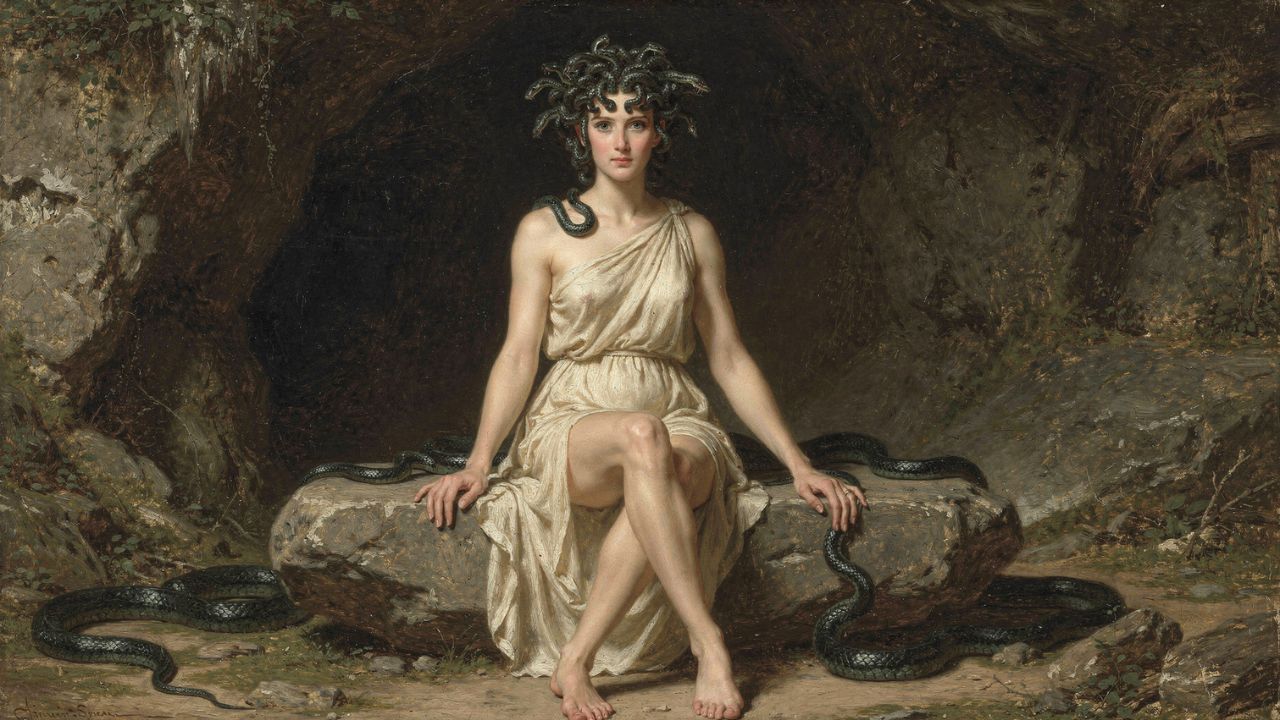
The cold water of the fountain ran through her fingers every morning. Purify her hands, light the incense, stay quiet for a moment before the first pilgrims arrived. Medusa had been doing this for as long as she could remember. It wasn’t an obligation. It was the one thing in her life she had chosen, and she had chosen it gladly.
No one who knew her then could have imagined what she was about to become. And that’s the problem with this story: everyone knows the ending. Almost no one knows the beginning. And the beginning is where the uncomfortable truth sits, the one the Greeks preferred not to repeat out loud.
The woman before the myth
Medusa was born mortal, daughter of parents that even the oldest sources don’t bother naming. What they do agree on is what came after: she grew up beautiful. Ovid, centuries later, would dwell on a single feature to describe her, her hair, thick and black, falling in waves that drew attention even when she wasn’t seeking it. The most admired part of her whole person, the text says.
Her eyes shifted between honey and dark green depending on the light of the day, her skin was golden from the coastal sun, and she carried herself the way someone does after spending their days walking between marble columns in service to a goddess. She didn’t walk like someone seeking to be seen. She walked like someone who already knew she was, and had learned to carry it with ease instead of vanity.
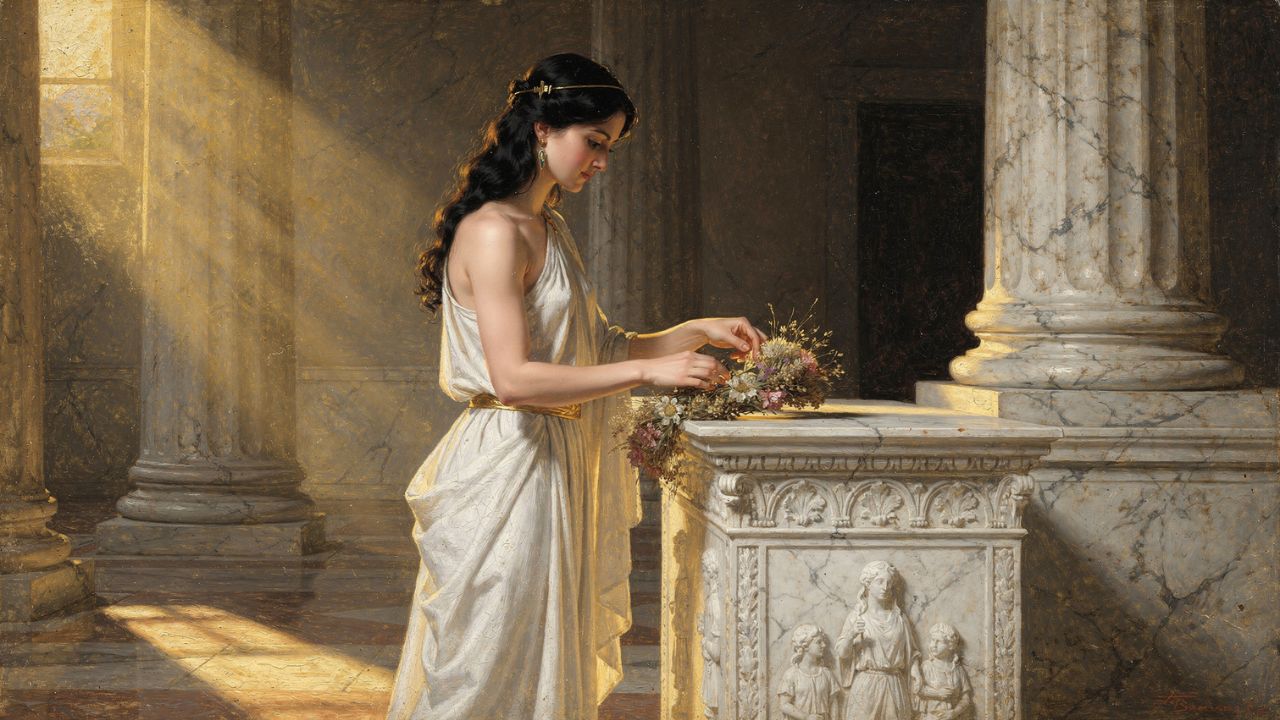
She had chosen to serve Athena, goddess of wisdom and a cool head, not out of family pressure but because something about that way of seeing the world made sense to her. The temple, white columns facing the sea, was her entire world. And up to that point, it was a safe world.
A rumor started circulating between neighboring temples, the kind that travels fast because people love repeating it: that there was a priestess on the coast whose beauty rivaled the goddesses themselves. Medusa heard it once, from another priestess, laughing. She just smiled and went back to work.
She was wrong not to take it seriously. That rumor did carry weight. Only she wasn’t the one who should have paid the price for causing it.
✦ ✦ ✦
Betrayal in the temple
The day everything changed started like any other. Medusa had stayed alone in the temple, later than usual, arranging the garlands on the altar. She liked that hour: the low-angled light, no pilgrims yet, just her and the sea hitting the rocks.
She didn’t hear him arrive. That struck her as strange afterward, that someone that size had entered without her noticing. When she turned around, he was already there.
Poseidon. God of the sea, brother of Zeus, dark beard, eyes the color of a storm, and that way gods have of occupying space when they decide to stop pretending at modesty.
“My lord,” she said, in the voice she used to address gods. “This is Athena’s temple. Visitors usually announce themselves.”
Poseidon smiled. It wasn’t a kind smile.
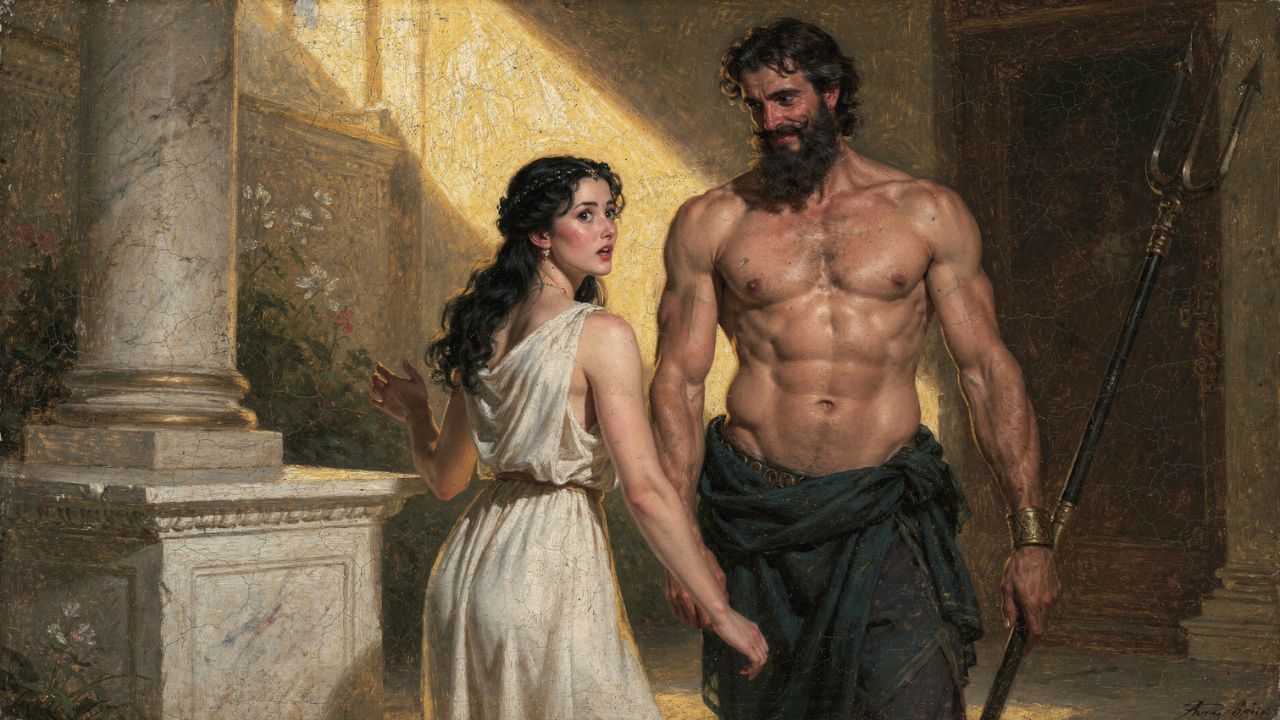
What happened next, no ancient text describes in detail, and there’s a reason for that: the men who wrote this story down over the centuries preferred to summarize in a single word what it would take her the rest of her life to understand. He raped her right there, on the floor of the temple of the goddess she served. She said no, with her words and then with her whole body fighting back. No version of this story, not the oldest nor the most recent, suggests otherwise. Ovid is specific on the point the story would later conveniently forget: it was rape, not a romance, not a seduction. An act of force she had no real way to stop.
When it was over, he left the way he came. No explanation, no apology. Medusa was left alone on the marble floor she had cleaned that very morning, the garlands scattered to one side, the incense still burning, indifferent, as if nothing had happened.
But something had happened. And she wasn’t as alone as she thought.
Athena had seen everything. No version of the myth says she arrived afterward, that she heard about it through rumors. She was there, in her own temple, and witnessed every second of what was done to the woman who served her with real devotion.
When it was over and Medusa looked up seeking comfort, she found fury instead. But not the fury she expected, the one aimed at Poseidon. Athena was looking at her. Only her.
“You have defiled my temple,” Athena said.
Medusa took a moment to process the words.
“My lady,” she managed to say, “I didn’t choose this.”
✦ ✦ ✦
Athena’s judgment
Medusa never knew how much time passed between those words and what came next. Time, in front of a god deciding your fate, stops behaving like normal time.
Athena spoke again, no longer with her initial fury. She had something worse: the coldness of someone who has already made a decision and is only announcing it.
“This temple was mine. And you allowed it to be defiled within its walls.”
“I didn’t allow it,” Medusa said, finding the strength to keep her voice from breaking completely. “I fought. I said no with everything I had.”
Athena looked at her, and for an instant something crossed her face that could have been doubt, even the beginning of something like compassion.
It left as quickly as it came.
Because Athena had a problem to solve, and the problem wasn’t justice. It was order. Poseidon was her uncle, a primordial god. Punishing him directly would mean opening a war between gods that no goddess could afford. Someone had to carry the weight of what happened, be the example, and at that moment, in front of Athena, there was only one person available with no way to defend herself.
It wasn’t fair. Athena probably knew it. But her wisdom, that morning, translated into calculation, not justice.
“Stand up,” she said.
Medusa stood, her legs shaking, still expecting something different from what was about to come. Athena extended a hand. It wasn’t a gesture of comfort.
The first thing was heat, starting at her scalp, spreading as if fire itself were deciding what shape her hair would take. She brought her hands to her head and what she touched was no longer what she had touched that same morning at the fountain’s water. It moved. It had a will of its own. A low, multiple hiss, coming from her own head.
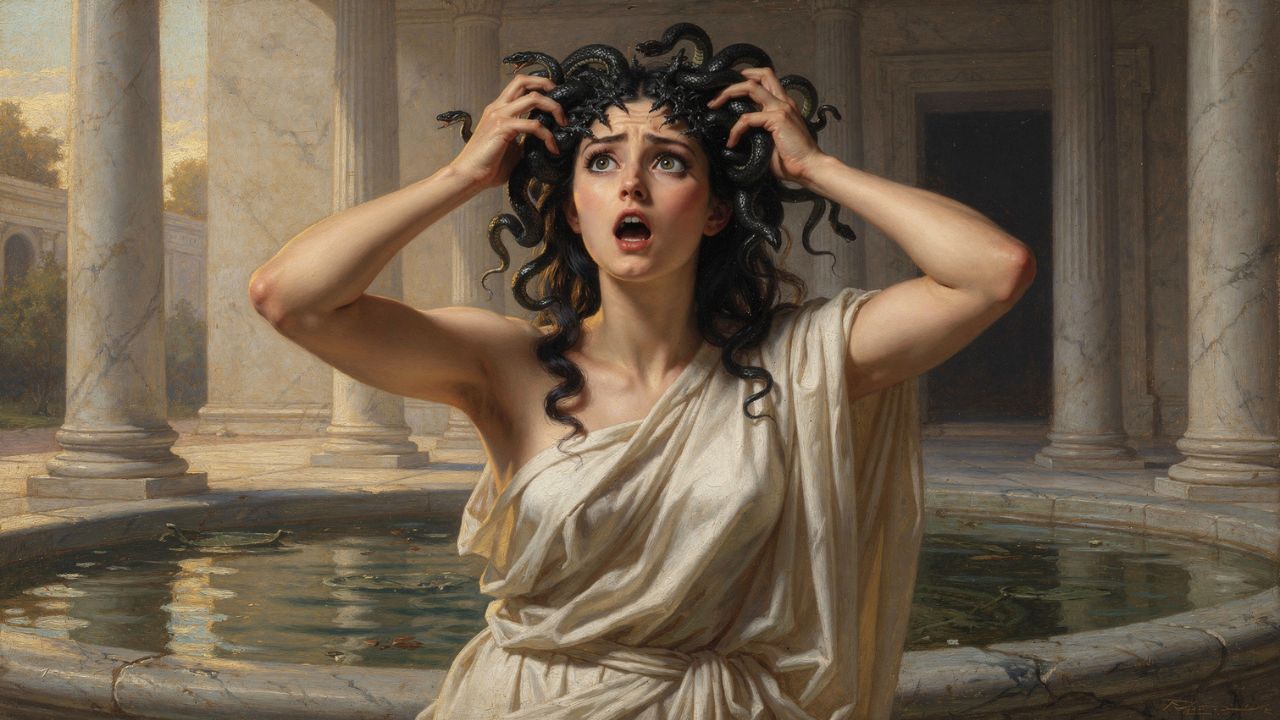
Here’s the detail almost no one remembers about this story, the one that gets lost among the versions that prefer to imagine her as a monster from the first second: Athena didn’t touch her face. She didn’t give her fangs, or green skin, or the grotesque ugliness cinema would invent centuries later. She changed her hair. And she gave her a gaze that turned to stone whoever received it.
That was all. And it was enough to destroy the entire life she had built up to that point.
When she could finally see her reflection in the same fountain where she had started her day, what looked back at her still had her eyes, distorted by shock but recognizable. But surrounding that face, where the hair Ovid would consider her most admired feature used to be, there was now a full nest of snakes, each one breathing at the same agitated rhythm as her.
And she knew, without anyone having to explain it to her, that if anyone else looked into that water and saw what she had just seen, that person would stop moving forever. Skin, blood, bones, all turned into the same cold stone as the statues that decorated the temples where she no longer had a place.
Athena watched her for a moment longer. Then, without any further explanation, she turned and left.
Medusa was left alone in the temple that had been her home, understanding, as the sun finished rising over a day that had started like any other, that she no longer had any place in that world to belong to.
✦ ✦ ✦
Exile and learning her power
She left the temple that same night. She couldn’t stay, not even near someone who only wanted to pray.
She walked toward the wildest part of the coast, away from any traveled path, with an improvised veil over her head. It didn’t do much good. She could feel the snakes moving underneath, restless, as if they shared her own terror.
The first days were the worst. Not from hunger or cold, but because she still didn’t know, with certainty, what she was capable of. Part of her needed to believe she had been wrong, that the reflection in the water had just been shock distorting her perception.
The proof arrived without her seeking it.
A shepherd found her on the third day near a spring, her veil slipped just enough for him to see her face before she could cover herself again. It was less than a second. The man didn’t scream. He didn’t have time. One instant he was walking toward the water with his goats, and the next he was a gray stone figure, his mouth half open in a greeting that would never finish.
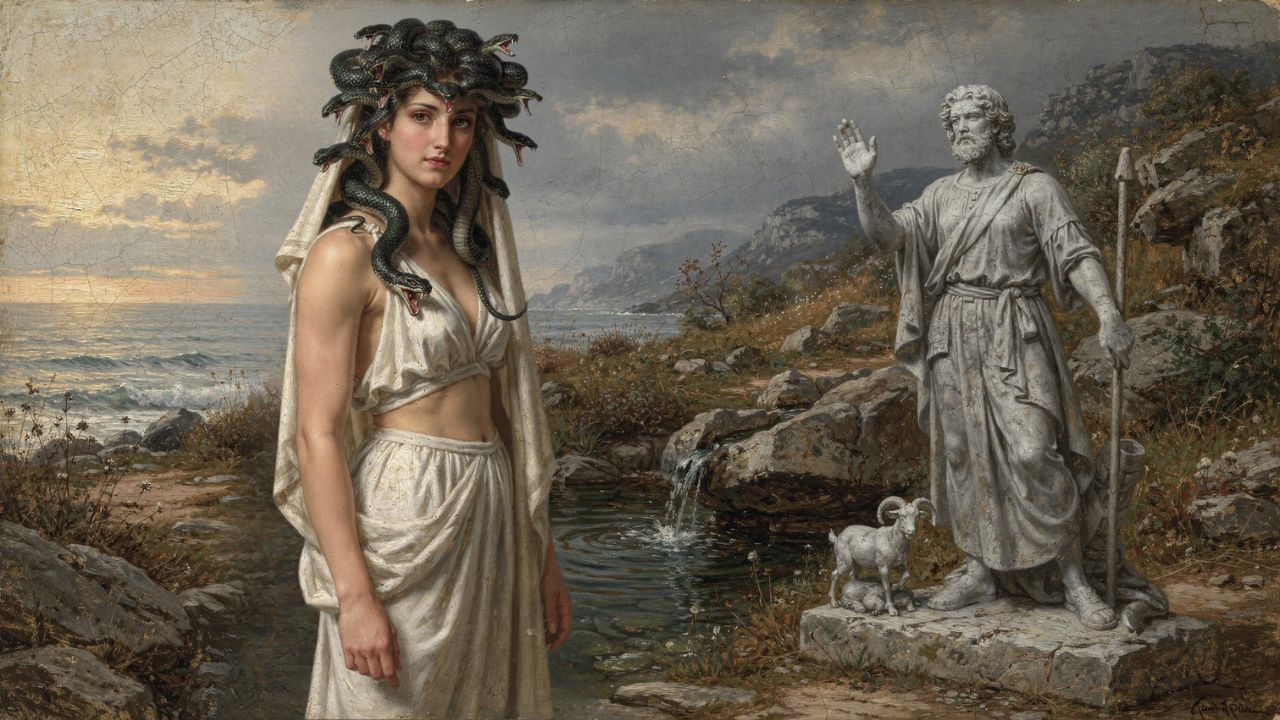
Medusa stood staring at what she had done for far longer than it was safe to stay there. She hadn’t wanted it. She hadn’t even had time to decide whether to look at him or not. It had simply happened, the way the sun simply rises, without asking permission.
The shepherd’s goats kept grazing beside their stone owner, indifferent, and that indifference was what finally broke her. After that, she stopped keeping the veil on out of caution. She started keeping it on out of necessity.
The following months took her further from any path, and there, alone, she learned to live with what she had become. At first, above all, she was afraid of herself. Over time she understood something harder still: the same power that had stripped away any chance of a normal life was the only real protection she had left. No one could approach with bad intentions without paying the highest price.
It wasn’t justice. But it was, for the first time since the temple, something like power.
She learned to read intentions before they became actions, to tell a lost traveler apart from a hunter already looking for the creature rumors were beginning to spread about. She let the first ones pass. The second ones, when there was no other option, she confronted.
She never enjoyed it. It’s worth saying that clearly, because the later versions of the myth, the ones that would reduce her to a pure monster, would forget this detail: Medusa never turned anyone to stone for pleasure. Every time, something in her remembered the shepherd, the hand frozen mid-greeting, the indifferent goats.
She became, over the months, a survivor. Alone, feared, but alive, with a way of protecting herself that no god had asked her permission to give, but that they also couldn’t take away without undoing the entire curse.
✦ ✦ ✦
The sisters and the cave
She found them almost a year later, on an even more remote coast, black volcanic rock falling straight into the sea.
Stheno and Euryale. Medusa had heard their names before, in whispers from other temples. The Gorgons, monstrous since birth, daughters of sea gods that not even Poseidon mentioned without a certain respect. Both immortal.
She didn’t know what to expect finding them. What she found was understanding.
“We know what happened to you,” Stheno said, before Medusa had told her anything at all. “Rumors travel faster than any person.”
Euryale, quieter, made room for her by the fire. It wasn’t a big gesture. It was the right one.
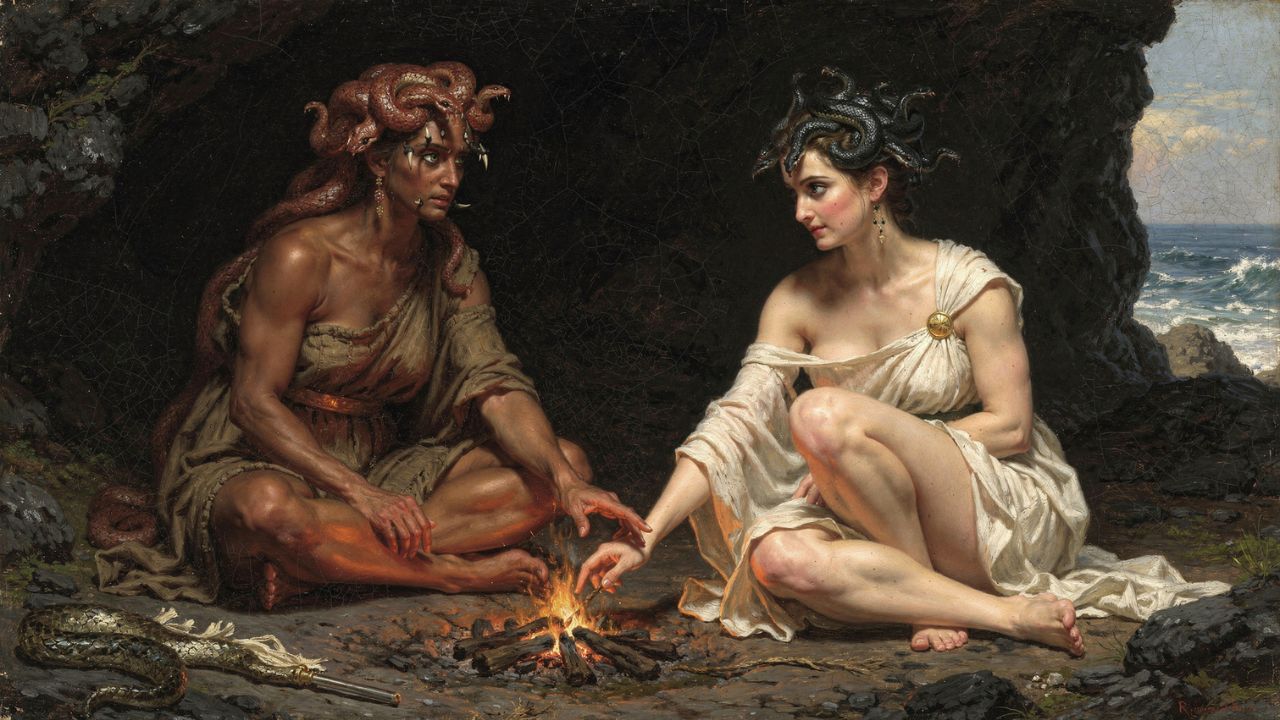
That night, for the first time since the temple, Medusa took off her veil without being completely alone. Among them, none of them were in danger: Gorgons were immune to their own gazes. It would become, from then on, the only place in the world where Medusa could look someone in the eye without fear.
She moved in with them. She learned their rhythms, and something that surprised her: that her sisters, with their fangs and bronze wings, with an appearance no mortal would ever mistake for anything human, weren’t cruel underneath. They were, above all, tired of a world that had feared them from the very first day without ever giving them the chance to be anything else.
With Medusa it was different, and all three knew it without saying so. She had memory of another life, of walking among people without anyone fleeing. That memory was her greatest comfort by the fire, and her deepest wound on the quiet days.
Years passed. She learned to read the sea, to tell human footsteps apart from the rocks before they saw her. She got good at surviving being what she was.
Hunters showed up now and then, drawn by stories that exaggerated both the danger and the empty fame of killing her. Some left after seeing the stone statues at the mouth of the cave. Others weren’t so lucky. None of the three sisters enjoyed those deaths, but they didn’t fake a grief they didn’t feel either.
At some point during those years, Medusa stopped waiting for anything to change. She stopped dreaming of undoing the curse, of the world ever deciding to treat her with the justice she had never received. She accepted what she had: two sisters who understood her, a cave that had become home, and a form of power that, born from the worst possible injustice, was still hers.
It wasn’t the life she had chosen. But it was a life she could carry.
It was that routine, between the shared fire and the statues marking her territory, that Perseus would find asleep one ordinary early morning, with no idea that the woman he was about to behead had spent years learning to survive with dignity what had been done to her.
✦ ✦ ✦
The end, and what remained after
Of that early morning, Medusa barely knew anything. She was deeply asleep, with the sound of the sea as always. She never felt someone approaching, guided by the reflection of a shield. She never had time to wake up or feel afraid.
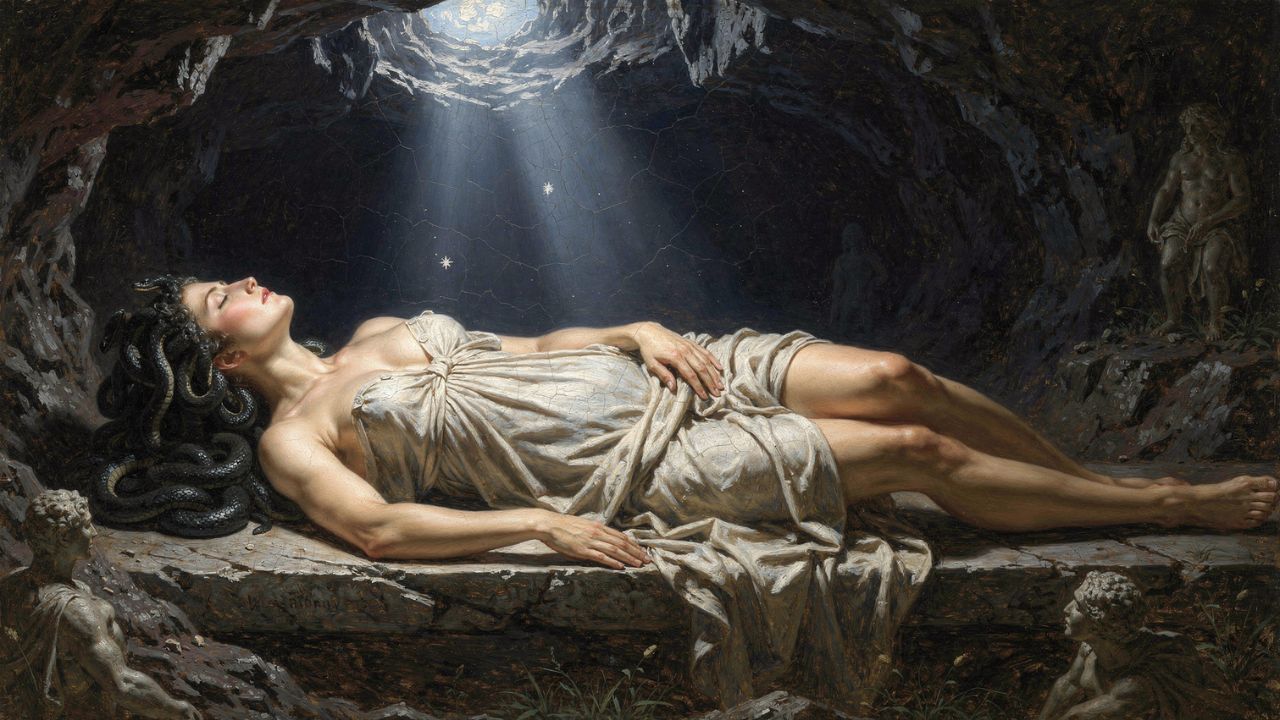
It was, in some sense, the closest thing to mercy fate offered her. The full hunt already has its own account in the Perseus article, for anyone who wants to know it from the hero’s perspective. Here it’s enough to say what she got to experience: nothing. A sleep that didn’t end in waking up, but went straight into something else.
Two creatures were born from her blood, in the same instant her head stopped belonging to her. Pegasus, the winged horse who would become an eternal symbol of inspiration, and Chrysaor, a giant warrior born already fully grown and armed. Both of them, children of Medusa and Poseidon, though no one ever put it in those terms. She didn’t even experience that consciously.
Almost no one remembers Chrysaor today, overshadowed by his winged brother. But he had his own moment in mythology: he married the oceanid Callirrhoe and fathered Geryon, a giant with three bodies joined at the waist, owner of a herd of reddish cattle guarded by a two-headed dog. Geryon would end up dead at the hands of Heracles, in one of his Twelve Labors: stealing his cattle. Medusa’s grandson, then, also ended up as the victim of a Greek hero completing an impossible mission. The family had a certain tendency for that.
Stheno and Euryale woke up too late to do anything more than chase after a man already flying away, protected by his winged sandals and now also by Pegasus, the creature newly born from their own sister’s blood. They stayed behind with Medusa’s body, and with a grief no ancient text ever recorded, because in two thousand years, no one ever thought the mourning of two monsters was worth a single line.
Perseus took the head with him. What he did with it afterward, rescuing Andromeda, turning the sea monster Cetus to stone and later Phineus, Andromeda’s spurned fiancé who tried to ruin the wedding, also belongs to another article. What matters here is where that head ended up in the end.
He gave it to Athena. And Athena, the same goddess who once decided Medusa should carry alone the punishment for a crime she didn’t commit, did something no god had ever done before with the remains of someone she had cursed: she placed it on her own aegis, the protective mantle of leather and bronze she wore over her chest as part of her war attire, the same one sometimes mistaken for her shield because they ended up depicted together in art. She didn’t discard it. She didn’t hide it. She placed it on her own chest, near her heart, where she would carry it into every battle, in every statue the Greeks would make of her over the centuries that followed.
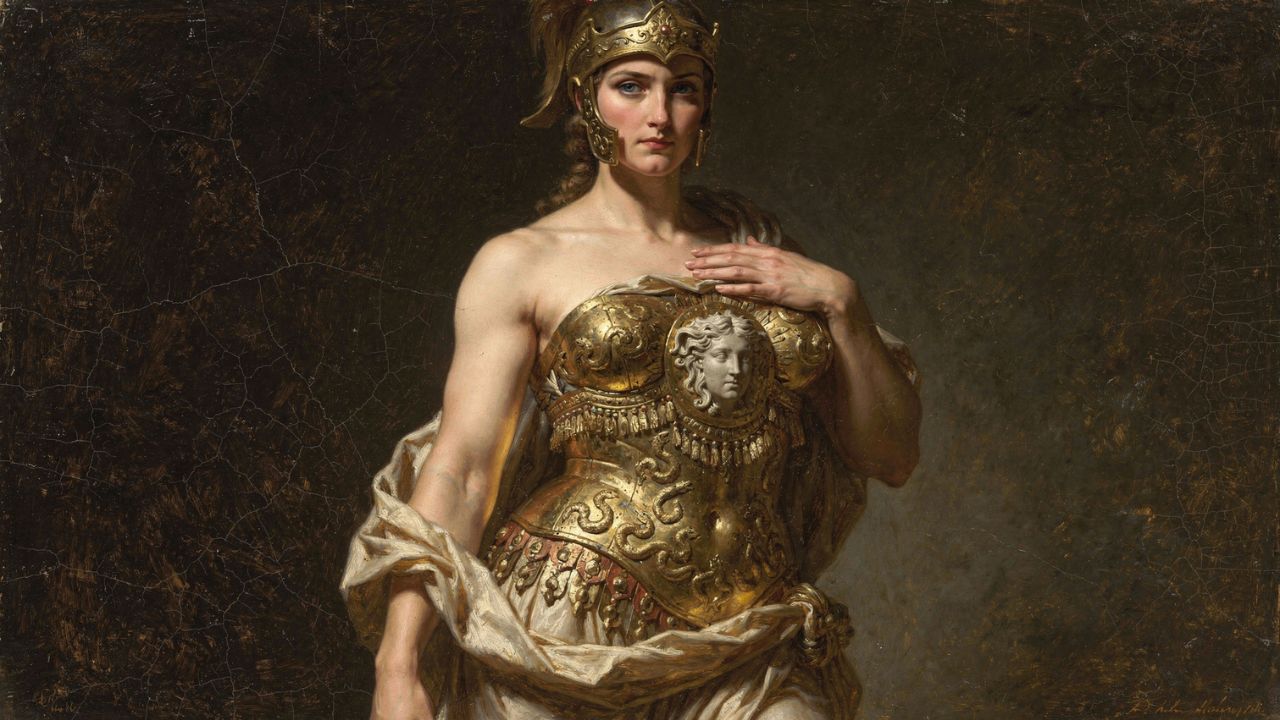
No one knows what went through Athena’s mind at that moment. Ancient texts only record the fact: the head stayed there, and it would stay there forever.
It can be read as triumph, the trophy of a defeated enemy. That’s the simplest reading. But there’s another one: that carrying Medusa close to her heart, protected, into every battle, was the only way Athena found to make amends, late and in her own way, for what she had done to her. To stop treating her as a shame to hide, and start treating her as what she had always been, even before the curse: someone who deserved protection, not condemnation.
Medusa never stopped honoring Athena, not during her years of exile, not with snakes for hair. It was never her intention to offend her. She never stopped being, deep down, the same devoted priestess who one ordinary morning lit incense without knowing what she was about to lose.
Maybe Athena, in the end, understood that too. And maybe placing her on her own chest, where no one would ever touch her again without her permission, was the closest thing to an apology a goddess like her knew how to give without ever saying it out loud.
Today, in the autumn sky, when Perseus rises carrying with him the star that marks, on the map of the sky, the exact spot on his hand where he held that severed head, there’s something fitting about that star flickering. Insisting, every 2.87 days, on reminding anyone who looks up that she’s still there. Still visible. Still impossible to fully ignore.
✦ ✦ ✦
What the sky remembers
The Greeks weren’t the only ones who looked at that flickering star in the constellation of Perseus and felt something was wrong.
Centuries later, in the Hebrew tradition, astronomers gave it its own name, with no direct connection to Medusa or the Gorgons: Rōsh ha Sāṭān, the Head of Satan. You didn’t need to know the Greek myth to reach the same conclusion they did: a star that changes brightness on its own, for no apparent reason, is a star hiding something. Ancient peoples, watching the same unstable point of light in the sky, kept arriving at the same instinct, over and over: that, up there, was something worth fearing.
Algol: the star that keeps flickering
That star is real, and it has a name in our sky today: Algol, Beta Persei. It sits exactly at the point in the Perseus constellation where the hero holds the head he cut from Medusa, and its behavior proved right everyone who feared it without understanding it.
Every 2.87 days, Algol drops in brightness noticeably for about ten hours, then returns to normal. It’s not an illusion or an atmospheric coincidence. It’s a binary star: a dimmer companion passes in front of the main one, eclipsing it periodically from our point of view, as if something stepped between us and the light at regular intervals, with an almost unsettling punctuality. It’s the difference between seeing a lightbulb at full brightness and seeing that same bulb dimmed to a third of its intensity, the kind of change anyone can notice without needing any instruments.
Modern astronomers use it today as the reference example of what are called eclipsing variable stars, a type of star that exists throughout the universe but that Algol was the first to reveal clearly. It gave its name to an entire category of stellar phenomena.
There’s something almost poetic about the fact that the star marking where Perseus carried Medusa’s head is precisely the one that refuses to stay still. That insists on flickering, on reminding us it’s still there, centuries after the Greeks decided how her story should end.
How to find Algol, and how to prove for yourself why people feared it
Algol is best seen in autumn and winter skies, between November and February, when the constellation of Perseus climbs high above the horizon at nightfall. It’s a Northern Hemisphere star: from Mexico, Colombia, Ecuador, Guatemala and Spain it’s perfectly visible during those months, no problem at all. The further south of the equator you go, the trickier it gets: from Peru it already sits lower on the horizon, and in cities like Buenos Aires or Santiago it barely rises at all, because the star stays glued to the northern horizon or doesn’t climb high enough.
You don’t need a telescope for this, just a reasonably dark sky and some patience. Use Cassiopeia as your starting point, that bright W or M shape you already know. From its center, look downward and toward the side where the constellation of Perseus opens up, about two or three times the width of your fist held out at arm’s length.
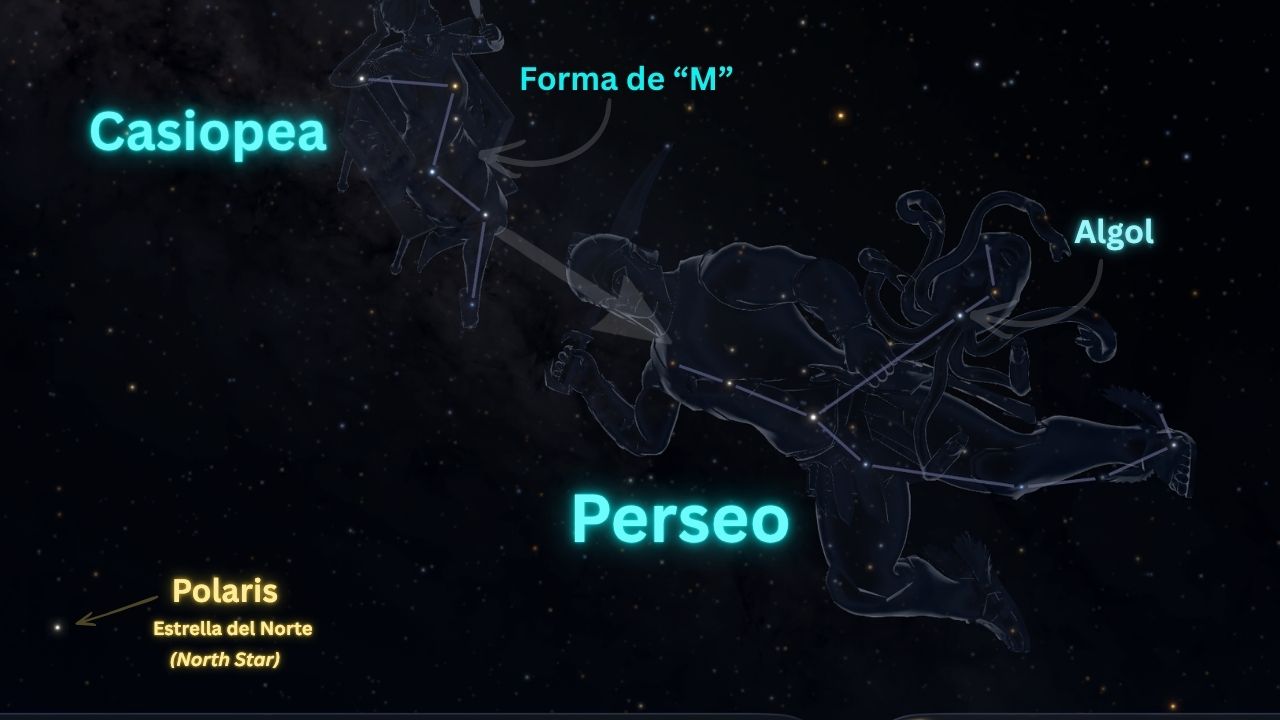
The medieval Arab astronomers who named it Ra’s al-Ghul, the Demon’s Head, didn’t have telescopes or photometers. They noticed the change in brightness with the naked eye, comparing it night after night with the fixed stars around it, and concluded that something up there breathed with a rhythm of its own. You can do exactly the same thing, and it’s easier than it sounds.
The trick is comparison, not photography: look for Algol shining next to Mirfak, the brightest star in Perseus itself, which always stays equally bright. Being in the same constellation, it’s even easier to keep both in the same field of view without having to search another part of the sky. At its brightest, the two stars look practically even. At its dimmest, Algol visibly fades below its neighbor. Check both at the same time of night, on different nights, and you’ll be able to see the difference with your own eyes, exactly the way the astronomers who feared it without understanding it once did.
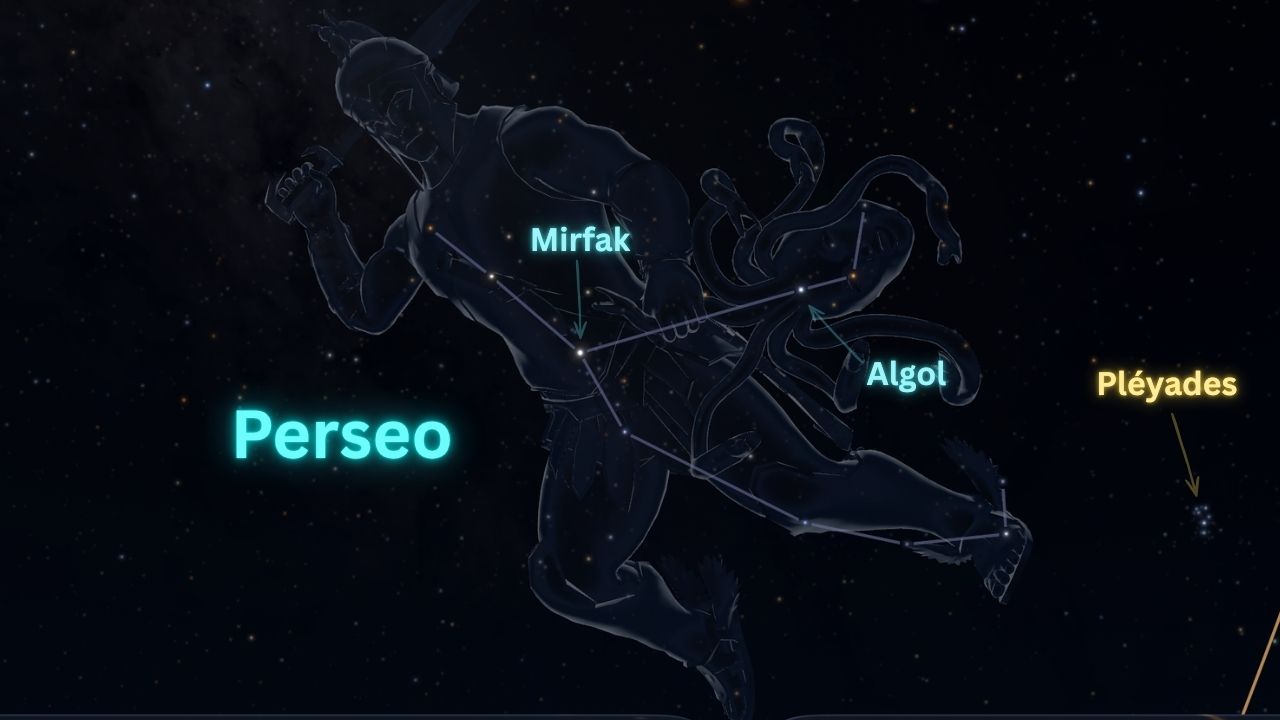
And if you don’t want to guess whether tonight is your lucky night to catch Algol bright or dim, you don’t have to. The Algol minima calculator from Sky & Telescope gives you the exact time, for any date, when the star will be at its dimmest. Just go in, click “Initialize to today,” and it shows you the upcoming weeks of minima. It’s the same kind of prediction Arab astronomers once made through patient observation across generations, now solved in a single click.
A fact to show off once you’ve confirmed it: what you just watched, that dimming and brightening every 2.87 days, is the same kind of phenomenon astronomers use today to find planets around other stars. The method is called transit, and it works on the same logic that made Algol famous centuries ago: something passes in front of a star, and its brightness drops a little. The difference is that today that “something” can be a planet the size of Earth, and the change in brightness space telescopes detect is a tiny fraction of what you just confirmed with your own eyes.
And since you’re already familiar with the star’s Arabic name, here’s another curious fact that connects more than it seems: the word al-ghul, “the demon” or “the ghoul,” ended up giving its name to the word “alcohol” in English and several other languages. Medieval alchemists used that same term to describe any substance that appeared to change state or behave unpredictably before their eyes, the same unease astronomers felt watching a star flicker for no apparent reason. The star that lends its name to your weekend drink and the Head of Medusa literally share the same root.
Is it worth using gear to see Algol?
Being honest with you: you don’t need it. Algol is one of the few stars in this guide that’s perfectly visible to the naked eye in any reasonably dark sky, even from a city if there isn’t too much light pollution nearby. Neither binoculars nor a telescope will show you anything different from what you already see with your own eyes, because the point of this star isn’t resolving detail, it’s comparing brightness over several nights.
That said, if you already own binoculars for other reasons, here’s a specific recommendation worth making: go for lower-power ones, like 7×50 or 10×50, over bigger ones like 15×70. The reason is field of view. With 7×50 or 10×50 you can have Algol and its reference star, Mirfak, in the same frame at the same time, which makes comparing brightness much more direct. With higher-power binoculars, the field narrows, and you’re more likely to end up moving the gear back and forth to see each star separately, losing exactly the advantage you’re after.
We typically recommend the CELESTRON line for its good value, though availability varies by country. Here are equivalent 7×50 and 10×50 options that work well for this exercise:
If you’re looking to photograph the full field of Perseus, Algol included, to show off on social media or just keep the memory, a ZWO Seestar S50 does a notably good job capturing wide deep-sky fields without needing any manual configuration.
Here’s a detail worth clarifying before you try it: comparing two photos taken on different nights doesn’t always show the brightness difference clearly, because the Seestar’s software processes and adjusts each image automatically. The correct way to confirm it with your own gear, the same way serious amateur astronomers do, is to capture Algol and Mirfak together in the same frame, within the same session, and compare their relative brightness against each other in that single image. Repeat the exercise on different nights and you’ll see how that brightness relationship between the two stars shifts, following the 2.87-day cycle.
This isn’t just a homemade trick. The American Association of Variable Star Observers, AAVSO, the world’s reference organization on this subject, has reports of amateurs using exactly the Seestar S50 to measure brightness changes with a precision that, until a few years ago, only professional equipment costing thousands of dollars could achieve. If you feel like showing off with your friends, there’s your argument: it’s not just any toy telescope, it’s a tool ordinary people are using to do real science and contribute data to international variable star research databases.
This article contains affiliate links. If you purchase through them, I receive a small commission at no additional cost to you.
✦ ✦ ✦
The saga continues
This story doesn’t begin or end here. Medusa is just one piece of a much larger web written into the same corner of the autumn sky.
The full hunt, told from the perspective of the hero who found her asleep, is in the Perseus article. The woman Perseus rescued using that very head to turn a sea monster to stone has her own story in the Andromeda article. And Andromeda’s parents, Cepheus and Cassiopeia, whose vanity set off everything that followed, will also get their turn to tell the story from their own point of view, coming soon on ASTRONOMIKA TV.
Frequently asked questions about Medusa and the star Algol
Was Medusa born a monster, or was she ever human?
According to Ovid, in the Metamorphoses, Medusa was born mortal and was a beautiful woman, a priestess in Athena’s temple. She was turned into a Gorgon as punishment after Poseidon raped her in that same temple. Worth noting: there’s another, older version that doesn’t even agree with this. According to Hesiod, Medusa was born a Gorgon from day one, with no human past. We’re going with Ovid’s version for this article, the one that gives Medusa a life before the tragedy, because it’s the one that lets us tell her story as more than just a monster born that way.
Why did Athena punish Medusa instead of Poseidon?
Because Poseidon was a primordial god, brother of Zeus himself, and punishing him directly would have meant opening a conflict between gods that Athena couldn’t afford. Medusa, mortal and with no power to defend herself, ended up carrying the consequences of a crime she didn’t commit.
Did Medusa’s gaze kill, or did it turn people to stone?
It turned people to stone, not killed them in the traditional sense. Anyone who looked directly at her was fully transformed into stone, frozen in the exact instant of that last blink. It’s an important distinction, because it explains why Perseus needed a shield as a mirror to approach her without looking at her directly.
Was Medusa the only mortal Gorgon?
Yes. Her sisters, Stheno and Euryale, were immortal. That’s why Perseus could only kill Medusa, and why she was the only one of the three who ended up beheaded.
What are Pegasus and Chrysaor, and why were they born from Medusa?
They’re the children Medusa conceived with Poseidon, though they weren’t born until the moment of her beheading, springing from her neck instead of through a conventional birth. Pegasus is the winged horse Perseus later used to fly. Chrysaor was a giant warrior, father in turn to Geryon, the three-bodied giant Heracles would kill in one of his Twelve Labors.
What did Athena do with Medusa’s head after the beheading?
Perseus gave it to her as a gift, and Athena placed it on her own aegis, the protective mantle she wore over her chest as part of her war attire. It remained depicted there in Greek art for centuries, close to the goddess’s heart, in every battle.
What is the Gorgoneion?
It’s the name given to the image of Medusa’s head used as a protective symbol. The Greeks placed it on temples, shields, breastplates and buildings, believing it would ward off danger and evil before it could get close. Even Zeus himself carried it on his shield.
Why does Algol flicker?
Algol isn’t one star but two, orbiting very close to each other. Every 2.87 days, the dimmer of the two passes in front of the brighter one from our point of view, blocking part of its light for about ten hours. Astronomers call it an eclipsing variable star, and it was the first of its kind to be clearly identified.
Why did Arab astronomers call Algol “the Demon’s Head”?
Because they noticed its change in brightness with the naked eye, centuries before understanding the scientific reason, and it seemed to them that a star behaving that way, with no apparent rhythm in the rest of the sky, must be hiding something. They called it Ra’s al-Ghul, which is where the modern name Algol comes from.
Can you see Algol’s brightness change without a telescope?
Yes, and it’s one of the most satisfying observing exercises out there for beginners. By comparing Algol to Mirfak, the brightest star in its own constellation, which stays constantly bright, you can notice with the naked eye when Algol is at its brightest and when it’s at its dimmest, checking the same patch of sky on different nights.
Was Medusa connected to the Perseus constellation, or only to the star Algol?
Both. Perseus is the one who beheaded her, and the entire constellation carries her story: he holds Medusa’s head in his hand, marked exactly by the position of Algol. The full story of that hunt, told from the hero’s perspective, has its own article on ASTRONOMIKA TV.
Sources and further reading
Ovid. Metamorphoses, Book IV.
Hesiod. Theogony.
Apollodorus. Bibliotheca, Book II.
Hyginus. Fabulae.
Britannica. “Medusa: Mythology, Face, Hair, Perseus, & Facts.” britannica.com
Sky & Telescope. “Meet Algol, the Demon Star.” skyandtelescope.org
EarthSky. “Algol the Demon Star, named for its strange behavior.” earthsky.org